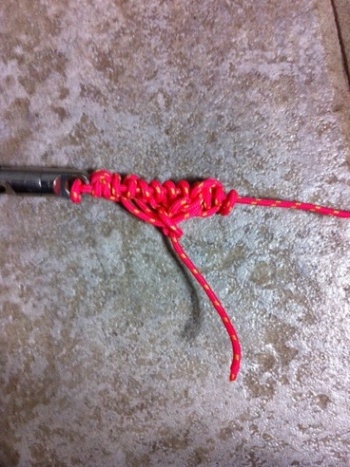
Hello folks. I just found this site around 1.5hours ago. I hope someone can help me out. Please bear in mind that I am a newbie and may use the wrong terminology.
I fly a powered paraglider as a hobby. http://www.youtube.com/watch?v=QZjd9kIUeoc (not me in the video). To steer the unit you pull on some brake toggles to go either left or right. Those toggles are attached to the trailing edge of the wing via lines. Once you figure out what length you want the lines to be you route the lines through some metal loops and tie the line off to itself.
Here is my question. I have the length of my line figured out (for sake of this conversation lets say 5.5’ from the wing), and I have the line tied off to itself however the knots are an ugly rats nest looking thing. I am wanting to tie some kind of decorative knot to take up the slack. So is there a decorative knot that you can recommend for me to tie that will only require for me to use the working end of the line since the other end is tied to the wing?
There are a varied lot of decorative knots that could be tied using the remaining/unused working end.
A picture of your set up or a link to one similar will go a long way to help us help you.
If the lines hang free at your control end, you could tie a simple monkey fist and have a ball structure on the ends, but that was a wild stab of an offering since I am unfamiliar with the contraption or the specifics of needs.
If the line is three strand twisted, it is easy to tie an eye splice around the grommet in the wing. It would be the lightest and most aerodynamic knot, which is probably a good thing out in the wind. Depending on how the other end of the line is attached to the steering control, it can also be eye spliced for a custom length. An eye splice prohibits the ability to untie the knot, so if the line needs to be removed from the wing grommet, maybe a light weight snap hook could be used. Since this a life safety flight control, I would reccomend quality hardware from REI or a similar vendor, not some cheap snap hook from a five and dime.
It is also possible, but more difficult, to place an eye splice in paracord, and similar braided lines. If you go this route, please practice splicing on a few pieces of scrap before tying on the knot you will rely on for flight control. Every time I try a new knot the first one is never a keeper. Sometimes it takes a few tries before I am satisfied. Since knot tying is something you are new at, please get it right before attaching it to your aircraft.
I really appreciate your replies. The lines do not hang free. I only have the working end available for me to manipulate. The other end is secured to the wing at the factory.
I will be more than happy to take a picture tonight when I get back home. How do I post the picture here?
The line is not three strand twisted. I do have an extra piece that I will be more than happy to take a picture of and show the inner workings.
Take the picture and upload it to your computer. Make sure that the picture does not exceed 100kb in size. Each picture to be no more than 100 kb, a limit of four per post.
Click “Additional options…” in the lower left corner of the reply window. Click on Browse and navigate to the picture and select it.
Add any reply and click Post.
Or if you have an online photo sharing page or a web page that has the view you need, place the link in the body of the post text.
I thought I had a piece of brake line cord that I could cut and take a picture of the innerds but I was wrong. What I have on hand is not the same stuff.
That stuff looks like Paracord. Paracord has a nylon jacket with a core of 5 or 7 lines, typically a white nylon. The number of core lines determines the breaking strength, most paracord is either 550, or 440, but occasionally you run across different weights. Paracord is short for parachute cord, which originated as a durable line used in parachute shroud lines. This would be an appopriate line to use on your powered parachute aircraft.
Paracord will hold a knot reasonably well, and being nylon, the ends are typically melted to prevent fraying.
One of the best knots for tying a loop in the end of a line is the bowline. It’s easy to tie, it won’t slip, it’s easy to untie. I’m sure that there are other knot tyers who will reccomend various mountain climbing knots, and there are other knots that form a reliable loop at the end of a line, but I think the bowline would be all you would need to form a sturdy loop. In your photos you have quite a bit of extra line, so if you do cut it, be sure to melt the ends so it doesn’t fray.
What I am really looking for is an idea of a decorative knot that I can use to take up the extra line. I don’t want to cut it since I may need it in the future. The problem is since one end of the line is attached to the wing I only have the other end free to work with. All of the decorative knots that I have seen require you to be able to work with both ends of the line.
The cord I am seeing reminds me of Accessory cord. Most of the major climbing rope manufacturers can supply this if you need replacement.
Just how much surplus rope after the tie in at the handle do you have or want to have for future use. This will be important on what knot I or others can recommend.
There are many decorative knots that can be tied with just one end available. Most if not all Turks head knots can be.
My first though is that I might tie a long Turks head with just 2 bights and the number of leads (parts) to be determined by the amount of cord available.
Or tie a “hangman’s noose” type of covering.
There are many fishing knots that could be customized for use as well.
Since the surplus cord is of indeterminate length, then I would suggest doing a nice snug hangman’s noose affair. You’ll end up with a neat little tubular sleeve extending away from the connection loop. Fairly secure too.
Pretty simple to tie and untie. Easy to routinely inspect.