Hi All,
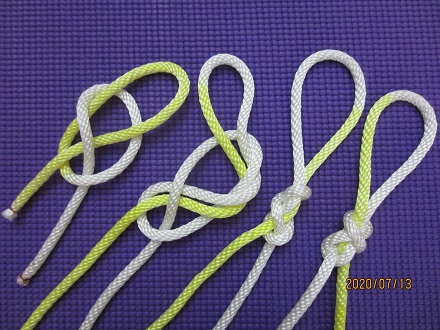
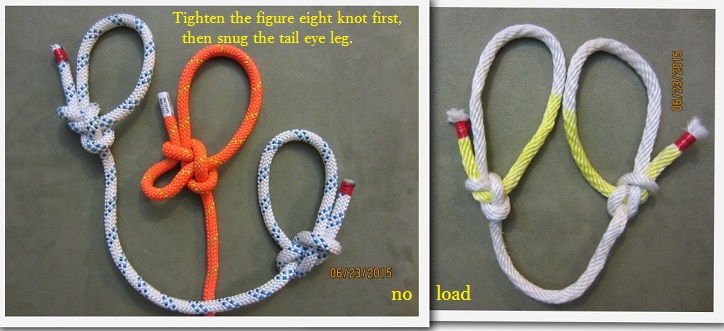
I have few quick test on these Non Slip TIB Adjustable Eyes v1 v2, with 1/4" solid braid nylon rope,
both are doing fine, after heavy loading, can be untie easy.
For 8mm bluewater rope, after heavy loading, little harder to untie, take me little more time to get it untie.
Will do more test with videos, and bring it in next round. 谢谢 alanleeknots
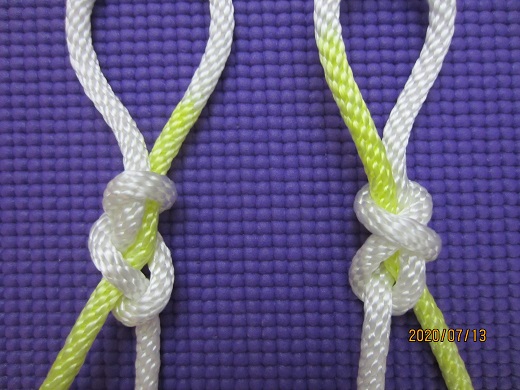
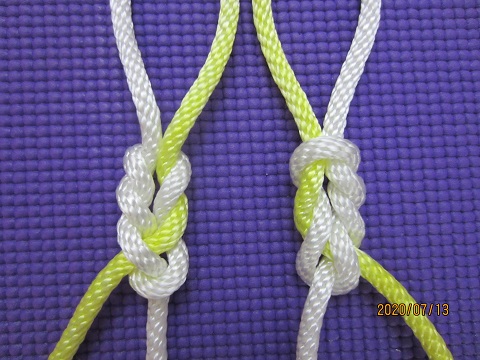
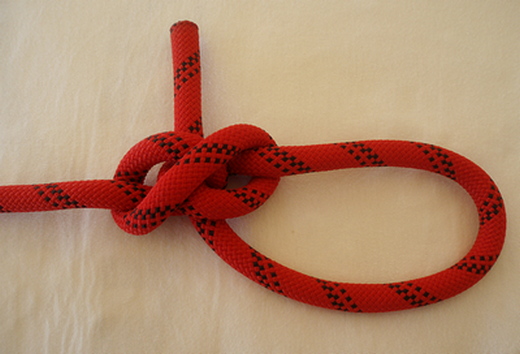
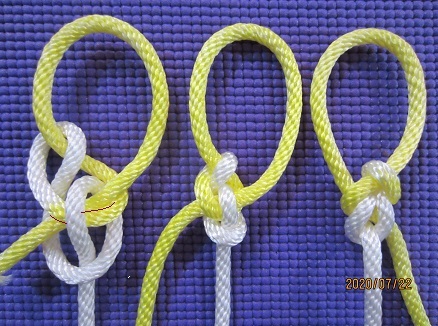
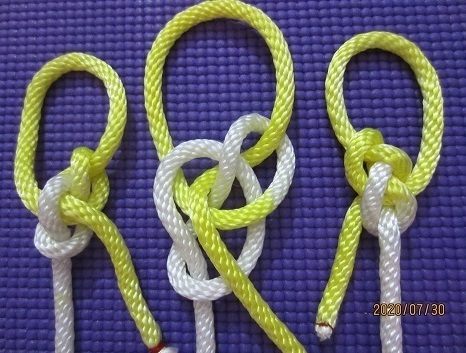
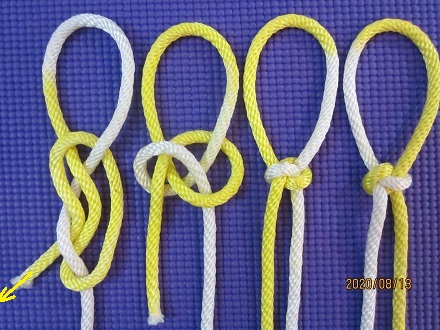
This is an alternate geometry, of your V1 figure 9 based nipping structure, shown in the first two images.
The insertion of the WE through this configuration, leads to a non slip, figure 9 based adjustable eyeknot, as shown in the next two images.
Note how the nip fully constricts the WE, forcing it to retain the L shape, as it enters the nub, while the two opposing forces prevent it from slipping.
This two collar, figure 9 based, adjustable mechanism, appears to be jamproof too, in human EN rated ropes. If you wish to adjust the size of the eye, just press the two collars to release the pressure. Too bad, it’s not TIB.
@tsik_lestat,
Excellent, all these hard work pay off, you deserve it, see if there is a more memory way to tie
that two interlock nipping structure.
Cheer ! alanleeknots.
Alan, your knot is an old one to me! But I think you
show the tail too straight --it should be moved into
slight curvature as the rest of the knot grips it all
along its tuck. The quick8 can be seen as such a knot,
the simple passage of tail through fig.8 surprisingly secure
under load (and a backflipping tuck between eye legs
is not only sure security but at least in flexible cordage
a way to gain slack-security. (And it was a structure
I’d fiddled a number of times en route to putting in
a bowlinesque collar, not realizing that one could stop
at that point and … it would hold!)
And per the popular orientation qua stopper/eyeknot,
we must call this knot base a “reverse” fig.9.
BUT we must ask :: what is the point of such a knot,
an “adjustable” eye knot?! Unlike with some friction-gripping fixed eye, where the eye size in indefinitely large,
these knots are tied with a maximum that can only
be diminished, tightened down --unless a long length
is left for enlarging. And tightening under load might
be problematic re stability/structure or just plain
limited by force & friction.
In the top orientation, rotate the leftside’s turn
down around the upper part of right side
and similarly move the right side down the left,
and collapse the diagonal part shared between them.
THIS is another symmetric-fig.9 form,
and makes for some nice eye knots,
and for a nipping of the tail between turns
such as you do.
Beware cases where the returning eye leg might
be isolated in loading, as it can slip out, then.
The structure is akin to #1425, with those overhands
continued into fig.9s. There are lots of interesting
uses of it, e.g., as a re-tucked overhand in making
a noose hitch.
My poor English,  I need some help here,  as always, I don't understand anything Mr Dan have said.
Can any one transform the words to picture knot . so I can answer him.

BUT I not we "me" here must ask :: what is the point only limited number of members here can understand
what you have said. 谢谢 alanleeknots
Tsiks loops is great for hanging loads.
It can be adjustedad while loaded with light to medium loads!
In both directions!
With a tail left long, even if the knot itself is higher, out of reach.
Id be very interested in another knot which has this function.
Hey Alan, i wasn’t able to devise so far a more memorable way to form this nipping structure than the straight forward method of the two interlocking crossing knots. Any suggestions are welcome. Cheers!!
Hi Dan, i wonder, does this symmetrical figure 9 orientation you are suggesting, retain this two collar configuration? After fiddling with the nipping structure just to follow your lead, i wasn’t able to keep this entangled collar geometry which i think plays a key role to the untying process.
Hi Andreas, i believe it’s all about geometry. A subtle geometry differentiation in the knot structure, could bring about drastic functionality changes.
It would be nice to have access to the nub during heavy loading, in order to have the ability to bend the collars and adjust the eye size.
Alan lee has tied myriads of adjustable loops. The most recent i remember is the one in the following link which is based on a figure 8 mechanism. Check out how this particular adjustable eyeknot works for you.
.
As any support structure against;
a change in the geometry, changes the mechanical commands given(just like computer commands to tool chain set)
Of cosine, sine to a different cumulative output product(then how applied/ direction thru structure).
.
Base/single event/timeslice (static or dynamic, rope or not) can be broken down furthest into the minimal cornerstones of
cosine/sine that all the rest of considerations fan out from, so that whole event can be described thru pivotals cos/sin.
there is no more deeper/pivotal examination of these forces of single event, than the 2 generic cos/sin that all can be broken down to
Then, the direction of force thru the ‘rope circuit’, like running electric or water force thru the same network;
the direction of physical force thru cosine/sine can change things thru the same structure as like for wires or other pipelines etc.
.
Changes from 1 side of the 45 degree median to equidistant to other side of this median;
gives a more ‘pivotal’ change, as where the cosine and sine swap values.
Like 0 to 90 degrees, 30 to 60 degrees etc.
deg cos sin clock position w/Natural gravity load direction
00 1 0 12o’clock (ea. 45 from median)
90 0 1 3o’clock ( ‘ditto’)
30 .86 .50 1o’clock (ea. 15 from median)
60 .50 .86 2o’clock ( ‘ditto’)
45 degree median is unique in that cos=sin=.707 (also greatest sum total of cos+sin)
rest play out from that point.
.
180 Arcs(ends pull in same direction) can use both sin/cos for controlling frictions
but, non arcs (ends pull in opposing directions) cannot
In nonArc use cosine component for support,
then primarily sine as friction control, as segregated cos/sin usage
(cosine ‘bound to’ support, any incidental sine for frictions/grip incurred if direction towards host etc.)
.
Cos & Sin will pivotally describe physical: force, spatial and waveform etc. displacements/potentials; in any physical event.
No, not really collared. Look at #1425,
and take its tails around to trace out along
the SParts. Also, Ashley shows the basic
structure in single-strand stopper #525
–make it symmetric! It’s a knot form that in some
tying one can go wrong and get a double OH.
If you like how they look, i bet you like how they function too. A compat, good looking knot, usually corresponds to a proper functioning knot :).
In your second variation (V2), IMO, i have the impression that it will work gradually to equilibrium state sooner, if the WE, is being fed through this entagled two collar configuration, from the other side of the nipping structure.
In other words, look to see if such a structure alternation, will restrain the returning eye leg continuation, much sooner and more effectively, without further slippage, forcing it to an L shape formation.
I like the Sp/On-going collaring in both variations. it somehow, gives you degrees of freedom in relation to the loading magnitude.
Hi All,
I have some old creations and few new one, might as well put it in one place, anyone have
Non Slip Adjustable Eye knots, you are welcome to add it here.
For fig.8-based please see this link ; https://igkt.net/sm/index.php?topic=5383.90
     Overhand knot-based adjustable loop, can handed heavy load,  TIB version do better,
     both of them can't handed extreme load.  谢谢 alanleeknots
 Hi All,
         Very nice little loop, you can adjust the size of the loop and locked it in.
          I found this loop handed heavy weight very well and easy to untie.
           謝謝 alanleeknots
Having tied this structure before, i think of it as the simplest one of helical adjustable eyeknots (reply#14).
And here comes the good part…
If you unbend Spart’s helical curvature (straighten the helical coil), you will transform it into Xarax’s constrictor noose (or buntline extinguisher ;)) and vice versa.
In my experience it is harder to make a very strong friction-gripping knot where the loop is adjustable by moving the gripping part along the standing part than it is to make a knot where the loop is adjustable via the working part.
Yes, tightening under load might be problematic, and untying, too.
One application of adjustable loops is to secure loads, but I think Trucker’s hitch variations are more suitable for that in many cases.
Funnily it looks literally like figure 8 in the first image and reminds of Hunter's Bend in the third one. I learned to tie it my eyes closed.
Interesting this figure 9 geometry can transform to a loop, kind of a Non TIB false Butterfly knot ,
see the photo below, I think there is a interlock overhand knot bend or loop, is somewhere in Ashley knot book.
Do you think there is some advantage in the more complicated version 2 over version 1?
I think so too, version 2 is more stable and compact. 谢谢 alanleeknots.