I’m a knot novice, and I’m trying to figure out what knot I should use for something.
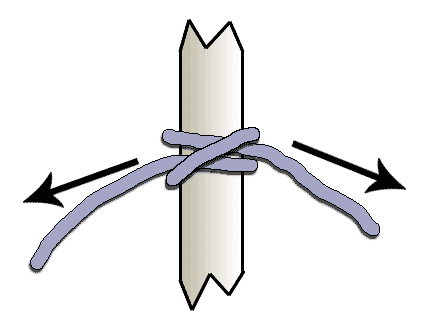
I have a Theraband (rubbery resistance band for physical therapy exercises… it looks like this). I want to tie it to a post in my apartment.
The purpose of the Theraband is for exercising, so I’ll be pulling on the hanging ends of the rope. The key for this knot is to allow me to yank on the ends, without becoming unraveled.
The post I’m tying to meets the floor and ceiling at both ends, so I can’t loop the Theraband ‘over’ the post. It must be tied around it.
Here’s a hilariously poor sketch that illustrates this:
I would probably use a simple clove hitch orienting the crossing on the opposite side from the pulling. I am assuming that the tension to each strand will more or less be equal.
I don’t have the material you are using, so it’s not easy to make suggestions. You might try a Midspan Sheet Bend applied as shown in the second diagram here:
Since you have end access to your line, you could try a Cat’s Paw tied similar to the Tumbling Ring Method, except you just keep tucking the two free ends to introduce the extended twist instead of flipping the ring (lower diagram):
The highlighted terms (by me) indicate that you have
presumed part of the solution, which has narrowed our
focus to knotting Theraband to a post; I suggest that this
general solution might be inferior to what can be achieved
–that of tying with another material the Theraband to the post.
Let me suggest that you try using a soft cord (or maybe
that increasingly frequently found polyester tape used
for cable hauling, which ranges from 1..2cm wide)
to tie the rubber band to the post. E.g., this cord
could be tied to the Theraband with Prusik hitches
and so closing a loop around the post --maybe best
done by fulling wrapping the cord (360 degrees plus)
while the Theraband passes around just one half (180deg.)
of the pole.
Tying such rubbery bands can be tricky, in that they have
often much friction and even more elasticity --making the
compound problem of a knot that doesn’t readily set into
a snug form, but which on loading greatly deforms in its
elastic stretch. In the above-sketched knotted structure
(in which the rubber is tied to, not itself knotted), one
would need to put in some considerable stretched tightness
of the band against the cord knotted to it (so that when in
use, it doesn’t elongate in this joining span between Prusik h.s).
(Given the nature of the Theraband, probably simpler hitches
than the Prusik can be used, gripping adequately; but the
former has the nice quality of being symmetric with respect
to loading direction --which for each hitch in this structure
would change with which end you were using.)
Hello all. My wife caught me messing with her Theraband and after showing her what krazy had in mind we both think a clove hitch would be the knot to use. The clove hitch is simple enough to be untieable yet the Theraband has enough grip to keep the clove hitch from turning on the post.