Been experimenting with various combinations of F8+OH knots to create stable offset bend geometries.
A definition of offset bends: The knot core is displaced from the axis of tension.
Offset bends facilitate easy translation of the knot around 90 degree edges.
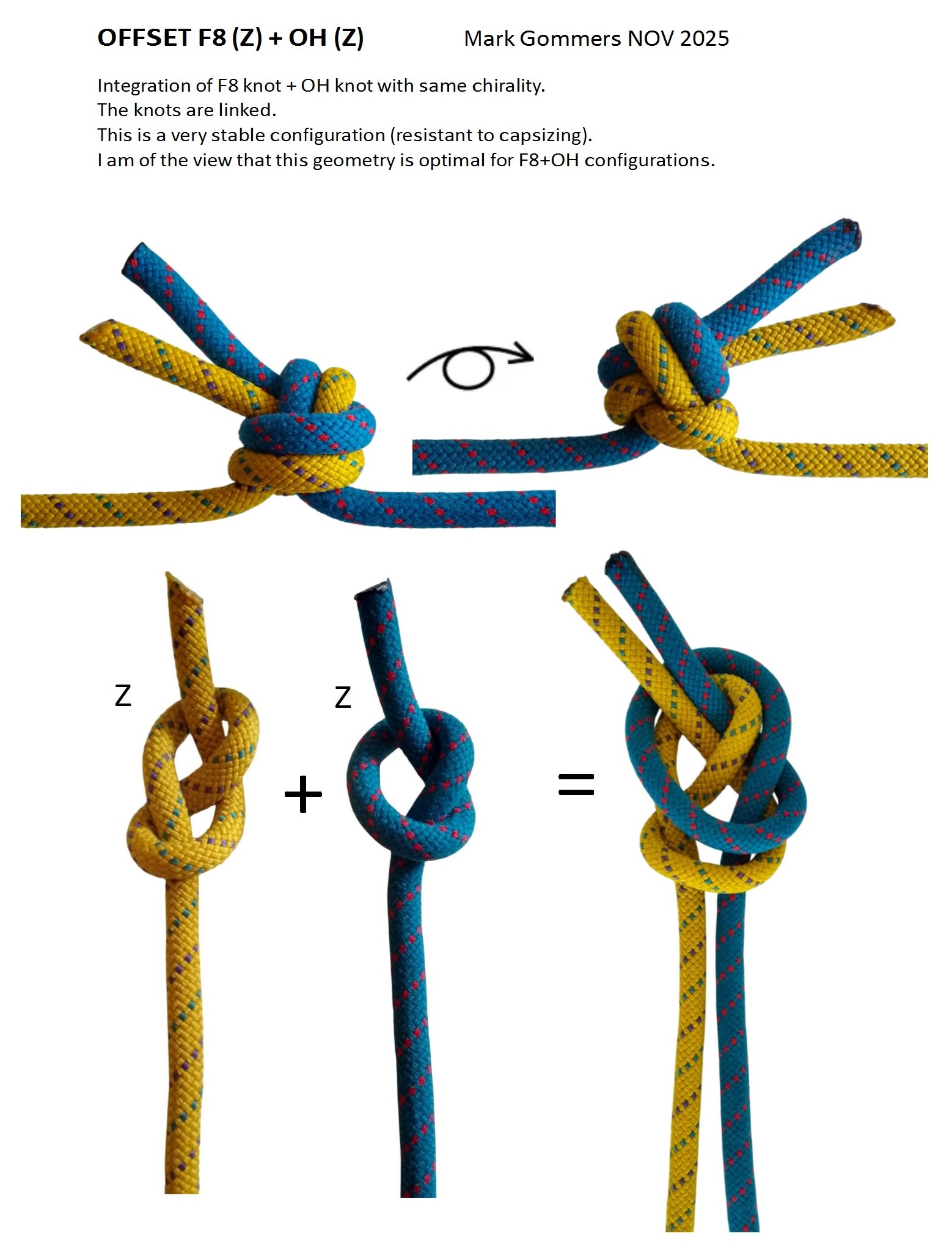
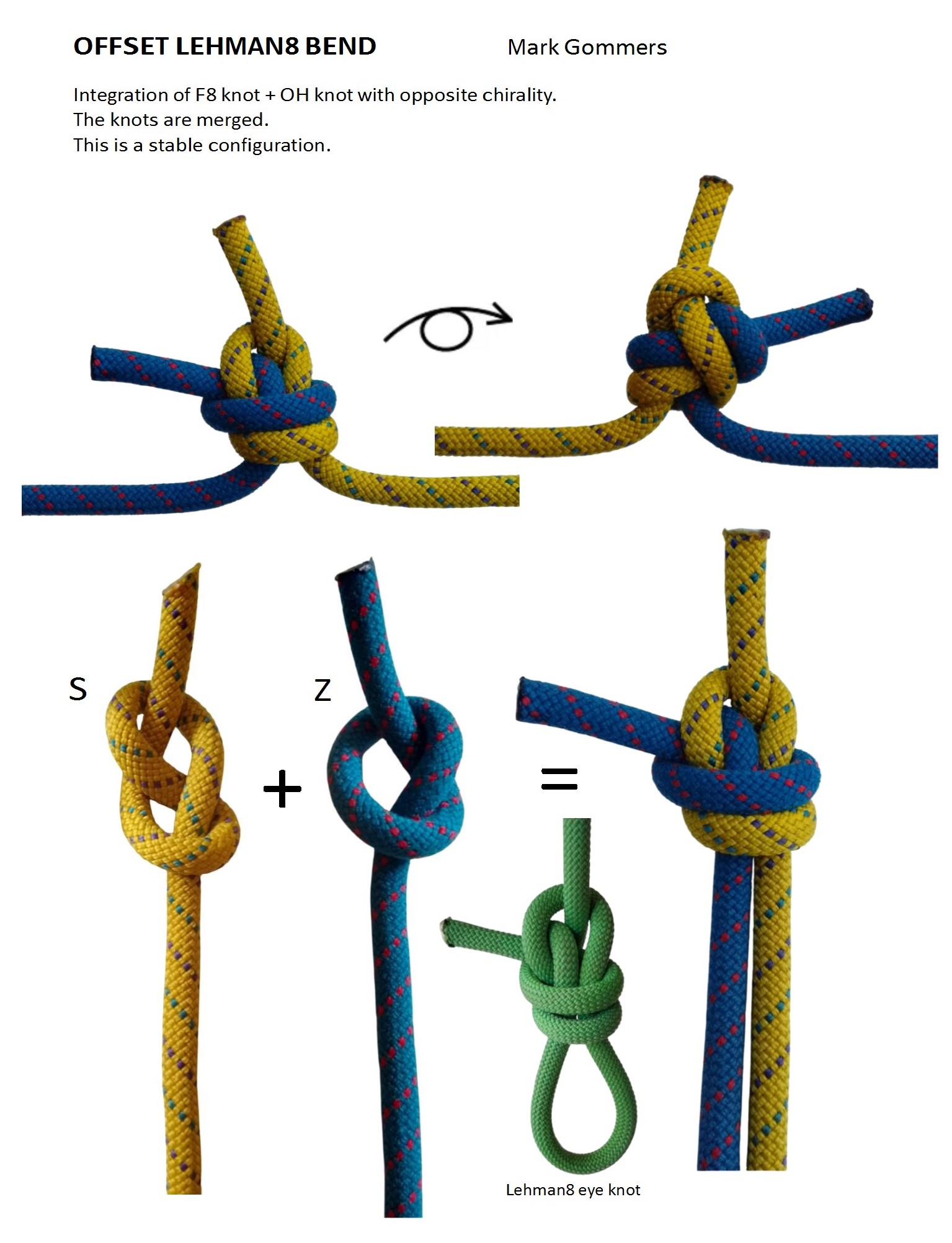
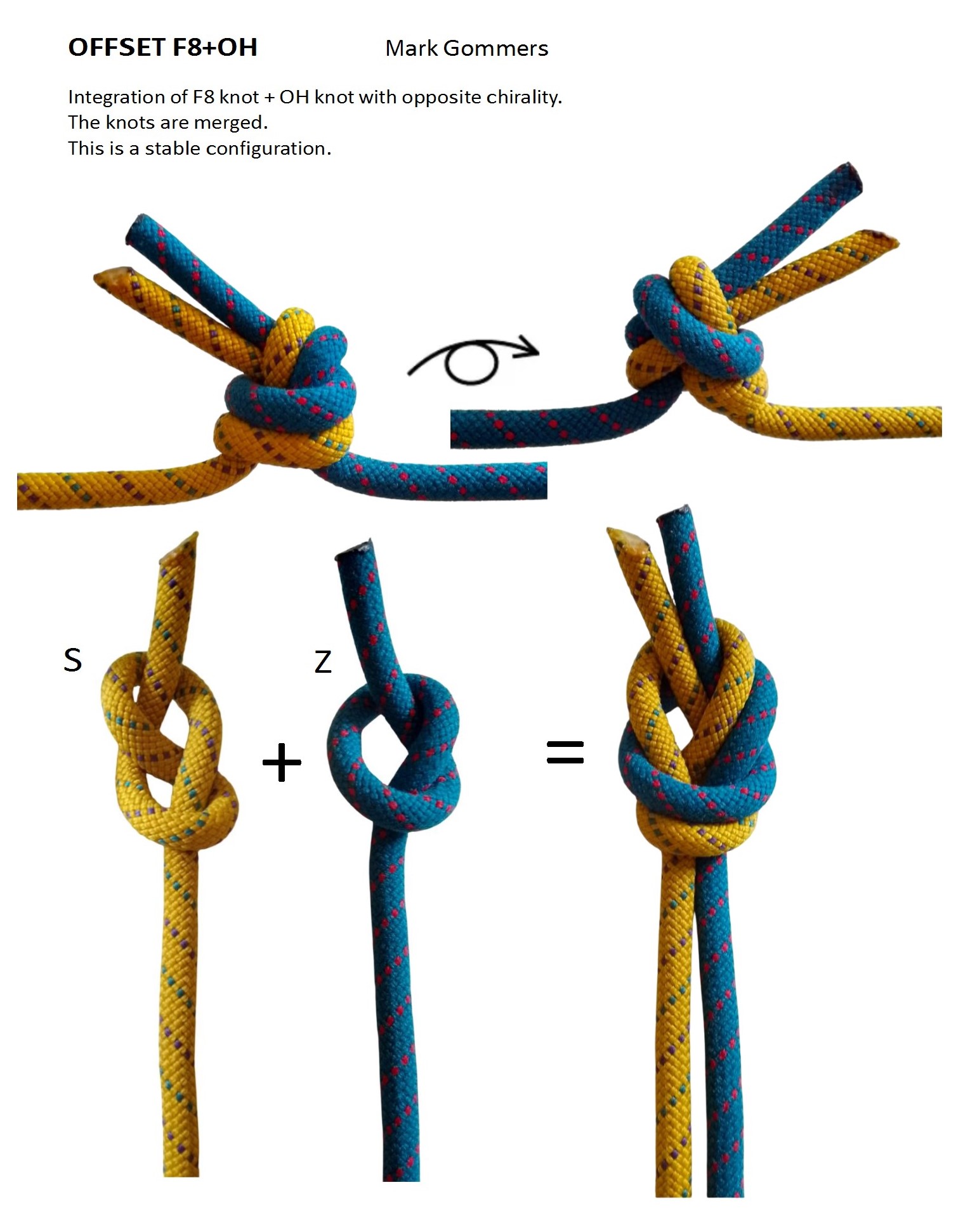
I’ve shown 3 F8+OH knot combinations below. The Offset Lehman8 bend is included. I have not carried out extensive load testing at this stage. Will need to determine the load threshold where instability occurs (eg ‘capsizing’).
Historically, F8+OH bends have not gained popularity amongst climbers (likely due to fears related to the F8, and also perceived tying complexity).
The footprint of these bends is reasonably small - very comparable to #1410.
The geometry in the first image (below) looks promising.
EDIT NOTE: Fixed image directly below. It is a Z/Z coupling (not S/Z). The depicted geometry can only be achieved with F8 (Z) + OH (Z) chirality.
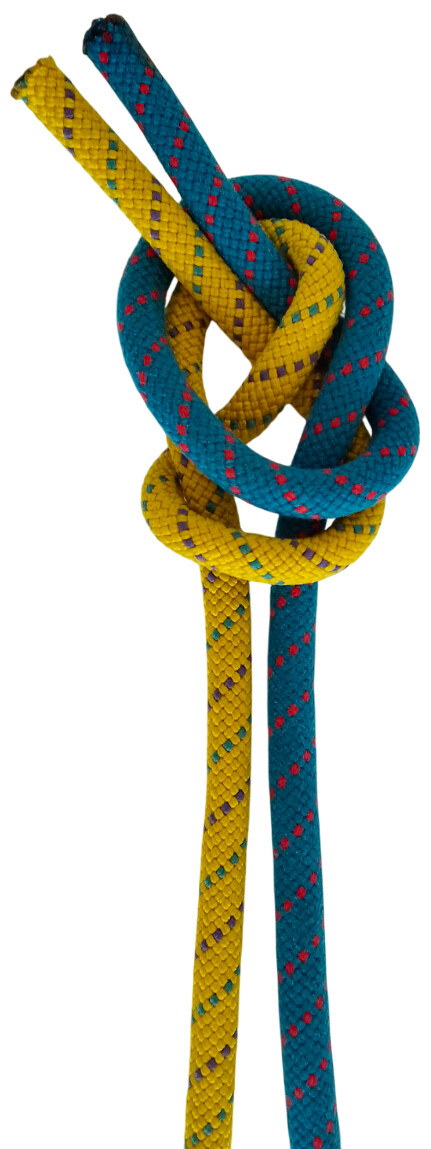
Yes - The Z/Z coupling appears to be optimal for integrating F8+OH knots to create an ‘offset’ bend.
I’ll put my neck on the proverbial chopping block and make the claim that its the ideal Offset bend in terms of achieving the metrics of; stability and reasonably small foot print.
The issue that some rock climbers will have is perceived tying complexity. The usual argument goes something like this… “a tired person with numb fingers may easily make a mistake and pay the ultimate price…”.
Counter arguments include; remembering the Z/Z coupling, and practicing in the field with sufficient repetition to build long-term memory. The S.Parts initially start parallel, but then diverge and turn in opposite directions.
The bottom one has wrong-handed yellow rope on left side
–one can see that the F8’s shape remains as for top case
in opposite “hand”.
Also, note that this tangle is asymmetric,
and one can load the opposite two ends.
(And one can probably go into any climbing
gym and have a EK formed from this tangle
validated as a proper F8 EK --that knot so easy
to recognize! (-;
Also, there’s an F8-Oh offset bend in which one ties
as for the infamous “EDK” (Offset Water Knot) except
for making the choking strand go a half-wrap further
and tuck out opposite the direction of the OH’s tuck.
This is more easily formed, but somehow I have had
some doubts re its full security.
That’s correct Dan - the yellow F8 knot should have been shown in Z chirality. I have too many knot images on my computer and stuff is getting lost in translation. I’ll correct this asap hopefully within the next day.
Of course, one can also tie the mirror image of all depicted offset bends - which are equally valid.
I’m only getting started with this - and there is much work to do.
The key requirements are:
the offset bend must have the smallest possible footprint (ie bulk/volume)
the offset bend must be stable and secure - up to around 3-4 kN.
the offset bend must be reasonably ‘easy’ to tie (ie have a tying method that is logical and/or can be tied from simple mnemonics - the yardstick likely being my own bound offset overhand bend which has gained widespread use).
EDIT NOTE: A design goal is to have a geometry that is more resistant to capsizing/instability than either #1410 or my own bound/locked #1410. The trade off being a slightly larger footprint and perhaps a slight increase in perceived tying complexity.
… secure with ropes of differing qualities
(within the realm of likely use) in both
cases of one or else the other rope making
the “choking” wrap --i.e., having an abseil-ropes
joint that behaves even wonderfully with one
orientation but poorly in another would be
tossing too much risk into the figuring.
Of course, one can also tie the mirror image of all depicted offset bends - which are equally valid.
Not sure why this was stated (though it tickles
aspects of chirality that might affect laid rope),
but my note about this F8+OH tangle being
asymmetric was pointing to loading the shown
knots’ Tails vice S.Parts (“fore<=>afting”, “Tail-Loading”).
As for Tail-Loading, ack, I’m just seeing that one might
tie an Offset F8 and set it tightly by first pulling Tails
to tighten the choke, then pulling hard on S.Parts
twinned in stopper-loading (i.e., NOT pulling
them against each other, as use will require);
AND THEN … load the Tails ! !? --it’s a matter of
shaping of the knot and so on : looks OK but that’s
just my quick-check-with-pocket-cord looking.
… more resistant to capsizing/instability than …
Take care in this goal, as it’s rather like asking
for greater strength, where the given knot(s)
already provide completely safe strength
to which “greater” is only a testing-result quality.
As you note, after all, there is a force expectation
of only so great, for abseiling (and doing so with
twin ropes sharing the load); security/stability to go all
the way to an impressive rupture is beyond need.