So, if the overhand knot is if you cross the working end over the standing end before tucking and the underhand knot is if you cross the working end under the standing end before tucking, what happens if you’re left handed vs right? What happens if you form the loop above or below the axis of the ends?
I did a little experimentation and put together a quick comparison grid. Is there better/established terminology?
if in the “SZ equations” (in your picture) you mean right-handed (Z) “OverUnderHand” Knot (that is to say the crown formed by the two strands is counterclockwise) and left-handed (S) “OverUnderHand” Knot (the crown formed by the two strands is clockwise), I think these are the correct equations:
S = UUL = OUR = OLR = ULL
Z = OUL = UUR = ULR = OLL
You should swap the two “Overhand” Knots under the “equations” too: the black-red Overhand is a right-handed (Z) Overhand, whilst the white-red is a left-handed (S) Overhand.
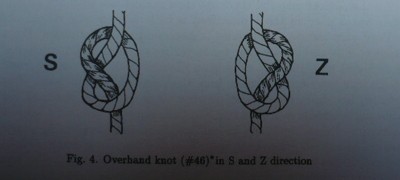
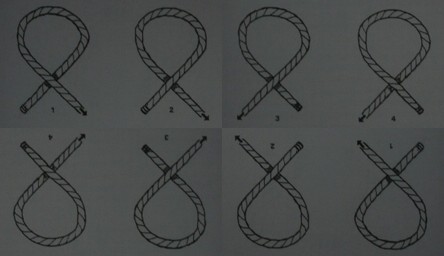
I copied (and modified) two pictures from page 47 of “History and Science of Knots”, please look at the attached pictures SZ_Overhand.jpg (the knots were illustrated vertically for showing the “S” and “Z” shape (the shaded parts remember the shapes)) and, above all, look at the SZ_OverUnder_UpperLower_Crossings.jpg
(in the last picture the arrow is the Working End,
S = from top-left to bottom-right or from bottom-right to top-left,
Z = from top-right to bottom-left or from bottom-left to top-right
as in the left (S) or right (Z) twisted ropes)
1 = Over-S crossing Upper (OSU); = your OUL if you tuck the Working End (but it’s a right-handed (Z) Overhand knot)
2 = Under-S crossing Upper(USU); = UUL (left-handed Overhand)
3 = Over-Z crossing Upper (OZU); = OUR (left-handed Overhand)
4 = Under-Z crossing Upper (UZU) = UUR (right-handed Overhand)
On the bottom I added the 180 degrees rotated image to obtain the four cases with the lower turn/loop:
(1, 4, Rotated4 and Rotated1 are right-handed turns/loops; 2, 3, Rotated3, Rotated2 are left-handed ones).
This classification could be useful if we want for instance to distinguish the (tying method of the) two Overhand knots in the Fisherman’s Bend (ABoK #1414), in ABoK #1414 picture the upper (right-handed) Overhand is a UUR (a tucked UZU, number 4 above), whilst the lower (right-handed) Overhand is a ULR (a tucked UZL, number Roatated4 above).
I usually (and only) distinguish a right-handed Overhand from a left-handed one and I don’t like the Over/UnderHand terminology, perhaps I haven’t understood it at all, but I think we should take into account the twisted ropes too, because when we tie a right-handed turn using a right-handed twisted rope we follow the torsion of the rope…
I think that a right-handed person usually ties an Overhand Knot using Over-Crossing turns/loops, so
if the turn is up (upper ((over hand???))) he/she uses an OSU turn and then tucks the Working End (your OUL) obtaining a right-handed Overhand knot!
if the turn is down (lower ((under hand???))) he/she uses an OZL turn and then tucks the Working End (your OLR), obtaining a left-handed Overhand knot!?!?
(A left-handed person ties
an OZU turn and then tucks the Working End (your OUR) obtaining a left-handed Overhand or
an OSL turn and then tucks the Working End (your OLL) obtaining a right-handed Overhand!?).
Well, I was defining SZ based on the tilt of the long ends coming out of the knot since the knot parts themselves are recurved. By chance, this is exactly the opposite of that defined by Willemina Wendrich to which I will totally respect on the basis of precedence. I will, of course, have to find the mind-space to redefine how to get there (other than the opposite of what I thought made sense independently ) since, to me, the alignment of her drawings to get S & Z seems arbitrary.
Many thanks for the research/reference and thought you put into your response!
Well, I see, your definition is driven by the lower parts of the crown formed by the two strands, but if you look at the upper parts (more visible parts) of the crown you see a Z or S pattern: please, look at ABoK #1202 (Z (Ashley calls it Right-Handed Half Knot)) your red-black knot, #1203 (S, Left-Handed Half Knot) your red-white knot (apart from the difference between Half Knot and Overhand Knot (see ABoK #46, #47)).
You are welcome.
Ciao,
s.

 ) since,