Hi KnotMe,
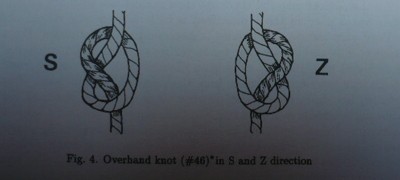
if in the “SZ equations” (in your picture) you mean right-handed (Z) “OverUnderHand” Knot (that is to say the crown formed by the two strands is counterclockwise) and left-handed (S) “OverUnderHand” Knot (the crown formed by the two strands is clockwise), I think these are the correct equations:
S = UUL = OUR = OLR = ULL
Z = OUL = UUR = ULR = OLL
You should swap the two “Overhand” Knots under the “equations” too: the black-red Overhand is a right-handed (Z) Overhand, whilst the white-red is a left-handed (S) Overhand.
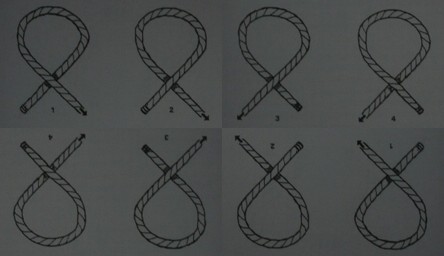
I copied (and modified) two pictures from page 47 of “History and Science of Knots”, please look at the attached pictures SZ_Overhand.jpg (the knots were illustrated vertically for showing the “S” and “Z” shape (the shaded parts remember the shapes)) and, above all, look at the SZ_OverUnder_UpperLower_Crossings.jpg
(in the last picture the arrow is the Working End,
S = from top-left to bottom-right or from bottom-right to top-left,
Z = from top-right to bottom-left or from bottom-left to top-right
as in the left (S) or right (Z) twisted ropes)
1 = Over-S crossing Upper (OSU); = your OUL if you tuck the Working End (but it’s a right-handed (Z) Overhand knot)
2 = Under-S crossing Upper(USU); = UUL (left-handed Overhand)
3 = Over-Z crossing Upper (OZU); = OUR (left-handed Overhand)
4 = Under-Z crossing Upper (UZU) = UUR (right-handed Overhand)
On the bottom I added the 180 degrees rotated image to obtain the four cases with the lower turn/loop:
Rotated4 = Under-Z crossing Lower (UZL) = ULR (equivalent to 1);
Rotated3 = Over-Z crossing Lower (OZL) = OLR (equivalent to 2);
Rotated2 = Under-S crossing Lower (USL) = ULL (equivalent to 3);
Rotated1 = Over-S crossing Lower (OSL) = OLL (equivalent to 4);
(1, 4, Rotated4 and Rotated1 are right-handed turns/loops; 2, 3, Rotated3, Rotated2 are left-handed ones).
This classification could be useful if we want for instance to distinguish the (tying method of the) two Overhand knots in the Fisherman’s Bend (ABoK #1414), in ABoK #1414 picture the upper (right-handed) Overhand is a UUR (a tucked UZU, number 4 above), whilst the lower (right-handed) Overhand is a ULR (a tucked UZL, number Roatated4 above).
I usually (and only) distinguish a right-handed Overhand from a left-handed one and I don’t like the Over/UnderHand terminology, perhaps I haven’t understood it at all, but I think we should take into account the twisted ropes too, because when we tie a right-handed turn using a right-handed twisted rope we follow the torsion of the rope…
I think that a right-handed person usually ties an Overhand Knot using Over-Crossing turns/loops, so
- if the turn is up (upper ((over hand???))) he/she uses an OSU turn and then tucks the Working End (your OUL) obtaining a right-handed Overhand knot!
- if the turn is down (lower ((under hand???))) he/she uses an OZL turn and then tucks the Working End (your OLR), obtaining a left-handed Overhand knot!?!?
(A left-handed person ties - an OZU turn and then tucks the Working End (your OUR) obtaining a left-handed Overhand or
- an OSL turn and then tucks the Working End (your OLL) obtaining a right-handed Overhand!?).
Hope this helps!? 
ciao,
s.