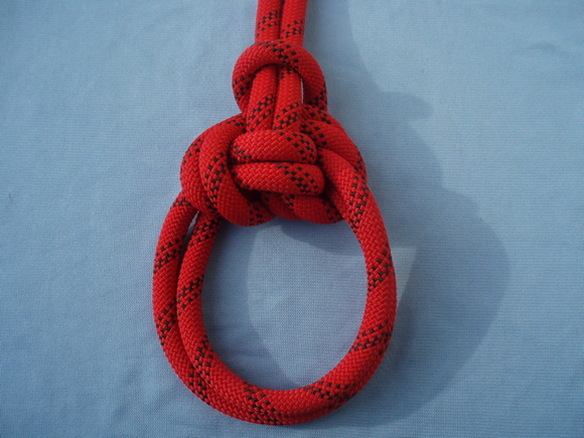
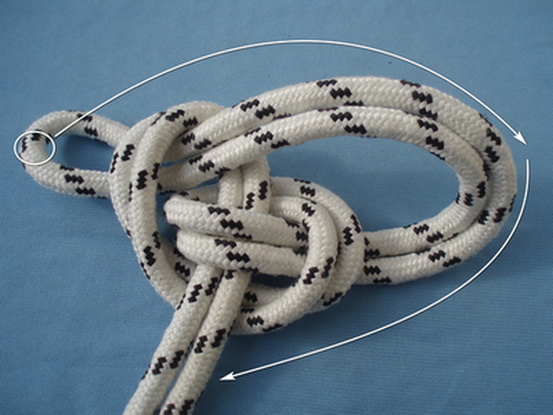
I just wanted to share: capsizing the Palomar knot produces the Bowline on a bight and vice versa.
Probably old news, but it has practical connotations: in the double loop department Karash double loop may be the most secure and sensible option. There is also the Super 8 (bunny ears), but it’s bulkier and the loops’ legs run next to each other making it more difficult to clip carabiner to them when they are tensioned (if this is a good idea in the first place…).
This ability of Bowline on a bight to capsize (or almost capsize) may be at the heart of an unusual failure mode (pulling the S-Part through) as documented e.g. here:
https://www.peakinstruction.com/blog/2nd-round-of-testing-on-the-bowline-on-the-bight-knot
Karash or Super 8 are much less likely to do it.
This video is both related and fascinating to watch especially the Dyneema demo. It’s about loading just one loop of the Super 8 and leaving the other unclipped. Another point for Karash which I’m pretty sure would have much harder time slipping in this scenario (unless the free ear is cut, not just unclipped).
https://www.hownot2.com/post/super-8-knot-are-the-bunny-ears-actually-redundant
capsizing the Palomar knot produces the Bowline on a bight and vice versa. Probably old news,
I assume that by the word “capsizing” you mean to flipp the collar encircling both eye legs, and then pull the returning lines of the running knot, to form the nipping loop and the bowline on a bight.
Not so old news for me, because i knew that collapsing the nipping loop of the bowline on a bight you get the “running Pile”,(my term) but i didn’t know that flipping the “pile bight”, one can end up with the Palomar fishing knot.
With respect to the double loop concept, knots like bowline on a bight or Karash double loop might develop cycling loading or deformation issues but they are not vulnerable to jamming at heavy loadings, in contrast with the bunny ears which is more stable but more prone to jamming at higher loads.
I have seen many good attempts with respect to double loop creation from Xarax or Alan Lee (in fact they are so many), solving this problem with “myrtle” or “end bound turns” that bind the nipping loop for more stability, and i highly value them, such as the mediterranean bowline.
https://forum.igkt.net/index.php?topic=5490.msg37213#msg37213
I would also reccomend a knot that might interlace the stability of a figure eight with the jam resistance of a bowline and that is the pseudo eight bowline on a bight.
Very stable, closed form nipping structure, not vulnerable to distortion, no jamming issues, TIB, EEL knot, and it is tied exactly as the bowline on a bight, but it features a large nub profile.
I guess one would choose the knot that works better for his application.
I would also reccomend a knot that might interlace the stability of a figure eight with the jam resistance of a bowline and that is the pseudo eight bowline on a bight.
How do you tie it? If you have a picture of the back of the knot that may help me… Cheers!
How do you tie it? If you have a picture of the back of the knot that may help me... Cheers!
-
Tie a clasical figure eight with a large eye using the bight meThod of tying.
-
Flip/capsize the collar that encircles both eye legs to give it a form of crossing knot +nipping turn/loop.
-
Push the bight down through the nipping turn.
These three steps are summarised in the attached image. The final step is like bowline on a bight, and that is to pass the bight through the whole knot in order to make it the bowline collar.
Cheers for that!
An interesting bit (related to the WhyNot2 video on top) is that in bunny ears if one loop is unclipped, pulling on the other may slip the unclipped loop through the knot and (mostly) undo it. This is not the case for the other 3 knots, I think, as long as the unclipped loop is not cut.