Hello,
Could someone please help identify the name of this knot for me?
Please checkout the video below.
Thank You!
Hello,
Could someone please help identify the name of this knot for me?
Please checkout the video below.
Thank You!
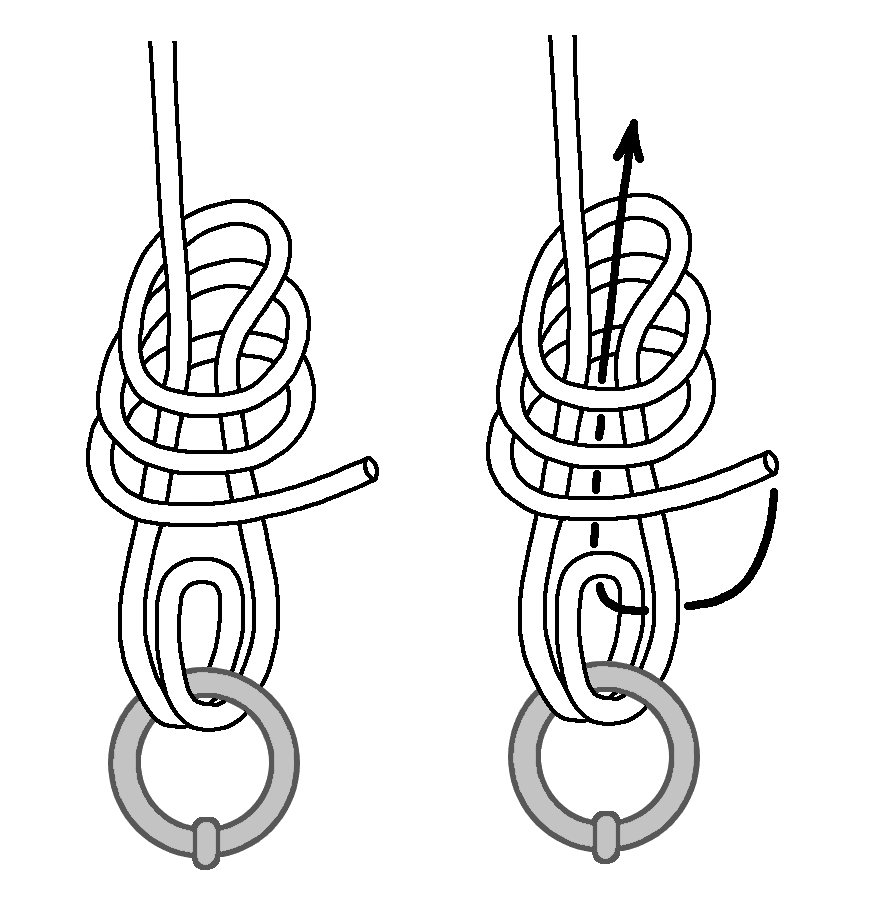
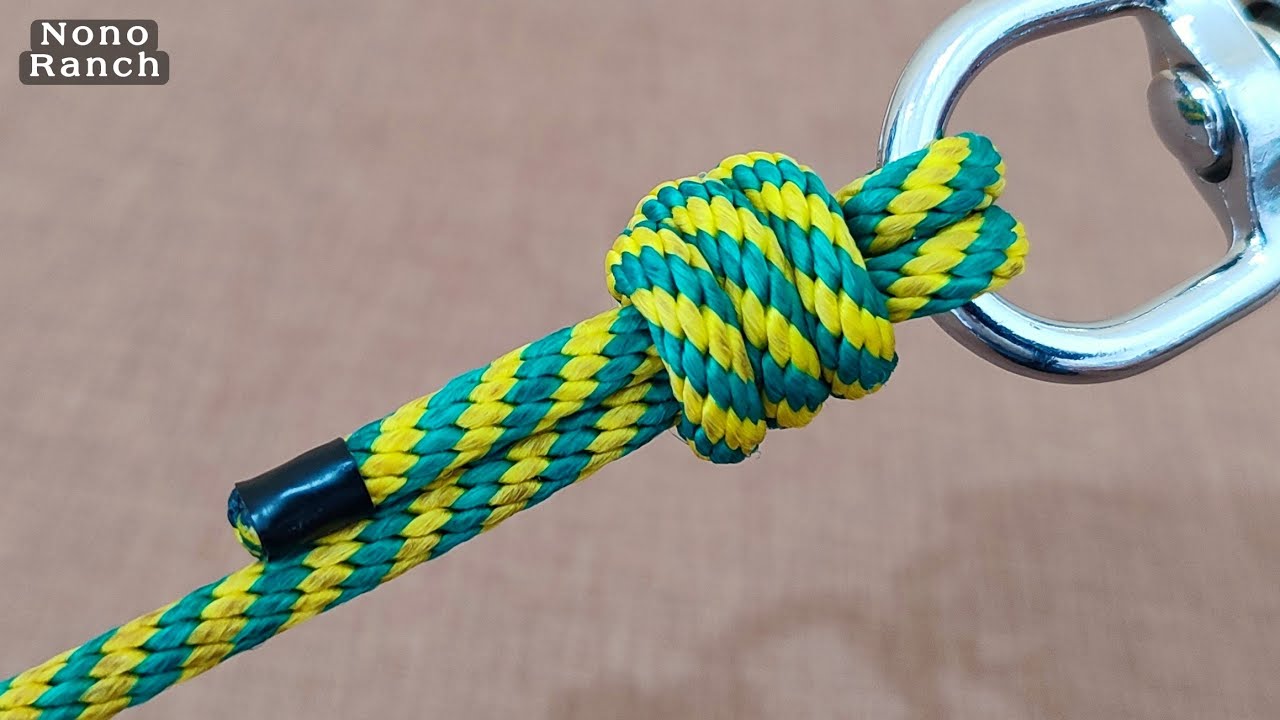
What you have is first a Round Turn (2 wraps) around the object. Then you tie a Triple Overhand Knot around the standing part to get a noose. Ashley calls this noose a Scaffold Knot or a Gallows Knot [ABoK #1120, 1121]. A more informative name would be a Triple Overhand Noose, with the Round Turn as a nice additional feature.
Thank You Very Much Dennis!
Much Appreciated! 
Someone replied to your post.
| Dennis_Pence
10 May |
- | - |
What you have is first a Round Turn (2 wraps) around the object. Then you tie a Triple Overhand Knot around the standing part to get a noose. Ashley calls this noose a Scaffold Knot or a Gallows Knot [ABoK #1120, 1121]. A more informative name would be a Triple Overhand Noose, with the Round Turn as a nice additional feature.
Better : “Dbl. Strangle Noose” (w/round turn).
(“Overhand” is most general vs. “strangle’s”
limited forms. And I like how the “double”
matches the two overwraps; the (single)
overhand having none, hence its need for “triple”, here.)
It would be nice to see this version (w/round turn)
tested, and also to see the triple OH here in Strangle
form be put into Anchor Bend form. Tests of the
non-round-turn’d knot have shown the break coming
where the Strangle turns hard around the S.Part;
using the Anchor Bend form would remove this sort
of contact.
–dl*
====*
Dan is correct that a Multiple Overhand when tied around an object in this fashion is often called a Strangle Knot {2-turn or Double Overhand [ABoK #1239]; 3-turn or Triple Overhand [ABoK #1240, 3440]}.
I sometimes take it as a challenge to implement something Dan has suggested. I experimented with trying to include some part of the Tripple Overhand Noose into the Round Turn as in an Anchor Bend [ABoK #1841, 1842, 1843]. Here is the best of what I tried. I wrap the Tripple Overhand a quarter turn more and tuck it into the Round Turn in the back. That way we still see a full three wraps all around. While it is possibly more secure, it most definitely will be harder to untie, and it is harder to tighten.
I like what you have better. If you want something similar which is easier to untie, you can replace the Triple Overhand Noose with an Ichabod Knot [#1123] which also has three wraps. But this Round Turn and Ichabod Knot is not as nice looking. I also tried two Round Turns with the Triple Overhand Noose (as Ashley suggests for [#1836]}, but it did not look very nice either.
is often called a Strangle Knot
Actually, not --that’s the sad thing : there IS this
“Strangle” name for the particular struture, but
the literature instead usually makes the comical
“half-a-Dbl.-Fish.” or some such.
to implement something Dan has suggested. I experimented with trying to include some part of the Tripple Overhand Noose into the Round Turn as in an Anchor Bend
While I only just did the same tuck-under-turn
that you show, it’s not this Anchor Bend aspect
I’ve been advocating. (And, IMO, this tuck-under
looks to ruin the probably-better-performance-wise
rounding wraps (of perhaps nice firm & smooth
& heat-absorbing metal) of the OP knot.)
Now, what I --often voicing-- want to see is the
hitch-part of this structure
(i.e., what comes after the (well chosen) round turn)
be an Anchor Bend --and in either with the AB
S.Part near the RT, coiling away,
or tied in reverse/Tail-Loaded --the reach
away then coiling back towards the RT/object.
In this latter formation, the post-RT force runs
up to a broad Anchor-Bend turn down to its
wrapping the overall structure’s S.Part,
with the force crunching the turns but not
seeing turns tighten around S.Part, but
making a broad (2-3 diameter) collar the
S.Part bears into but isn’t Strangle’d by.
(Testing --at least some-- showing that
the Strangle apparently so nips the overall
S.Part that the S.Part breaks at entry point.)
And the former structure --Anchor Bend
loaded normally w/its S.Part nearer the object–
will have AB wraps tightening around
the S.Part, but at the entry point it will
be later wraps, the stronger force upon
the nearer-to-object ones --which come
with a slightly greater around’ing than
the longer reach to the entry point.
–dl*
====*