I would like to submit a knot which I discovered while exploring alternative methods for joining two ropes.
To the best of my knowledge, it has not been previously documented, and experienced knotting communities were unable to identify an existing equivalent.
Of course, if anyone knows it already exists and has a name, I would be very curious to learn about it.
The knot is quick to tie, symmetrical in structure, secure under load, and generally easily releasable, though depending on rope type and diameter, it may require a little extra effort to untie.
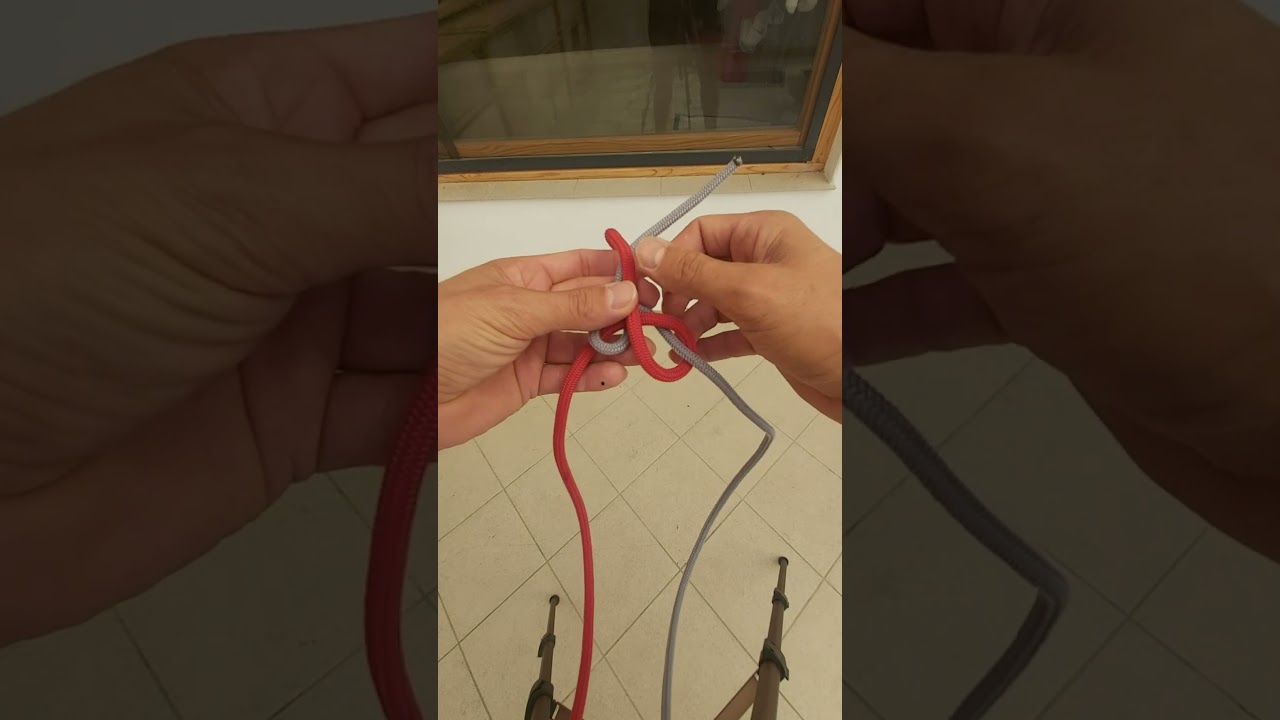
Please find a link below to a video demonstrating the knot, including the tying sequence.
Thank you for your time and consideration.
I’m happy to hear your feedback.
That knot became known to me circa 1976 as “#4”,
later noted to be of same “tangle” (different loading)
as Ashley’s ABoK#1043 (and one other place, IIRC?),
though he misses the obvious case you & I (et al
–Harry Asher’s “Shake Hands”) have discovered
for ourselves.
It makes a good Eye Knot, as well,
which is NSE (Noue’ Sans Extremites (aka “TIB”)).
One would think that it would’ve popped up as one
of the ways to make the (capsized form) Carrick Bend
more slack-secure --simple tucking of those Tails gets
one some of the interlocked-OHs Joints.
Oh as for “The knot is quick to tie, symmetrical in structure”,
one must wonder how often is symmetry in JOINTS a Good Thing?
–in that the joined ends might be not so much “symmetric” in
their nature (sizes, flexibilities, slickness) !! When making a
round sling, one uses the same physical rope; but in how
many other natural joining of ends are they likely to be
all so alike?! (Sometimes I find myself dressing & setting
a knot with consideration of the behavior of the particular
rope under load; if there are TWO ropes’ particulars to
accommodate, well, there goes (pure) symmetry!
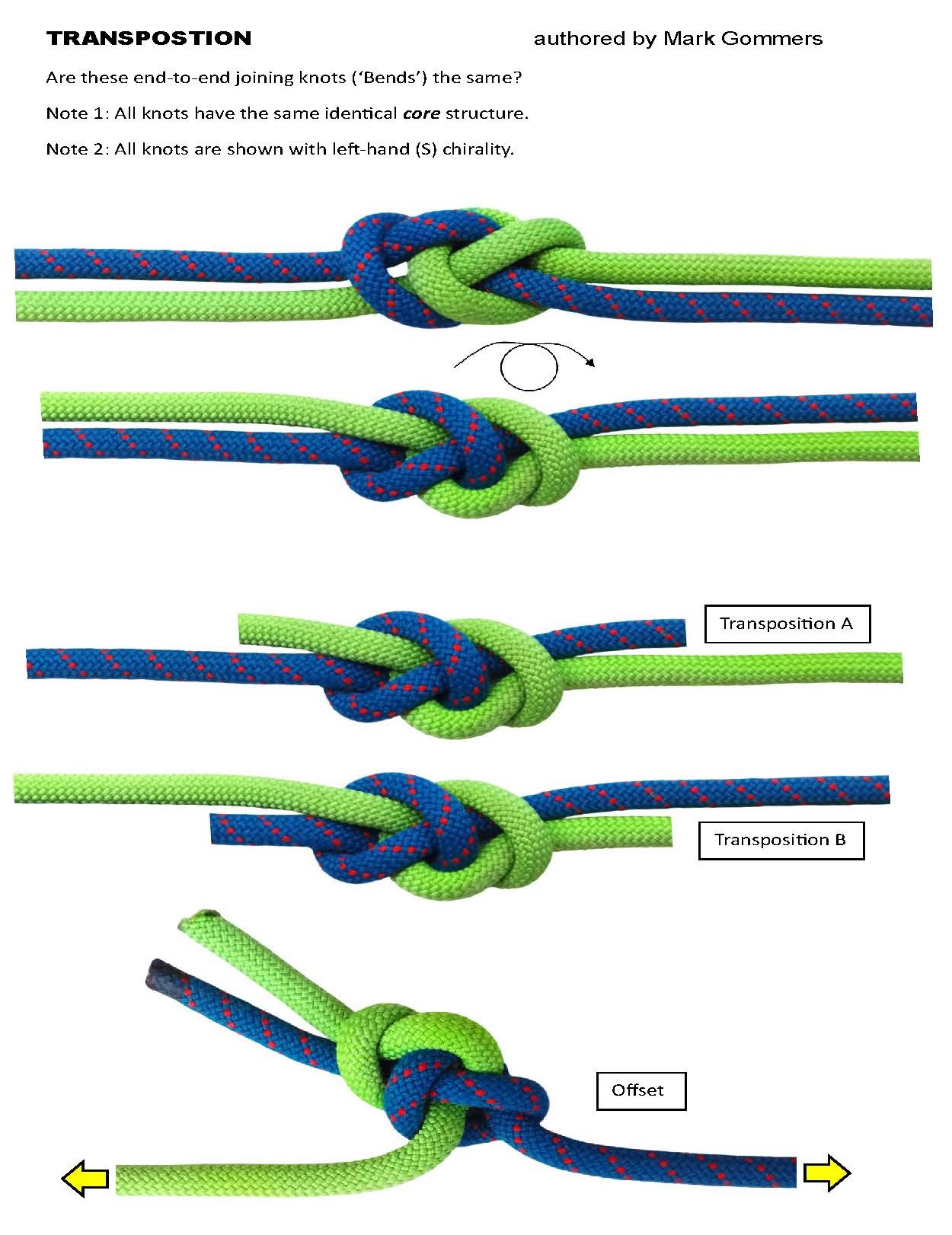
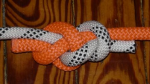
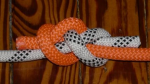
Asher recognized that this bend had the same structure as a decorative loop knot in Ashley [#1031, 1048]. But your knot is slightly different. Here I have an image of a loose Shake Hands Bend and an image cut from your video of your bend. The relationship between the two is what we call a full transposition. You interchange the free end and the standing part of both ropes.
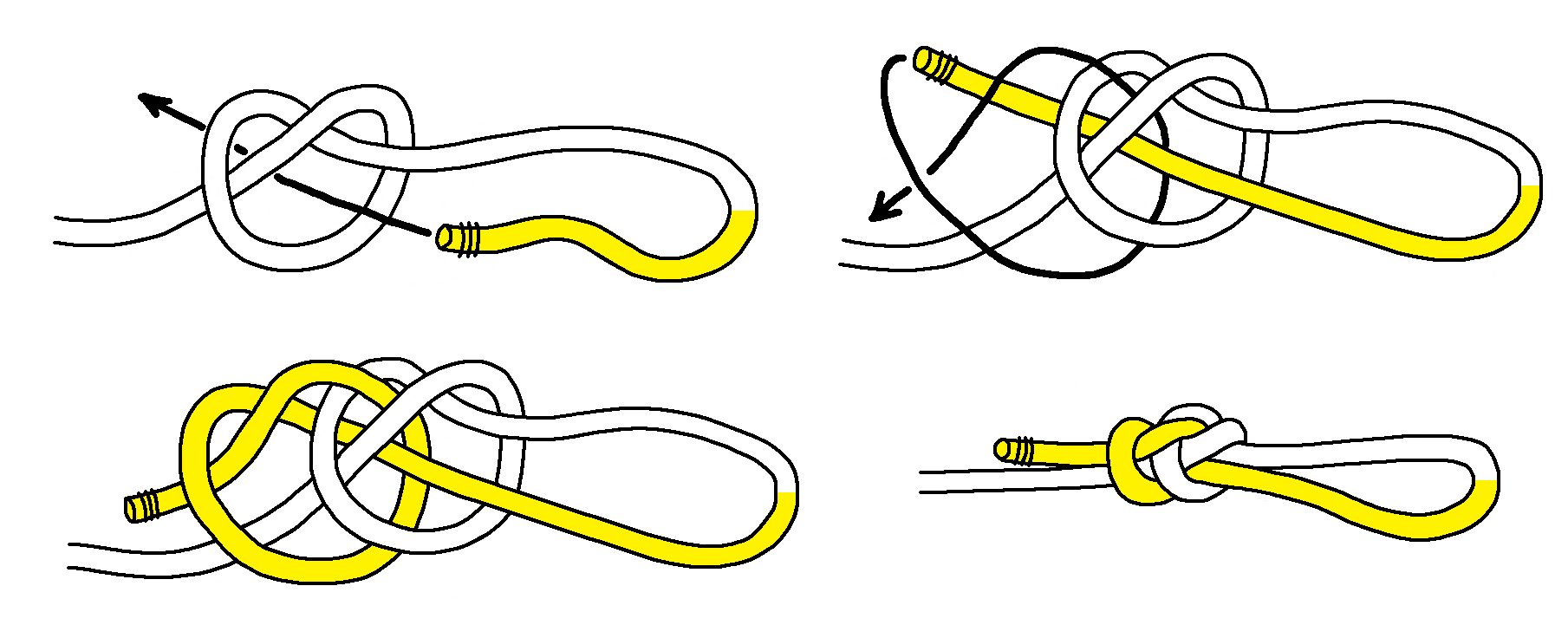
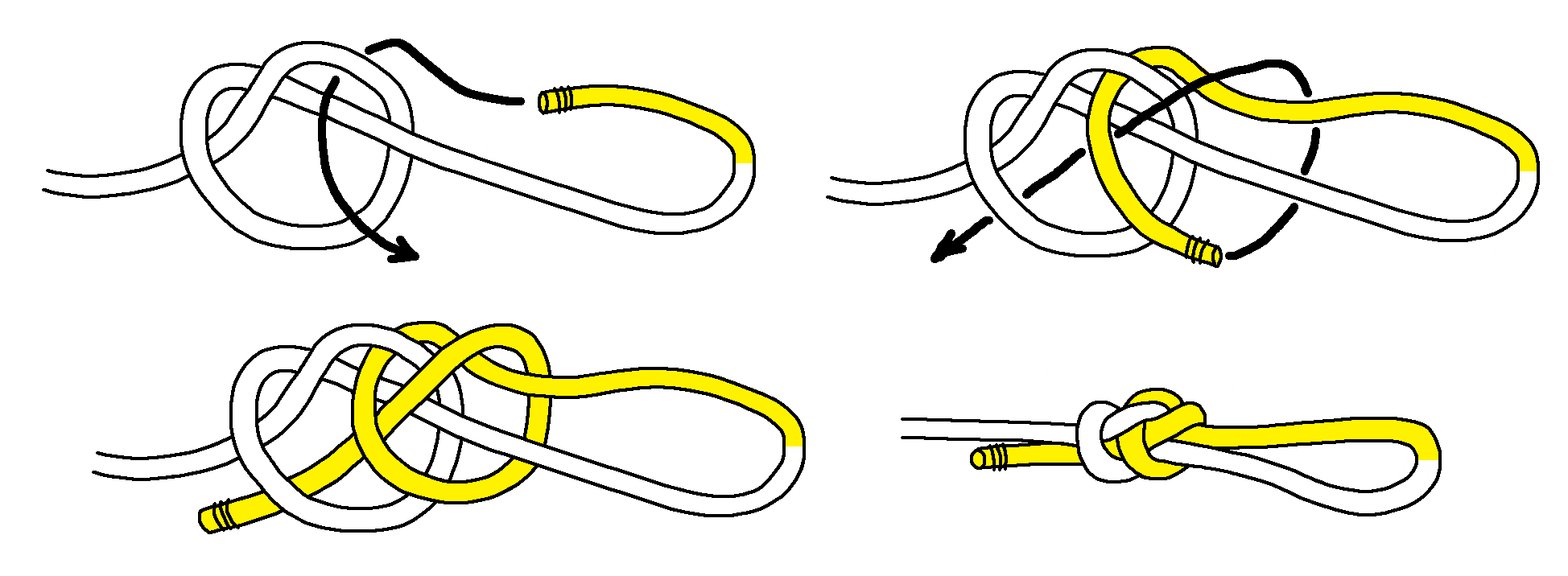
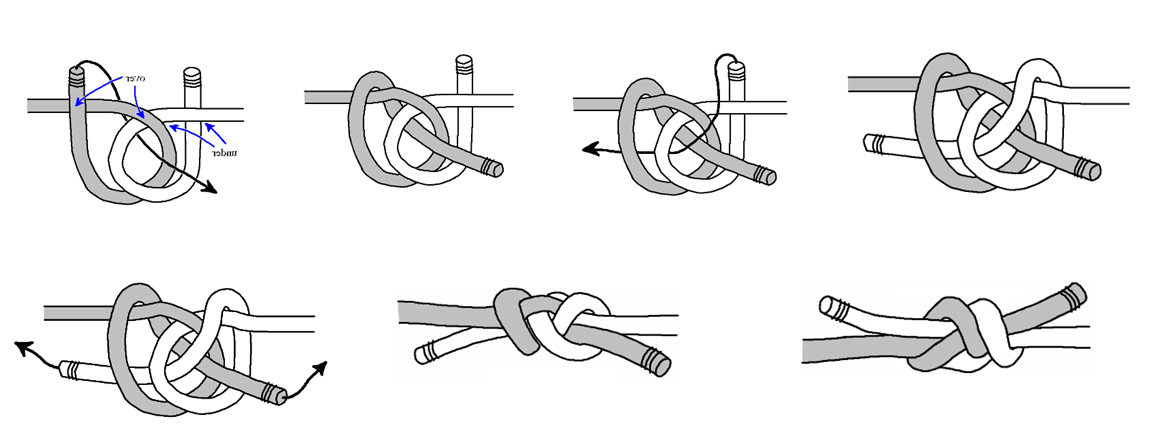
The bend presented by MasterTom is called Salty Cracker’s Bend. It has been mentioned in the old forum years ago. You may find some other tying methods of this bend in my knotting folder.
Thank you all for the thoughtful comments, references, and perspectives shared here — I really appreciate the time and experience that went into them.
The historical context, comparisons, and technical observations are genuinely valuable, and this kind of informed discussion is exactly what I was hoping for when posting.
I agree with Dan that your knot is closely related to …
Ooops, Dan agrees that he must’ve lost track of the
S.Parts/ends, and concurs in your correct identification!
(“is what we call a full transposition” ; well, is what I call
“reverse” and for ends joints “tail-loaded”;
but I don’t know what I call the loading of
one original S.Part vs. the other Tail. )
I cannot resist showing how you might double this knot
(replacing the Overhand Knots with Double Overhand Knots).
Ah, that’s inspirational :: I’d get those Strangles more
engaged/intertwined --a 2nd wrap together!
We do not have a generally accepted term for this switch or reversal of the standing part and the free end. I have heard reverse and inverse, and more recently Mark Gommers has suggested transposition. All of these terms work better for a loop or a stopper knot where there is only one standing part and one free end. With a bend you have two of everything (including two ropes). Thus, you might say you have a partial transposition in a bend when you switch one rope but not the other (and you might still have to specify which rope). Partial transpositions tend to give some kind of offset bend that may not be very attractive. In particular, here the partial transposition of a Shake Hands Bend (or equivalently the partial transposition of a Salty Cracker’s Bend) would be a weird kind of Offset Overhand Bend. I doubt if anyone would be interested in it.
Dan is also correct that there are many other ways you can “double” the bend. I was merely giving the one that is also very close to the Double Fisherman.
Back then, the term “inverse” was used, and there the Salty Cracker Bend was introduced. Knot tyers think of the “input” of a knot as the standing part and the “output” of the knot as the free end. Switching the two yeilds the inverse knot.
Mark Gommers did indeed introduce the term “transposition”.
I’ve attached an image below showing the concept.
There are several IGKT posts over the years where a transposition has been submitted - but the various authors were not cognizant of the broader concept. I’ve also shown the “offset” orientation of this knot presented by “MasterTom”.
NOTE: All bends have corresponding ‘eye knots’ that can be derived from the parent bend. There are 4 linkages available - from which ‘eye knots’ can be derived. Some of these corresponding eye knots are homogenous to the parent bend (some aren’t). Four (4) eye knots can be derived from the available 4 linkages… and then a further 4 eye knots can be derived by way of transposition. This allows for up to 8 eye knots to be derived from a parent bend (when taking transposition into account).
NOTE: All of the derived eye knots will be tied within a particular chiral orientation which corresponds to the parent bends chirality. Of course, we can flip this to the opposite chirality. Tie any knot. Now hold it up to a plane mirror. The reflected image you see is its chiral opposite. The mirror of a knot can also be conceptualised as its inverse. Language is complicated, and that’s why I favour the term transposition instead of inverse.
Knot book authors generally only show a knot in one particular chiral orientation. For example, Ashley generally shows all of his ‘Bowlines’ in Z (right handed) chirality.
I am also curious as to why this wasn’t posted in the “New knots” category? It was offered as a potentially new knot.
We probably need the related loop knots here. Given the symmetry of the Shake Hand Bend, we only get two different loop knots (in one chiral orientation). I was surprised that cutting [#1034] gave the Salty Cracker Bend, so that should probably be called a Salty Cracker Loop. [#1048] could be either one, but we will call the transposition the Shake Hands Loop.



 )
)