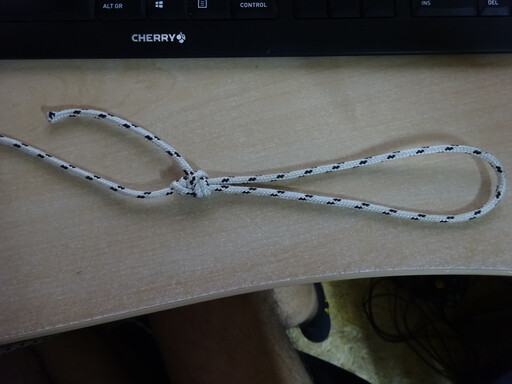
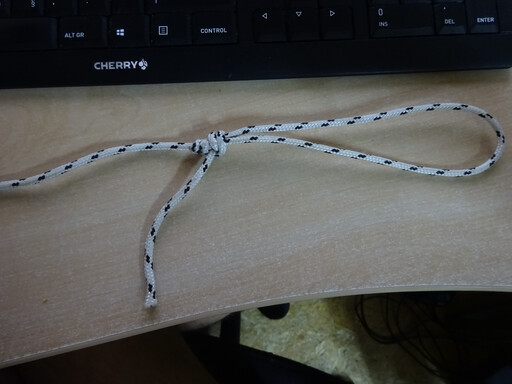
I did some random knotting and was thinking if there is some way to make the adjustable grip hitch better in some way. That moment breed this proof of concept, that makes the tieoff resemble the Lobster buoy hitch.
Tested it abit (developed it just today), and it definetly grips better then the original, but only if dressed properly. Might work better on slippier rope (must test).
What are your opinions on this? And has anyone come up with something that totally resembles this or is similar?
I watched your video and found the concept very interesting. I am going to try to reproduce the hitch myself and see how it behaves in practice with the ropes I have available.
After I have done some testing, I would be happy to share my observations with the group.
TYSM for your time and passion on this.
Friction type Hitches are a personal fave.
They can make not just a fixed nor adjustable 'terminal'/end eye. But also instead of grabbing at a right angle to a host structure(even other rope or even self); but pull parallel to the host. By making a 90° turn and still working; 90° being worst/hardest geometry to express force thru as can apply force in 2 Dimensions with RT forms.
i favor upgrade of a single Turn type structure to Round Turn(RT) for many things. Hear i see a RT to RT type structure. Looking at this shows a Standing Part(S.Part) to the eye as the equal & opposite (E&O) defining endpoints for the Dimension of linear force travel.
Always seems to me in these that we have a primary structure as the workhorse which hers is the RT betwixt the S.Part and eye, i call the primary RT. Then the subsequent structure(s) that are just 'keepers' (like cotter pin/clevis key for a bulkier hitch pin as workhorse) which here i see as the subsequent RT.
Both RTs do function to grip and keep and fight the spread of the eye. But the primary RT is the gripping workhorse i see; and the subsequent RT controls more of the keeper and anti-eye spread quantities. For just s the linear pulls from S.Part to eye in Bowline, spread of eye can work against the locking mechanism. So if want to upgrade the grip would focus on upgrading the primary RT to Dbl.RT vs. upgrade of the subsequent RT to upgrade the other 2 functions ; if go to tuning further. But if any slip etc. would primarily focus on cranking the primary RT extra hard. In fact in a more standard Adjustable Hitch, the subsequent Turn/Hitch can be looser i have found.
Can define same tiered breakdown of workhorse and keeper in a Taut Line. For i see the Taut Line's subsequent keeper Hitch as just shuttled down/scooted to lay under the primary RT workhorse to make regular Adjustable Hitch. Re-affirming the primary RT workhorse theory to me.
In a hardware hitch pin example comparison:
A>the bulky/beefy pin it self is the workhorse joining 2 parts(typically) as more rigid
B>and the frail cotter pin/key is the keeper as less rigid.
In ropes we see the workhorse as having more 'Tensioned Rigidity' and the keeper as less. In Taut Line/Adjustable Hitch to form adjustable terminal eye, the primary workhorse as hard tensioned, and then subsequents may even be loose in moderate usage.