Re: My Working Notes 1, 2, 3, 4, 5, 6, 7, 8

Thank you for your replies and images bipoqid.

- Can the 2 knots be readily differentiated by an average recreational user? - Can they be readily identified? - Which pair is the easiest to differentiate (A/B or A/C)?

I note that the configuration you have opted to photograph are not a true indication of a properly tensioned dressing state. Try tensioning the false Zeppelin bend just a bit more (by hand)…what do you notice?

To be 100% crystal clear…
#1425A Riggers bend (aka Hunters bend) is perfectly safe to unite 2 climbing or abseiling ropes.
You can safely use the Riggers bend as a method of joining ropes in preparation for a retrievable abseil system.
However, it is not jam resistant - meaning: There is an increased risk that your ropes will be difficult to untie.

there is a certain level of absurdity in my attempt to present a practical perspective on this naming issue
Agreed - it is absurd.
That said, some groups are leaving slings behind in canyons, tied with the False Hunter's Bend, thinking they are tying the Hunter's.
The name you insist on using to describe the 'false' version of #1425A Riggers bend is your personal preference - and it is based on superficial appearance at a surface level. However, the underlying structure of what you insist on calling a 'false hunters bend' in fact has nothing to do with #1425A Riggers bend (it is an outward illusion).

In my previous reply to you - I asked if you had actually set and dressed what you believe (via outward appearance) is a ‘false hunters bend’.
Can you please set and dress this knot very tightly (in cordage is best) - what do you notice?
Also, when tying a #1425A Riggers bend - notice that is constructed from 2 inter-linked loops of the same chirality.
The Zeppelin bend - on the other hand - is constructed from 2 superposed loops of opposite chirality.
Exercise:

  1. Tie what you refer to as a ‘false hunters bend’
  2. Now very carefully reverse engineer the knot - by very carefully unpicking the tails (without disturbing the remaining loops).
  3. Examine the remaining loops… are they interlinked or are they superposed?

Here is food for thought about your concerns over people who are tying knots incorrectly.
Practice is key! Like all skills - you need to practice to develop long term memory pathways. Tying a knot once from an image on the internet or from a book may lead to error. I always recommend professional instruction from an experienced, competent instructor. You will always come across miss-tied knots and you will always see people do stupid things (that is the nature of being human). Maybe you could use social media to organize a knot tying skills tune-up evening or afternoon? However, I would ask that if you do get involved with skills development with others - be careful about your terminology - don’t just label knots with your own personal naming preferences. Try to be accurate and consistent - using science to back up your claims.
One only has to look at #1410 Offset overhand bend (aka ‘EDK’) as an example of rampant miss-information gone wild.

If I may be bold and ask you some questions:
What are you hoping to achieve?
What are you hoping to prove and to whom?

Mark G
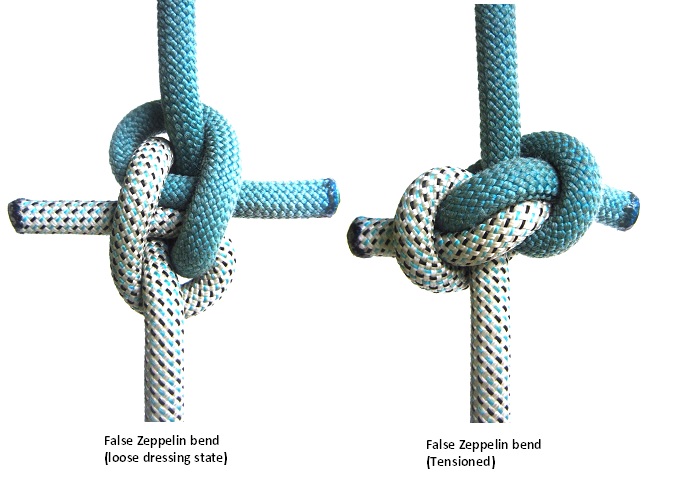

Zeppelin_false_dressing-states.jpg

…from the Forum history
(!?)
http://igkt.net/sm/index.php?topic=1992.0
http://igkt.net/sm/index.php?topic=3204.0

(I had said that we wouldn’t have changed our own minds :-\ :slight_smile: )

Let’s call it … False Bend! or FTB (Falsely Tied Bend) :wink: :slight_smile: :frowning:
Poor it, by the way it is fully (triple for Miles) symmetric, it is an autoreverse bend!..
Ciao,
s.

Refer attached image.

It shows the dressing state of the knot when properly set and tensioned by hand.
This is its true appearance which seems to have been overlooked.

Hi Mark, your photo above is not the final state. You may see the pdf. of my previous thread. The photo shows both the final states of FHB and ABOK#1425 are very much alike.

yChan

Hi Mark, your photo above is not the final state

Incorrect.

Statements like this leave me wondering if you have actually properly set and tensioned the knot?

Try again please.

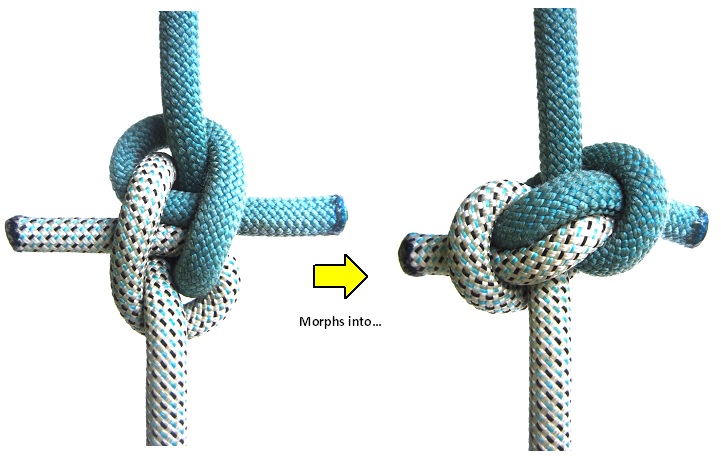
And no - it is not necessary for me to re-read your pdf because clearly something must be wrong. The knot structure morphs - it does not stay in the nice Zeppelin-like shape (or if you must insist, #1425A Riggers bend) as depicted…you surely must know this if you tried to properly set and tension the knot?

Apologies yChan - If you cant get past some of these basic concepts I don’t think I’ll be following this thread much further…


Zeppelin-False_Morphing.jpg

Hi Mark,
I made a pdf. for everyone to view on 27th Feb., not only for you. It is self explanatory.

I understand that you base on ‘superposed’, and I base on ‘chirality’. That is different perspective.

Anyway thanks for all your informations that help me a lot. I do not need to proof myself on what, but just love knotting. I share my work in this forum and will keep doing it, and would like to have more comments.

Let me tell you ‘Tying Method’ is an art. The art that you can tie a knot with different starts. No tricks but transformations. The art that you will find knotting joy. It will lead you to discover more, and perhaps discover new knots.

Happy Knotting

yChan

I understand that you base on 'superposed', and I base on 'chirality'. That is different perspective.
I'm sorry yChan but that is a misrepresentation.

I base my understanding on both chirality and loop geometry (inter-linked or superposed) - they go hand-in-hand (they are inter-dependent factors).

I think everyone on this forum appreciates your good work yChan :slight_smile:
My critique is largely focused on your tying methods - in that a significant proportion of your work appears to be focused on tying methodology rather than underlying structure.

And you do seem to ignore certain aspects of what I have presented to you (eg the morphing of what you insist on calling a ‘false hunters bend’).
Your ‘false hunters bend’ morphs as soon as any load is applied - even when setting and dressing the knot by hand force alone - it morphs immediately.
My point being that its appearance is not actually as you depict - it axially rotates - and it has an unmistakable shape.
And this is one of the reasons why I have a fundamental disagreement about its genesis - because in my view, what you insist on calling a ‘false hunters bend’ in fact has debatable resemblance to it either superficially or structurally.

Anyhow - I think you will dispute this to the end of time - and that’s why I grow weary of this…

One thing I will say… Since I have explored loop chirality and physical geometry (inter-linked or superposed) - it has enabled me to better understand symmetric bends.
Had I only played around with tying methods - I don’t think I would have advanced my understanding.

Hi Mark, we both agree it is a False bend (see my posts). It is dangerous to use it whatever the purpose. We were discussing on the structure and the outlook. We have our own reasons to believe our assumption. I find this is good to the forum.

Furthermore, why not doing more tying methods. I believe some of them are easier to finish the bend. This is another choice for tiers. Why not sharing and exploring for more?

yChan

…please, let us agree about the knot, at least!
yChan tightens the bend as the ABoK #1062, by the way you can tighten the Hunter in that way too, if the bend is in a loose form, why don’t you do? (it is not so easy to tie the Zeppelin in that way).
Mark tightens the bend with the bend not in a loose form, I mean, by tightening the SParts and the WEnds…
it’s a "bi-“stable” " bend!

I understand that you base on 'superposed', and I base on 'chirality'. That is different perspective

yes, but you yChan base on tying method (above all), whilst Mark (and I) on knot “performance”/behaviour, after (and independently how) it was tied.

However, I changed my mind: I will not name it False Bend anymore…I think “false” is the “knottyer” (not any of you, please :wink: ) who is wrong on tying other bends!
I like tying methods (elementary/didactical and advanced/tricky), they can be a good field of research, I think they could be useful to enumerate knots, but I repeat a knot is a knot, it’s not its tying method(s)!

[edit] a knot is like a mountain (or maybe not a knot is not so static! :slight_smile: ) and the tying methods are the roads/paths/climbing routes to the mountain! [edit]
As you like tying methods, yChan, please find (it does exist!) an elementary/didactical tying method, for the Zeppelin and the Neat&New, different only in one point, I mean, suppose you want to tie a Zeppelin and you remember “superposed loops and tails exiting from opposite sides” (you (you generic “knottyer”) don’t remember chirality, what it means…))…and after a while you got in your hands a Neat&New! So the Neat&New can be a falsely tied Hunter as well as a falsely tied Zeppelin!
I don’t know if this helps! :slight_smile:
Ciao,
s.

It’s important to remember that this knot has a cross-dressing nature, which has been noted elsewhere. To slightly paraphrase agent_smith’s wording, it can morph and axially rotate 90 degrees. It does not automatically do so, depending on how it is tightened, and on the friction characteristics of the cordage used. Referencing a photo from my previous post,

http://igkt.net/sm/index.php?action=dlattach;topic=5991.0;attach=22303;image

Knot A is the Voldemort knot, and the dress it wears is quite stable. Let’s call this dressed state D2. Referencing agent_smith’s dress:

http://igkt.net/sm/index.php?action=dlattach;topic=5991.0;attach=22313;image

Also stable, let’s call this dressed state D1.

My knot A is tied in well-used but still-supple 8mm aramid cord, which has a high-friction sheath. This results in a knot that is quite stable in its dressed/set state, when the standing parts are tensioned. To contrast, I tied the same knot in brand-new Beal 100% Dyneema cord, fully set in D2 and the knot does indeed morph and axially rotate to D1 when the standing parts are tensioned. I also tied the knot in a piece of well-used stiffish 8 mm Nylon cord and it also was stable in D2. This conditional stability of D2 is also evident from the canyoneering anchor sling referenced in my first post.

Given this, it’s not especially useful to continue referring to a correct or incorrect dressed state for this knot. Either state, D1 or D2, is possible depending on how the knot is tightened, and D2 can be stable depending on the type and condition of the cordage used. Perhaps with enough force, even a stable D2 tied in high-friction cord would tend to morph into D1. I don’t know, and if this were an important knot in the field of canyoneering, it would be worth the trouble to test this. Its importance to me lies only in the fact that people in canyons are using it, tying it in D2, thinking it is the Hunter’s and calling it so. Given that, the name False Hunter’s Bend would be useful in a canyoneering context, to emphasize that Hunter’s has an evil twin. I think False Zeppelin Bend is less useful, given that the Zeppelin does not have an evil, cross-dressing twin.

Speaking to agent_smith’s story of the guide that couldn’t tie straight: in that moment, when the guide mis-tied the knot, the spontaneously given name of False Zeppelin makes complete sense. In a broader context, it does not make sense as the Zeppelin is readily discernible from the Hunter’s at a glance (from the collars). That this one individual did not know this well-known point of distinction is not solid support for taking the False Zeppelin name beyond the context of that story.

This whole discussion is a good reminder of why we have multiple knot names in the first place. There are many knot subcultures, described by Ashley in fascinating detail. I especially love the story of the various Butcher’s knots used in the Washington, DC area. In any case, it’s inevitable that there will be multiple names for the knots that we use. In a specific subculture, however (in this case canyoneering) it is useful to standardize those names, based on appearance, as much as possible. I am especially grateful and supportive of agent_smith’s work in the naming of offset joining knots for rappel ropes. Bravo, and please continue that work. 'Nuff said for now.

Hi bipoqid,
there is the state shown by siriuso in his pdf file too, it is another state…see siriuso’s pdf file or ABoK#1062 (the SParts of the eye are the tails of the bend and the eyelegs are the SParts of the bend).
Ciao,
s.

It does not automatically do so, depending on how it is tightened, and on the friction characteristics of the cordage used. Referencing a photo from my previous post

Hello bipoqid,
This is one of the finest examples of obfuscation that I have ever read!

If you are going to post on this forum - please understand that you must be willing to accept critique.

The false Zeppelin bend (aka ‘Voldemort bend’) transitions from its unstable dressing state to its final dressing when load is applied. In some cases, the transition may only be partial (as you have pointed out) - likely a phenomena related to sub 9mm cordage and how the person pulled on each of the 4 rope segments when setting the knot. Even in a partial transition, the appearance changes as the collars begin to collapse and morph. This partial transition will progress further if load increases. And in the end - as load is further increased, the structure will continue to morph to its final stable state as I have earlier depicted. The structure appears to be vulnerable to jamming. Your assertion that the ‘Voldemort bend’ doesn’t always morph from its initial dressing state is conditional in my view - as stated above, certain conditions must be met. Even if those conditions are met, there will still be a partial transition/morphing - which will change its appearance.

Your photography is potentially misleading in my view (camera angles - lighting, mono-colors etc). However, I reiterate that its all based on outward appearances.

I can immediately detect the difference between the two knots - despite your careful dressing and careful use of camera angles and mono-colored cords.

Your entire premise is based upon outward appearance rather than underlying structure. The underlying structure is key to understanding knots as force machines (ie discussions focused on tying methods and outward appearances usually lead up dead-end alley ways). Which leads to me to believe that you lack understanding of the underlying structure and orientation of the loops from which symmetric bends are created.

A dressing state - imputes a geometry of a transitory nature.

Canyoning, climbing, abseiling, caving etc… all involve the use of human-rated ropes/cordage (eg EN1891 / EN 892 / EN564, etc). I have a vast array of 10mm-13mm ropes and cordage in my collection (many makes and models) - and I have yet to see the ‘Voldemort’ bend remain fixed in its transitory dressing state. It always morphs to its final dressing when load is applied. One only has to look closely at the physics of how force is acting on the structure to understand this. The SParts are applying differential loading across the central axis which triggers a state change. The result of this injection of force is the structure morphs under load.

To repeat again - in case it wasn’t clear - your entire premise is based upon superficial outward appearance and not the underlying structure upon which symmetric bends are built.

The reason why some prefer to attach the label of ‘False Zeppelin bend’ to your ‘Voldemort bend’ is because of underlying structure (not superficial outward appearance). I am of the view that you still don’t seem to understand that crucial and salient point.

Now - there is one aspect amongst this obfuscation that I concur with - its that I like the name ‘Voldemort bend’.

Mark G

Mark,
I don’t know if with heavy load it capsizes in the dressed knot you show (the state D1 as called by bipoqid), but try this, tighten the bend as yChan does (ABoK#1062) but using the tails/WEnds (as SParts), then load the real SParts (the action should be as you load the SParts of ABoK#1062 by pulling in opposite directions), you should obtain a maybe-stable D2 (bipoqid) state.

To my (Italian) ears " Voldemort" sounds strange because in Italian “mort(e)” means death!

I like “underlying structure”.

Ciao,
s.

Aye! So, another European death knot, eh. :stuck_out_tongue:

Indeed!?
but in this case it could be North American or Australian too not only European :slight_smile:
However I don’t know Harry Potter’s saga and Lord Voldemort’s knotting skills! :slight_smile:

Mark, I try tying the bend with nylon monofilament and it capsizes in ABoK #1062 form (yChan’s state)!?

Ciao,
s.

I don't know if with heavy load it capsizes in the dressed knot you show (the state D1 as called by bipoqid), but try this, tighten the bend as yChan does (ABoK#1062) but using the tails/WEnds (as SParts), then load the real SParts (the action should be as you load the SParts of ABoK#1062 by pulling in opposite directions), you should obtain a maybe-stable D2 (bipoqid) state.

Just making an important comment here: I do not use monfilament and I likely never will!
I only use human rated cordage intended for abseiling/climbing/vertical rescue application.
So I just wanted to get that crucial point out of the way.
Also - I dont regard monofilament as representative of what most people undertaking ropes sports would use in their day-to-day pursuits.
So the behaviour of monofilament (to me) is largely not relevant (sorry).

Second point:
knotsaver - have you tried using a lever hoist / chain block /winch or some other means to generate a lot of force when determining response to increasing load?
I had alreasy done as you had suggest long ago…but, once you hit the knot with some significant load - it morphs.
Again - I am talking about human-rated ropes (not monfilament or some other exotic line that most climbers/abseilers/canyoners would never use.

In certain conditions and with certain types of human-rated cordage - you can reach a point where it is difficult to get the ‘voldemort’ knot to morph. But - and here’s the but, keep apply load using a ‘machine’ - and lo and behold - it morphs.
I had a really stiff and old Edelrid 9.0mm diameter canyoning rope which resisted my efforts to get it to morph (by hand force). However, as sure as taxes, as soon as I got the 2 ton lever hoist on it - it morphed.

My point: The Voldemort (false Zeppelin) bend is a dressing state. With load - it morphs. In some special conditional circumstances and with deliberate efforts to try to circumvent the morphing - you can delay it from happening. Keep adding load - and it morphs.

No Mark, please, don’t close your mind! :wink:
Not all knot tyers are climbers or use human rated cordage! :stuck_out_tongue:
Nylon monofilament, to my mind, is great to let one see how the knots work in limit cases…so with reference to the Neat&New Bend (I name it in this way after Mandeville who first showed the bend, (Voldemort doesn’t add anything to the understanding of the underlying structure)) the monofilament shows that the bend rotates/morphs and finds its equilibrium when it looks like the nub of ABoK#1062.
Do you think that this is not relevant?
maybe, but I instead guess (and this is my point) that with heavy load and with generic (they can be nautical, climbing …) ropes the bend could capsize in the form of the nub of ABoK #1062!
Please, (if you find a piece of monofilament 0.8-1mm) try tying a Zeppelin Bend and look how it works.
In a precedent post I said that the Hunter Bend could be tied in a form similar to ABoK#1062, but if you tie the knot using monofilament you see that its equilibrium is with the standard form of the Hunter (and with reference to slippage it can lose against the Zeppelin)!

Ciao,
s.

No Mark, please, don't close your mind! ;) Not all knot tyers are climbers or use human rated cordage!
Of course not! Its a question is context and relevancy. Many symmetric bends would find use with human rated ropes in activities at height (eg climbing, abseiling, etc) - but unlikely to be used in fishing or for decorative purposes. For example, people who work at height or in recreational climbing would be more likely to use a Zeppelin bend than a fisherman.
Do you think that this is not relevant?
It can be relevant - but with diminishing relevancy. Fisherman (for example) tend to join their broken lines using a 'blood' knot or a 'unit-to-uni' knot. They would not use a Zeppelin or #1415 Double fishermans (despite the name!). However, there is no climber, abseiler or rope technician in the world that would join their human rated kernmantel ropes together with a blood knot. [ ] Blood knot = joining monofilament line [ ] Zeppelin bend = joining human rated kernmantel ropes

What does this mean?

Yes- we can use ‘exotic’ lines (eg monofilament) as a tool to study knots.
We can also use dyneema / HMPE type lines as a tool.

The reality is that users of symmetric bends such as the Zeppelin or #1415 Double fishermans are rope technicians and/or climbers/abseilers/canyoners. They would never use monofilament - ever.
And similarly, a fisherman would never use human-rated climbing ropes to catch a fish on a hook.

#1410 Offset overhand bend is the domain of cllimbers/canyoners/abseilers.
No sane fisherman would ever use #1410 to join broken fishing line (it wouldn’t be secure).
And yet - #1410 is secure in human-rated ropes.

So the behaviour of #1410 in monofilament - is not reflected in human-rated ropes.
And by extension, just because a knot performs in a certain way using one particular type of line does not mean that it will perform the same way in an entirely different type of line.

Testing knot behaviour in radically different types of lines/cords is the realm of academia.

EDIT NOTE: One other thing I should mention - because I think it is important - is that the realm of ultra-thin monofilament / fishing line is very difficult to work with - and its very hard to see whats going on while trying to tie a knot. You need really good eye-sight and a lot of patience. Also, it would be very difficult to photograph actual knots in monofilament / fishing line- i dont think I could do it. And even if you had the right camera gear/lens to get super close (macro) photography to capture details - I still think it would be difficult for most people to discern salient structural details. So if you cant really see whats going on (unless you have excellent vision and eat a lot of carrots) - most ordinary folk would struggle. And if you cant really see properly and you are struggling to try to achieve a particular and definite geometry, what good would that do? I doubt if i could (even with a jewelers magnifier) and non-shaky hands achieve a defined target structure.
I am thinking you are going to read this and still find a way to rebut it somehow… Perhaps you would counter with - “Use a jewelers head-mounted magnifier + a strong light source and don’t suffer from shaky hands”, etc etc etc ! I would still say - this is all the realm of academia :slight_smile:

Anyhow, this is all drifting off topic.

Hi dear all,
We should notice that the tying method of Hunter’s Bend in ABOK is loops superposed. It is the first known method and a fastest method too. After tails tucking, it becomes loops inter-linked and the bend is formed.

This transformation/phenomenon of loops superposed changes to loops inter-linked should not be neglected and should be mentioned in further study.

So tying methods matter always.

Happy Knotting Always

yChan

We should notice that the tying method of Hunter's Bend in ABOK is loops superposed.
Its a trick tying method - its an illusion (I already pointed this out in an earlier post - you must have missed that?) Looks can be deceiving.
It is the first known method and a fastest method too.
[b]Incorrect[/b]. Phil D Smith had devised a tying method earlier (he was the first to report and illustrate the 'Riggers bend'). His method was a variation on the twist tying method to create a #1053 Butterfly - but to reverse the direction of one of the tails through the central axis (however, he didn't report that it matters [i]which tail you choose to reverse[/i] - because it does matter! Otherwise, you will end up with an [i]axially rotated[/i] Riggers bend). 'Fast' is a matter of opinion - and varies according to ones perspective.
So tying methods matter always.
[b]Incorrect again![/b]

Tying methods tell us nothing about the underlying structure of a knot and how it functions.
One only has to look at #1053 Butterfly eye knot (TIB mid-line)…there are many different tying methods to arrive at this eye knot. Do a forum search and you will find lots of people all touting that ‘their tying method’ is the ‘fastest’ and ‘easiest to remember’ method.
What does this mean?
It tells us nothing about the structure of the Butterfly and how it functions.

There are no doubt a myriad of tying methods to arrive at a Zeppelin bend or #1425A Rigger bend too. Again - so what?
If you carefully reverse engineer these knots by carefully unpicking the tails - guess what you are left with?

yChan - You have done some nice work with devising all the different tying methods of arriving at the same knot. Well done :slight_smile:
But, all these myriad of tying methods does not tell us anything about the underlying structure of a knot or how it functions.
Your analysis of the tying method depicted at illustration number #1425A (ABoK) is an illusion - it is simply a trick method - note how the moment you apply a little load to try to set and dress the tangle - it immediately becomes unstable and undergoes a transformation… its sort of like your opposite twist tying methods.
At the end of the day - it is all lost in translation and meaningless in terms of the underlying knot structure.

EDIT Note: Grammar edits…