New poster here.
Trying to identify by name the pictured knot. Commonly used in rope rescue.
The knot is used to secure two mainlines together yielding a redundant double loop and long tails. The tails are used as the secondary tie-in for the rescuer and/or subject.
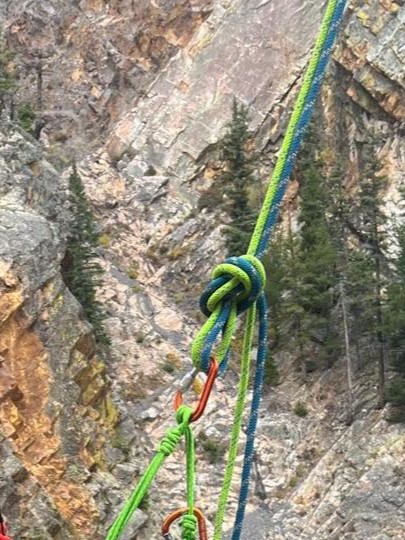
From the photo given (I tried to zoom in but it’s not a huge image) it looks like an overhand knot loop tied in the middle of a pair of ropes.
Ordinarily this knot is regarded as unsafe when loaded from both ends of the rope, because it can ‘capsize’ over the eye of the loop. However in this example the presence of the karabiner in the eye of the loop and applying some tension means capsizing is less likely.
We have much more knowledgeable knot experts than me on here, I’m sure they’ll be along in a minute 
But… Its not a simple overhand. It has a loop.
If the tails were pulled all the way through it would be a Flat Overhand Bend. ABOK 1410. Often used to join two ropes for rappelling in the climbing world.
An alternative that is used to achieve the same result are interlocking long tail bowlines.
I am still hoping to name this knot because it is obviously not the same as a simple flat overhand bend and very different than a water knot (296).
This is a Double Overhand Loop (Knot), or a Double Openhand Loop (Eye) [(Knot)]. Some farming machines baling up straw with this method call them Cormick Knots.
I agree that the knot is an Overhand Loop ABoK #1009, 1046, but tied with two ropes instead of one. It is OK if there is no real load on the long tails. But it is well known to slowly come untied with a great load on both the standing parts (two ropes) and the tails (two ropes) in different directions. Ashley has lots of knots on pages 190 and 191 that might be better, including ABoK # 1057 and 1058 which are now usually called In-Line Figure Eight Loops or Three-Quarter Figure Eight Loops.
Thanks for the comments. Agree that the knot is a overhand loop #1046. But because it connects two ropes wouldn’t it be some sort of bend? Maybe an Overhand Loop Bend?
More info for any interested.
In my rope rescue work the static load on the system would likely not exceed two 2kN (two people).
The breaking strength of each knotted rope (30% reduction for a knot) is around 20kN. So a static system safety factor (SSSF) of 10:1. For each redundant line.
The long tails would only see a load if the primary connection (loop, carabiner, tether) were to fail.
The single rope version, even though there is much misinformation, has been proven to be a competent knot to join two climbing ropes as long as the tails are long enough (18-24")
I don’t see where this knot could come untied even on a much higher load given the long tails and the carabiner clipped in the loop.
Agree the other knots mentioned would work, but the extra bulk and difficulty tying with two 9-11 mm ropes makes the simpler knot desirable.
The long batch of statements offered by “AI”
should clearly show the dangers of using AI
–and anyone familiar with knots & knotting
ought to see this pretty immediately !
Consider one obvious mistake ::
Nothing “aka” about the two distinct knots cited above.
Nor is there likely any testing to support that “stronger”
assertion --which a knots-ignorant AI culling of uttered
terms might string together into a statement; and then
the laughable “… used on the tail of a Fig.8 …” : no, it is some
Strangle or multi-Strangle knot that will secure the BWL,
or capture a long Tail of the F8 (which needs no back-up).
Pacharanero correctly identifies the knot --which clearly
is NOT a Fig.8-- as an OH Eye Knot tied with two ropes,
resulting in the well visible doubling of OH parts and the
two eyes, two tails, two S.Parts.
As depicted, the loading makes the tangle an Eye Knot.
Were somehow the clipped 'biner to be unloaded AND
the Tails tied to something --rescue litter or attendants–
and they became loading (eye unloaded), the knot would
become an Offset Water Knot [please, don’t call it “flat…”;
it’s not flat, but offset from axis of tension ] tied with double ropes
(essentially regarding the eyes as cut and thus being
the four Tails of the doubled end-2-end joint.
Yes, this is shown in some SARescue books, such as that by
Hudon & Vines. The “L-T-BWLs” structure is simply a BWL in
each line tied such that their eyes run through each other,
and the litter’s 'biner is clipped through both eyes. An
advantage that the L-TBWLs is that one might support
the load fully so that the other can be untied. (Well, that
is a possibility; I don’t know to what degree it will be used
to advantage.)
Not only then :: they could see loading if the tied-in attendant
were to slip/fall and thus load an end. With the knot yet
intact, it becomes harder to slot into “e2e joint, EyeK”
category, as it has loadings for both. In any case, it should
work in such a case.
And given the batch of material in the knot,
I suspect that it will resist hard jamming
–too many strands to pull & wiggle in getting
the knot loosened!
Some rockclimbers have tied of “cordelettes” with
a multi-strand OH and called it simply “Big Honking Knot”.
(It takes a trio of U-folds into a single OH, yielding 3 eyes.)
–dl*
/====
Not only then :: they could see loading if the tied-in attendant
were to slip/fall and thus load an end.
If the system is set up properly the tails would be long enough to remain slack while the primary attachment would take the load.
One other advantage of the long tail bowlines is that the long tails are easily adjusted before loading.
If my reply is wasted space i have deleted it happy now ?
Actually it will be my last post on the IGKT forum i dont have the time to waste on such trivial things.
Charles.
!!?
Did you come to preach or to learn?
The former is usually quicker, but not always productive.
A good strength of the Net is in seeing an idea from
various contributor viewpoints. What remains standing
after the various examinations ought to be pretty solid.
Among your cited Youtube videos was of a fellow who
in one video shows the Offset Water Knot used to tie off
a rope through two anchors, and then that same fellow
tying abseil ropes with it. In this latter case, at about time
1:57, one can see that his knot is poorly dressed, but he
thinks he’s tied correctly just for having set it by pulling
on each of the ends --not so, alas. Then he shows it being
pulled BETWEEN rocks :: while an OWK is of rather small
bulk and so might pull through such channels better,
the point of the offset nature of the knot is to let it
flow over ridges, which would snag parts of non-offset knots.
But no one was rightly seeing an end-2-end Joint here,
in the OP, but an Eye Knot.
As for the AMGA, it has been now some 3 decades
since Tom Moyer & I remarked at their continued
use of the Offset Fig.8 --which can be well more
dangerous in offset loading (though it CAN be dressed
and set to a good holding). Tom tried to convince them
to stop using that knot. (It is of more recent awareness
to me that IIFC a French caving organization recommends
the Offset Fig.8 vs. the OWK, and has test data supporting
its better performance. But one must attend to finer details
of dressing & setting than people are used to doing!
(Mark Gommers of PACI has a draft paper on offset
abseil knots. See (PACI)) Paper #5.
–dl*
/====
No - not a ‘bend’ (and can’t be defined as a ‘bend’).
A ‘bend’ unites 2 ends to form a join.
The knot pictured in your opening post isn’t uniting 2 ends - it is depicting an ‘eye’ (what some refer to as a loop).
per ‘eight0six’
In my rope rescue work the static load on the system would likely not exceed two 2kN (two people).
The breaking strength of each knotted rope (30% reduction for a knot) is around 20kN. So a static system safety factor (SSSF) of 10:1. For each redundant line.
Static load would in fact likely exceed 2.0kN (patient + rescuer + stretcher + first aid gear).
Your “30% reduction factor” is at best a guess. Too many variables with hand tied knots and ropes. I would point out that knot strength is largely irrelevant - more relevant is anchor point strength and risk of ropes contacting sharp edges.
The long tails would only see a load if the primary connection (loop, carabiner, tether) were to fail.
Obviously, that depends on precisely how the entire system is configured. Unable to see the entirety of the system in the photo (opening post). Possible to guess that maybe a rescuer (and possibly patient) is attached the ‘eye’ (ie eye knot formed in the double ropes) - and possibly the ‘tails’ are serving as a backup attachment?
The single rope version, even though there is much misinformation, has been proven to be a competent knot to join two climbing ropes as long as the tails are long enough (18-24")
You are now referring to a ‘bend’ - which is not the configured loading profile of the depicted knot in your opening post.
In the case of joining 2 ropes with an ‘offset overhand bend’ (Ashley #1410), there are a number of variables that effect the stability and security of the knot. As Dan pointed out, my technical paper on offset joining knots would be of interest to you (refer PACI knots website).
I don’t see where this knot could come untied even on a much higher load given the long tails and the carabiner clipped in the loop.
Agree the other knots mentioned would work, but the extra bulk and difficulty tying with two 9-11 mm ropes makes the simpler knot desirable.
Your comment re “… come untied” is likely true - it wont come “untied” in the depicted configuration. This is referring to knot ‘security’.
Bulk (ie ‘footprint’) of a knot is one of the metrics of efficiency, as is resistance to jamming. Your depicted simple overhand loop is more likely to jam than other eye knots. A ‘tail outside’ (Ashley #1034 1/2) simple Bowline with long tails is jam resistant and with similar ‘footprint’. And Bowline with a bight (Ashley #1074) is also worthy of consideration particularly since it can be through-loaded (and so is a Butterfly - Ashley #1053 - which can easily be tied using doubled ropes). Through-loadable knots have their uses in vertical rope rescue.
I dont think volume/footprint of a knot in your depicted application is going to be a major issue. Of more importance is knot security, stability, and resistance to jamming.