Anyone have a picture or drawing of how to tie this knot? What is it’s “claim to fame” over the original GLH?
If you can’t find a diagram of the hitch, it doesn’t have much fame to claim. 
But if you find it ubiquitous in commercial-fishing knotting,
devoid of this “fame” (which the sheepshank has a-plenty!),
you might wise up to the value of fame . 
Here is a photograph (among many at the site) of the sort of useS
of this binding hitch : the binding of netting into a bunch at
the edge, as well as running connections between net-knots, tied
around the cut-off netting. (I think it is actually a different constuction
in the latter role in this photo, and for the former, it’s hard to discern
–and is at least a multiple such binding.)
(Alas, our good field researcher here was too timid about tampering
with the subject matter to turn the darn stuff over so we can see the
knotting of the binding instead of just its wraps! )
The binding hitch is tied typically with its material having run in a
spiral around what is to be bound (e.g., I have seen it around wire
mesh pieces serving qua hinges). It’s a series of opposed half-hitches,
taken back’n’forth in direction. It is a groundline hitch tied in reverse.
(And, btw, tying the actual GLH in reverse can be an easier way to tie
that knot, which is loaded typically perpendicular to the hitched object.)
It is sometimes seen as an only occasional locking of the spiral wrapping
of one to another object, other times as a regular locking connected in
the briefest span to the adjacent ones (as shown by the URLink above).
I’ll attach a trio of pics I’ve found among my own, showing the basic
structure as a binder, then one with a netting connection where it
alternates with a net-knot attachment to capture the cut-off net node,
and then a doubled structure (i.e., a 2nd set of this-way&that-way
half-hitches put on).
OH, THIS KNOT WORKS BEST WITH FLATTISH CORD.
The orange (also blue-green) line is a polypropylene kernmantle
with a few (5?) parallel fibres in the core, mostly sheath; the white
stuff is hollow 16?-strand nylon, which has the benefit of shrinking
when wet (making it seem as though the rigger got the knots really
tight!).
–dl*
Your description of exactly what IT is remains elusive.
Until that definition is unambiguously diagrammed, discussion of the subject is pointless. “Tied in reverse” could mean many things.
I see that a couple of the above photos are already resident here
under the apt Subject Knots in the Wild , to which I
think I’ll edit in a note to point to this thread for further viewing
pleasures, and let this be a point of focus on this (and perhaps
some like) structure.
The first two photos show a well-worn binding of netting to cable
of PP-coated wire (my surmise) --in one case, the PP is worn and
UV-degraded to expose the wire. Note how well the knot sets
–and these are both “double” versions-- in the flatten-able twin
cords (it works less well in firmly rounder stuff). (Actually, the
cords of the 1st pic are a bit unusual to me, and appear to be
not so flat as the single-strand cord used in the 2nd pic; but that
is one benefit of twinning cords --it makes for a wider & flatter
unit in the structure.)
The flow of tying can be seen in these first pics of double hitches,
too : the upper end feeds in beneath two wraps, while the lower end
lies beneath only one, and thus shows itself to be the final half-hitch,
flowing leftwards to the more spiral wrapping and then next binder.
Pics #3 & #4 show single binders. The cord in #3 is another unusual
one, rounder than the usual binding hollow braid --it has some core.
(I’ve collected a piece of this, and believe that it was used in the
binding of some shipment of netting or other rope, not itself intended
to be out in the field.) The 12-paired-strands rope being bound to in
#4 is CoEx PP/PE, and showing some age at that. --fairly stiff fibres.
–dl*

Continuing, with four more photos of now some variation
on the binding structure.
#5 shows a larger hollow-braid nylon binding cord, which
here is wrapped around two strands of 3/8" square-ish 8-strand
polyester/CoEx rope. I’ve seen this used to build the large-diamonds
start of a big net (feeding into a finer, tarred-nylon laid cord,
which then feed to pre-made black nylon netting), and in some
cases to tightly wrap as though for padding/protection other
lines (still more common is the black&white PP/PES version).
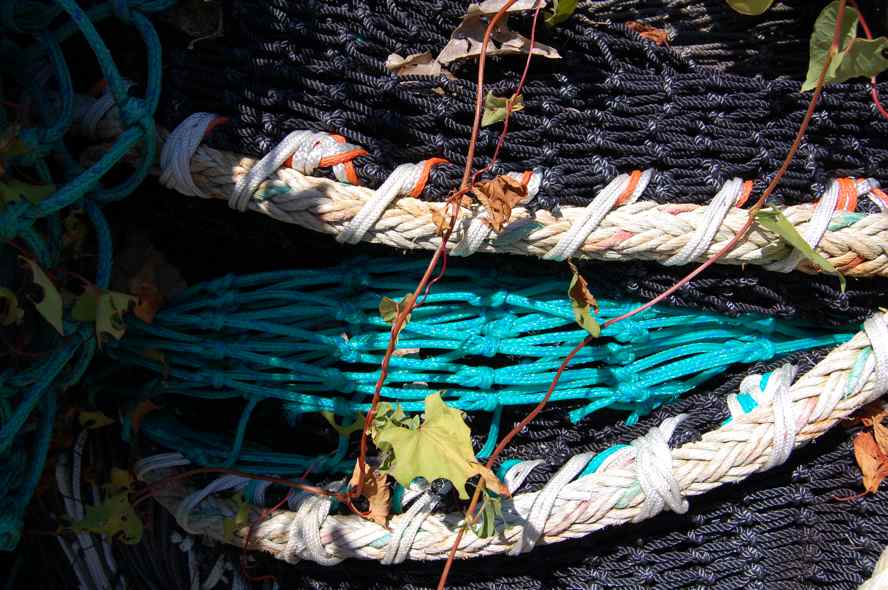
#6 shows two sets of spiral binding --of twin lines (orange PP
& white nylon) binding the edge bunch of black netting); and
of twin white cord binding this first-bound structure to large
CoEx 12-twin-strand rope. A single reverse groundline hitch
is used in the latter case; and apparently a variation on this,
with a 2nd closing half-hitch is used around the netting
–the next photo will better show this. (I cannot make out
what’s happening with the lower bunched netting binding,
appearing to have 2 white & 1 blue-green strand at work.)
#7 In this sea of black netting, the white-with-orange twinned
binding cords move rightwards (in tying), and e.g. the separated
twins near center, flowing up over and back rightwards around,
reach around up past some net-nodes clump, coming back behind
this to make the initial half-hitch, and continue to complete an RGH
but instead of continuing rightwards are bent back over to to
around leftwards & back around and up through a now 3rd H-H,
and then reach right to continue. This 3rd HH could/should be
dressed better, keeping the orange strand right of the white,
(at this point, given that there was a crossing before this; in short,
though, the twin strands can/should be treated as a ribbon) but … .
#8 Here is another common structure when the line doesn’t wrap
another but arcs off of it, through some attached structure
(such as netting), in regularly attaches to the heavier support line.
The tying flow for the upper knot would be from below, the cord
making a clove hitch with its crossover part going up & leftwards
and the being crossed to put a half-hitch on the right side,
which end is drawn away --fairly taut in the photo-- leftwards.
Sometimes just a clove hitch is used, and I’ve seen both orientations,
with the one with ends going to opposite reaches (left to right, &
vice versa) being much better set, snug.
.:. Whereas the RGH acts mostly qua binder , this last knot is
serving qua hitch --and a both-ends-loaded hitch.
–dl*
Indeed, and even “hitch” might be seen as somewhat misleading.
The structure should be apparent from some of the photos (and by
some bit of figuring --figure that these things are put on in the easier,
not problematic, way, i.e.-- the more complex variants are understood).
One of the Miller’s/bag knots has this form –“the sack knot”, #1243.
Frankly, Ashley’s tying method for the groundline hitch presented as #1680
seems needlessly finicky : rather, tie it in reverse as for the “RGH”, anchoring
the initial half-hitch with the thumb, setting this relatively tight with the
other hand, and then cast the locking half-hitch with the free hand using
the (here’s the enabler!) short SPart --practical with snoods/gangions,
but not longer lines. --same reasoning in forming the sack knot, I say.
The “RGH” is exactly the “GH” but tied opposite to the latter, and loaded
typically on both ends AND at rather unusual angles, ends coming along
some bound object rather than perpendicular to it. Tying the RGH is
simply making back’n’forth half-hitches, although to this simple formula
one can put in some extra turns (a bit of sailor’s whipping mechanism)
or other half-hitch (such as embedding a clove hitch’s pair).
Again, I have used this RGH tying --and impromptu variations on it-- in whipping
with thin flat strips from the often-found-littered PP twine. (Just last night
I put on such a whipping around a broken (cheap-o) steak knife --short shaft
had broken up out of the handle, and gluing that back together I then bound
it with first cotten string (idea: build some frictional base (possibly a holder
of some further glue, too)) and then with the PP strong thin material, which
could be put on in a couple layer w/o much bulk. I have done a similar
repair job on a plastic finger-handle of scissors, there using a file to put in
some grooves to keep the whipping from slipping off of the plastic.
–dl*
isn’t the RGH ABOK#3098?
I’d always imagined the reversal mentioned between the Ground-line (#277/278/etc.) and Picket-line (#1676) hitches was one of handedness. This is (perhaps) really only relevant to how it behaves when made in small cordage around larger laid rope. In particular it may affect how the wraps of the hitch lay in the cuntlines (look it up!) of a larger (right-hand?) laid rope.
The “reversed” at #3098 seems to refer to switching the working and standing parts. #3099 is actually #1241, rather than the Ground-line’s binder form, #1243.
It seems possible Ashley may have overloaded the term “reversed”. It’s happened before and I’m sure it’ll happen again… 
If this is indeed the fabled Reverse Groundline Hitch that Dan likes to talk about, then the repeated references have been much ado about not much. When used as a hitch, and not just a storage mechanism, it rolls apart from a round object with just a little strain.
Well. my eyes see the first pic of Lehman’s most recent post as #3098.
Dfred - can you extrapolate as to what you mean by “reversing the working and the standing parts” please… never mind. I just turned my computer upside down and I can see that now. I think you are right. If that is the case - it seems like the RGH is just a more direct way of tying this particular knot. Also, looking at 277 - it would seem to be that the RGH facilitates tying this knot with the standing end secured. I.E. at the last RGH tied.
Roo - Do you mean it rolls apart when force is applied to the standing or the bitter end? I think this is a case of looking the knot’s intended use. If you tie a RGH and coil the bitter end around the rope (as shown in the above pictures) to the next RGH, the force on the knot can only be perpendicular to the knot. there is no chance for the knot to roll in this case.
I was looking at 3098 as the method of stowing a bunch on lines on the boat I newly work on. This is turning into an interesting extrapolation of that. Below is 3098 in a coil of floating line I had handy that I was practicing on.
http://farm6.static.flickr.com/5022/5626815938_0c96a26f24.jpg
 BINGO!! Good catch, thanks --now I’ve an Ashley #
to refer to. Here, the line feeds into the knot parallel to,
rather than spiraling around, the object hitched/bound.
I think that in its usual commercial-fishing use one would
classify it as a mid-line binder : it’s main function seems
to be holding two or more items together, and both ends
are in some tension (if not from setting by hand, from
shrinkage-tightening of nylon in water).
I'd always imagined the reversal mentioned between the [i]Ground-line[/i] (#277/278/etc.) and [i]Picket-line[/i] (#1676) hitches was one of handedness. This is (perhaps) really only relevant to how it behaves when made in small cordage around larger laid rope. In particular it may affect how the wraps of the hitch [b]lay in the cuntlines[/b] ...
Yes, what Ashley says @#1676, “reversal” is only that --quite odd,
to my mind, really (and he re-presents the ground-line hitch there).
I can’t understand one using “reverse” for lay, or for having
a clear specification of lay. (Which, btw, is better put, in bold,
“lie in the lay”.) While Pieter van de Griend did publish in PAB’s
newsletter, Knot News, an article advocating this distinction,
I find it beyond the pale dubious (and based on the happenstance
of Ashley’s images and his unconvincing words here). I.p., I find
no happy lying-in-the-lay for the groundline hitch --just doesn’t
work that way, as soon enough any so-laid part will have to pop
out of the lay. (Ashley himself shows no aspect of this; one can
infer that it is only an orientation per tying method that makes
the distinction (and left-handers might go otherwise). Frankly,
even were one to have a particular need in the GLH case,
there is still the question of any such particular orientation for
the PLH case!)
If this is indeed the fabled [i]Reverse Groundline Hitch[/i] that Dan likes to talk about, ...
“If…” ? After all my words AND photos, you can’t figure it out?
But, given this whopper:
then the repeated references have been much ado about not much. When used as a hitch, and not just a storage mechanism, [b]it rolls apart from a round object with just a little strain.[/b]
… you must NOT get it. For it certainly does no such thing,
even in grossly inappropriate circumstances (2.2mm soft-laid PP
around 1" smooth PVC pipe) !
But it has never been advanced (by me) qua end-hitch as such
(it holds the initial time, but I won’t count in it taking
repeated on/off loading, et cetera).
The "reversed" at #3098 seems to refer to switching the working and standing parts.
Right : as Ashley presents #3098, it is exactly the GH tied in
reverse, BUT it is loaded qua Groundline hitch --when that
coil is suspended. In the com-fish uses, there will usually be some
tension all around --on each end in resistance, and of bound parts
trying to shift. Often, the structure is repeated with another
course of half-hitching, maybe two or three additional.
And this is just the sort of problem I find with “standing part”
(partly why I like “S.Part”/“SPart”, to hint at distinction) : it is
a term traditionally defined for a part during tying time
and has no life for the completed knot, in use!
And yet there is good need for just some term to refer to the
part bringing primary force into end-2-end joints, eye-knots, & hitches.
–dl*
ps: looks2ce, what type of rope is that? Where’d you get it?
It looks like CoExtruded PP/PE, fibrilated/flat-fibre (kinda waxy
feel, at times) --quarter-inch, soft-laid (easy to open and tuck
its own end through (often done in com-fish work). Have some
of that, too!
pps: “bitter end” : some of us urge that left as a reference
relevant to bitts, not tail-ends.
Dan - I cut a length for my own use off of a (missing term here. it was a brand new coil, so not really a coil as it had a center piece) coil that was floating downriver on the Thames in New London, CT as I was working on the Fishers Island Ferry. I am fairly sure it is used by the conchers, who are fairly new to the area. Def soft laid.
By The Way - a normal bowline is wicked soft in this stuff. it just wants to fall open. I tied a Janus in one end and it feel rock solid to my hand.
spool maybe…?
Both your words and photos were unclear at best.
then the repeated references have been much ado about not much. When used as a hitch, and not just a storage mechanism, [b]it rolls apart from a round object with just a little strain.[/b]… you must NOT get it. For it certainly does no such thing,
I just tried it again around a 1-3/8 inch wood round and using 1/4 inch line, and it again rolled for a disturbingly long time. A bump of the outer layer to the right, and it rolls even more profusely. Lousy performance for a hitch, especially with all the under-tucking required.

If you want to advance this as some sort of binder, then it’d be best to leave the hitch moniker off. Even as a binder, it’s not terribly impressive.
They were perfectly perspicuous; you must have some
serious comprehension difficulty (or be like a politician,
who doesn’t want to understand). But I’ll repeat a bit,
in that foolish hope that an action might get a different
result (it sometimes does --even, e.g., for MacOS GetInfo(file)!):
[b]The "RGH" is exactly the "GH" but tied opposite to the latter,[/b] and loaded typically on both ends AND at rather unusual angles, ends coming along some bound object rather than perpendicular to it. [b]Tying the RGH is simply making back'n'forth half-hitches,[/b] ...
(The photos are there for review --what they could possibly
have to be more obvious is beyond me.)
When used as a hitch, and not just a storage mechanism, [b]it rolls apart from a round object with just a little strain.[/b]… you must NOT get it. For it certainly does no such thing,
I just tried it again around a 1-3/8 inch wood round and using 1/4 inch line,
and it again rolled for a disturbingly long time. A bump of the outer layer to the right,
and it rolls even more profusely.
Lousy performance for a hitch, especially with all the under-tucking required.If you want to advance this as some sort of binder, then it’d be best to leave the hitch moniker off.
Even as a binder, it’s not terribly impressive.
What part of this
[b]it certainly does no such thing, even in grossly inappropriate circumstances (2.2mm soft-laid PP around 1" smooth PVC pipe) ![/b]did you not understand? --that's 10:1 ratio, double your 5:1, AND with slicker materials. One would think that you'd be circumspect here and figure that something was wrong. (Maybe you're loading it backwards --reversing the reversal! Then point at the [i]GLH,[/i] which is a *ring* and maybe *spar* but not *pile* hitch.)
Post a photo of your supposed runaway RGH ; let’s see how you’re
fouling this simple structure so badly --must be confused by “all the
under-tucking required”! (Must never have seen fishing nets built.)
Those tucks are made easily, without disturbing prior work,
unlike the “only one tuck” Snuggle hitch, where that one
tuck requires pulling out a part or anticipating the tuck by
leaving that part slack. The RGH is often built up to what
might be called “double”, “triple”, or “quadruple” knotting,
by repeating the back’n’forth half-hitching --simply done,
sending the netting needle of material through.
Qua binder, it is of course exactly (and faster tying) #1243,
which works well enough for its tasks. In fishing nets, it has
the advantage of secured ends (that’s like cheating).
W O O F !! 
–dl*
Dan, don’t you think that repeatedly calling something a hitch that is not being used as a hitch is contradictory and confusing? : Why don’t you refer to it a Groundline Binder, if it being used as a binder? There can be no reverse in the loaded end versus the free end if both ends are loaded. Further, if a completed structure is identical in every way to another structure, it makes no sense to give it a different name for every method of tying.
When someone tells you that you’re being unclear, you should listen, rather than trying to justify yourself.
As far as the rolling issue of ABOK #3098 used as a hitch, I find that the stiffness and elasticity of the line are of more importance than the coefficient of friction. This is a problem not just for a ring or spar, but also for a pile, especially where any change of direction occurs.
Actually, the knot’s in a rather unusual situation:
- it is loaded on both ends AND internally
- the loading on the ends comes (in a common application)
at a particular, parallel-to-hitched-object angle - it has particularly good working in flat material,
or twinned material (which models flatness in expanding width) - its tying method is a key to its favor
So, it confounds simple classification; “hitch” is a convenient
name of something that joins flexible material to an object.
(“binder-hitch” has ambiguity, beyond awkwardness.)
There can be no reverse in the loaded end versus the free end if both ends are loaded.
–or maybe a half-reversal: from 0-&-100% to 50-&-50% in ends loadings.
Further, if a completed structure is identical in every way to another structure, it makes no sense to give it a different name for every method of tying.
It makes a sense, as tying method can be a qualifying
aspect. As you should be aware, knots nomenclature
is a rife with confusion and various localisms, free idioms.
We have “weaver’s knot” & “sheet bend,” “Fig.8 on a bight”
(also ‘bite’!) & “Re-woven/-threaded Fig.8” , among other
complications.
As far as the rolling issue of ABOK #3098 used as a hitch, I find that the [u]stiffness and elasticity[/u] of the line are of more importance than the coefficient of friction. This is a problem [u]not just for a ring or spar[/u], but also for a pile, especially where any change of direction occurs.
Which I guess implicitly answers my question that, yes,
indeed you were loading a ground-line hitch and NOT
its reverse --which doesn’t exhibit the behavior you decried.
And what I said above it contrary your words : it is FOR the
pile (by degree, spar) that the ground-line hitch doesn’t work!
(A gap between material & object larger than material diameter
loses the nip on the tail --likewise in re the ossel hitch. )
So, while it wasn’t posited that the “RGH” serve qua end-hitch,
which the “GLH” does, nevertheless the former will hold
where the latter fails, ironically.
Stiffness, in this case, will aid the ground-line hitch .
Friction around the object, especially, in key in raising
tension sufficient to pull parts through, to flow.
With a further testing, I just found 8mm bungee/shock cord
to give opposite results (RGH flowing out, GLH holding)
in some cases, depending on setting/tightness (and even the
reverse-direction final tucking of the GLH (#1674) could
fail to hold : 8mm cord (non-new, com.fish.-usage discard)
around 6cm (5/16" & 2+3/8") PVC !? Interesting!