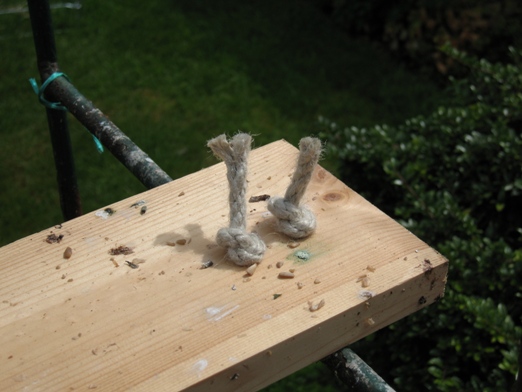
I see the important considerations to be:
-
efficient use of cordage;
-
redundancy;
-
ease of tying;
-
ease of adjustment / repair.
I can see some appeal to using a single rope (in a sense
–not to preclude that there are end-2-end knots to make
adequate length of pieces, overall), but am not sure of
the viability of this vis-a-vis durability vs. chafe in the
function of securing the planks.
I’ll presume that one cannot be matching plank-securing
to vertical hand_line-2-plank_line support --i.e., that the
vertical support lines will occur only about every 4 planks.
But that’s not a hard situation to accommodate. I’d see
using a line that satisfactorily enables twin vertical lines
(just as sometimes rockclimbers use twin (not “double”)
ropes vice a single rope --claimed to improve cut resistance).
Perhaps the running of such a single-line joint solution would
be:
a. from some anchorage at whatever point, assuming this to
be proximate to the initial plank, the line will run up and be
taken into the near interior (i.e. towards center, away from side)
hole,
b. down and around the support cable,
c. up through the exterior hole
d. and cross on the interior side of the -a- line,
which means one can tighten all (pulling on current working end);
e. which is led to go down into the 2nd exterior hole,
f. around under the cable and up out of the interior hole
g. and then tucked under the -e- part (mirroring the earlier such move)
h. and then over the plank down to secure to the cable.
To sketch the result (and help comprehension of the above words),
it’s essentially a girth hitch around the cable,
where the two SParts run (just in conceiving this structure) along
the planks, down through interior holes, around cables & up through
exterior holes, over the SParts as the collar.
IN USE, the ends/SParts will be pulled away from each other,
to run perpendicular to the planks, parallel to the cable.
I’m hoping that there is some sufficient nipping of the ends
by the collar should the line be abraded where it feeds into
this binding over either edge of the plank.
It might serve this structure to drill the exterior holes somewhat
closer together, to better strengthen the nipping collar.
Alas, it occurs to me that if one is using the “single line” approach,
there will be a lot of rope to be puling around each of these “moves”.
However, with some initial sizing of the work, measuring the amount
of line needed just to span one vertical support to the next, one can
chop the material into suitable lengths (do one per time, so to be
able to adjust length as needed); then the connection of one to the
next piece can be assuredly put in on the vertical support part,
and the amount of line in use for the next span will be reduced
to maybe a workable quantity.
Against the use of stoppers, which use does appeal in terms of doing
piece-by-piece attachments, building independence of each from the
others, is a fear that in time this binding tends to loosen --it’s not all
that easy to make tight. (Now, maybe nylon rope will tend to SHRINK
with exposure to the elements, and help counter knot compression?!)
Okay, there’s a start, one idea.
Cheers,
–dl*