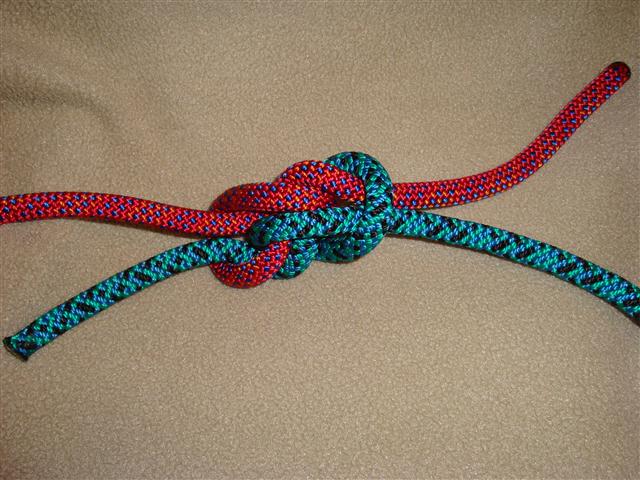
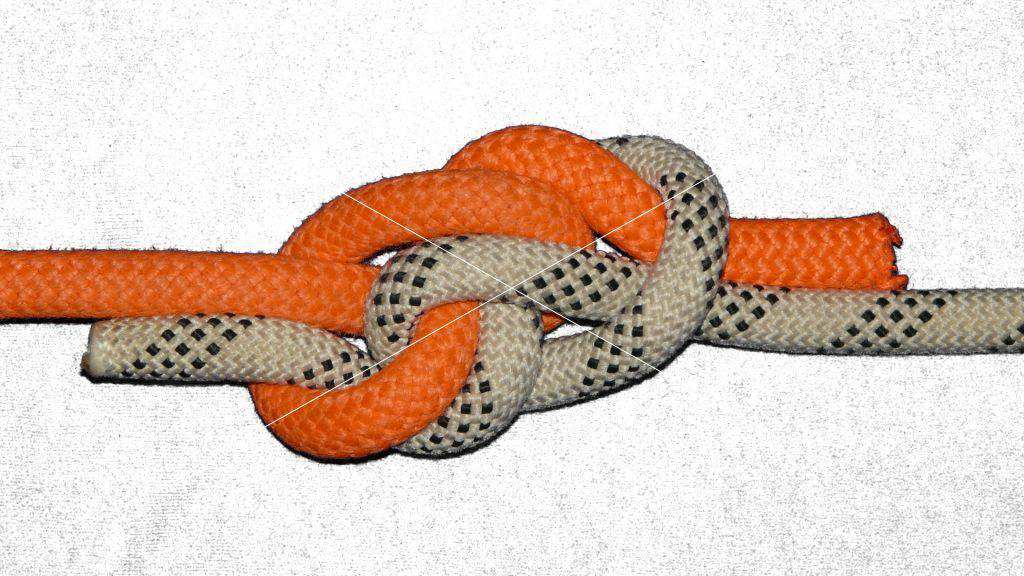
The perpendicular to tails to direction of load of the R-Zeppelin bend has been an interesting dilemma for me and that it could influence its dismissal from uses where that could be a deciding factor. At the insistence of a friend I decided to offer this as a possibility. A modification of a known and loved original.
The only known, to me, drawback is if you were to pull the tails (by themselves) during dressing the bend will revert back to the original knot. After loading it will take a much bigger force than I am able to supply to cause this to happen.
It makes the bend more bulky and harder to inspect. But more to the point, in what application would you want the tails to be parallel to the parent line? It seems like a disadvantage, as it makes a hook-like structure that is more likely to get hung up.
The added bulk will also make the bend more likely to get stuck in a crevice or hole. As an aside, the original Zeppelin Bend can fit though crevices that would stop a European Death Knot tied in equal-sized rope.
An unexpected, wonderful dressing of the Zeppelin bend !
Congratulations ! ( I have never tied this knot - although I admitt I have spent many days of my short remaining life studying the Zeppelin bend, and all possible variations of it…It could have never ever cross my mind, that this variation would be so stable, in this very unfamiliar - yet very neat - “fluid” shape ! )
Even if the tails will happen, somehow, to be pulled back to the position they usually have (on an ordinary Zeppelin bend), all that will happen is that the knot will be transformed into an ordinary Zeppelin bend - so its security will not be jeopardised in any way. A big advantage, indeed: Even if this knot, by some internal or external disturbance, would “capsize” or “collapse” into something different, the final state would be as stable and as safe as the Zeppelin bend !
The lesson this particular dressing offers to us is this : the pair of tails - that act as pivot(s) in this marvellous mechanism, the rope-made hinge that is called Zeppelin bend - can be dressed in many ways, set in many positions. When the knot is loaded, in some of those positions the tails are not affected by the shrinking and constriction of the bights that surround them. The particular position of the tails shown in this thread enables the knot to be dressed very differently, be stable and, at the same time, gain the advantage of the parallel ends. It seems like a coincidence, but , in fact, it is something we now know how to explain : The shear forces that act on those tails are very effective in their grip. Whatever is caught into the embrace of the bights and is constricted there by those shear forces in the first place, has a little room to move, and a low probability to be re-positioned at some time afterwards. So, the tails remain fixed in the initial place we have arranged before we load the knot, and, doing so, they can then be driven through the outer bights, and exit the knot in parallel with the standing ends.This unexpected stability of the tails also happens in the case of the symmetric sheet bend, and of the Whatknot (ABoK#1406).
As to the bulkiness you are referring to, well it is longer, but not by much.
I have tied this with one half in the original form and the other interwoven end as I am offering here and the bulk (width) increase is negligible.
Uses you ask? Perhaps this will be a great fishing bend or maybe not? I have no mono-filament to try it with nor the inclination, but there was a thread about this just the other day, so perhaps one of those gentlemen might give it a go and report back.
Any use the RZ has this will as well, with different tails orientation.
Yes, the modified knot may or may not get stuck in a crevice or hole, but that’s a poor argument because the original knot would do so as well, as well as other bends that could.
There are of course many uses of a pair of joined ropes where a hole or crevice will not come into play.
The “hooks” you speak of are there with most knots and either trimming them short or lengthening them goes a ways to alleviate the challenge.
Use best judgement for the task at hand.
And for the harder to inspect aspect you pine of, well, that is subject to debate and capabilities. I don’t find it all that hard. Not hard at all in fact.
If any one felt at sometime that seizing the ends of a RZ bend would be of some help, this mod would help towards a more streamlined bend.
Yes, the modified knot may or may not get stuck in a crevice or hole, but that's a poor argument because the original knot would do so as well, as well as other bends that could.
I'm not saying that a modification should make the bend impossible to hang up, but it definitely should not make the situation worse, as this modification does.
The "hooks" you speak of are there with most knots and either trimming them short or lengthening them goes a ways to alleviate the challenge.
The hooks only exist with knots whose tails form acute angles with the parent line. Lengthening the tails doesn't really change this acute angle, and shortening tails of a bend down to nothing is typically a big no-no in practical rope work.
If any one felt at sometime that seizing the ends of a RZ bend would be of some help, this mod would help towards a more streamlined bend.
OK, [i][b]here[/b][/i] you might have something. I would thus expect this to be used in a nearly-permanent application where splicing is not desirable for some reason. This wouldn't come up often, but it is possible and it is good to make this objective clear.
Hmmm, this exercise to re-orient the tails seems like (in its
result) trying to put the square peg into the circle --time to
find another knot. (I played around with spacing the nipping
parts apart and circling tails through them, but … , eh. (I
wanted to avoid widening the knot.)
!! Wow, you have to reach pretty far down to pick up
a factoid such as this --fitting through a constriction…!
As though … ?
(This strikes me as helpful as asserting that the knot
with a 57% break strength vs. one with 53% will survive
all those times the force is in the range 53..56%.)
I would thus expect this to be used in a nearly-permanent application
where splicing is not desirable for some reason. This wouldn't come up often, ...
The fisherman’s knot is much used by fishermen, and often
the tails are in some way secured to the SParts --easily by
being taped, hog-ring stapled, or through-the-lay tucked.
OTOH, the zeppelin knot I have tied in my binding cord
through a key ring has nearly no length to its tails,
which have --in the 16?-strand small cord-- sort of mushroomed into de facto stoppers, flush to the knot
(and held w/o loosening (or much tightening)) for years
& years. The flattened (hollow) braided cord takes to
the zeppelin quite well.
(Oh, wait --I forget–, wrong tense : “had”, in that that
particular item was, for some reason I don’t know, CUT
by EMTs(?) at some point in flying me off from being roadkill
to medical attention, after being run over by a van. All
the cordage is there --the circular sling to key ring, the
two auxiliary play ropes (! must be some knot tyer?),
and a 2nd key ring. Hmmmm, maybe it was a friend,
who fetched the remotely parked car whilst I was laid up?
Still, the knot remains (cord cut just outside of it).)