Hi All,
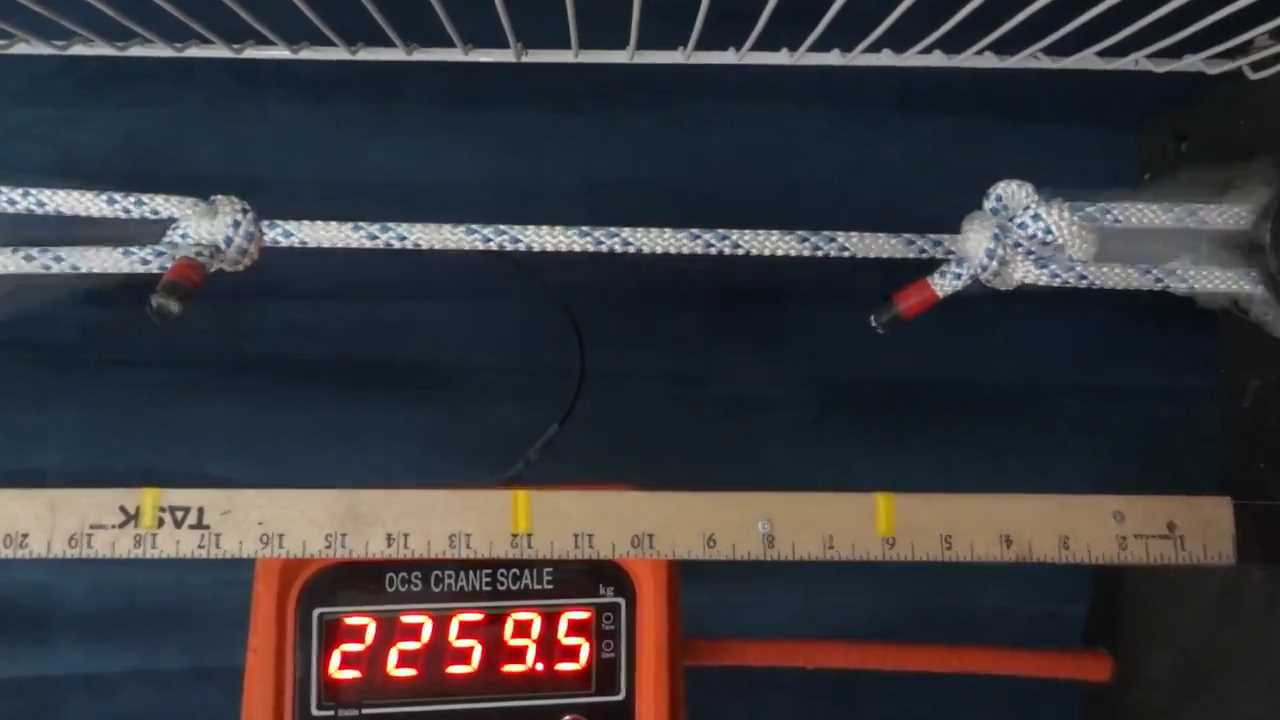
I have 12 videos testing “Scott’s lock Bowline (3D) VS #1010 (2D)”
Don’t want to occupy some much space, I just post one video which has Xarax’s comment.
I see an initial break at 1:45 / 2,101.5 (or that’s
the reading on my quick STOP click) --and I think
that this reading is also a slight drop in force
(yes, with quick-clicking I see 2,125.0 as tops).
The bowline (#1010) was set more tightly than
I would likely do; in this way, I think it better anticipated
the deformation of high loading. The SPart assumed a
pretty nice curve of flattened rope (given that the inner
laid strands can move laterally and don’t hold roundness).
I can’t see what was going on with the right-side knot.
The post-mortem revelation of TWO damaged parts is
most interesting !
And what rope ? (Some low-elongation nylon one, it appears.)
At the secure bowline, the segment of the rope just after it leaves from the nipping loop for the last time and just before it enters into the collar for the last time, is never tensioned ! In other words, after the very first stages of the pulling, it does not participate in the function of the nub any more - or, even if it does participate is some degree ( by altering the geometry of the nub, and by enlarging the diameter of the nipping loop ), its role is only secondary. The nub tries to withstand the tensile forces with the segments it has before that part, which are about what a standard bowline has - no wonder that, statistically, in some cases, this secure bowline will be not much stronger, or even that it will be slightly weaker, than a standard bowline.
Firstly, any secure bowline will be infinitely stronger than
an untied #1010, which is the main concern of climbers
–not the upper reaches of a test device! NB!
I’m inclined to see an issue with the amount of slippage
–or call it, perhaps better, “SPart feed” (i.e., feeding its
material out of the knot)-- shown in the breaking knot;
near the critical point, look at the check marks that come
out of each knot : on the left, one slowly emerged; whereas
on the right, movement is greater --again, at high load/friction
= heat. Note that one part that the SPart crossed got quite
damaged.
.:. So, it bring to question those knots that might seem
“strong” and kind to the rope for their gradual --which
necessarily implies relatively long– initial curve
having a cost of such heat-generating movement!?
Back to the drawing board?
Note that the mirrored bowline has this built-in
looseness to it, and “security by proximity” (i.e., though
not set snug-tight, the loosening is arrested quickly by
parts bumping into other parts); it also turns the SPart
around 3 diameters.
But will testing show this to have a top-strength cost?
(And might some repeated drop tests well shy of break
forces reveal some accumulating damage?!) Or is the
rapidity/quickness & shorter duration of the heat going
to offset its potential damage, at least somewhat (making
long falls worse than short at the same Fall Factor --IIRC,
peak impacts are the same, but duration grows with
fall length.
–dl*
ps : I saw this sans any audio so know only … visuals,
but I think some boater dude is promoting . . . a knot
more familiar to this forum! --to wit: www.youtube.com/watch?v=-rGROTyDv88
ps : I saw this sans any audio so know only ... visuals,
but I think some boater dude is promoting . . . a knot
more familiar to this forum! --to wit:
www.youtube.com/watch?v=-rGROTyDv88
Scott has been morphed into ‘Alex’ in this video.
And this is how misinformation and legend begins… Scott - if you’re reading this - I suggest contacting this dude and informing him that you are not Alex!
…
Thanks Alan for your tests…I’ve only looked at one test so far (no.11) - #1010 versus Scotts lock.
I’ve run out of time today…have you tested scotts lock versus scotts lock (ie scotts lock at both ends)?
Will try to look at the rest of the videos sometime later.
And of course, we know that pure MBS break testing is investigating only one aspect of a knot…it doesn’t mean that scott’s lock is no good. For example, #1410 (offset overhand bend) will have a significantly lower MBS yield than #1010 common Bowline but, that doesn’t mean its no good …Just commenting.
Thanks Mark.
Contact has been attempted. I await a response.
Yes, Thank You Alan for the great work!
As I have suspected and mentioned in prior posts, I don’t believe that encircling more rope in the nip will make a knot stronger. I personally believe that there is too much movement within the nipping area and that will lead to heat and/or mechanical fiber damage.
And to disagree a bit, I think that a knot well tightened is a better idea because the knot is closer to its final shape and condition hence limiting the destructive movement.
The idea originally was to provide a “simple lock” for the #1010 standard bowline for security.
I’d like to see the mirrored bowline put to the rigors of this
break test, to see what slack parts do and the effect of what
should be significant rope movement.
FYI, I just found some video of home-brew testing
in which in ONE test of the [i]bowline /i where
it was tied at both ends, ONE of the knots sported
a ruptured bit of material --a yellow puff-- that was
in the TAIL (um, the loaded leg of tail bight, I guess?) !!
Soon, though, the rightside/other bowline broke,
and clearly in the turNip (long bit of tail left), and
no sign of pre-break partial rupture.
(One can see at 16:23 e.g. that the surviving knot
has a damaged tail --the guy untied it too quickly
w/o the careful showing that Alan gives us.)
In a later video --same thread on Treebuzz forum–,
he tests the butterfly vs. the “non-alpine” one with
just half-hitching; and the “bad” one is stronger,
so far as his testing went.
Slowed down test #11 and captured the breaking.
Big puff of smoke (?) headed away from the SP.
I am of the opinion that it is due to the increases, squeezable bulk in the nipping area that allows too much movement and heat build up thus reducing the strength overall.
See the attached picture that captures the rupture.
I think this is it (and note the extent of this
visual haze all around the pin).
And I also agree re the heat aspect as key to breaking;
I’ve been wondering if some of the strange HMPE slippage
comes from some melting of surface fibres and then …
one is trying to knot liquids!?
I have capture the frames of this “smoke” or vapor , whatever and compiled a animated gif file. I clearly shows the “whatever” moving from the nub and spraying towards the anchorage. The file is too large and if I reduce it, the clarity is gone.
It would not take much heat damage to start a cascading fail of the fibers and most of them not be melted. I have seen this in my own destructive tests.
Alan, did you see any puffs of “smoke” or smell anything related to the knots breaking?
Thanks for these tests Alan.
I particular enjoyed the music The good the bad and the ugly in the Scotts locked Bowline v Scotts locked Bowline.
I concur with Scott in his general observations.
Knot failure (in broad general terms) usually involves a combination of:
localized heating caused by friction
localized compression/squeezing
unequal loading across the cross-section area of the rope (compression on one side versus shearing on the opposite side)
The injection of force into the knot core is the trigger for these effects.
Dan and I have been discussing the terms ‘ratcheting-out’ and ‘drawing-out’ of rope material from the core of a knot under increasing load.
Dan Lehman’s strict definition of ‘ratcheting-out’ of rope material imputes a one-way effect - with no rope retracting back into the core.
In Scotts locked Bowline test video (dual Scotts locks), when Alan removed load to stop and examine the knot (at 4:08 elapsed time) - rope material recoiled back inside the core/nub.
This is likely due to the fact that Bowlines are jam resistant.
With regard to the puff of white powder/particulates - Alan isn’t using an expensive ‘high-speed’ camera.
But, given that the puff was commensurate with the yield point being reached - this is a smoking gun in support of Scotts observations (pun intended).
As for notions sniff tests and being able to smell anything, the small quantity and transient rapid dispersal of particulate residue would make it unlikely that Alan smelled anything.
Being able to smell or not smell is not a deal-breaker in my view. One of my colleagues here in Australia has no sens of smell - so if he were present, he wouldn’t smell anything.
High-speed cameras are a fantastic tool but they can be prohibitively expensive for home-brew testers.
Hi All,
I saw little puffs of smoke mix with fine pieces of fibers flying out, and heavy odor smell, it is very unusual.
usually after the knot broken and when I get hold of the knot very close to me, then I can smell a very light odor smell,
maybe the rope had been contaminated with oil or grease along the line, seem like some how the hot melting gas was trapped
in a small pocket inside the nub. when the knot break, it releases and shooting it out.
    Mark, I am working on your Offset knots, Will post it the next few day.

    siriuso, I find not all 3 rope diameters inside the nipping loop would boost the MBS yield of the knot.
               We have discussed a little bit before about 3 rope diameters inside the nipping loop may or may not raise
               the knots MBS yield?
               see this link   https://igkt.net/sm/index.php?topic=5383.msg35987#msg35987
               謝謝 alan lee.
maybe the rope had been contaminated with oil or grease along the line
Hi Eric, this concerns me.
Contaminants would skew your test results.
Do you think this may have been an isolated (one-off) event or could this have also occurred in other tests?
With all the discussion on puffs of white powder, sniff testing and contamination risks - it reminds me of just how difficult it is to setup a test and carry it out.
It can be a thankless job.
…
I think with all the testing that you have done to date - what some people are looking for is a summary or conclusion from you.
Every test series needs to wrap up with a final conclusion based on results/observations.
I think that the issue of 3 rope diameters inside the nipping loop of a Bowline is still a ‘cold case’ - and needs to be wrapped up with a concise conclusion/summary.
This will also open the way for other testers to verify or refute your results (that’s how science moves forward…others need to do follow up tests).
 …Just commenting.