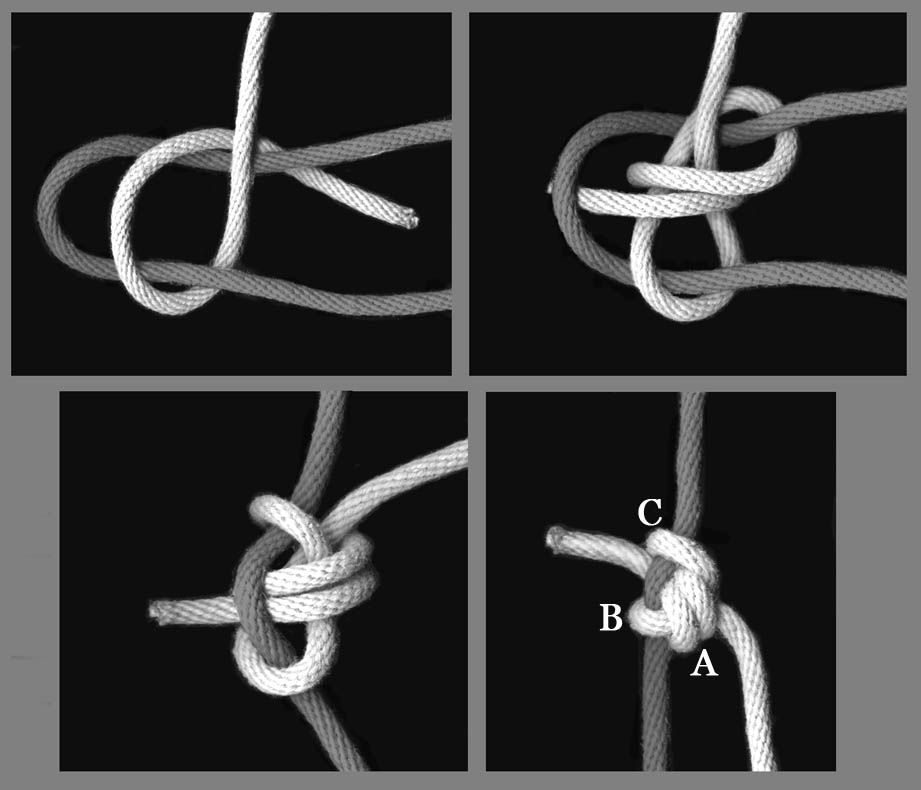
I’m from outside knot culture, so I’m not up on nomenclature. I’m using it for the friction of its grip, whatever the term for that is.
..that the hitch really is
"friction"-like perhaps in its sliding along
a line until ... it gets its holding effect from
being jammed tight at some point, thereafter
not slipping & gripping (so well).
Once it is snugged down, it strongly resists sliding along the taut line. And to my way of thinking, if something is slipping, then it is not gripping, and vice-versa. Your suggestion that it might not do well at both to me implies you might be thinking of some sort of ability to alternate between low and high friction. If that is a defining quality of a friction hitch, then yes, this hitch would indeed be something different from that. But I looked up jam hitch, and the images and descriptions for that also seem like something different from this.
And to this point --i.e., the need to be able to be
"jam"med into the gripped line--, I expect that this
knot doesn't work well if at all as line strength/tension
rises : that the knot cannot then make the effective
jammed deflection in the gripped/object line!?
The surface slickness of the rope definitely makes a difference. I haven’t noticed that the amount of tension and deflection in the taut line makes much difference, but maybe such a difference would occur mostly outside of the range of tensions I normally encounter.
In what circumstances (line type, forces, configuration)
have you tried the knot?
I use it when I want to tie onto a taut line–either because I want to pull the taut line to release tension in some part of the rope, or to attach a return line to prevent loss of tension in a load-binding situation. For such uses, I don’t need a low-friction feature. I just want it to grip and not slip.
In most cases, the attaching line has tension roughly in parallel with the taut line, but I have also used this where the attached line pulled at more of a right angle. The most common hitches I saw recommended for this use were the taut-line and midshipman’s hitch, but when I tried them, they seemed quite prone to slippage. I tried more elaborate friction hitches, but even with lots of extra turns, they didn’t seem to grip as well as the noname hitch, and they were quite fiddly to tie. (And none of these could be tied on a bight.)
I usually tie the hitch as I showed it, but the grip strength of this hitch is actually greater if the hitch is tied pointing the other direction on the taut line (or if the attached line is pulled in the opposite direction). But I have a hunch (untested) there could be a greater capsize risk when pulled the opposite way, and it is easier and quicker to tie the hitch pointing in the direction shown, and the grip strength is usually ample, so when I do encounter a particularly slippery rope and need more friction, it only takes a couple of seconds to tie in a friction-multiplier (or tension-reducer) helper hitch before tying this noname hitch. (Again, I don’t know the nomenclature for an in-line hitch which increases friction so that the line tension is higher on one side than the other.) I’ll attach an image to show a typical configuration.
Ropes I’ve used this on range from around a quarter inch diameter up to roughly 3/4"–usually braided synthetics. I’ve never measured the tension or line forces. I’ve dropped branches and 50 lb. feed sacks on this knot under tension without it slipping, and the tension between the bed walls in my pickup is often high enough that I have to release the tension in order to open the tailgate.
As for novelty, I don't offhand recall having seen
this particular knot previously.
Without knowing how extensive your knowledge of existing knots is, I don’t know how much that might suggest a possibility of novelty. My assumption was that this surely had to be some well-known hitch that I was not finding due to my inexperience at how to search for knots. It seems almost unthinkable that this could be a novel hitch, but if you have broad experience of knots, that would at least suggest this is not already a popular or well-known hitch. That would just be mystifying. For my purposes at least, it has been a solid performer–rarely slipping (usually when there’s no helper hitch), never jamming, it’s never capsized on me, and I’ve never had it fall apart. Maybe my uses are freakishly odd, but I wouldn’t have thought so. Or maybe this hitch is completely eclipsed by a better one, but if so, I sure haven’t run across it.
Something here does not seem to add up, but perhaps I’m just missing or failing to understand something. Wouldn’t be the first time.
Anyway, much thanks for your comment.
K.
Attached Image: The taut line is on top, the attaching line is coming up from lower left. I tie the helper hitch first, then the noname, and snug them in the same order. (I show all the hitches before tightening for clarity.) I spaced the noname hitch and helper hitch closer together than usual to reduce image size. Helper hitch in the main image is, I think, a lobster buoy hitch. Inset shows an alternate (I don’t know the name) which is at greater risk of capsizing, but very easy to untie while the taut line is under full tension (unlike lobster buoy). Cow hitch is kind of in-between on both factors. I expect there are others, but I use these depending on whether I need stability more, or ease of untying. Haven’t run across a helper hitch which excels at both. A string of three or four lobster buoy hitches is about as secure, but the noname hitch is faster to tie and untie, and can be tied on a bight.