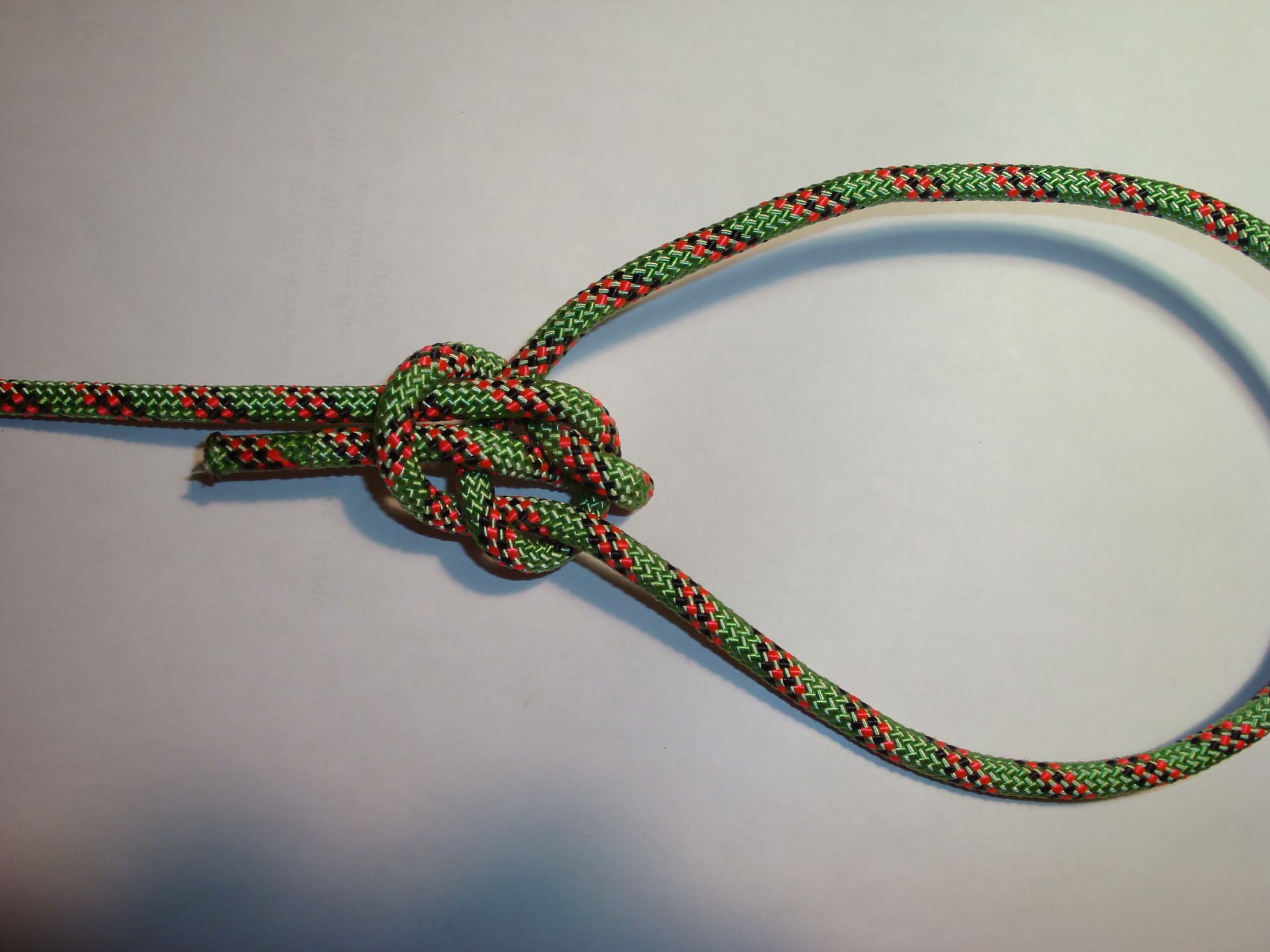
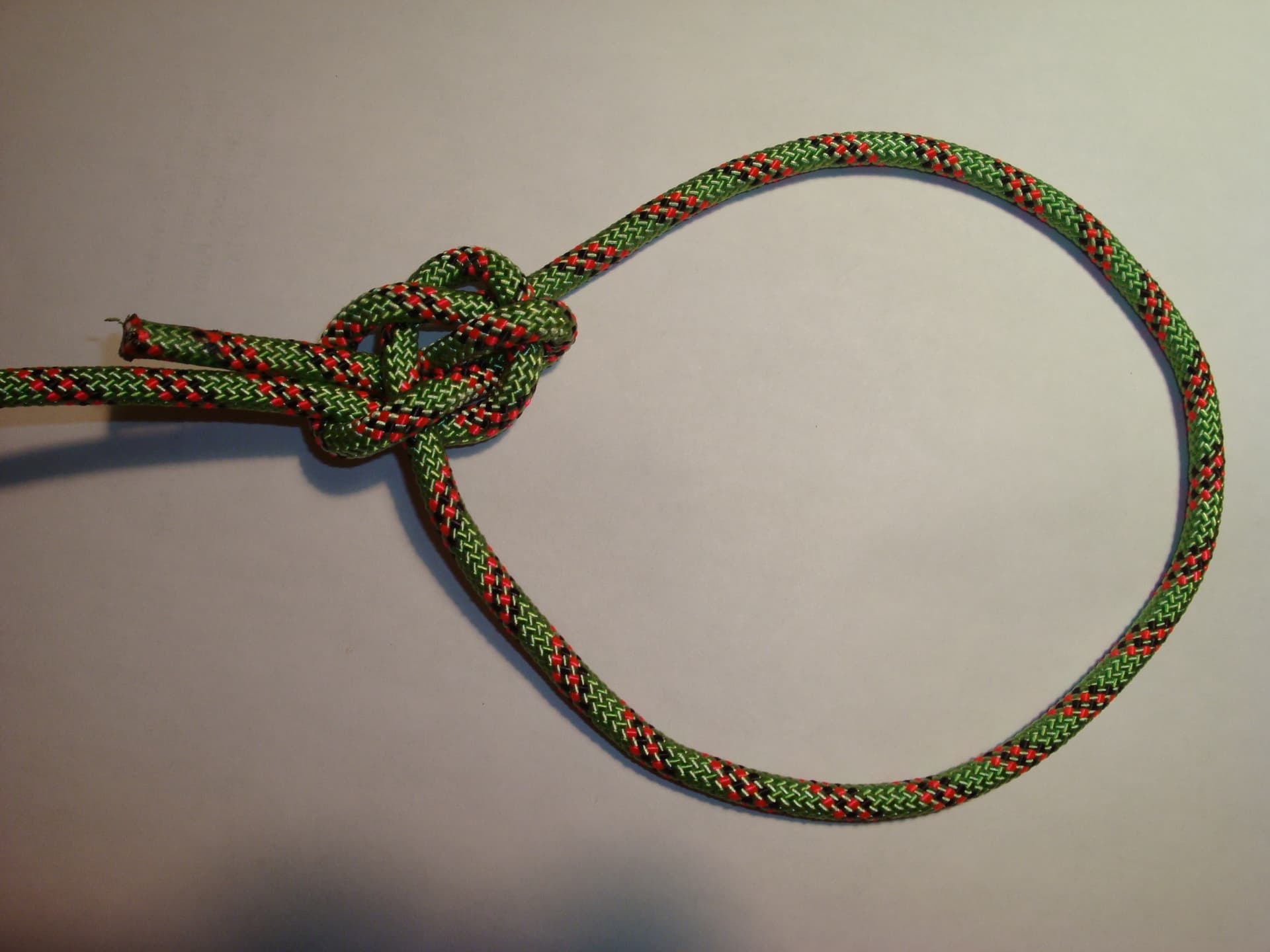
Having read or reviewed just about every book on knots that I have run into, I have never seen a lock documented that I use when I don’t want a bowline to inadvertantly loosen.
Does anyone know if locks for bowlines, excepting an additional stopper knot or a half hitch around the standing end, is documented anywhere?
Indeed, there are many simple ways to do this, and yet the
only thing knot books seem to show is what other books have
shown–a brain-dead parroting of often nonsense.
The Yosemite Bowline comes to mind: it has popularity well beyond
its merit!
Heinz Prohaska long ago showed what I call the Janus Bowline,
in which the end makes a turn around the side of the eye
nearer
(in origin) the SPart, and is simply tucked back through the
knot’s loop part–which makes a symmetric knot.
I simply loop the end around the crossing point of the gooseneck,
and back out beside itself; this is esp. effetive for the Dbl. Bowline.
There are many other ways … .
I don’t know if you describe the lock I use, but I let the line naturally turn away from the main loop and back through the loop in the standing part.
It is simple enough but I never see anything documented about securing the bowline except lashing or a stopper knot although enough is said about the chance of the bowline coming undone. Seems simple problem to solve, quick and easy, doesn’t compromise the security of the knot and it is still as easy to release.
Hi Rob, There are some climbing sites and some arborist sites that may help find out if others are doing what you do. I am too dumb to figure out what you are describing verbally. Because you are a “guest” I can’t “message” you offline with my address or E’mail address. If you want you can go to our website <www.igktpab.org> and e’mail the president there and I’ll come back with a snail mailing address where you can send me your knot in some cheap stuff. Right now I am illustrating some fishing knots for another member which will be first published in “Knot News” (the PAB newsletter) then offered to “Knotting Matters” the IGKT magazine and finally put on the web at KHWW (Knot heads world wide). If you have something that nobody else is doing lets get it out there! ;D
Having read or reviewed just about every book on knots that I have run into, I have never seen a lock documented that I use when I don't want a bowline to inadvertantly loosen.
Does anyone know if locks for bowlines, excepting an additional stopper knot or a half hitch around the standing end, is documented anywhere?
rtt
It may be misleading to call a back-up measure a “lock” because any additional tucks may or may not increase the bowline’s mediocre resistance to shaking.
It sounds like you’re looking for a more secure loop that can be readily untied after heavy strain, but I’m not sure if that’s what you’re asking. Here are some:
Remember that quite a few back-up measures are actually more prone to fall apart before the bowline itself, and thus are fairly useless other than the extra rope length they provide. Even a stopper knot that holds may be of little use if the bowline springs open enough to allow the stopper to wiggle through.
I don't know if you describe the lock I use, but I let the line naturally turn away from the main loop and back through the loop in the standing part.
Language is more powerful than we're making it! You can be more helpful
than this vagueness. Let's find a common image for reference.
Try www.iland.net/~jbritton/bowline.htm Step#4's image.
If I take your words “naturally turn AWAY from the MAIN loop”,
I would guess that in the ref.image the end (as it’s drawn by the
SPart) would go Leftwards & down slightly and cross UNDER
all parts, to be then tucked back right/over/down-under?
THAT, in any case, is going the opposite way from what I do, to
lock the gooseneck/loop of the knot! I don’t see the above as
being at all very secure.
To describe my end-binding directly, bring the end (image#4)
back under all parts, parallel & slightly to the right of itself;
then re-tuck it parallel to itself (thereby looping the loop of
the knot, locking it).
The Janus Bwl is as follows (from image#4): take the end around
the right-side led of the eye, going Under & back Over (and in
doing so, a bit upwards/higher);
then tuck the end out through the gooseneck/loop going slightly
“SouthWest” in direction, UNDER the closer loopedge and
the two nipped parts of the end and Over the farside loopedge.
The knot should be symmetric, looking the same “coming as going”.
Do you know of a reference to the Janus bowline?
That is my name for it (and a good one!), based on its shape.
It was presented in an old Nylon Highway newsletter (ca. 1990)
by Heinz Prohaska (and perhaps also in Summit)--the periodicals
being resp. of caving & climbing.
Next picture after step #4…finished bowline…if you follow the standing part through the original small loop then I find it traps the tail and makes the bowline more resistant to loosening. Being a sailor, I find it holds up after constant jostling by wind, water and work. Finally, when it is time to remove it is still easy to release and untie.
If anyone knows of a picture reference to the Janus bowline online anywhere, please let me know as I don’t really follow the explanation above…although I do appreciate the effort made to try and explain it.
Does anyone know how I can attach a digital image through this forum or if there is a URL location that I could post it to or perhaps just email it to a member who could post it for anyone to view?
Rob, don’t give up! Where do my words fail?
This is really quite simple–we’re talking about CONTINUING from
a given image, and only a VERY simple bit of making one turn and tuck!
This shouldn’t take xxxMbytes of pictures.
Your description is adequate. What you describe has been shown in
KM (Knotting Matters–IGKT newsletter). A similar bowline, which also
can be tied in the bight(!) is shown on the same site:
www.iland.net/~jbritton/KnotPhotoContributions.htm
–scroll down a few images.
This version simply crosses the end to the outer side of the knot’s
loop (not eye) before tucking it back through the collar. The
version you describe has a risk of the tucked end working to the
wrong side of the SPart (mostly during the tying process, and likely
most vulnerable in stiffer material).
The lock I described as binding the gooseneck is simply described
re that “rear view” bowline image (which seem front to me!
as follows: bring the end down over the parts (towards the
viewer, i.e.) and just to the left of the collar (which your
version goes through), and then follow the end’s original tuck
back up through the gooseneck. The end thus makes a full
turn around the part of the gooseneck where parts cross in
its forming a circle/loop. Done with the Dble.Bowline, this is a quite
secure binding (which gets no tighter on loading, and indeed
as rope stretches & thins, there will develop some space in the
turn).
Now, for the Janus Bwl.: the end is going to make a collar around
the left side of the eye just as it has already made a collar around
the SPart (Standing Part). Thus, the end goes left OVER &
back under this left side, then it is tucked through the gooseneck
rightwards & downwards (NW to SE); it will cross under itself
(to the extent one might see that even as a crossing)
and over the rightside end of eye, under right side of knot’s loop
(i.e., tucked between those parts).
Pulling on the end when finished thus will pull in the left side
of the eye; in many materials, this suffices to keep the gooseneck
tight enough to prevent loosening of the knot. YMMV.
I just hooked up my digital camera so posted are two pictures, front and back, of what I do to lock the bowline at www.khww.net under rtt.
Of course I have left the bowline loosened to enable easy viewing of the lock.
A couple of points that I have noticed with a loosening bowline…
[*]the bowline starts opening with a gradual slip of the small loop forward allowing the small loop to open thus allowing the tail to slip free. This “lock” or final turn prevents this movement thus locking the bowline.
[*]also the fact that the small loop must accomodate both lines now, the standing part and the end, allows for a tighter cinch by the small loop as the line doesn’t have to make as radical a turn around itself. This produces less stress on the fibers and allowing the loop to stay tighter as it doesn’t have to fight this internal force and, of course, it is easier on the line in the long run.
I just hooked up my digital camera so posted are two pictures, front and back, of what I do to lock the bowline at [b]www.khww.net[/b] under [b]rtt[/b].
Of course I have left the bowline loosened to enable easy viewing of the lock.
A couple of points that I have noticed with a loosening bowline…
[*]the bowline starts opening with a gradual slip of the small loop forward allowing the small loop to open thus allowing the tail to slip free. This “lock” or final turn prevents this movement thus locking the bowline.
[*]also the fact that the small loop must accomodate both lines now, the standing part and the end, allows for a tighter cinch by the small loop as the line doesn’t have to make as radical a turn around itself. This produces less stress on the fibers and allowing the loop to stay tighter as it doesn’t have to fight this internal force and, of course, it is easier on the line in the long run.
I found it in the gallery section.
The base bowline looks like a mirror image of the standard bowline. Anyway, I wouldn’t say that what you have is a lock. If you can get your hands on some slippery polypropylene rope, tie your knot and shake it around some. It doesn’t hold up. Not all rope is that slippery or springy, but it’ll give you an idea of what may happen in other rope when flogged for a longer duration.
Lastly, you might want to wait until you perform some strength tests before you assess the strength or stresses of the variation in comparison to a standard bowline.
The base bowline looks like a mirror image of the standard bowline. Anyway, I wouldn’t say that what you have is a lock. If you can get your hands on some slippery polypropylene rope, tie your knot and shake it around some. It doesn’t hold up. Not all rope is that slippery or springy, but it’ll give you an idea of what may happen in other rope when flogged for a longer duration.
Lastly, you might want to wait until you perform some strength tests before you assess the strength or stresses of the variation in comparison to a standard bowline.
I agree on the slippery stuff, however many knots, bends, and hitches don’t work well with poly, etc. and is a reason to use the Vice Versa knot instead.
This version of the bowline does however work very well in situations where the tension is not always keeping the bowline taut. I have had it tested may times in polyester and nylon with flogging sails and preventers and it seems to hold up better than a simple bowline.
Remember my interest is only to find out if it has been documented anywhere.
Nice site, Roo. Good to see the Alpine Butterfly tied ‘in the coil’ rather than ‘in the twist’ as on many websites.
Personally, I don’t lock bowlines as I only use them where the tension is more or less constant and the cordage is soft. Leave a long enough end (12D) and they snug up safely - and may even jam if soaked. Given that long end, a half hitch or a sticky tape stopper are practical options.
If the rope is hard, eg, halyard-stuff, I just use Figure 8 loop instead.
Based on the above links, roo feels that the Double Bowline isn’t quite as secure as the Water Bowline. Is this the general consensus? Is the end of the rope fairly well “locked” with either of these forms of the Bowline?
Also, which of these two is considered to be stronger (in terms of breaking strength)?
The Water Bowline (http://notableknotindex.webs.com/waterbowline.html) and the Double Bowline (http://notableknotindex.webs.com/doublebowline.html) are variations of a basic Bowline in which an extra half hitch is added. The difference depends on which half hitch lies on top of the other.
Based on the above links, roo feels that the Double Bowline isn’t quite as secure as the Water Bowline. Is this the general consensus? Is the end of the rope fairly well “locked” with either of these forms of the Bowline?
Also, which of these two is considered to be stronger (in terms of breaking strength)?
Before going too far, you might want to define what you mean by “locked”. Given a slick enough and springy enough rope, any knot can eventually be shaken free.
I do not know which form is stronger. If one is stronger than the other, it’s likely to be a wider gap in especially knot-sensitive materials (i.e. spectra) than in nylon rope, for example, which seems to keep more of its strength when knotted.
The Water Bowline and the Dble Bwl are variations of a basic Bwl in which an extra half hitch is added. The difference depends on which half hitch lies on top of the other.
It's an extra TURN in the Dble.Bwl, not a HH. The additional security
that provides is partly in that whatever slight loosening might
come will be allocated over the two vs. a single turn; and the
round turn (another name for it--"RT Bwl") will better grip the collar legs
under tension.
Based on the above links, roo feels that the Double Bowline isn't quite as secure as the Water Bowline. Is this the general consensus? Is the end of the rope fairly well "locked" with either of these forms of the Bowline?
I concur in Roo's assessment, ASSUMING that one takes the "Water
Bwl" to be essentially a Bwl using a Clove vs. HHitch in the SPart;
it is otherwise sometimes shown with this extra HH spaced at some
remove from the main knot (and I might suggest that the source even had
really tied off some object--"hitchec" we might say--with a simple
knot which became capsized into this HH, and the point being
to better snug the loop eye to the object. (This is something
along the lines of what Cyrus Day muses in his attempt to figure out
the point of the knot. Budworth seems to be one who has made it
a point to put the extra HH up snug with the knot. As such, with
some working when setting the knot, one can gain security.
My guess it that the Dbl (aka “Round Turn”) Bwl is stronger.
As for locking, I’ve already suggested better ways to lock a Bwl; see above.
Again, esp. with the Dbl.Bwl form, look at the 4th, “rear view side”
image of the single Bwl shown on Dan Britton’s site: www.iland.net/~jbritton/bowline.htm
Notice where the SPart crosses UNDER itself informing that collar-nipping
part of the knot, before it then flows into the eye. That’s where one
would like to bind the knot with the end! So, simply bring the end (as
oriented in the “rear view” image) back down OVER this crossing,
and then re-tuck (don’t untuck to begin–just continue from the
regular form!) the end beside itself; tighten this end-turn,
tighten the SPart’s turn; repeat … .
For a truly added HH, with the end, again from the position above
(“rear view”) take the end Over to the right and around in
making a HH around BOTH legs of the eye; tuck (to make it a HH)
under itself (end) AND through the loop of the SPart, which puts
one more piece of rope to hold the end.
That said, I want to offer an easy method of securing the WE of a “standard” bowline (instead of starting a new thread.
It appears to help with some anti-ring loading and most certainly inhibits shaking loose.
Adds a tad of bulk, but then so do other methods and the WE is pointed away from the loop, if that is a major concern.
I’ve not found reference to this simple method, as of yet.