This loop is the reverse version of a structure presented here a long time ago maybe by X; excuse me for not remembering the # of the post.
Edit 13 feb = Mobius and knotsaver recognize the Tugboat bowline
I show the simple version TIB’s method in order to get to the “double turn” which seems secure enough to serve as a middle of the line loop.
Pictures
Simple Structure = the reversed state of what I saw.
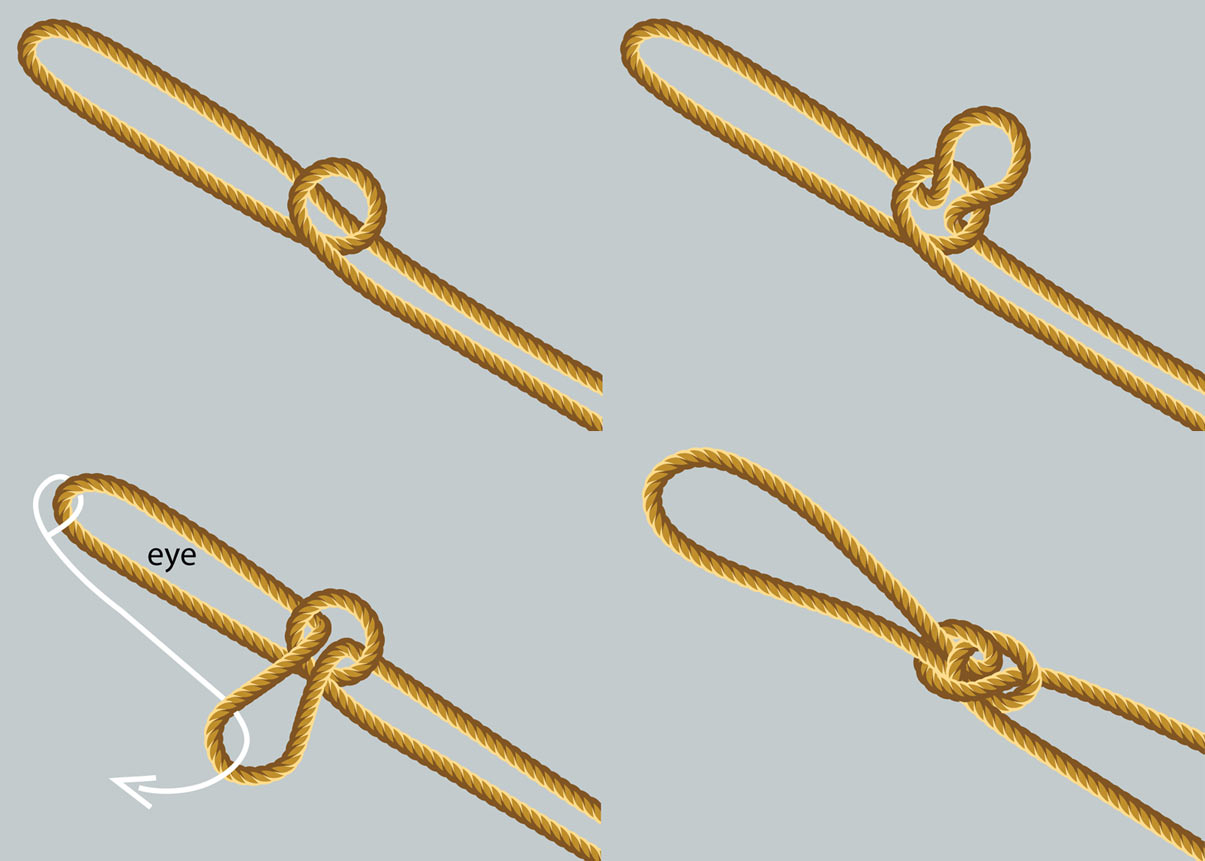
Simple-double-wedged-loop
Simple_Wedged-Loop = the making of
Simple_Double-wedged-loop = making of part 2
Perhaps I am looking at it wrong, however isn’t the single loop version a ‘tugboat’ knot and the double looped version a ‘double dragon’? The double turn version might indeed be able to serve as a middle of the line loop, and I think this has been mooted before.
The creation of an end-to-end loaded eye knot (eg butterfly) that does not jam in its primary loading and in one (preferably both) single end loadings is quite tricky from the trials I have done.
Thanks for the feedback,
I knew it had to be something already done but I missed the source.
agent_smith I assume you have tried the double version; is this an improvement?
mobius none jamming end-to-end loaded eye knot are not rare in this forum, and I think plenty are to be discover in the futur.
Edit; 12;39pm 12 feb
I just had a look at the angler’s loop wiki page.
It is not the same as the one shown here.
Tomorrow I will post some photos in order to compare and evaluate their differences.
Edit 13 feb = Mobius and knotsaver recognize the Tugboat bowline
@agent_smith
Here are the loops;
Top = The angler’s loop
Bottom = The no-named loop Edit 13 feb = Mobius and knotsaver recognize the Tugboat bowline
The differences are clear.
Citing Ashley on the angler’s loop;
“The ANGLER’S Loop has the best lead of any loop and is one
of the best of single loops for the ends of small lines such as fishline,
twine, etc. But as it jams, it is not suitable for rope.”
The loop unknown loop in this thread will not jam; the wedging tail provides enough breaking power to lock the loop.
The angler’s is built to sustain tension in this simple form the other asks for a double wedged as shown in the first post in order to be stable.
Pictures = Comparison
= Minus 28 celsius plus fresh snow this morning
@ knotsaver
Yes thanks for the link and the precision; it is a Tugboat Bowline.
I am surprise to find that this loop deserves the bowline attribute.
My point being that with two wedging turn the whole structure becomes strong, reliable and remains TIB.
The Double Dragon is a nice eye knot in my opinion. Easy to tie TIB and it has survived a few tugs on my rig to my satisfaction, for what that is worth.
For the sake of precision it’s a Tugboat (version) B (the “B” isn’t B as Bowline), it’s different from the Tugboat version A (the Dragon) and from the Tugboat C (the Angler) (as I’ve got it! )
(EDIT: the knot (showed by enhaut) is a mirror image of the Tugboat B at the cited URL)
It should be a Double Tugboat B, the Double Dragon should be a Double Tugboat A (they are different!) (again, as I’ve got it! ).
I ignored the original diagram mistake and used it to tie what I believed was a Double Dragon before my first post comments. Indeed, isn’t the tugboat ‘bowline’ simply a one turn Double Dragon? What is the difference?
Hi mobius,
please look at the
section 13. Perfection Loop (Angler’s Loop, ABOK#1017, ABOK#1035) and Tugboat Bowline (Flying Bowline) of Knots_SingleLoops at
[Edit]
this is the correct url now (18/10/25)
[Edit]
(look at the pictures! the KnotMaker diagram of the Tugboat A is wrong!?).
Follow the path from the Standing End to the Tail and you’ll see the difference!
Using the original (wrong) diagram of the Simple_Double-wedged-loop , the same Simple_Wedged-Loop (Tugboat B) was obtained!
with the torsion of the bight (in the left hand) you obtain an Angler’s Loop,
without the torsion of the bight you obtain a Tugboat B (a Flying Bowline)
(the methods in the videos are for the simple (not double) loop)
The knots comparision would be clearer IMO were the lower
image flipped to show the opposite face --and tail would now
point upwards at the other’s tail (I guess you aligned per tail?).
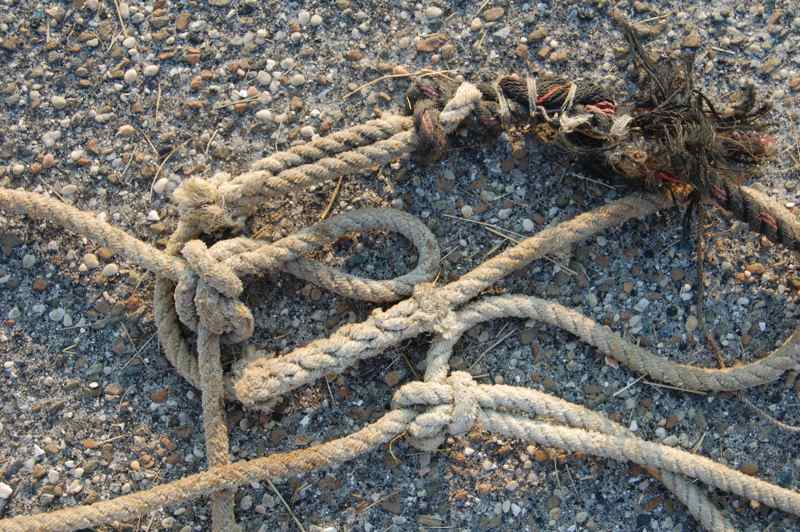
FYI, I’ve found once the perfection/angler’s loop tied in rope
of about half-inch diameter in some boating ropes by a dock,
seemingly used qua mid-line eye knot. (attached)
Yes, and;
My rational was to show the nipping part in the continuation of the SE.
Your finding in the wild is interesting, showing abok# 1017 in the same orientation as in the book.
Some bold boaters have clearly not followed Ashley's recommendation. ;D ;D ;D
 )
)