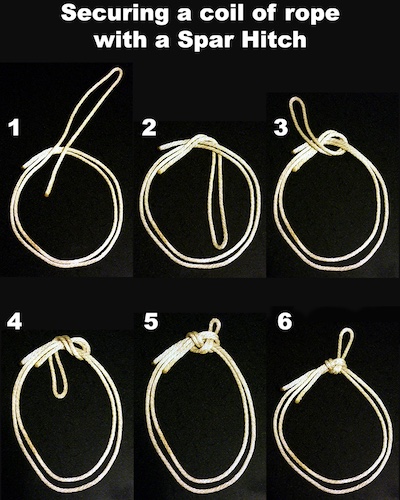
The method of finishing a coil of rope described in this post is one I’ve been using for the past twenty years. It is easy to tie and untie, is secure, leaves the coil in its natural circular shape without constriction of the coil (as is the case, for example, with the figure-of-eight knot method of finishing a coil), and provides a nice loop for hanging the coil
It has some similarities to the sailor’s coil, which finishes the coil of rope with what is essentially a ground-line/picket-line hitch (ABOK #154, #227, and #1243) and which is tied with a single strand of rope. The current knot differs in the following ways from the sailor’s coil: (1) it finishes the coil of rope with what is essentially a spar hitch/miller’s knot (ABOK #1187 and #1244), (2) it is tied with a bight of the free end of the rope rather than a single strand, (3) because of #2, it provides a handy loop with which to hang the coil of rope, and (4) at least in my experience, it is somewhat easier to tie than a sailor’s coil.
My apologies if this method has been described before. I could not find a previous description on the IGKT website, with an internet search, or in Ashley’s Book of Knots (#3083 through #3113 for finishing rope coils.)
But which could as well be tied with a bight
and have the same convenient eye to use.
The reverse groundline h. is arguably (!)
easier to put in, as it is a casting of half-hitch
turns back’n’forth (done opposite to how Ashley
mistakenly shows at #3794-5 (which mistake
should be obvious to any who actually try tying
such a series of run-on binder hitches, done in
many commercial-fishing structures --e.g. binding
head/ground ropes to netting )).
Note also that you have #1242 --not -44-- in structure,
as that end of things is coming out to run aligned with
the coil, and not be perpendicular to that (and so is
essentially a fig.8).
Thank you for the correction about the structure of my knot, which is indeed ABOK #1242, not #1244! ABOK #1242, like the knot I describe in this post, doesn’t have a slipped finish, whereas 1244 does.
I agree with your observation that a ground-line/picket-line hitch tied with a bight is an alternative possibility. I did not go with that technique because I find it a bit more difficult to tie than the spar hitch/reverse ground-line hitch described in this post, whose final pass under the first turn round the coil is in the natural direction that the bight wants to “travel”. Also, I find that the knot resulting from a ground-line/picket-line hitch tied with a bight is somewhat bulkier than the streamlined knot with which the tying method described in this post finishes.
Thank you very much for your comments and insights.
Just to elaborate further on your observation that the current knot is akin to ABOK #1242, not #1244…
Not only does the current knot not finish with a slip, but also it completes the second round turn on the right side of the standing part, as in #1242, not on the left side, as in #1244. Thank you again for that correction.
Note also that you have #1242 --not -44-- in structure
If this is indeed a newly described method of finishing a coil of rope, a name for the knot would be in order.
Ashley described two “Miller’s Knot” variants, Miller’s Knot #1 = ABOK #1241/#388, and Miller’s Knot #2 = ABOK #1242/#389. As Dan Lehman pointed out, the current knot is akin to Miller’s Knot #2 in structure. Miller’s Knot #2 differs from Miller’s Knot #1 only in that the free end of the rope makes its final pass under the first turn in the reverse direction of Miller’s Knot #1.
Therefore, I would like to suggest that the currently described technique be named the “Reverse Miller’s Knot” method of finishing a coil of rope.