A  the very informative site maintained by Gary Storrick :
http://storrick.cnc.net/VerticalDevicesPage/VerticalHome.shtml
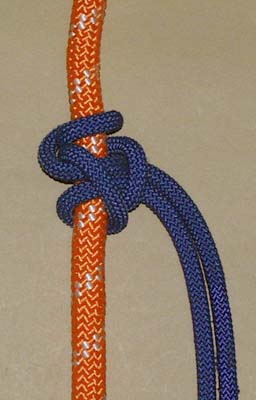
there is the picture, and a short comment, about a climbing knot I was not aware of, named [i]"spong knot"[/i].
http://storrick.cnc.net/VerticalDevicesPage/Ascender/KnotPages/KnotSpong.html
(See attached picture). I think that this knot is quite interesting, and that it can be improved in a number of ways. Does anybody know anything more about it ?
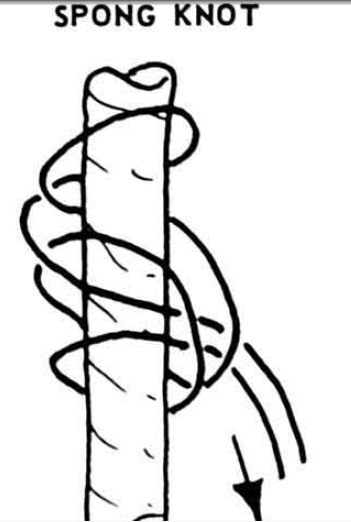
hopefully this drawing can help visualize the knot better and aid in the tying if necessary. It is an interesting knot that can work, though the users of prusik knots (spelunkers here mainly) state that it is unnecessarily difficult to tie. Many, including myself, resort to the basic prusik knot when tired and conditions are tough. But, it is good to know substitutes always.
Sorry, it was not my knot, or picture… When there is an ambiguity, I always post a “front view” and a “back view” picture of the knots I study and present. Thank you SS369.
Well, what was obvious to you was not obvious to me - obviously . Although I had tried many modifications of this knot, I had never seen it as a derivative of a cow hitch ! ( probably because I was thinking of modifications like the one tried on ABoK# 1740, at (1) ). Now , I have tried to do whatever has been done to the “parent” cow hitch on the upper side of the knot, on the lower side as well. It works! A “symmetric spong knot”, possibly easier to tie and inspect than the original one! Due to its simplicity/symmetry, this hitch should well be known already.
The “anti-symmetric” version of the spong knot. This knot, just like the one in the previous post, is also easily inspected, and it works very well. ( No wonder, of course : see the functional similarity with the “ww” hitch, at (1) ). We can load/pull any one of the two (horizontal, orange) free ends, or both. All three ways seem to achieve adequate gripping power on the (vertical, white) main line, but I do not know which is better.
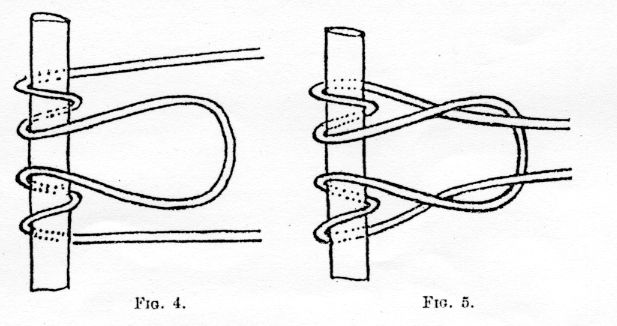
SS369 shows the picture of the Spong from the May 1967 NSS News. Here is the picture from Prusiking which shows how it is tied. The Spong Knot grips around its own sling, which reduces the gripping force on the main rope and makes the sling hard to loosen.
I have not figured out how to attach more than one picture to a message. The Symmetric Spong Knot posted by Xarax resembles the Gerard Hitch more than it resembles a Spong Knot. This is from the 1929 Alpine Journal.
Thank you Bob Thurn,
I wonder where do you find all those magazine texts and fine pictures from the Great-War, grand-mother era !
The two knots I have posted, as simple modifications of the spong knot, have something that is missing in the “Gerard hitch”. They involve crossings - “cross garterings” ( of the coils on the main line, which is something resembling the “ww friction hitch”, rather than the prussik hitch. It is an essential element of the parent spong knot, too. We have been discussing this the other day (1). Of course, only experiments will show us which of the two methods, the prussik-like way or the ww hitch way, offers the better grip on the main line.
 When there is an ambiguity, I always post a “front view” and a “back view” picture of the knots I study and present. Thank you SS369.