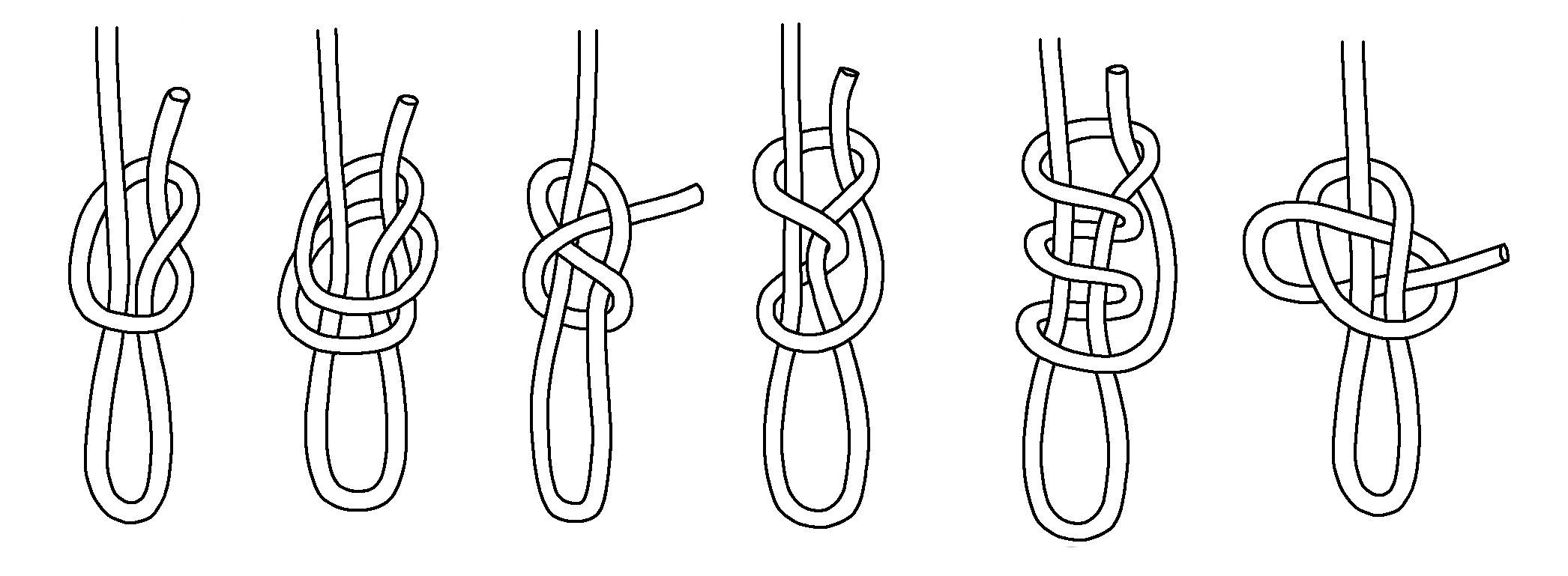
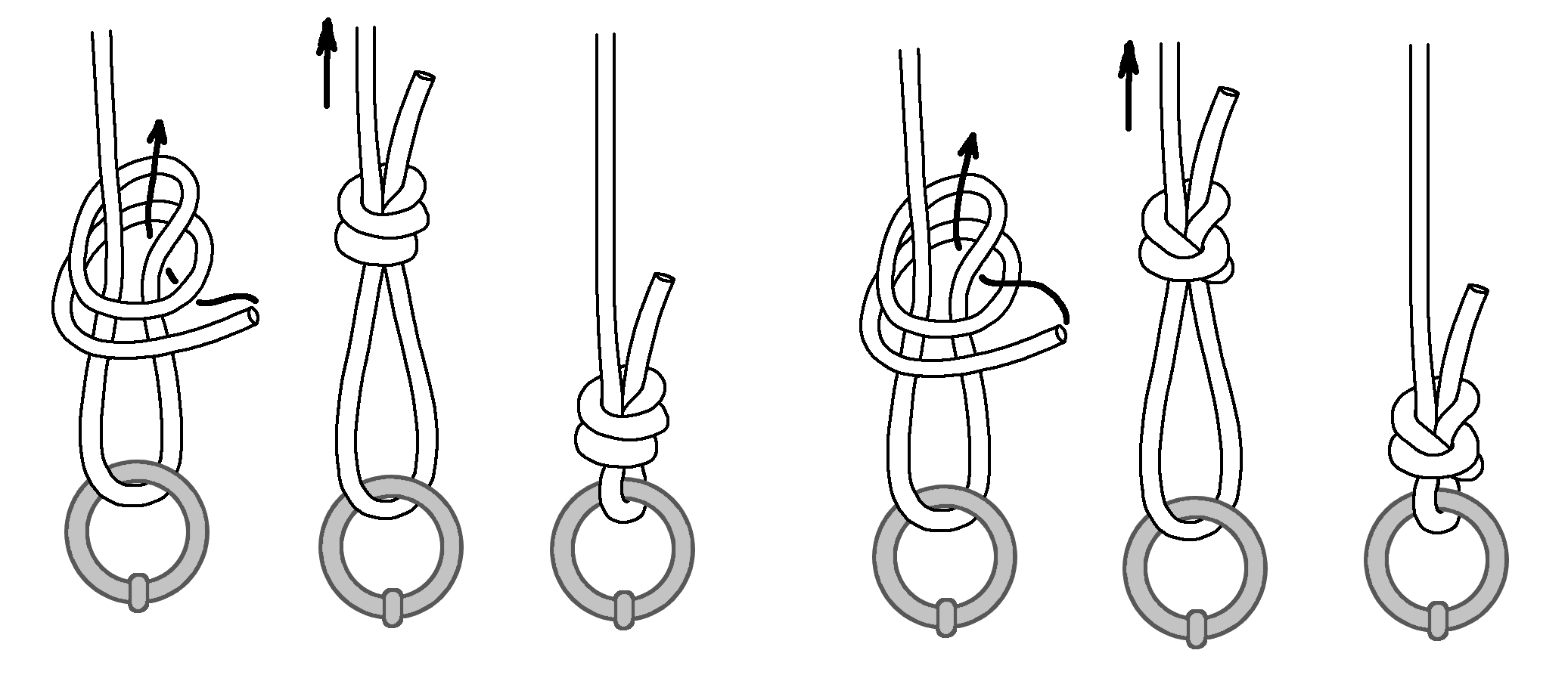
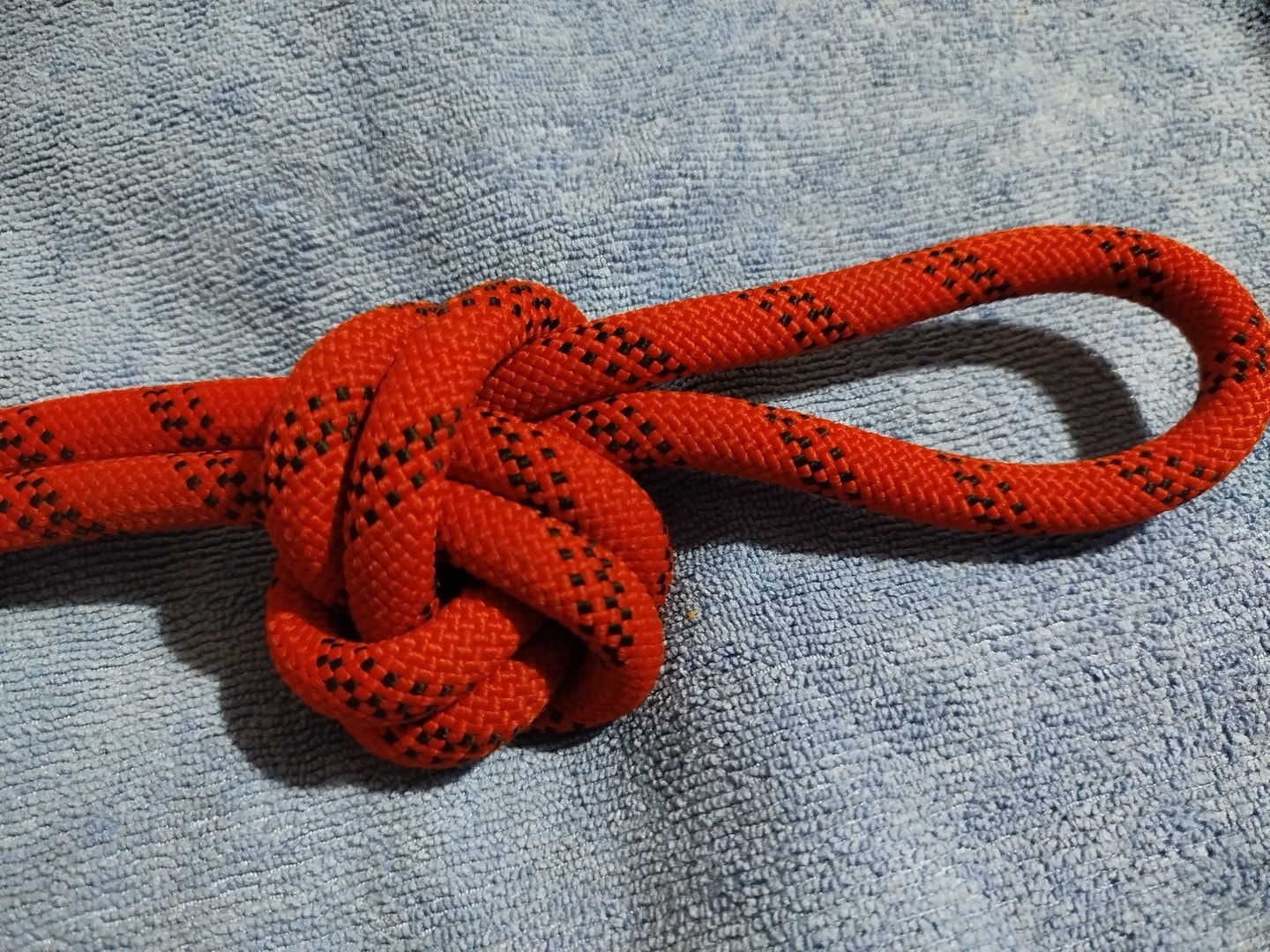
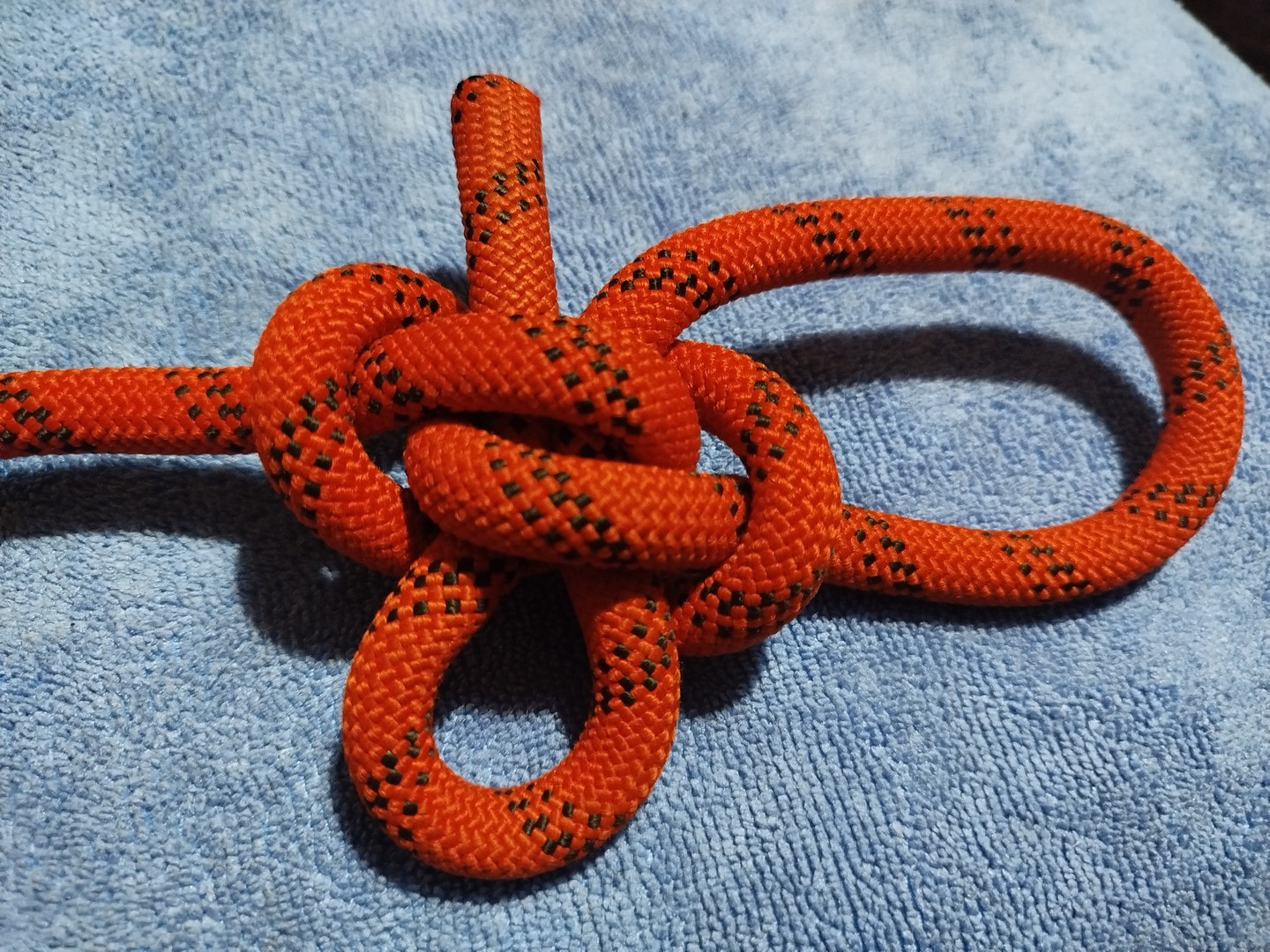
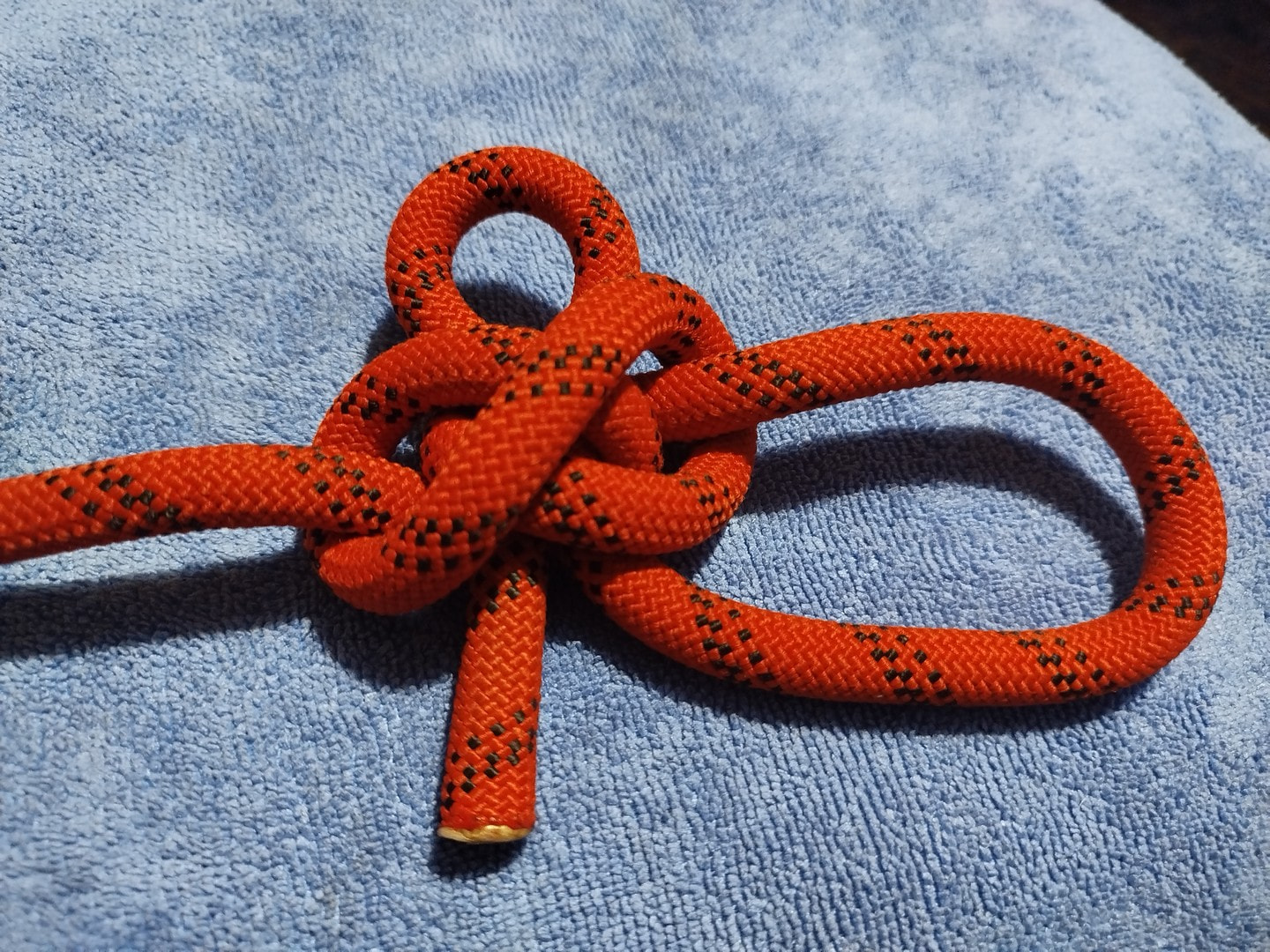
Ahhh, now you’re scoring! This has long been one of my
favorite EKs, though with the REL-Tail part making only
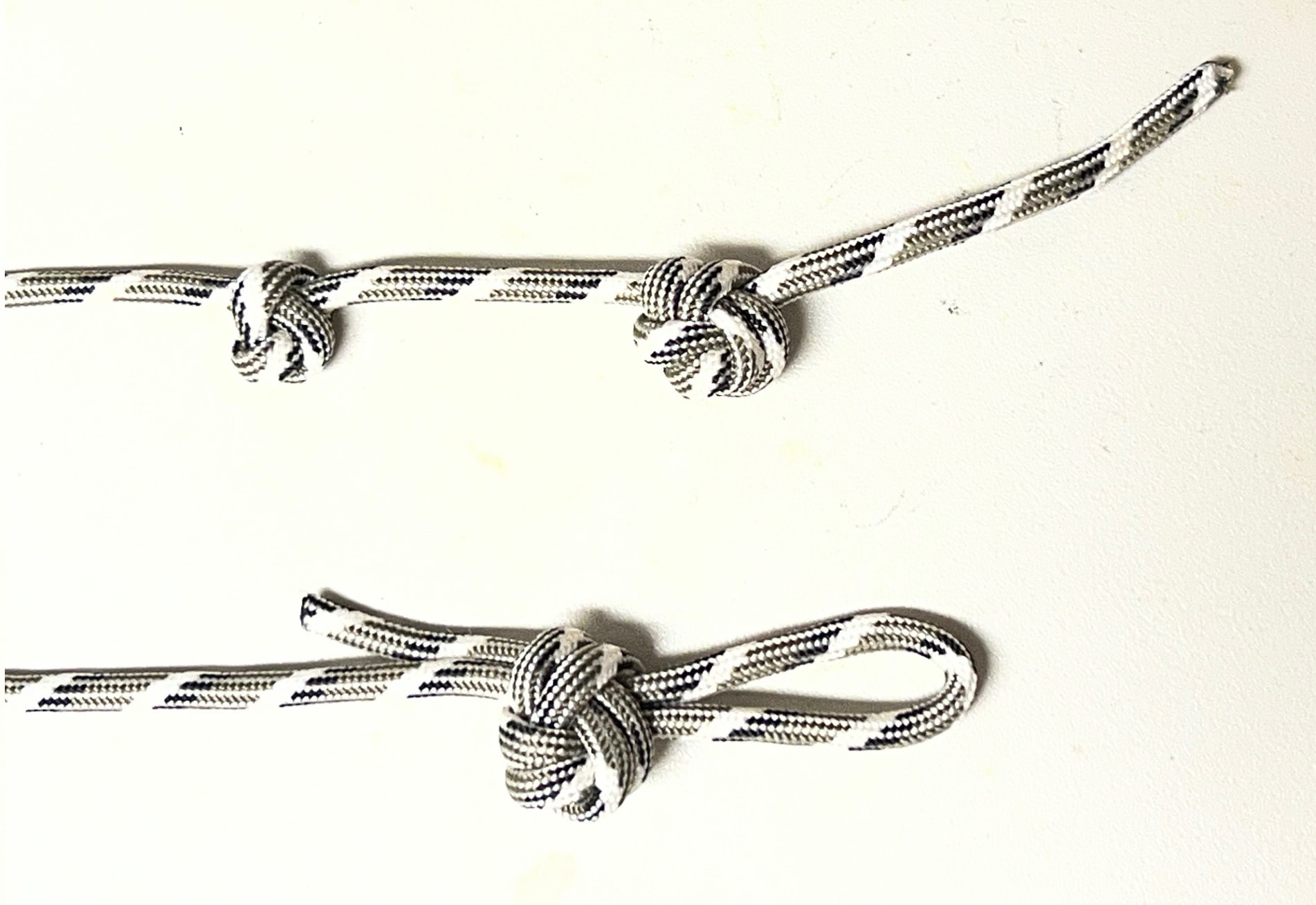
the OH part of the tracing journey, 'a la #1425. (The stopper
is Ashley’s #525.)
The EK is NSE, and one can put the Tail (2 B…) in either
of 3 places before taking the working U-fold
around to form the EK. Although I’ve not well tested it,
likely one of those positions & consequent twinning of the
knot will work better than the others for MID-line loading
–i.e., "through (e2e) loading & tail-loading.
I had this knot (one of the versions) tested in urethane-coated(?)
Samson blue 12-strand HMPE (not sure if it was Dyneema SK-60
or -75). THERE --in that slick, static stuff–, the knot did somewhat
jam --the material flows tension! That said, I think that in many
common ropes, it’ll work fine. It takes some bit of working
to loosen after loading, but … it does loosen. And otherwise,
though not set super tight, it resists slack-loosening.
And it’s good for bungee/shock cord in that --so far as I’ve
seen, in 5-6mm such cord-- it pulls and elongates the S.Part
but not tightening so much the rest of the knot, and thus
the S.Part easily returns to un-stretched state (vs. the knot
holding some tensioned part thereafter, which e.g. Angler’s
Loop might do).
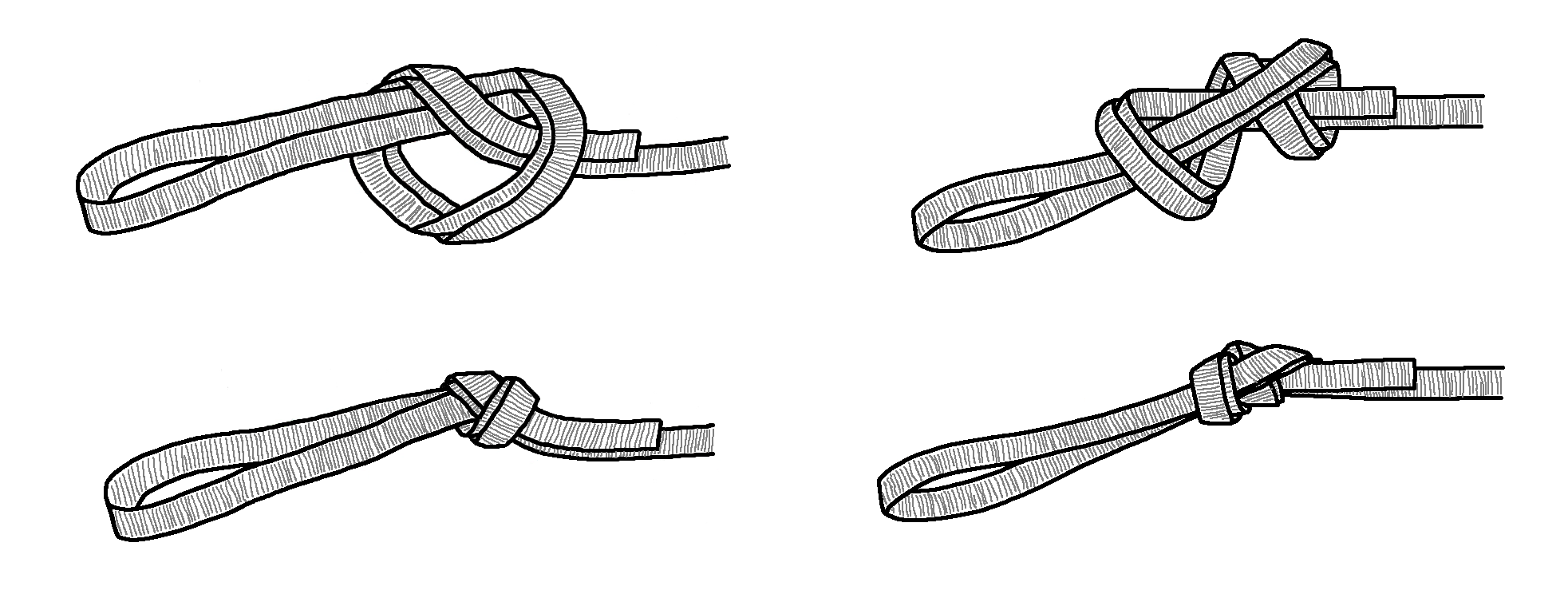
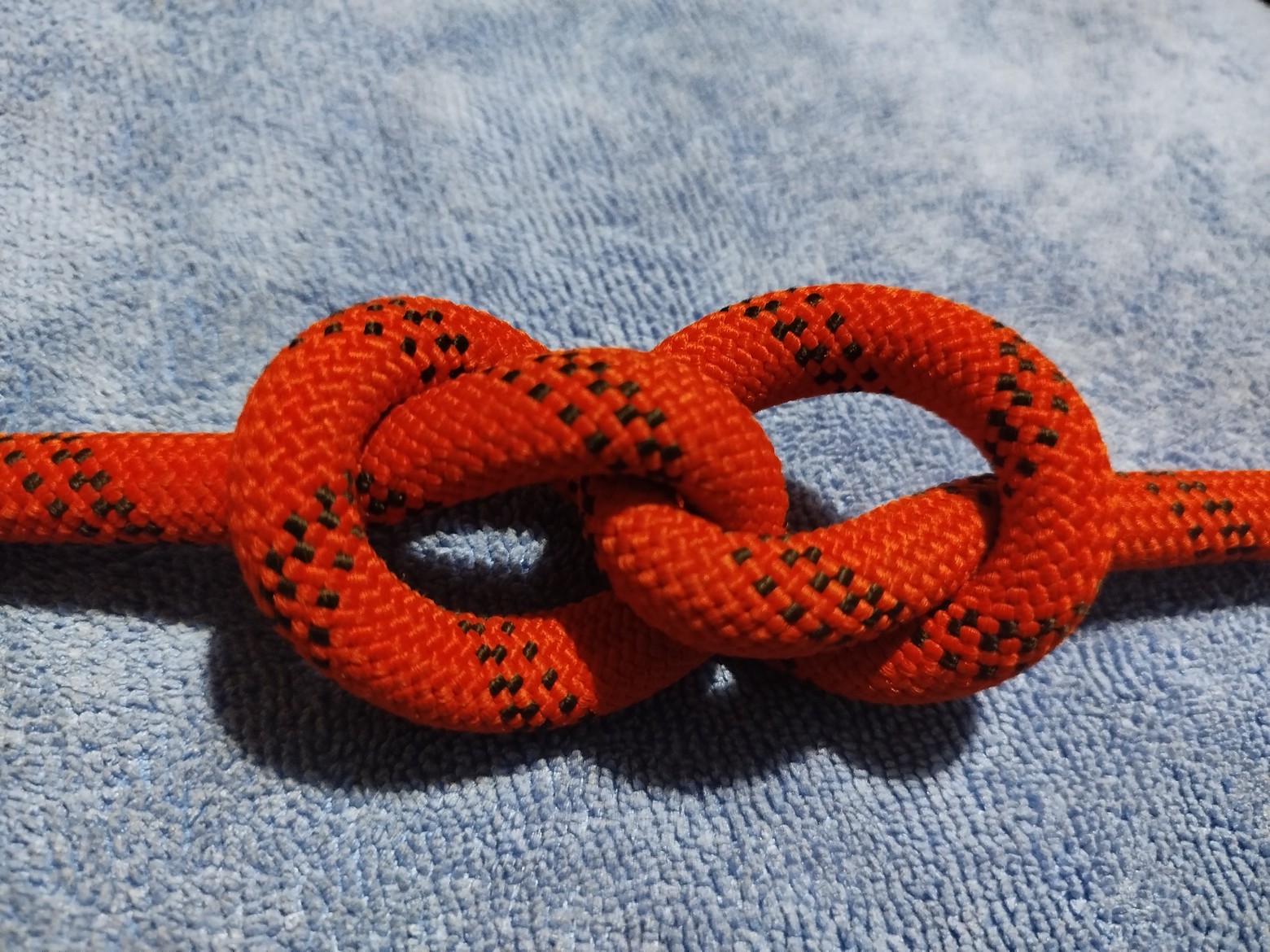
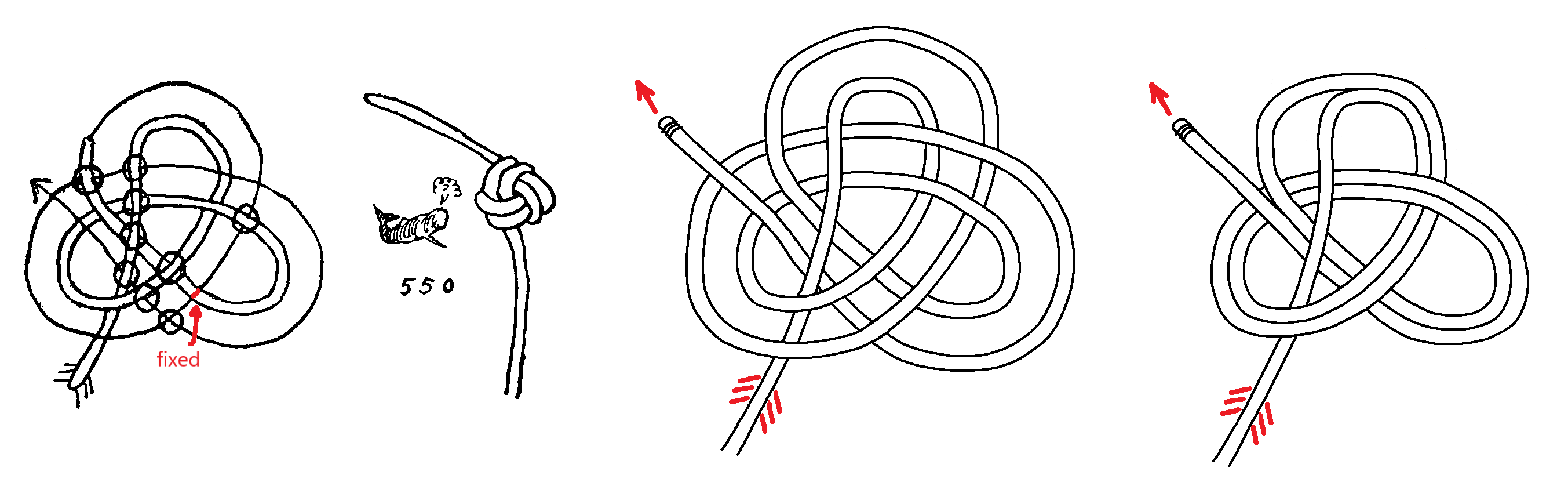
There is yet another formation of the Fig.9 :: just look at the
mid-flype, PRETZEL state of the Fig.8, and give the two
ends another twist --an alteration one can repeat and so
do Fig.10,Fig.11, … Fig.N,
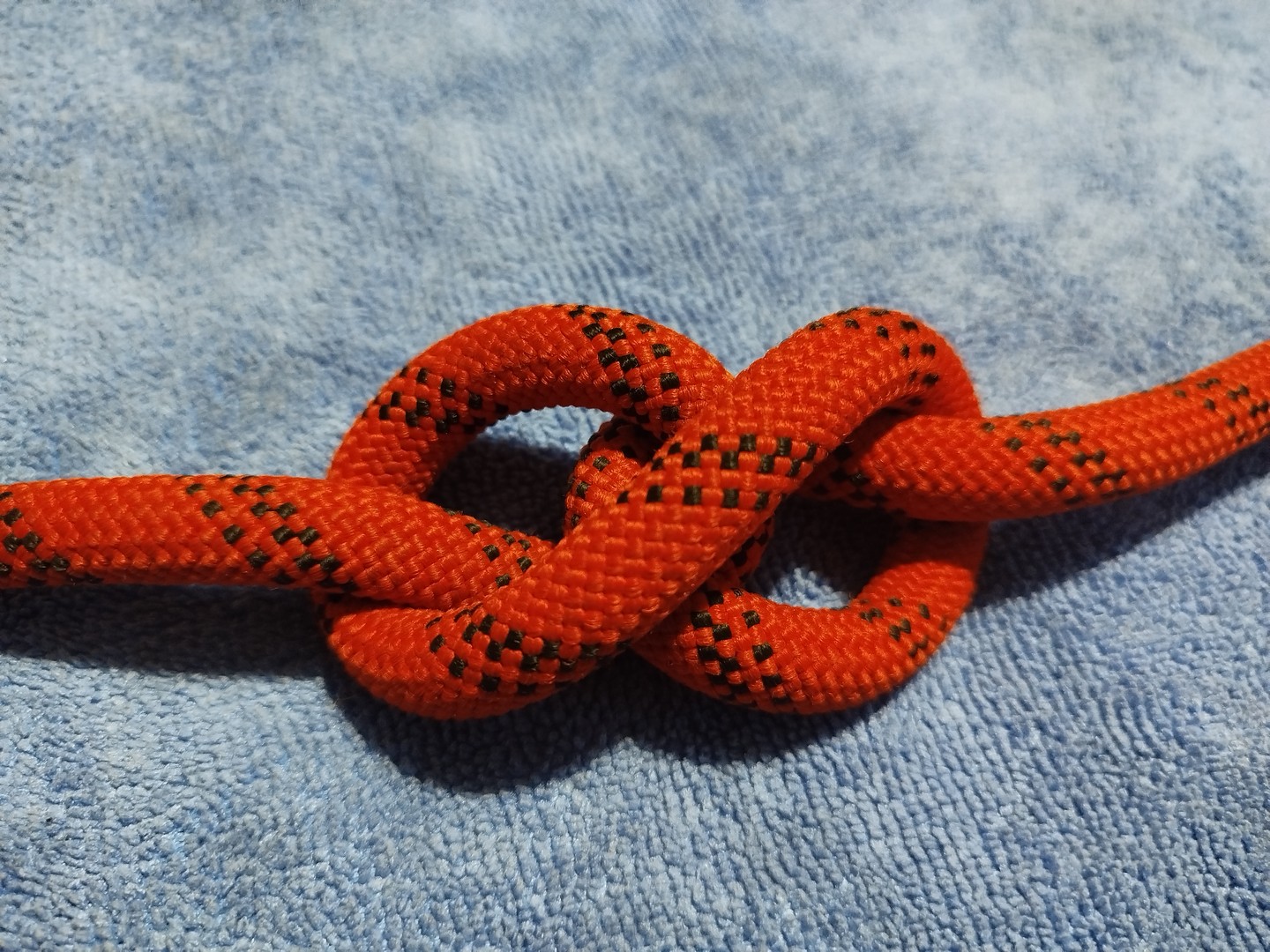
just as the familiar Fig.9 in near-Stevedore-stopper form
can be given another (half-)twist and so on, for also getting
“Fig.10/Stevedore, Fig.11, Fig.12 .. Fig.N”.
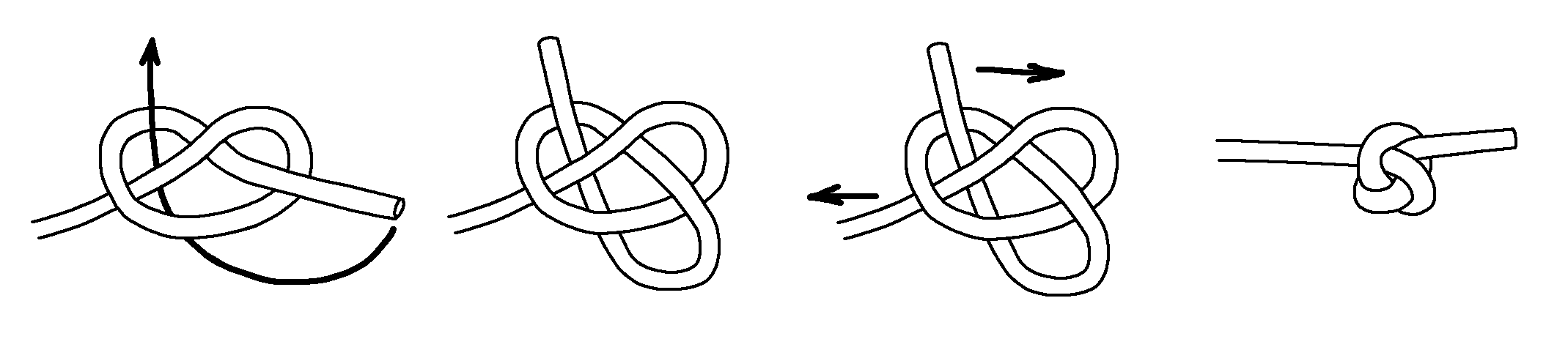
(Another method of conversion :: see the conventional form
–that straight S.Part making a loop and then wrapping itself
down the shaft until reaching up to tuck out through the loop–
as a dancer holding up one leg high through joined arms
(the loop, these), then pulling down the leg still w/arms
around, and evening out the wrapping around S.Part to
be equal “twsiting” of these two parts.)
THIS form itself doesn’t seem to be much help, practically,
but for the F9 & F10 (maybe not so much/well beyond these)
the starting center twists can be, um, rolled/pealed back
down around and --w/care to keep things from going amuck,
which they might want to do-- the knot(s) can be set tight
and take both a high load (500# in 10mm Slim Gym dynamic
kernmantle) in end-2-end loading OR qua stopper (I’ve
recently used one jammed to my pulley hook in stressing
some other knots).
I’m currently trying to see how THIS presented-above
form gets similar Fig.10-11-..N extensions; what I’ve done
so far isn’t convincing me I’m doing a proper continuation
of a series vs. just coming up with some other geometry
that the general/math knot can get. [argh]
I think that this “what I’ve call 'Semi-Symmetric Fig.9”
–where I’d seen “semi” denoting that only-to-OH part
not full ‘9’–, a dubious naming, I admit. Maybe easier
to see e2e Joint #1425 making one tail do bit of further
reeving so to run out parallel to the opposing S.Part
with which it fuses to make an EK.
Well, calling “Fig.9” we can see from above varieties
of geometry as itself being less than perspicuous.
[sigh]
–dl*
==== *
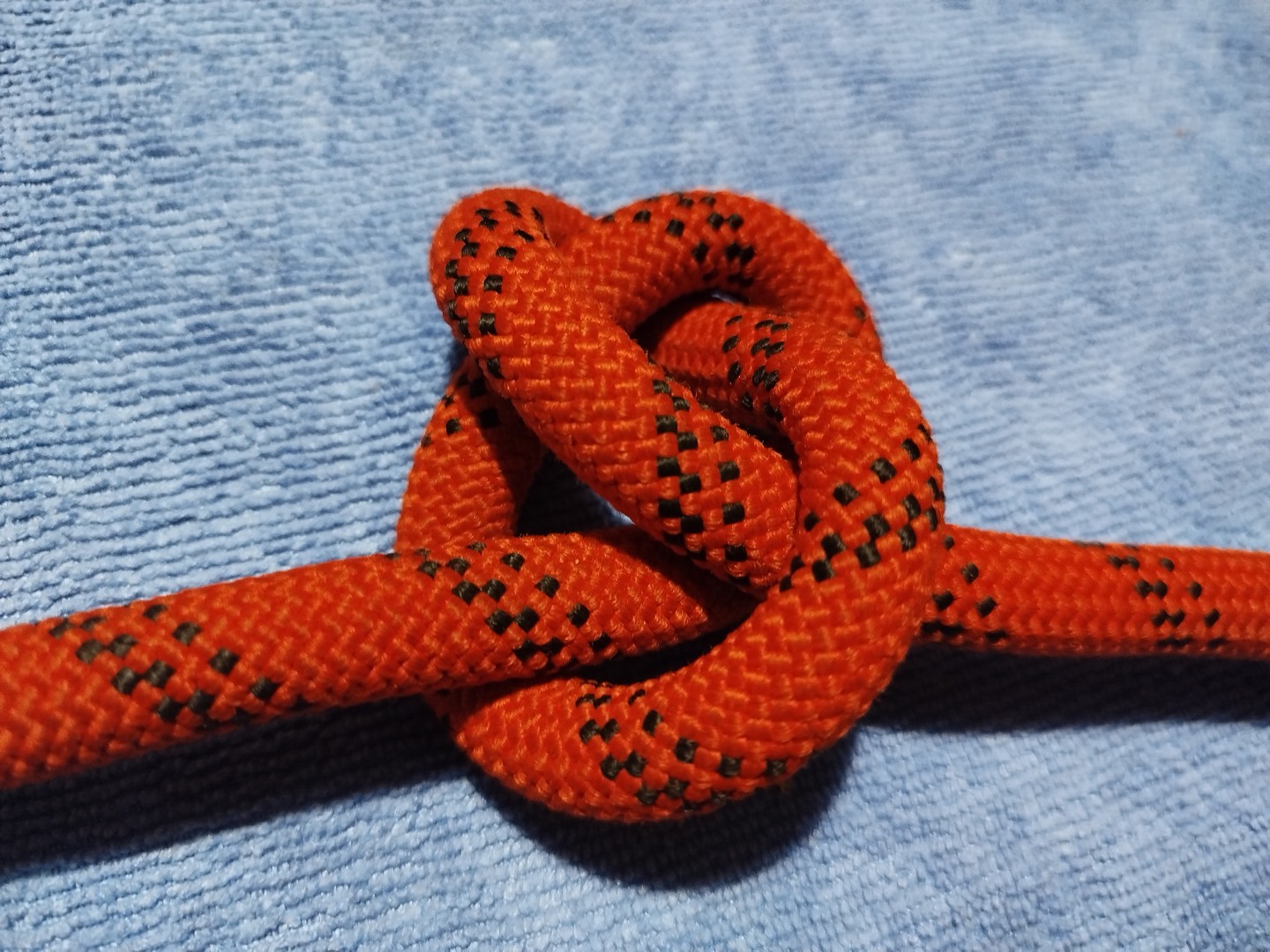
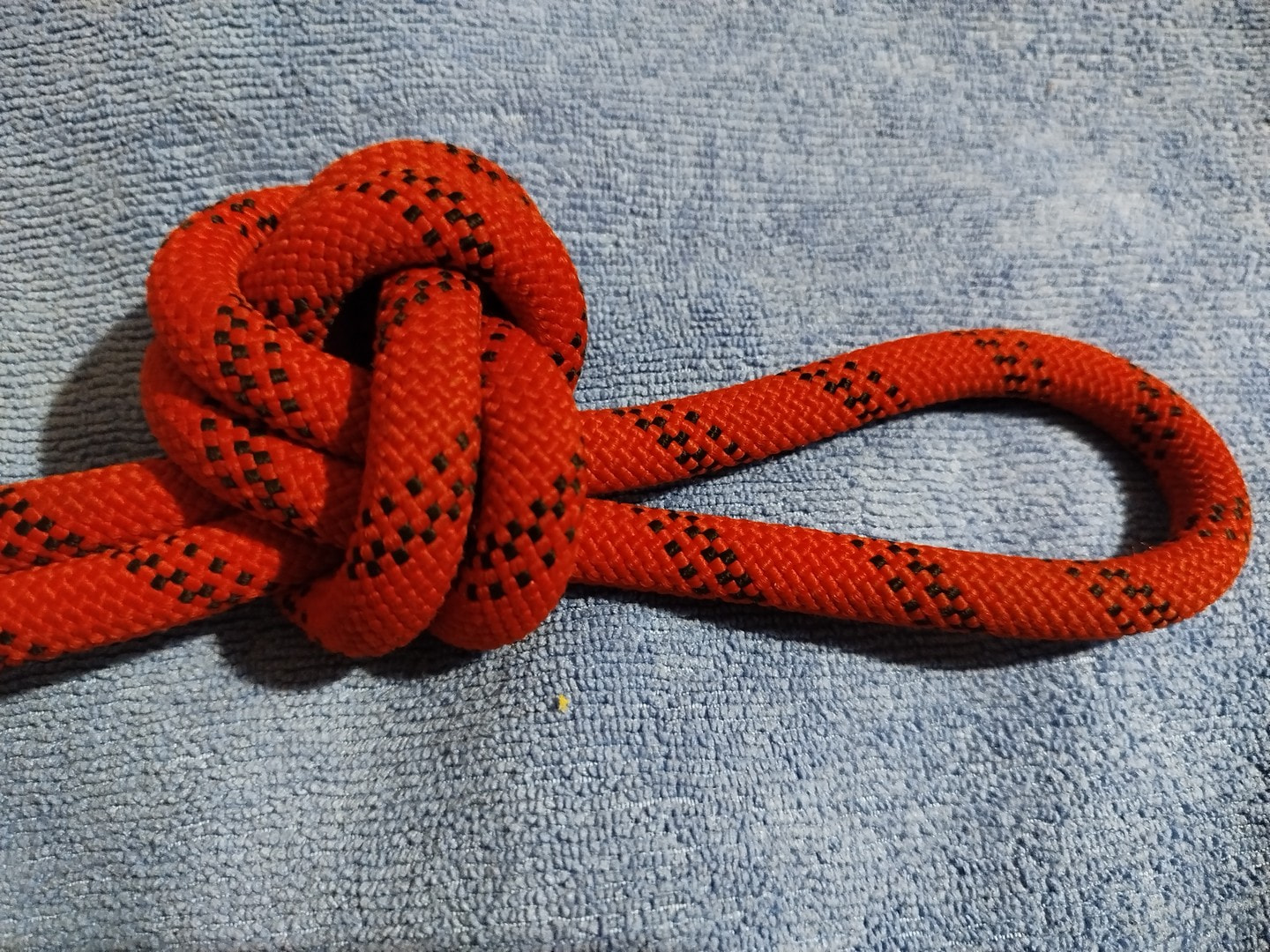



 ) but try to imagine a knot with a closed form nipping structure, that would go unblocked right up to the rupture point, what bwl would defeat that?