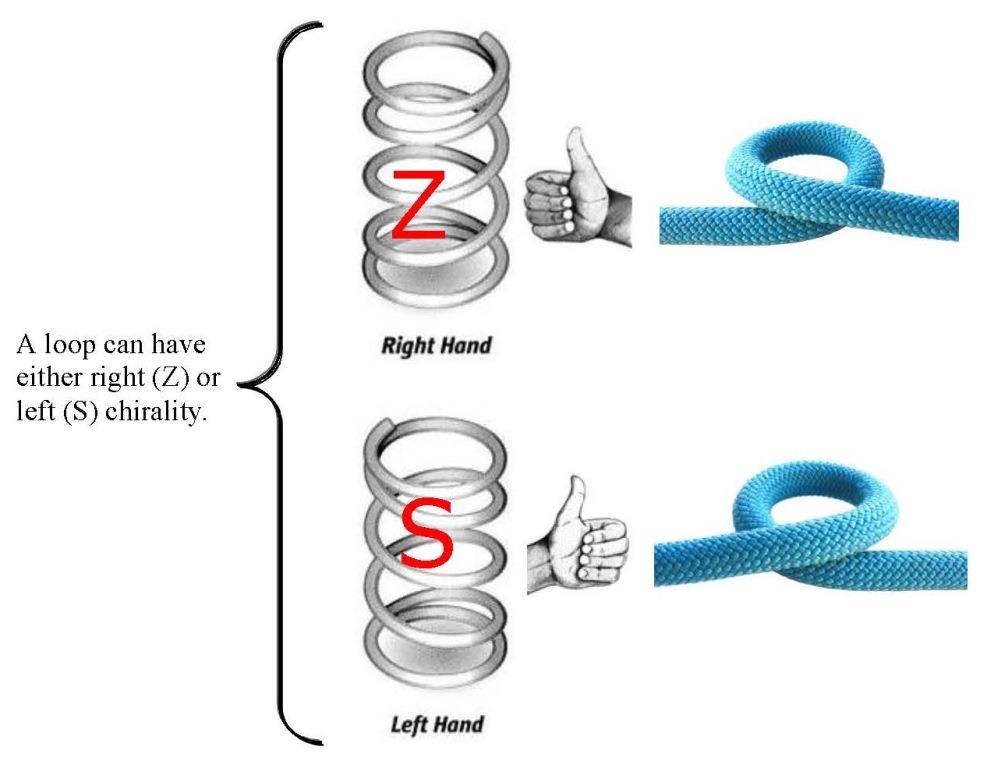
I am no expert, but it would seem that direction of rotation would be hard to determine with that small diagram, since you don’t know the reference point. Are you supposed to be looking from the back or front of the knot? Is the knot supposed to be upside down with the loop at the top?
I am reminded of sheep herding, where one does not give “right” or “left” commands but clockwise or counterclockwise rotation with the reference point of the dog facing the sheep. (and ‘walk up’ and ‘get out’ for towards and away from the sheep) Depending on the position, left to the handler might be clockwise or counterclockwise. If one was looking from the ground upwards, the direction or rotation would be reversed.
Similarily, chirality has to have a x, y, and z axis, and if you are looking from the negative z to the positive z direction, rotation will be opposite from looking from the positive to negative z direction. So you need a reference point. I would think it would be from a directional curve from what has been tied to what additional wraps are being created (in 3D, ordered numbering of points along a curve). I know how it is defined in organic chemistry for four ordered atoms, but I think chirality just would be confusing to someone trying to learn to tie a knot. Why not just define directions from the perspective of the person tying the knot looking downwards?
Here is the same diagram (but reversed based on Mr. Lehman’s comment) looked at from the bottom, top, front, and back (I did not change the labels, so they are either all correct or all incorrect). I think this would be confusing.
I would comment that chirality is the logical way to describe a loop.
A loop will be either S or Z chirality (ie handedness).
It is like your left hand and your right hand…in that your right hand will always be your right hand - you cant flip your hand over and turn it magically into a ‘left’ hand.
Same goes with gloves - one will always be ‘left’ and the other ‘right’.
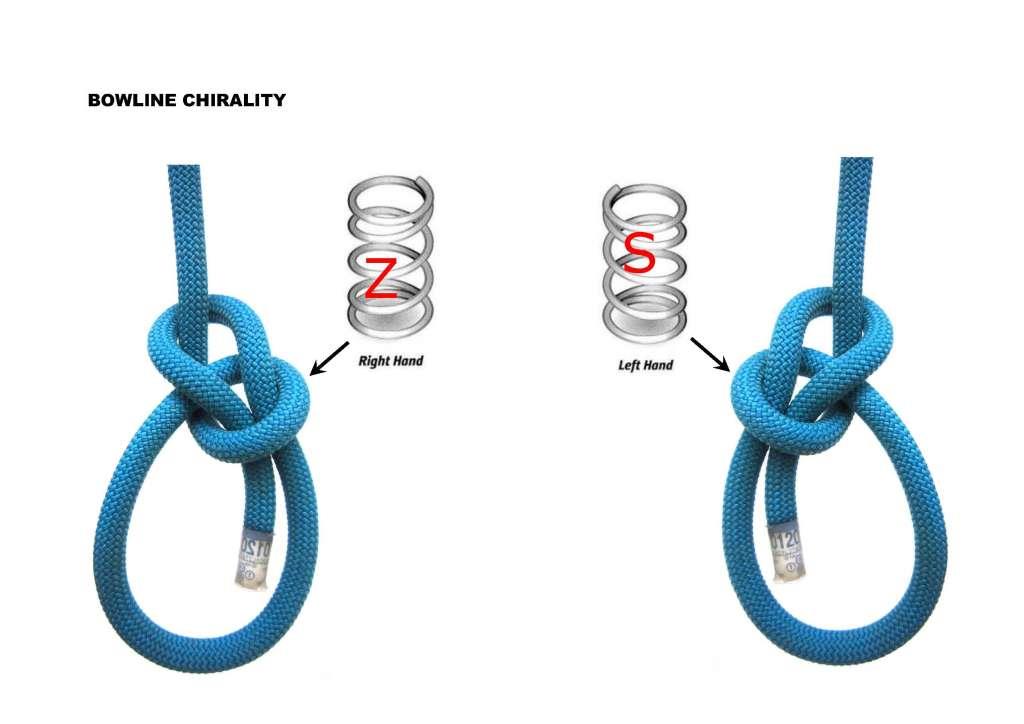
Bowlines are another example of where chirality plays a role (see attached images).
I have attached some images to explain.
I think if you are writing or presenting a technical paper on knots - the concept of chirality should feature in your explanation!
EDIT NOTE: Yes - your images in red are all reversed…the S should be Z; and the Z should be S.
It shouldn’t be confusing…a quick rule of thumb is to apply what I refer to as the ‘right hand rule’ (same as it applies to direction of magnetic fields in physics).
If you hold your hand hand in front of you - point your thumb up - then curl your fingers. This will create a right chirality twist.
You can apply the right hand rule to any loop - it is universal in its application.
When applying the right hand rule, if loop doesn’t match the curl of your fingers, then it must be the opposite chirality (ie left).
A loop is always one or the other…it cant be both!
I see what you mean based on your diagram. The figure in the article would be confusing, as the loop is actually going downward despite the free end being shown lower. It is one of the reasons I think 3D diagrams are a lot more helpful than a figure from Illustrator or equivalent.
It really shouldn’t be confusing…but, yes - if the image is not clear, then it may be hard to ascertain the chirality.
That’s more of an accuracy issue… in that the illustrator needs to take care when drawing the knot structure…
I’ve added an image of the Constrictor hitch to show how chirality plays a role.
A Constrictor can only be built from 2 loops that have the same chirality.
You may be right that it is an important concept that I should include in my book, since I emphasize the benefits of a granny noose over a square knot noose. The Granny would have the same chirality of both loops, whereas the square knot noose has reversed chirality. The physics principle would be that reversed chirality would be additive for frictional force, whereas same chirality is exponential (based on the Capstan equation).
You definitely should address the concept of chirality in your book - without which, your book would not be authoritative.
It would be instructive to introduce the Constrictor hitch to your readers, showing both S/S and Z/Z chirality forms.
Also, I would recommend that you carefully define what a ‘turn’ is.
Xarax has done a lot of work on hitches - it may be worthwhile to run some of your ideas past him.
He has devoted much of his time and energy to discovering and exploring a vast array of hitches.
Xarax convinced me to be careful when describing a ‘turn’.
At the very least, use terms such as:
U turn = 180 degrees (Pi radians - 3.1415926 radians)
Turn = 360 degrees or 2 Pi radians
Round turn = 540 degrees or 3 Pi radians (9.42478 Pi radians)
And the term ‘riding turn’ should also be defined - as it plays an important role in how hitches work.
Sounds like you have a good handle on the capstan effect and capstan equation.
Regarding creating a slip knot within a slip knot: there is a surgical knot that is used to end a continuous suture that does that. It is called the Aberdeen knot. It is like crocheting.
Looking at the images in that paper - it appears to be constructed from 2 inter-linked #206 Crossing hitches (aka Munter hitches).
Interesting concept.
In a way, yes :: the “way” is the direction of the turn at the (first) deviation from straight. Look at your bowline examples : IFF you continue the nipping
loop’s SPart-first turn into a helix, it runs off to the right,
“Z”-like. OTOH, if you form the nipping loop and then
rotate some nipped object within it so as to render the
nipping loop into a pure helix, … left-/S-handed.
.:. IMO, the greater significance (i.p., for laid rope)
is the initial turn, not what follows.
Perhaps the better case to address is that of a rolling hitch,
where the direction shows so well & repeatedly in its
coils, contrasting with its initial turn.