I recently came across this knot named after its creator, Sylvain Berger from IGKT France, quite similar to a bowline but said to be 10 ~ 15% more resistant and less prone to get untied in shaky and loose conditions like a flapping jib. I tried to search here and in other forums for more informations, e.g. if it is known under a different name or what are the feedback from people using it but it seems it is rather unknown outside of France.
Salut Antoine d’apres mes recherches non exhaustive sur internet j’ai trouver quelques réferences en anglais mais sans plus.
Donc je croit que le noeud de sylvain est principalement d’origine française.
Charles.
Hi Antoine, based on my (admittedly incomplete) internet research, I found a few references in English, but nothing more.
So I believe the Sylvain knot is primarily of French origin.
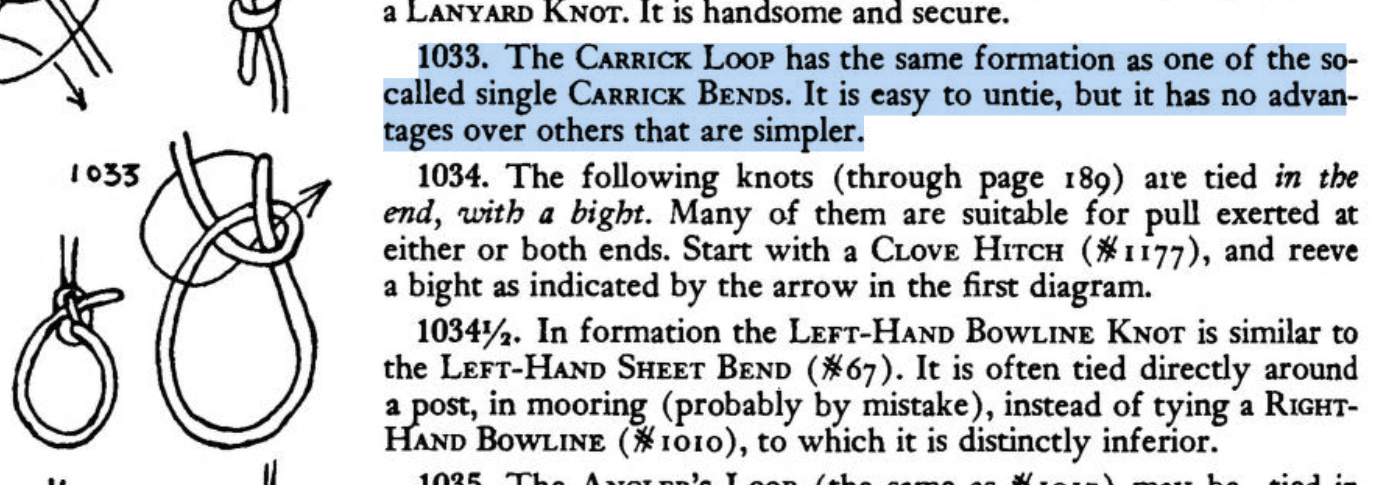
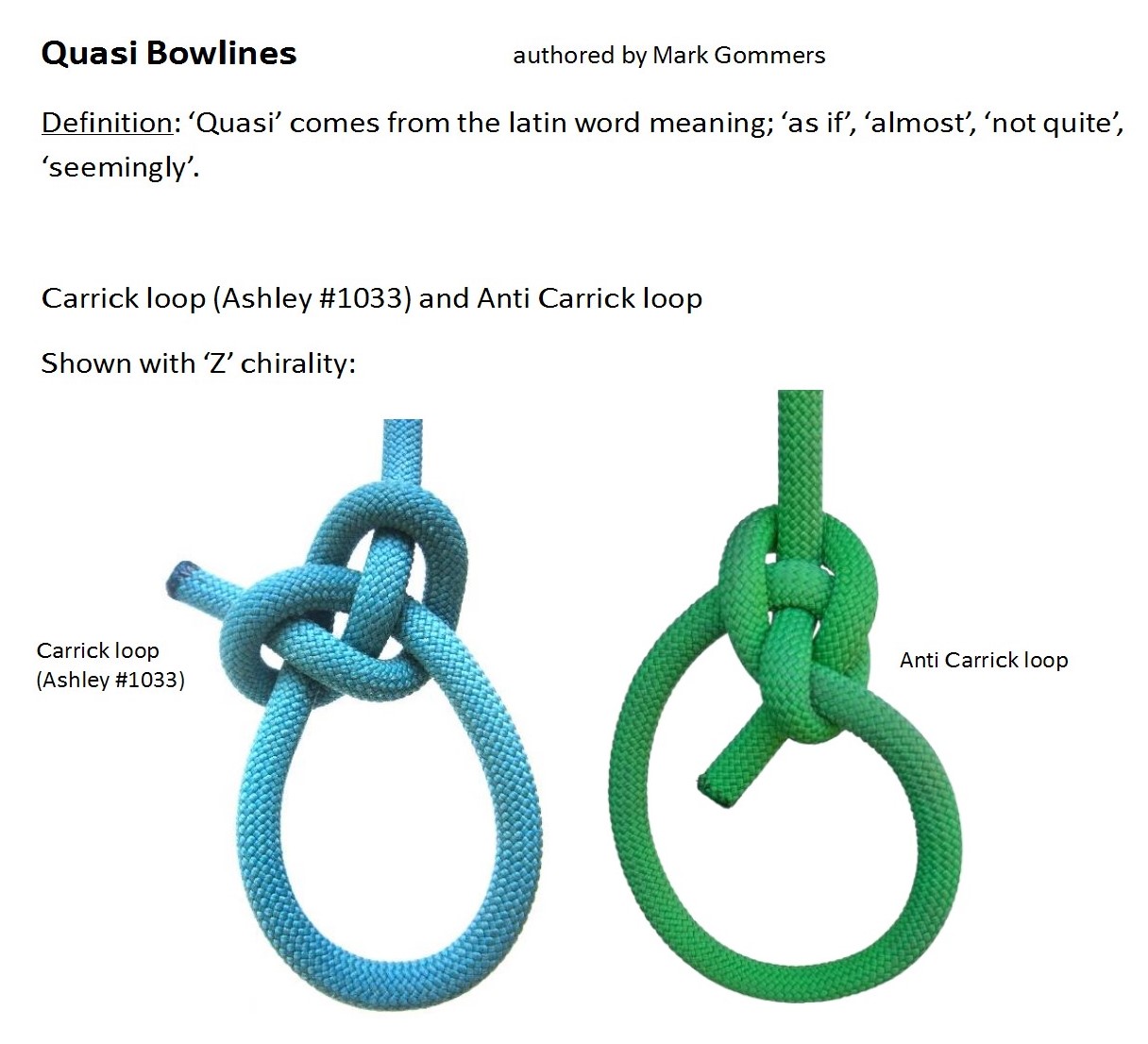
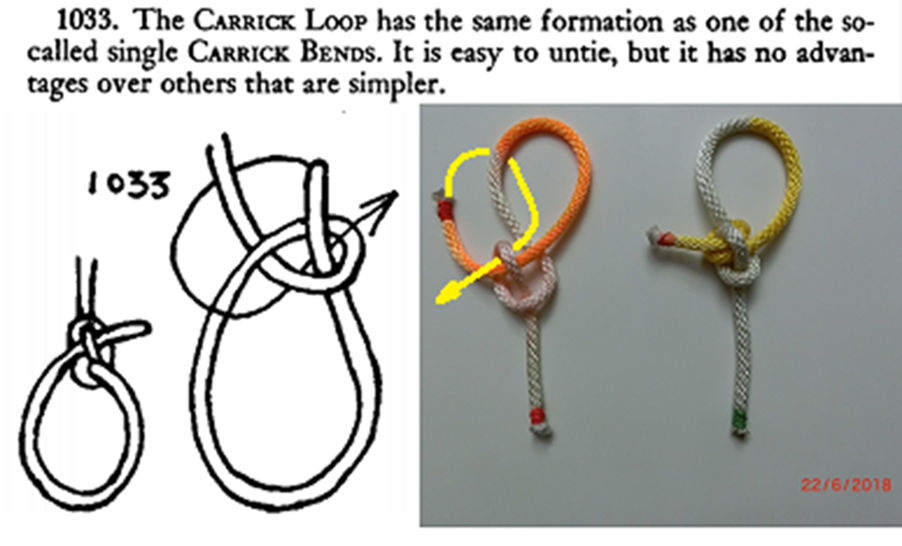
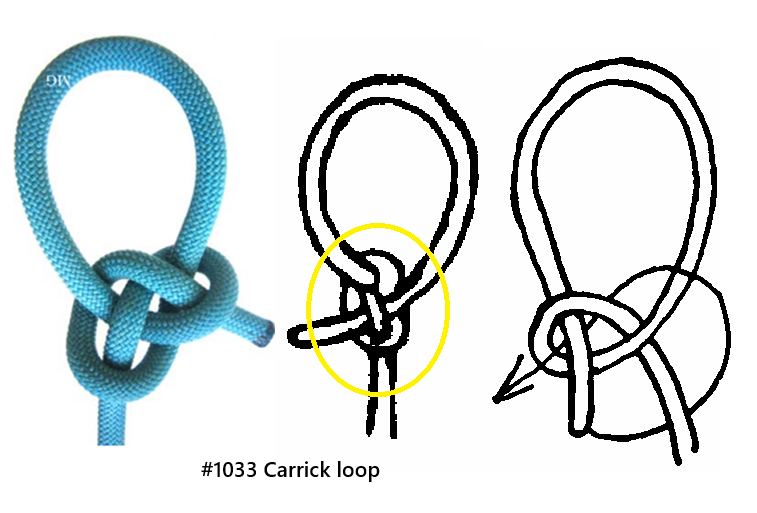
According to the video embedded by Charles I believe this one fits into the Carrick, Abok#1033, group of variants, eight in total.
More specifically, Carricks feature two states, one with a simple nipping loop, and the other with a crossing knot nipping structure, and the latter comes from the former with just capsizing the Carrick collar.
Similarly, the nipping loop state comes from the crossing knot state by capsizing the returning loop.
Doing so in this paradigm, it appears that the nipping loop is stabilised in an Eskimo-Carrick-like fashion in a pattern under,over,under,over,under.
In other words, this knot is an anti-carrick, transformed into its crossing knot state.
These profiles are generally known to the majority of the knotting community, mainly for their resistance to jamming right up to the MBS yield point.
Can it actually dethrone the standard 1010 bowline?
After messing around a bit with the Sylvain knot and others knot of the same familly i thnik you just about right @kost_greg.
The Sylvain knot as the holding power of the angler’s loop ashley #1035 and yet it is easy to untie even after a load as been apply to it like the Carrick loop ashley #1033.
So i think that the Sylvain knot is a hybrid knot between the angler loop and the carrick loop.
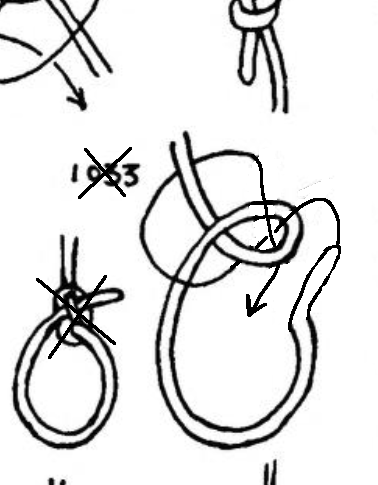
I have been playing a bit with the Carrick loop and the Sylvain’s knot is almost the same… the difference is that the running end is doing the final loop in exactly the opposite order (and that you have to capsize a bit the knot before tightening it). I tried to draw over the Abok diagram, not sure if this is clear.
I also watched Alan’s video. From what I understood, the right knot is the same than the Sylvain’s one. And the left one is almost the same, the only difference is the way the running part is inserted to make the last locking loop, by doing it on the loose loop side instead of the standing part side. But I may have missed something.
The test ended at 1120 kg, but is it because the knots were about to break ? or you did not want to damage your line ? It also seem it was a bit hard to untie.
Yes Totozero, it is clear and quite right, if your intention was to represent Sylvain’s knot in its mirror form as shown in Abok .
From what I understood, the right knot is the same than the Sylvain’s one. And the left one is almost the same, the only difference is the way the running part is inserted to make the last locking loop, by doing it on the loose loop side instead of the standing part side. But I may have missed something.
Indeed, Alan performs the test using slightly different loopknots, and the difference lies in the polarity of the returning loop.The right knot (Sylvain) encompasses a Z loop, with the tail located under the first inserted returning line, while the left knot encompasses an S loop, with the tail located over the first returning line(note that i made a previous reference about eight profiles in total).
The test ended at 1120 kg, but is it because the knots were about to break ? or you did not want to damage your line ? It also seem it was a bit hard to untie.
The knots were not about to break, that would occur right about 2266 kg, 65% of MBS, but you were quite accurate to notice that the right knot was actually a bit more challenging to untie.
So, for what reason the left knot appears to be more releasable than the right knot?Is it because the left is eyeloaded while the right(sylvain) is SP loaded?Or maybe the Sylvain’s topology which places the running end under the returning line, causes heavy core constriction?
If the experiment was to be repeated with the line just reversed with no other change, perhaps i would be able to answer these questions, but i would certainly ask for Alan’s opinion, who’s very experienced with such stress tests.
The knot posted by ‘TotoZero’ (so called Sylvain’s knot) is simply another re-discovery of something long known and already in existence. Re-discoveries occur all the time, and indeed, the existence of the IGKT owes itself to a re-discovery of the ‘Riggers bend’ (aka Hunters bend) which had been presented by Phil D Smith in his ‘Knots for Mountaineering’ book.
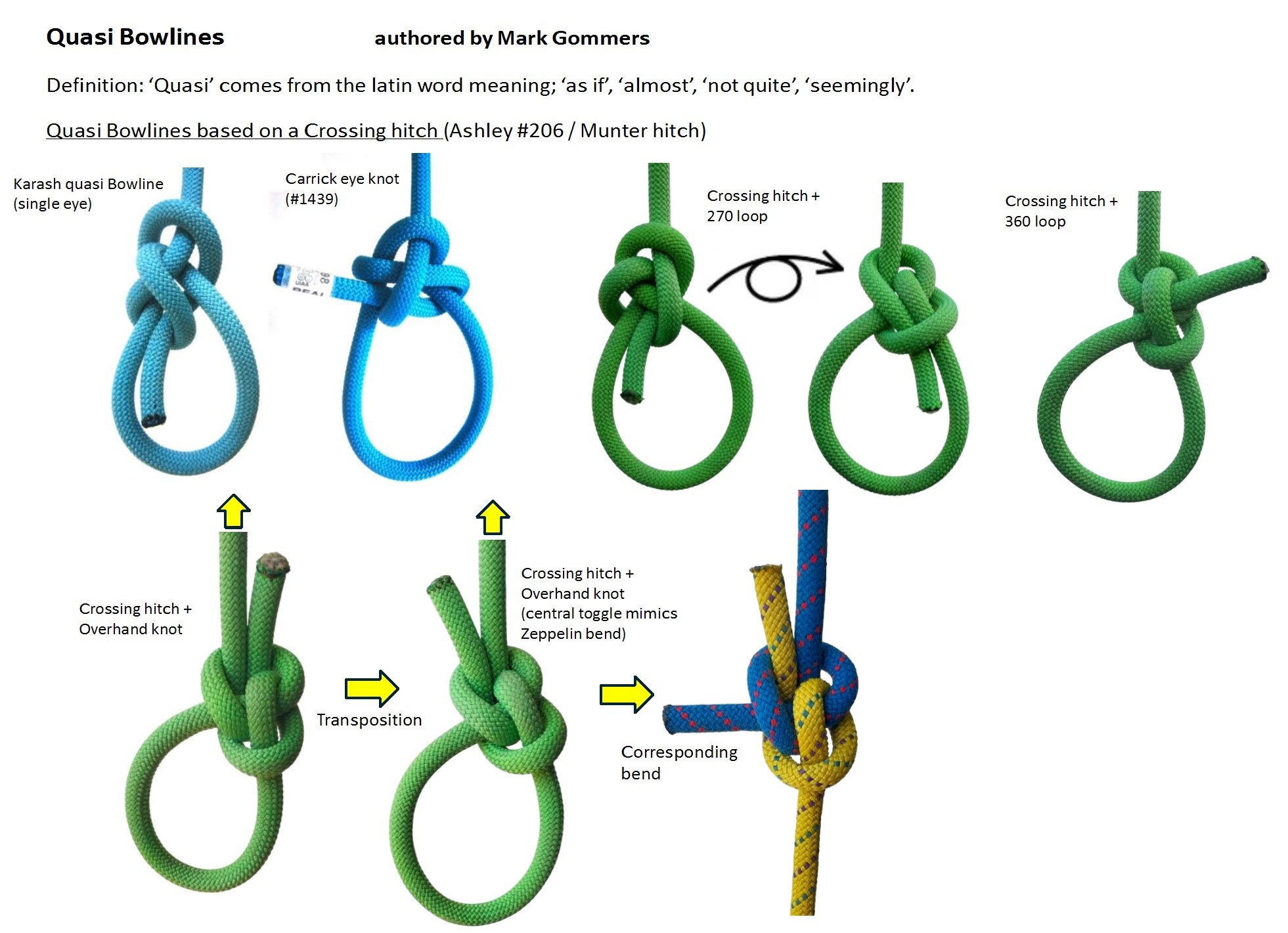
Quasi Bowlines are ‘almost’, ‘not quite’, ‘seemingly’ (etc) a ‘Bowline’. Disqualifying features usually related to the nipping loop and the 2 legs of the collar which don’t re-enter the nipping loop from the same side.
In this case, the originally presented image (from TotoZero) is an eye knot based on a Crossing hitch (Ashley #206) + 360 degree loop.
There are a number of eye knots that are based around a Crossing hitch - some good, some bad, and some ugly.
Most had been discovered and presented by knot legends - Xarax and Alan Lee many years ago. One or two are my creations… (derived from corresponding ‘Bends’ and ‘Transpositions’).
Hi all, Some time back in the year 2018, I played with #1033. I found out the #1033 dressed loop was wrong, and I capsized it.as second image. During that time I didn’t know the word capsize, so just simply posted the image. Xarax has many crossing knots loop, I have to ask him. The Sylvaini’s knot is just about to jam at 1120kg. Maybe add another 30kg. You need a tool to untie it. One bad thing about this knot is the incoming eye leg fighting with the crossing knot nipping loop. A good knot has to have a soft cushion for the nipping loop. Thanks alanleeknots.