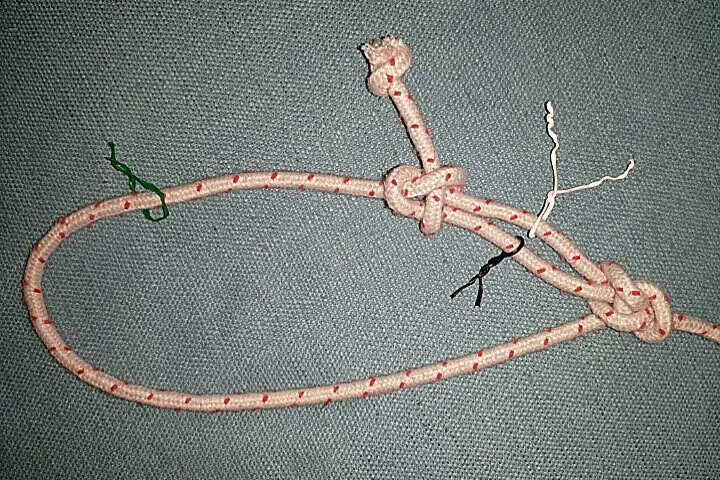
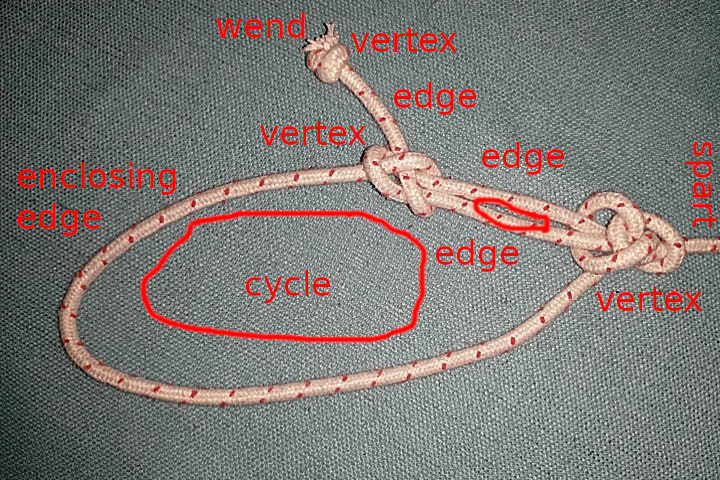
I would like to discuss about the history of the term post-eye-tiable (PET for short) and about the concept in general and about closely related concepts and definitions in this thread.
I found a couple of descriptions for the term:
-
https://igkt.net/sm/index.php?topic=5254.0 that also discusses about some other terms:
“PET - Post Eye Tiable. This is the concept of tying a rope end to an endless rail (or a toroid) where the knot can be fully formed in a one-step process after the rope has been passed around the rail, or through a ring. That is, a knot-free rope first makes a loop around the endless rail, then the knot is tied.” -
is an answer https://outdoors.stackexchange.com/a/22087/20453 for a related question:
“Post eye tiable means that the rope is passed through the eye or harness before any part of the knot is tied.” (other ‘any’ trimmed by me)
The concept is non-trivial for loop knots i.e. eye knots, I mean fixed loop knots that do not contain a knot that can move along the working part. A noose knot is always tied in PET way so it is trivial.
I think it is not needed to pass the rope end through the eye, if you use a bight.
I wonder what was the original meaning of the ‘eye’ in the term? Does it refer to the eye, the object, to which the knot is tied to, or to the eye of the knot that is to be constructed by tying a knot? One could think the eye of the knot does not exist before tying the knot 
Attempt for an alternative definition for post-eye-tiable without mentioning an object that the eye is connected to:
A knot is post-eye-tiable in respect of its eye if and only if there exists a tying method for the knot such that no knot except maybe a tiable-in-a-bight knot is needed before the first threading that forms the eye of the knot and that threading must make the eye smaller, and a bight is not threaded over the eye later on in the tying process.
Example: With that definition the Bowline on a bight (ABoK#1080) is PET in respect of its first eye (provided you have access to the working end), but not in respect of its second eye. The knot is also tiable-in-a-bight, but not by the same tying method than it is partially PET.