TEST REPORT
Test date: 07 Dec 2018
Knot specimen: #1410 Offset overhand bend (aka ‘EDK’)
Knot class: End-to-end joining knot
Test objective:
To determine the effect of rotation.
Rope material:
EN standard: EN892 dynamic rope
Diameter: 9.0mm (‘half’ rope) - only tested equal diameter ropes to rule out any variables - unequal ropes will follow later…)
Manufacturer: Edelrid (Germany)
Condition: 10+ years old (retired from lead climbing)
Tester: Mark Gommers
Test configuration and parameters:
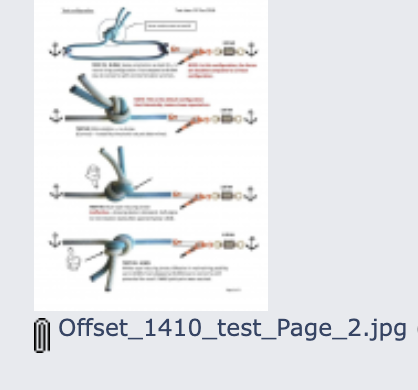
As per attached images.
Equal rope diameters used to form the end-to-end rope join (9mm to 9mm).
Assumptions:
It has been theorized that a simple rotation can improve stability (per Dan Lehman).
#1410 is typically tested in its mid-rotation state. This mid-rotation state is the default mindset. I am of this opinion because firstly, it is never reported and secondly, you have to make a deliberate effort to perform the rotation - its not a random occurrence - and only one particular rotation state appears to be effective. Furthermore, its never been photographed in detail by other testers.
As far as this tester is aware, nobody has tested and published the effect of different rotation states - with specific attention given to identifying the rotation state which is most effective at improving stability.
Conclusions:
The rotation state where the choking rope segment is lying furthest from the axis of tension is most effective.
At a peak load of 6.0kN, no instability was observed.
The rotation state where the choking rope segment lies closest to the axis-of-tension induces a torque - which causes the knot to revert to its mid-rotation state as load is increased.
Due to limitations of the test rig and equipment, peak loads were well below the MBS yield point of the knot.
Follow up testing is required to determine the threshold of instability with this rotation state compared to a ‘control’.
The mid-rotation state would be the ‘control’.
At this stage, I would posit that this rotation state will boost the threshold of instability compared to the ‘default’ mid-rotation state.
I encourage others to try to replicate my results using EN892 ‘half’ ropes (or a similar facsimile rope if EN892 rope cannot be sourced).
NOTE: In my test, I used ropes of equal diameter. This was to done to rule out any potential variables.
Unequal diameter ropes would be tested at a later date…