Hi David,
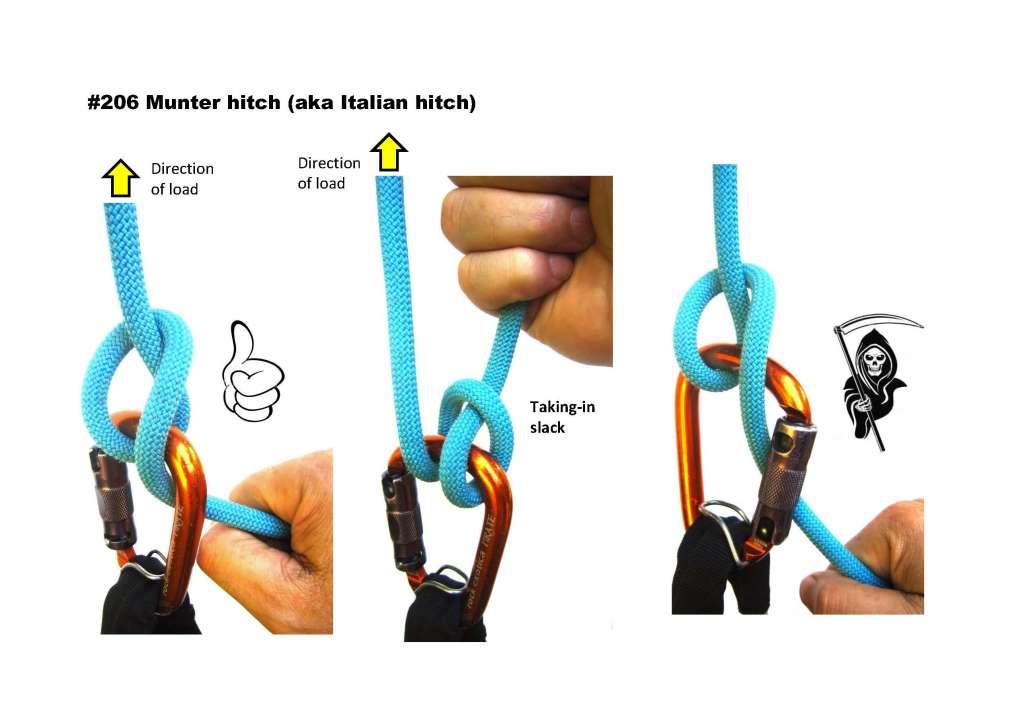
The first thing I note - and would point out is that the so-called ‘Backhanded hitch’ is actually a #206 Munter hitch.
The Munter hitch is widely used in climbing/mountaineering as an improvised belay system.
The Munter hitch is an example of a ‘knot’ that is unstable, yet perfectly secure in its intended application.
At illustration #1851, Ashley has made a simple error - which can be forgiven when you consider that he wrote his masterpiece before the digital age and before desktop computers. He had to do everything manually - by laboriously hand drawing every image. Proof reading the entire volume would have been nightmarish (in my view).
There are lots of errors in ABoK - as others have discovered.
A #206 Munter hitch has the ability to ‘reverse’ - and this reversal is triggered by alternating the load from one rope segment to the other.
In #1851, the Munter hitch is set to ‘capsize’ - because the SPart is the rope segment on the right hand side.
In #1852, the Munter hitch is in a stable loading state.
In #1853, he made he same reversal error as per #1851.
In #1853, the Munter hitch is set in its unstable state - ready to capsize.
Now - it is possible that Ashley intentionally drew the #1851/#1853 images in this way - knowing that the Munter hitch is in an unstable transitional state.
Ashley is long dead - so we’ll never know for sure what was going through his mind with regard to these drawings.
…
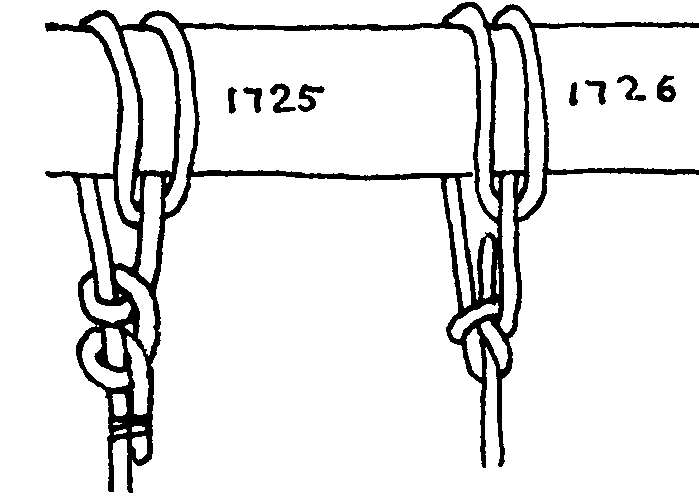
#1725 is also drawn ‘back-the-front’.
The rope segment that is half-hitched should be the loaded part (ie SPart).
The way it is depicted - it is in a transitional state - the ‘SPart’ as shown in this drawing will trigger capsizing.
Note that #1726 is correctly drawn.
Again - we don’t know what was on Ashley’s mind with regard to some of these drawings. It is possible he intended for them to be tied in this load transitional state.
But, in my view, it is more likely an error with his drawing.
EDIT NOTE: Ashley may have intended to exploit the ability of #206 Munter hitch to capsize. In its unstable loading state, as it tries to capsize, it will tend to grip firmly around the host object. In so doing, one has to be careful that the loose end is properly seized so it can’t ‘escape’ and release. By exploiting the tendency of the #206 Munter hitch to capsize - it will be caught in a balancing act.
I have attached an image showing how climbers use the ‘Munter hitch’ as a belay system.
The ability to reverse the direction of load is unique to the Munter hitch - and is what makes this particular hitch very useful to climbers.
Can I assume ABOK 1726 has the same caveats in modern cordage as the standard bowline? Should I apply, for example Lee's or Scott's locks when using this knot? I doubt I'll be facing any life support issues, but I'd prefer to avoid damage caused by a capsized knot!
Illustration #1726 is correctly drawn.
The use of a simple Bowline (#1010) is novel - but would be better served by using a double overhand 'strangle' around the SPart (as per #409 'Poachers noose' or #1228).
But yes - if you insisted on using a 'simple Bowline', [b]Scott's lock[/b] is a very [i]effective [/i]locking maneuver.