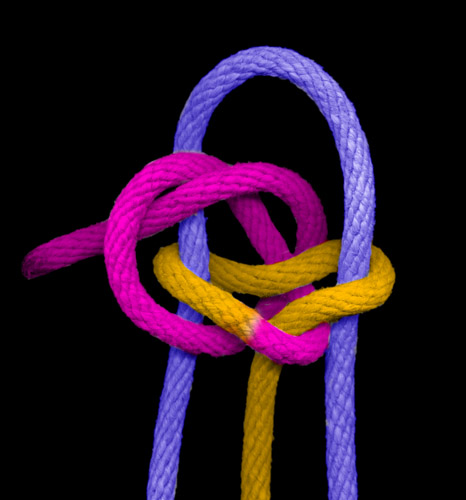
This is another one I came up with on my own, so, once again, if it has a common name, I don’t know what it is. If anyone knows its name, please post it here. For those who haven’t seen this hitch before, I find it interesting because of its mechanism-like properties, and because it has the easiest release and slide of any grip-slide hitch I’ve ever tried, even on high-friction ropes. It has good resistance to capsizing, it is stable and creep-resistant even with many load-slide cycles, and it is not prone to jam.
Conceptually, it’s pretty simple, just a basic yoke and choke. The yoke (orange) consists of the active bight, the anchor bight, and the bridge between them, and the choke (pink) just hold the yoke together and keeps the standing part from getting pulled in. All the gripping is provided by the snare action of the active bight, and the active bight loosens easily when unloaded and the tail is pulled upwards. I use a simple overhand for the choke and point the tail up so it is more in-line with the direction of the release-pull, but other knots could be used for the choke. You can use the tail to pull this hitch downwards as well, but sometimes it is easier to pull upwards first to release the active bight.
Limitations are that this only holds reliably for loads pulling in one direction (down), and the grip surface is small, so heat will build quickly if it is used as a sliding brake. It works well on utility ropes, but I suspect it won’t hold on slick ropes (untested). With its many bends, it’s probably also a poor candidate for stiff ropes. I don’t know how it is for ropes of different sizes.
But the main drawback with this hitch is also the reason I depicted the standing part formed into a bight for the tying illustration. This is not a good hitch if your standing part is already under tension–which is almost always the case for me. Those bends which make this a stable hitch also make it a major hassle to adjust anything about this hitch, and to dress it into the right shape. And if you want to change the length of the tail, it’s probably faster to just start over. But if you can form the standing part into a bight first, you can make the yoke bridge about the right length so that very little dressing is needed when the SP is straightened out. So even though this hitch is mostly useless to me, for anyone who has the option of tying onto a slack SP, this just might be a good little hitch.