The Carrick Loop

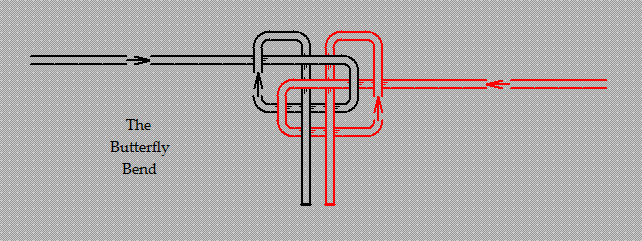
I’ve spent the last few days working on end loops tied through a mounted ring. I started with the Butterfly Loop, http://davidmdelaney.com/alpine-butterfly-loop/Alpine-butterfly-loop-m1.html, but when I tested it with thin stretchy braided nylon cord, it was very jammy. So, still hoping that there was a way to endow a Butterfly end loop with the spectacularly unjamminess of the Butterfly Bend, http://davidmdelaney.com/alpine-butterfly-bend/Alpine-butterfly-bend.html, I devised – I invented it. I was undoubtedly preceded – a way to bend the working end of a cord to the standing part with a Butterfly Bend to form a Butterfly Bend Loop, http://davidmdelaney.com/alpine-butterfly-loop/Alpine-butterfly-bend-loop.html. This Butterfly Bend Loop was indeed less jammy than the Butterfly Loop loaded as an end loop, and significantly so, but not enough to satisfy my desire to have a knot with the spectacular unjamminess of the Zeppelin Loop, and easier to tie.

So I tried the same idea of bending the working end to the standing part (through a mounted ring, remember) with the Carrick Bend. The result was extremely satisfying. Not only was the resulting loop spectacularly unjammy, every bit as unjammy as the Zeppelin Loop, but virtually any method of tying the Carrick Bend can be adapted trivially for this purpose with no more instruction than is contained already in this paragraph, which is not true for either the Butterfly Bend or the Zeppelin Bend forming their corresponding end loops. For example, I used the method of tying the Carrick Bend shown in http://davidmdelaney.com/carrick-bend/carrick-bend-1439.html essentially unchanged, just having to twist the knot a little more during construction.
Did you happen to see this related thread?:

http://igkt.net/sm/index.php?topic=1386.0

I have some practical questions:

Why would I want to use the Butterfly Loop on end when the Zeppelin Loop and Double Bowline seem to be superior? Knowing the Butterfly Loop on bight doesn’t mean I automatically know the Butterfly Loop on end. The Butterfly Loop on end is another knot to learn.

Are there practical reasons for using the Carrick Loop instead of the Zeppelin Loop? I see the that the original poster thinks the Carrick Loop is easier to tie than the Zeppelin Loop. Are there any other advantages?

Roo said

Did you happen to see this related thread?:

http://igkt.net/sm/index.php?topic=1386.0

No, I hadn’t. Thanks. I’ll digest it and see if I have anything to add.

knot4u said

Why would I want to use the Butterfly Loop on end when the Zeppelin Loop and Double Bowline seem to be superior? Knowing the Butterfly Loop on bight doesn’t mean I automatically know the Butterfly Loop on end. The Butterfly Loop on end is another knot to learn.

Well, I don’t want to, now that I know the Butterfly Loop and the Butterfly Loop Bend are not as unjammy as the Butterfly Bend.

But before that, well, the Butterfly Bend is less jammy than the double bowline, if you’ll allow me an apples and oranges comparison made sensible by the preceding paragraph, and, until today, when I saw roo’s post, I was sure the Zeppelin Loop was hard to remember.

knot4u said

Are there practical reasons for using the Carrick Loop instead of the Zeppelin Loop? I see the that the original poster thinks the Carrick Loop is easier to tie than the Zeppelin Loop. Are there any other advantages?

Well, the carrick loop requires no additional learning over the carrick bend in order to tie the loop through a mounted ring except the idea of using a bend to form an end loop. This seems to be unusual for loops made from bends, and to have some value. It’s certainly not true of the Zeppelin Loop.

Also, the carrick loop is a “one step” loop – there is no preparation required before putting the working end through a mounted ring.

It depends on the application. When used as the pulley loop in the trucker’s hitch, the Butterfly Loop on bight has not jammed on me. I want to clarify that you’re talking specifically about the Butterfly Loop on end.

I have found the Double Bowline to be less jammy than the Bowline, which I can always get loose.

Whoa, I tie the Zeppelin Loop in the same manner I tie the Zeppelin Bend. I use the “Alternative Method” here, which is fun and easy:

http://igkt.net/sm/index.php?topic=1872.0

knot4u said

It depends on the application. When used as the pulley loop in the trucker’s hitch, the Butterfly Loop on bight has not jammed on me. I want to clarify that you’re talking specifically about the Butterfly Loop on end.

I am talking about about the end loop, and in the extreme circumstances of heavily loaded thin stretchy cord, in which jamming may indicate only occasional difficulty in untying with lesser loads and less elastic cords.

knot4u said

I have found the Double Bowline to be less jammy than the Bowline, which I can always get loose.

OK, but I can make both the bowline and the double bowline troublesome to untie with my test rig, and the same with the sheet bend and double sheet bend. But I cannot do this with carrick and zeppelin loops, or with the butterfly bend, the carrick bend, or the zeppelin bend.

knot4u said

Whoa, I tie the Zeppelin Loop in the same manner I tie the Zeppelin Bend. I use the “Alternative Method” here, which is fun and easy:

http://igkt.net/sm/index.php?topic=1872.0

I have become instantly fond of roo’s option 2 diagram as a way of remembering and constructing the ZL, but neither option 1 nor option 2 is tying the ZL in the “same manner” as the ZB. Both require considerable insight and invention beyond the b and q method of the ZB. THis is not true of constructing the carrick loop with the carrick bend. If you taught 100 people the b and q method for the ZB, and said to them now use the “same method” to tie an end loop, about one in a hundred would be able to do it, and that person only after prolonged head scratching. If you said to 100 people who already knew a way to tie the carrick bend, “tie a loop by tying one end of this cord to its middle using the carrick bend”, a very substantial fraction of them would be able to do it immediately, because it really is the “same manner”.

In http://igkt.net/sm/index.php?topic=1386.msg9476#msg9476, roo remarked about the carrick loop:

Go to your local hardware store and pick up some slick polypropylene to test the loop via slack repetitive shaking. This loop is one of the first tied by people who are trying bends as a loop. However the (Double) Carrick bend form carries itself loosely, which may be the reason for its mediocre security. It fared better in the natural fiber ropes back when manila fiber was king.

Tied as a loop, more problems occur. If you alternately pull legs to simulate swinging or rotation some unsettling things can occur. You may also want to try ring loading the loop in polypropylene, so that you make the loop act as if something is trying to expand it. You may be unhappy with the results.

I’ve tried this in 8 mm dynamic climbing rope, and yes, the carrick loop, when unseized, is very loose and gets looser under these circumstances. This doesn’t seem to occur in nylon or polyester cabled or braided cord, or much less often. In the stiff and slippery ropes, or in any critical application, you’d tie a safety knot anyway. If you leave the carrick knot in open form and tie an overhand safety knot as a seizing to keep it from expanding (or contracting completely into “working form”), as shown in the attachment, the knot will distort when loaded, cross loaded, or ring loaded, including repeated jerking, but maintains its strength, does not expand destructively, and returns to the form shown. The configuration remains easy to untie after heavy load, because the overhand seizing is never heavily loaded.

Nope… I’m tying the Zeppelin Loop in the same manner I’m tying the Zeppelin Bend. That’s the beauty of Roo’s Option 1, which is now the “Alternative Method” from his site. I looked at the Carrick Bend, and had to refer to a diagram before I could figure out how to tie the Carrick Loop.

Not everybody sees this issue about the Zeppelin Loop like you do. By the way, I would have been really glad to know this info about Carrick Loop if I thought what you were saying about the Zeppelin Loop applied to me.

You said the Carrick Loop maintains its strength even though it distorts. How do you know that? Did you bring the rope to breaking failure? Did you mean to say the loop maintains its security?

I am trying my best to put the Carrick Loop on my favorites list, but it’s not there yet.

=====

Anyway, the way the working end sticks out in the Zeppelin Loop is an advantage to me. It provides the option of tying the working end either upward to the standing end or downward to the loop, or the working end can just hang out, which is how I always leave it.

It automatically distorts into a form that supports the load applied, then springs back and distorts in a different way for a different load. Tie it in small stiff cord, load it various ways, and notice what happens to it. It’s obviously strong loaded many different ways, because of the threading pattern and number of crossings, which the possible distortions cannot change, and the constraint on all four parts coming out of the knot when it is seized as indicated.

Based on you clarification, I’m thinking you mean security, as opposed to strength. As far as I know, strength is measured by testing the breaking point. If I were going to judge strength only by thinking it through, then I would never guess that the Palomar knot is as strong as it is.

You’re right. I meant, or should have meant, security.

. . . not necessarily “superior,” just more appropriate for a given task at hand. . . .

Remember, an application will dictate what’s good and what isn’t. . . .

JCS

You should note that the Butterfly knot is asymmetric,
and what eyeknot results from it will depend on which of the
non-eye ends is loaded; additionally, the knot can be dressed in
a variety of ways. E.g., your page on the end-2-end knot (bend)
–which I refer to because of color-coded rope strands–
shows two dressings (between Method-1 & -2): in the upper one,
the green rope makes what one might regard as a “minimal Timber
Hitch” with its Overhand; its tail should cross more rightwards & over
the white tail --and will be held in this position by the draw of its SPart
when loaded, and other parts will get pressed into this rope’s collar
(this turn & tuck teardrop structure) and keep it open, easier to pry
loose. (And your end-loop geometry is like Method-1’s.)
In the lower photos, it is the white rope that takes this position,
and while here its tail isn’t passing under the green, it also doesn’t
extend (in this case) enough leftwards and thus over the green.
(This was the geometry urged by Wright & Magowan; but after
loading the eye with --resp. of Methods-1/-2-- the white/green
ropes (so this described like-a-Timber-hitch part has a slack end),
I think the knot will loose the geometry.)

Your “Butterfly Bend Loop” has the better(?) geometry just described.

As you realize in your exploration, there are different ways to derive
an eyeknot from an end-2-end knot. The Butterfly knot started
with the mid-line eyeknot and by one line of reasoning birthed the
end-2-end companion by simply cutting off the eye. It’s a natural
relation to take, as expected usage of the knot would load it just
in that way. Of course,if one does this with the Fig.8 & Overhand
eyeknots, one gets the related offset end-2-end knots, not the
usually associated ones(!).

A third way to derive an eyeknot from an end-2-end knot is what
I presented in the thread on the Zeppelin Loop. This is tantamount
to making a bend of a single line with the ends of a bight, and then
fusing one of the bight ends with the single line’s end. You might
try this for the Carrick bend, e.g. – and beyond the proof-of-concept
result, there will come some yearning to get better dressing and so
on: refinements to play with. This “twinning” of one of the E-2-E
halves of course puts bulk into the knot, and arguably not in the
places that might best receive it (e.g., in the collar around the
eye legs rather than (better->) the SPart). But, it’s another way;
and as with the Zeppelin Loop it’s TIB (Tiable Inthe Bight).

–dl*

Ugh, not in any reasonable sense. Please don’t send people on this wild goose chase.

It is, exactly as was quite simply explained. If you can’t figure it out,
don’t discourage others (but what IS the problem?!)-: !

–dl*

I can figure it out just fine. It’s just a monstrosity of impracticality that few would consider a reasonable representation of the knot form. You’d be better off taking along a separate short piece of rope to make a “pure” loop-bend hybrid with three free ends of rope left sticking out of the knot (not that I’d recommend that either).

The following might help, in addition to using the Carrick Loop:

Three Easy Steps to Making the Butterfly End Loop

(1) Tie the Overhand (crossing OVER the line) and hold its rightmost section (of the Overhand’s three sections) farthest from you.

(2) Take your working end around a post (from underneath the post, if the post is horizontal), to form the loop, and bring the working end through the rightmost Overhand section from underneath (rotate your structure-in-progress as necessary, if your post is horizontal).

(3) Take the working end OVER the OTHER loop part, then UNDER that other loop part, and finally bring it through BOTH the rightmost Overhand section AND the formed loop from underneath, by first going over the TOP–if your post is horizontal–loop part.

Viola! Butterfly End Loop. Adjust the size of your loop when the knot is loose, by manipulating the appropriate Overhand (of the two Overhands that make up the Butterfly End Loop).

Note that, in the final dressed knot, you’ve got the option of having the working end either in front of or behind what we have been calling “the OTHER loop part.”

After having spent some time with this loop, I see that keeping the working end in FRONT of “the other loop part” yields FOUR advantages instead of just the one from putting it behind; therefore, since 4 > 1, I (now) suggest keeping it in FRONT of “the other loop part.”

Compare and contrast these steps with those in this post:

http://igkt.net/sm/index.php?topic=1872.msg12734#msg12734

Now, if you’ll excuse me, I’m going to make a Double-Knotted, French, and Dutch-Marine Bowline Combination with a Flush Figure-Eight Stopper–my favorite end loop.

Edit:

Personal note: The working ends of all Butterfly End Loops should always be pulled towards the standing part (even when stopper-flush). However, for the single loop, it is convenient (for the dressing) to have the working end cross over (“the other loop part”); for the double loop, it is convenient (for the dressing) to have the working end cross under. (You can cross under easily in this context by putting the working end into the formed loops from above and then pulling towards the standing part as you tighten the knot.)

JCS


BttrflyBnd100618nf19281.gif