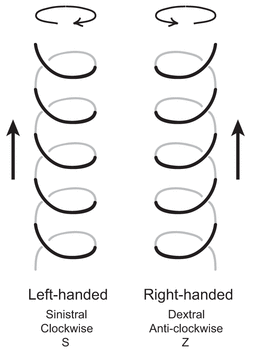
per Dan Lehman:
Discussion carried from this link: https://igkt.net/sm/index.php?topic=6748.msg44365#msg44365
It might be helpful to distinguish between a loop and a helix --though either might transform into the other.
We have to be very careful with terminology.
tsik_lestat did not use the term helix to describe a loop.
Rather, it is simply a loop with a helical shape (Note: This is not the same as declaring a loop to be a helix!).
I see #1013 double Bowline as having a nipping structure based on double loops.
The double loop structure has the form of a helical loop.
That is not the same as declaring the double loop to be a helix.
A rolling hitch presents a challenge to such handedness assignment, and the multiple OHs do as well.
I experience no such challenge.
A loop is created when one segment of rope overlaps and crosses itself.
The notional concept of ‘over’ or ‘under’ is irrelevant (or ‘up’ or ‘down’).
The notional concept of up, down, over or under can only have meaning within a carefully defined reference frame.
Such a reference frame (in the majority of cases) can only have meaning to an individual observer at a point in spacetime.
In my view, we can avoid difficulties with up/down/over/under by simply referring to chirality.
In which case, I can create a loop that has either left-handed (S) or right-handed (Z) chirality.
The chirality aspect takes the form of a helical loop (again - avoiding the word helix).
All hitches require a host.
They are all based on various geometries which involve a series of turns, riding turns and penetrations through existing turns.
One could more easily examine #1763 Prusik hitch… which consists of a numbers of turns around its host.
From one leg of the Prusik, the turns around the host are left-handed (S) chirality.
From the opposite leg, the turns around the host are right-handed (Z) chirality.
There is no ‘up’ or ‘down’ - and a mirror image makes no difference because it will still involve both S and Z chirality.
This is because #1763 Prusik is tied from dual legs (not a single leg… and is symmetric. An example of a single leg hitch is the so called ‘Blakes hitch’ - per Prohaska)
The Rolling hitch can have a mirror of itself too - which reverses the ‘flow’
It differs significantly from #1763 on account of its creation from a single leg (not dual legs).
Maybe you are only contemplating the Rolling hitch from the direction of flow depicted per Ashley (and not in mirror image form)?
And there is also #1245 Clove hitch - which can have mirror versions being tied with S or Z chirality. At illustration #1245, he shows the Clove hitch tied with S/S chirality (not Z/Z chirality).
I would further comment that in virtually all cases, Ashley illustrates his ‘Bowlines’ with Z (right-handed) chirality.
I continue to advance the point that handedness in at least these simpler bowline cases is determined by the SPart's initial turn --which in the OP's case, is right-handed.This is muddying already turbulent waters. I don't think this definition is useful or practicable (yes - I intended [i]practicable[/i]). Per Ashley's depiction of his Bowline at #1010 - it is shown with Z (right-handed) chirality. The SPart's 'initial turn' could be hard to define in any reference frame. Initial turn in reference to what? The nipping loop shown by Ashley at #1010 has the form of a helical loop (not a helix) and occurs because a rope segment overlaps/crosses itself. It matters not whether it is 'up' or 'down' (or over/under) - because these concepts are independent of chirality.
I am happy to debate these concepts with you…
I think good starting points are #1245 Clove hitch and #1763 Prusik hitch and Blakes hitch (which includes a penetration).
And for me, all loops have a particular chirality - while an ‘eye’ does not.
For example, the eye of #1047 Figure 8 isn’t a ‘loop’ - it has no chirality and it is intended to attach to some object and sustain load.
EDIT: attached image should be working now…