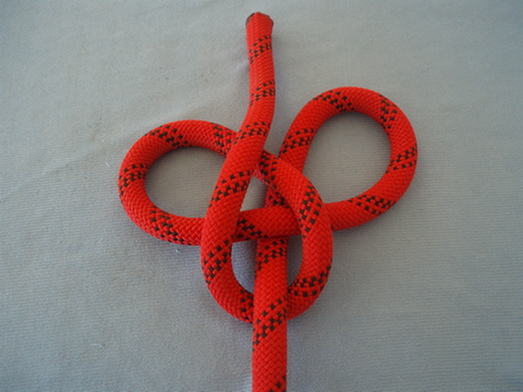
Reading Dan Lehman’s comment in another thread–concerning the grip-hitch principle whereby tension parallel to the object rope is redirected into a perpendicular nipping grip around the object rope–reminded me of this hitch that I came up with and put aside some time ago. I remember initially thinking it looked promising, but as I recall, I sidelined it for four reasons: 1) It was more fiddly to tighten and dress into the right shape than I wanted, 2) it didn’t release and slide as easily as I wanted, 3) I had some nervousness about whether the tending loop (pink in the illustration) was going to hold, and 4) on one occasion the hitch slipped when I felt it should have held. I had intended to look into it some more at some point to see if any of those were fixable problems, but then I just plain forgot about it–until Dan’s comment reminded me.
So now, looking at it again, problem 1 doesn’t seem to be as bad as I remembered it. 2 isn’t bad on some ropes, but it’s still an issue on others. However, pushing a bit of the tail of the nipping loop (orange) into the tending loop (pink) to loosen it up does seem to make it easier to slide. Still not sure whether 3 could be a problem. And 4 might not be as serious as I thought. I’m pretty sure I knew back then that the grip strength of this hitch is reduced if the tending loop (pink) is wrapped the wrong way around the attaching rope (orange), and if the tending loop is left too loose to form a proper nipping loop. The illustration is left loose for clarity, but I think the tending loop should be pulled up against the hitch prior to loading. (It will pull out to its working length when loaded.) But experimenting now, it looks like another important factor is to not let the tending loop legs fully cross before they pass between the object rope (purple) and the anchor loop (green). The tail of the tending loop needs to be in the pocket of the anchor loop. If it is out of position in the wrong pocket (i.e. where orange, green, and purple come together), that seems to significantly increase the risk of slippage. I didn’t take the time to examine what the problem was back when I shelved this hitch, but in trying to reproduce the problem now, this is all I’ve been able to find. Slippage could also be a problem on slick ropes, but I don’t have any slick ropes to test that. (I did, however, try it out on a steel rod, about the same diameter as the rope. On the smooth-chrome end of the rod, it could not generate enough grip-friction to hold against the pull parallel to the rod, but on the surface-rust end of the rod, it held firm.)
So, this might be an iffy hitch that still has some lurking occasional problem I haven’t been able to reproduce yet, or it might be a usable grip hitch that I sidelined for not-very-good reasons. But even if it is usable, it still might be eclipsed by other hitches that can do the same things as well or better. As with the previous nipping-loop hitch, I expect this would be a poor descender hitch due to rapid heating (due to small surface area).
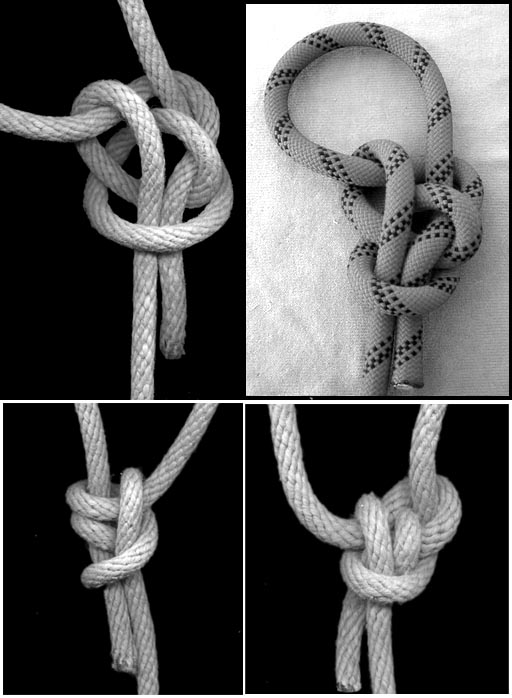
If this hitch already has a common name, I don’t know what it is. If anyone does, feel free to post it. I’m just calling it a Modified-Munter here because that seemed like an obvious possibility. I just made up the names tending loop and anchor loop, so if there are more standard names for those, feel free to post those also.