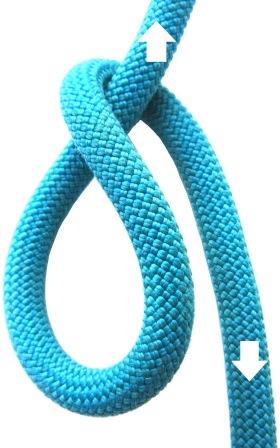
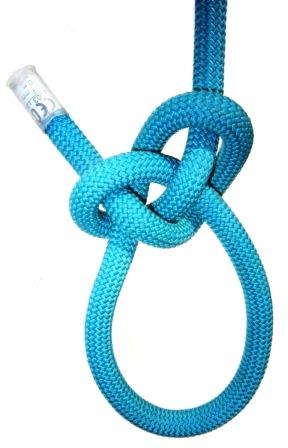
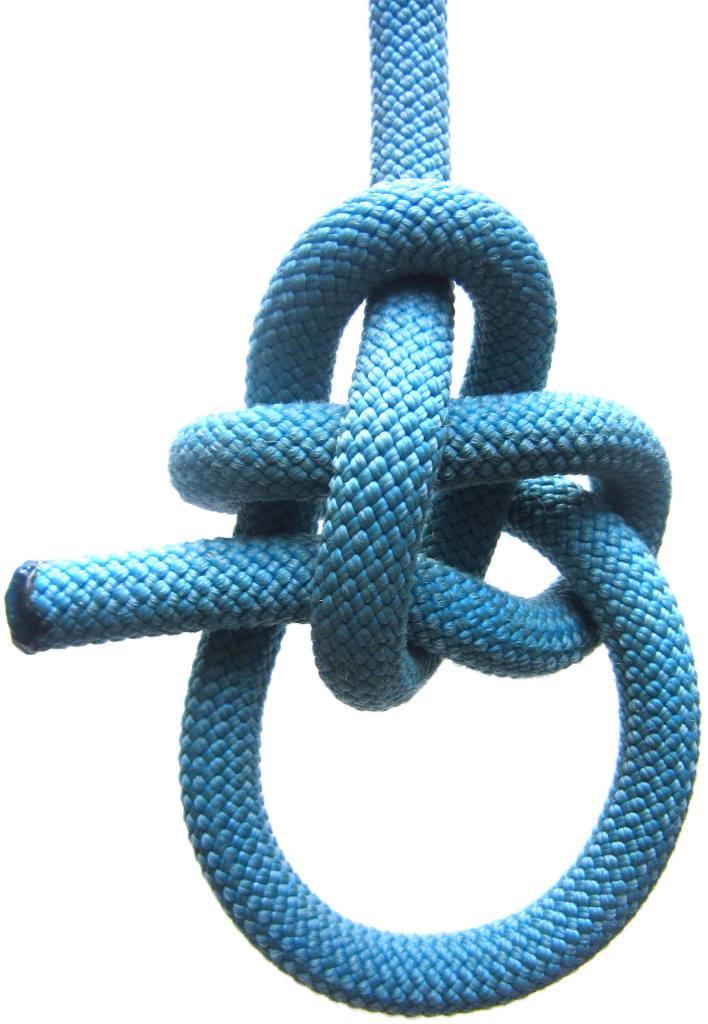
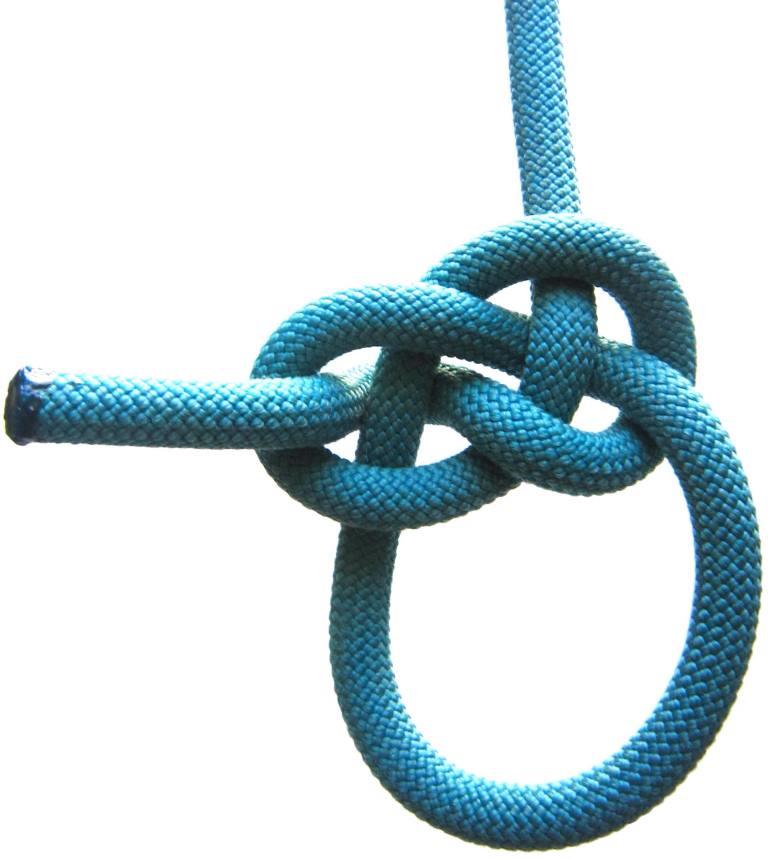
The Sheetbend loop knot and the Carrick bend loop knot.

Mark,

I admire your persistence and respect you determination to resolve this issue. You have made a huge response and although much within it is repetition, it does contain a number of nuggets which deserve discussion and may offer illumination.

I am out most of today, but will attempt to formulate a constructive reply this evening.

But, in the meantime, yes, I do classify a knotted sling as a Closed Loop Knot (the other two external components simply being WEs).
NB - not to be confused with a laid, spliced or sewn loop which do not contain a knot.

Derek

@Mark

In this regard, I am engaging with you on an intellectual level (sort of like the great debate between Bohr and Einstein about the nature of quantum mechanics).

I feel the only thing ‘great’ about this debate has been the number of words consumed by it thus far, with yet more to come?

So, let me come at this from two different angles.

Take a bight of cord. Now in the doubled cord tie an OH knot to make an overhand on a bight, or, if you prefer, a doubled OH on a bight. Or a trapped bight, or a bound bight, or maybe even a closed bight. I like it, so I call all knots that feature this external bound bight object bight knots. They used to be called loopknots, but the word loop is used to describe the nipping loop in a bowline, so we will call them Bowline bight knot or the Carrick bight knot… It has the shape of a bight, it goes around things like a bight, so henceforth they will all be called bight knots.

Lovely - but Why? When everyone else calls them Loopknots? They have a nipping loop component inside the nub of the knot and a bound loop outside the knot - they are fixed loopknots. Everyone knows what you are referring to when you say Loopknot, but how many twig on what you mean by Bightknot?

Second perspective :-
When I first joined the IGKT I was interested in the uses of knots, their history and their historical uses. Back then, we used pencil line diagrams and loads of words to describe knots to each other on the forum. Dan was king of the shaded 3D diagrams. At the time Frank Brown had access to a CAD drawing program and was working at drawing a set of ‘tiles’ that he could place on a CAD diagram to create a knot diagram. I stepped in and wrote the the first FCB.exe program that Windows users could use to draw and share diagrams using Frank’s tiles principle. Dave Root then stood up to the line and took the simplistic FCB program and expanded it to the ultra versatile KnotMaker with multiple layers to truly have cords in front and behind.

Through these programs, I started to become interested in the structure of knots and developed the Overs Index as a means of classifying knots for identification - only to discover that Geoffrey Budworth had already developed an almost identical system many years earlier. Unfortunately, both Budworth’s Forensic Knot Identification System and my Overs / Saturation Index, both suffered from a fatal flaw - they both required the knot to be opened up and laid out flat in order to be able to identify each crossing. But knots are not 2D, they are 3D and they work, processing the forces, in 3D. Apart from being able to lay the knot out into different shapes and therefore generate different OIs, the indexes told us absolutely nothing of the functionality of the knot. Likewise, the knot drawing programs could show us the lacings, but failed to show us the 3D structures.

I then started to work with a modified piece of braid that I had taken the core out and replace with ductile modelling wire. I would use it to tie one side of a bend, dress and set the knot. Then when I removed the normal cordage side, I was rewarded with the skeleton of one side of the knot. And so was born the concept of Components. 3D structures that managed to show me how they dressed themselves under load.

Now, although the concept of Components was a significant improvement on the OI or sketching, it was still flawed, because components were not ‘rigid’. For example, an Overhand Component might reconfigure itself in a knot to a Carrick Component with a crossover. Even the simplest of components, the Nipping Loop Component can take on a whole range of conformances from an open helix to a Simple Hitch, and what is worse, these changes can take place during the normal usage and operation of a knot.

Identification of components is a great step forward. Each component can be described structurally, its requirements and attributes can be identified, and how forces flow into, through and out of it can be analysed. We can identify the nature and direction of Cogging, both positive and negative.

Yet because Components can morph, and because components have lesser components, the challenge to understand what makes a knot perform as it does, continues to delve into greater and greater detail.

At that point it is almost impossible to ignore the fact that all the simplistic characterisations and classifications such as the Overs Index, the Knot diagrams, the Components, are progressions, but are still unable to qualify a knot. These 3D force machines are at one and the same time incredibly simple, yet stunningly complex..

Then one day along comes a highly competent knotter and states, a Bowline is defined as a knot with a collar and a nipping loop which has both ends loaded, and henceforth is going to be called an Eyeknot.
So I explain, no, the Bowline has internal components of a Nipping Loop and a Bight, with external components of a fixed loop an SP and a WE, and is a LoopKnot.

Lots of words follow that convince me that these folks don’t understand how knots work and are far more interested in naming a knot than in understanding it - so I back off and leave them to it.

Derek
per Derek:

I feel the only thing 'great' about this debate has been the number of words consumed by it thus far, with yet more to come?

I was under the impression that this IGKT forum provides (as one of its fundamental tenets) a means for knotting enthusiasts to engage in technical discussions? We may not all agree but, it is through discussion and debate that we can advance our collective understanding. Some have limits as to how far they are willing to venture in ‘discussions’ (and this may in part be reflected in diminishing returns or, perhaps a realization that they may have to revise their own paradigm or understanding of concepts).

Are you hinting that you dont necessarily like to engage in technical discussion - either short or lengthy?
By definition, technical discussions can be protracted because they involve concepts that are complex.

Well Derek, here is another lengthy discussion! All friendly and courteous - I am simply engaging with you in a intellectual discussion.

They used to be called loopknots, but the word loop is used to describe the nipping loop in a bowline, so we will call them Bowline bight knot or the Carrick bight knot... It has the shape of a bight, it goes around things like a bight, so henceforth they will all be called bight knots.

Derek, the word ‘loop’ and ‘nipping loop’ have different meanings. They are not the same thing.
A ‘loop’ becomes a ‘nipping loop’ when both of its ends are loaded and it is freely able to encircle and squeeze elements of the knot core.
I like to use #1431 Sheet bend as an example.
In #1431 Sheet bend, there is no functional ‘nipping loop’, because both ends of the ‘loop’ are not loaded.
In contrast, in #1010 Bowline, both ends of the loop are loaded - and therefore it is a functional ‘nipping loop’.

Then one day along comes a highly competent knotter and states, a Bowline is defined as a knot with a collar and a nipping loop which has both ends loaded, and henceforth is going to be called an Eyeknot.

Knot terminology has historically been confused and various terms appear to be loosely defined.
What got me started on trying to ‘solve’ the terminology problem is the notional concept of what a ‘loop’ is.

I define a ‘loop’ as follows:
A closed helix formed by the overlap of one rope segment over (or under) the other which can have either S or Z chirality. The arc scribed by the loop thus formed does not need to be 360 degrees (it may be less or more).

A ‘loop’ becomes a ‘nipping loop’ when both of its ends are loaded and freely able to encircle and squeeze elements within the knot core.

So I am very careful to make a distinction between a ‘loop’ and a ‘nipping loop’.

When I look at a #1047 F8 knot and a #1010 common Bowline, I don’t see what you refer to as a ‘loop’ actually fulfilling the definition I have tendered. I see what you call a ‘loop’ as taking the form of an ‘eye’.
I use the analogy of an eye bolt to describe the ‘eye’.
I don’t call an eye bolt a loop bolt or a bight bolt… its an eye bolt.

Now, I understand that this is a departure from Clifford Ashley’s use of the term loop knot. He uses the term ‘loop’ loosely - he does not have a precise definition. The use of the term ‘loop’ to describe what I call eye knots is heavily entrenched in the common vernacular.

To challenge common beliefs is to invite trouble. Nobody likes change.
It is a basic human condition to resist change - and, in some individuals, it can promote feelings of outrage.
I always try to put aside any emotions that are tied to resisting change and keep an open mind. I am a person who likes change and likes to challenge entrenched belief systems. So for me personally, change is interesting and does not generate feelings of fear and outrage.

And so, in the case of #1047 F8 knot, I wanted to see a ‘loop’. But, I had trouble with defining what a ‘loop’ actually is. In fact, there is no ‘loop’. The word ‘loop’ is being used loosely and is simply drawing on traditional thinking.

But, I am happy for you to use the term ‘loop’ to describe a class of knots that permit attachments/connections to be made. I would comment that the use of the term ‘loop’ in this context (ie to denote an ‘eye’) dilutes and loosens the definition of what a ‘loop’ is.

For me personally, things got difficult when trying to define the structure of a Bowline - and indeed, the many presentations submitted on this IGKT forum that wished to claim the title of ‘Bowline’.

yChan is a current example. He has presented several knots all claiming the title of ‘Bowline’.
He asked for opinions and feedback from this forum.
I find that I can apply my theory of what constitutes [a] ‘Bowline’ in a coherent and consistent way.
yChan is providing a means to test the theory.

Xarax has emailed very challenging knot structures that really challenge and push the theory almost to the point where I have to go back to the drawing board. I wish that Xarax could post his work directly in this forum rather than through third parties.
Some of his knot creations are very difficult for me to either confirm or deny as deserving of the title of ‘Bowline’.

It comes down to how you perceive a ‘nipping loop’, and whether that ‘nipping loop’ is freely able to encircle and squeeze both legs of the collar (which you Derek appear to call a ‘bight’).
Xarax is forcing me to more closely define ‘encirclement’ and whether a ‘nipping loop’ can only take the form of a closed helix (#206 / #1195 crossing knot forms are problematic). That is, if the nipping structure takes the form of #206 / #1195, is it still a ‘nipping loop’? And here the term ‘loop’ must be carefully defined. I say ‘no’ - a nipping loop takes the form of a closed helix that is loaded at both ends. If it isn’t in the strict form of a closed helix, then it can be described as a nipping structure’. Think of the Mike Karash eye knot that he presented a long time ago (Link https://en.wikipedia.org/wiki/Karash_double_loop ). This is actually a sub-class of ‘Bowline’ that has a nipping structure based on #206 / #1195.
Other ‘nipping structures’ include ‘clove hitches’, and ‘girth hitches’ (from which the so called 'mirror Bowlines are formed).

Xarax helped me to understand that what you call a ‘bight’ (within a ‘Bowline’) actually consists of a collar and 2 legs.


Karash_sub-Bowline_WEB.JPG

Nipping-Structure_Crossing-hitch_WEB.JPG

Xarac is quite correct in stating that the collar of the bight component is important, but he is wrong in letting you conclude that the collar is the key functionality of the Bight Component.

If we take a functioning knot (a working knot, not a decorative) it is a force processing machine, and like most machines, it has functioning components. Within a knot however, the integration of functionality is extreme.

Within most knots, those components can be identified and their functionality can be detailed. Most components can be viewed as partial knots in their own right, and so their sub components and sub functionality can be identified.

The ‘Nipping Loop Component’ is one of the hardest components to define because in reality is it part of a spectrum of structures ranging from the Simple Hitch Component through to the Open Helix Component. The requirements of this spectrum of components is that they a) require both ends to be loaded (but not in the extreme case of the spectrum - the simple hitch which is self loading), b) they require structural stabilisation and c) as they are hitches, they require a hitching core. In return, they transfer applied load into the hitching core and apply constriction and a rotary torque to the core.

The Bight Component (a top level, or compound component) on the other hand, requires its bight legs to be compressed together, and in return it provides a) structural stabilisation, b) a hitch core c) resistance to rotary torque and d) substantial linear negative cogging proportional to the applied load. As an entity, the Bight Component can be seen as the load bearing heart of knots such as the Bowline.

Now, as I stated at the start of this post, Xarax was right to identify that the Bight Component had sub components, and that one of these was what he called a Collar (I prefer to refer to it as a Turn subComponent). But you can see from the previous para, the turn is only a part of the Bight Component functionality. Indeed in some knots, even some configurations of the Bowline, the hitch core functionality is its key contribution to overall knot function. The Turn (collar) subComponent is funtional in its provision of stabilisation, and stabilisation is important, but it is utterly wrong to disregard the major functionality of the bight as a hitch core and in processing cogging and torque forces.

Yes, understanding the detail is important, but it is also critical that we perceive this detail in the context of the whole knot functionality.

Xarax almost certainly perceives this ‘whole picture’, but he failed you by not explaining it to you and by leaving you with the perspective that the Turn subComponent was a key identifier for the Bowline. I am sorry for calling Constant out on this when he is not able to respond, but he can perhaps respond by email - he has mine.

Derek

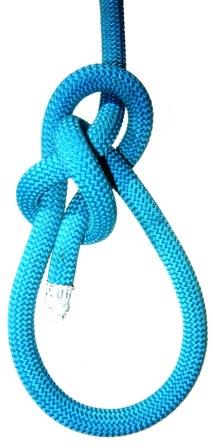
This lovely image is the Carrick Component.

https://igkt.net/sm/index.php?action=dlattach;topic=6223.0;attach=22988;image

(thanks Mark)

Tie a Carrick bend, dress and set it. Then carefully remove one end, keeping the structure on the other end intact. You will see that the Carrick bend is two of these components interlinked through their loops, each is taking its requirements from the other whilst satisfying the requirements of the other.

The Carrick Component has a Bight subComponent and requires the legs of this sub component to be clamped in order for them to provide negative linear cogging. The component also requires a hitching core into which it can transfer its load force. In return the component produces significant constriction force within its constricting loop.

A key feature of the Carrick is its long clear opening face which is essentially unjammable.

Another key feature of the Carrick bend or loop is that they are ‘self dressing’ as load is applied they auto configure into two enmeshed Carrick Components with a high degree of reliability. It seems as though this structure has a high intrinsic stability (minimal energy configuration).

per Derek:

[b]Xarax [/b]is quite correct in stating that the collar of the bight component is important, but he is wrong in letting you conclude that the [b]collar [/b]is the [b]key functionality[/b] of the [b]Bight Component[/b].

I march to the beat of my own drum - and am not a puppet for Xarax.
However, Xarax has generously shared his unique insights into knots and knotting.
Xarax (I am sure) does not see one element dominating within a ‘Bowline’.

Xarax simply points out that the ‘bight’ in a #1010 common Bowline actually consists of sub-components (sort of like Protons and Neutrons actually consist of Quarks - maybe Xarax sees Quarks and in contrast, you see Protons and Neutrons!).
Xarax had long ago pointed out that a ‘bight’ in a #1010 Bowline has a collar and 2 legs (an entry leg and an exit leg). The SPart acts as a bracing post for the collar.

The human body consists of many individual organs (components) which are all holistically inter-dependent. The same analogy applies to knots - which has individual components that are holistically inter-dependent. I think Xarax understands this well.

Xarax almost certainly perceives this 'whole picture', but he [b]failed you[/b] by not explaining it to you and by leaving you with the perspective that the Turn subComponent (ie collar) was a key identifier for the Bowline. I am sorry for calling Constant out on this when he is not able to respond, but he can perhaps respond by email - he has mine.

I think you have followed some breadcrumbs and tried to join them up to form a path - but that pathway has led you in the wrong direction and is manifestly incorrect.
I believe that Xarax sees the collar (and its 2 legs) as playing an important role in a ‘Bowline’ - but, I dont believe that he thinks it is the key underpinning identifier. I cant speak on his behalf but, if I were wagering a guess, I would say that he sees a number of elements all working holistically together - with the collar (and its 2 legs) being one of those elements.

The Carrick Component has a Bight subComponent and requires the legs of this sub component to be clamped in order for them to provide negative linear cogging. The component also requires a hitching core into which it can transfer its load force. In return the component produces significant constriction force within its constricting loop.

Your use of the term ‘Carrick component’ to describe a particular 3D structure is, (in my view) arbitrary. The #206 / #1174 Crossing hitch is not unique to the #1439 Carrick bend. The #1439 Carrick bend has no unique claim to #206 / #1174 - this structure exists elsewhere.

The core of #1439 Carrick bend (in my view) consists of 2 inter-linked Crossing hitches (#206 / #1174).
In order for the 2 crossing hitches to remain linked and stable, there must be simultaneous ‘through loading’ from both SPart’s. What is occurring is that the continuation of each SPart traps and clamps the tail of its counterpart (opposite) crossing hitch. The trapping and clamping of the tails is occurring simultaneously in a balancing act.

Further off-topic remarks:

There is no functional ‘nipping structure’ in #1439 Carrick bend - because each Crossing hitch is only loaded at one end. It is a balancing act of forces - where the tail of each crossing hitch is simultaneously trapped and clamped.

Of further note re ‘stability’ of a singular Crossing hitch: (tied as a Munter hitch)
The hitch will capsize in accordance with which end load is applied. That is, the #206 / #1174 Munter hitch will undergo a transformation event (ie capsize) from one energy stable state to another energy stable state in accordance with which end is loaded. One end will always play the role of ‘SPart’.
I also believe that a ‘capstan effect’ plays a [lesser] role - in that, any potential slippage of a tail is inhibited by the U turn of the tail around its own SPart.

And this U turn of the tail around its own SPart is key to understanding how a Munter hitch works (again, the capstan effect). The SPart acts as a bracing post around which the rope segment flows in a U turn.

Also, #1439 Carrick bend is a final energy stable state which results from a capsizing event inducing from a particular initial dressing state.
Although, it is possible to tie the final energy stable form directly, by tying and inter-linking the 2 crossing hitches directly (which thereby avoids the capsizing event some knot tyers use to reach the final Carrick bend form).

Back on topic to your original post:
The original contention in this thread was in relation to Grant Prattley identifying the ‘anti-Bowline’ (aka Eskimo Bowline) as a #1431 Sheet bend. The manner in which his report was written and the loading profile of the knot structure depicted in his photos, was not a ‘Sheet bend’.

What Grant (I think) was trying to do was point to the core of the anti-Bowline - which he apparently noticed had a striking similarity to a Sheet bend. He then conducts some tests (which are vaguely documented) and declares the anti-Bowline inferior (and suggestive as high risk).
I can only assume that in his testing, he loaded the anti-Bowline as an eye knot - with load directed to the core via the SPart.
I dont believe that he tested his article test sample as a round sling using #1431 Sheet bend to unite the 2 ends (to form the sling).
His conclusions are therefore (in my view) based on an incorrect premise, because it isn’t even clear if he understands the difference between an ‘end-to-end joining knot’ versus an ‘eye knot’ in terms of loading profile. All one could infer is that he noticed a striking similarity between a #1431 Sheet bend and the core of an ‘anti-Bowline’.

Re: The Sheetbend loop knot and the Carrick bend loop knot. ? Reply #22 on: August 17, 2018, 01:19:00 AM ? Quote per Derek: Quote I feel the only thing 'great' about this debate has been the number of words consumed by it thus far, with yet more to come?

I was under the impression that this IGKT forum provides (as one of its fundamental tenets) a means for knotting enthusiasts to engage in technical discussions? We may not all agree but, it is through discussion and debate that we can advance our collective understanding. Some have limits as to how far they are willing to venture in ‘discussions’ (and this may in part be reflected in diminishing returns or, perhaps a realization that they may have to revise their own paradigm or understanding of concepts).

Are you hinting that you dont necessarily like to engage in technical discussion - either short or lengthy?
By definition, technical discussions can be protracted because they involve concepts that are complex.

Well Derek, here is another lengthy discussion! All friendly and courteous - I am simply engaging with you in a intellectual discussion.

Indeed Mark, you are correct, however, I do not recognise repetition as discussion, nor does it do anything to progress clarity and understanding. However, let us progress in the hope of sharing views.

I march to the beat of my own drum - and am not a puppet for Xarax. However, Xarax has generously shared his unique insights into knots and knotting.
'Standing on the shoulders of greater minds' is not being a puppet, rather, citing the greater intellect is a mark of respect. Xarax is certainly 'unique', and also powerfully perceptual. However, he is not always right and suffers from a near myopic inability to acknowledge when his perception is flawed.

This problem was highlighted with Xarax’s inability to acknowledge that the Nipping Loop Component was part of a spectrum of hitch components. One end of this spectrum is the Simple Hitch, expanding progressively through a range of ever widening helixes. Through the functional part of this spectrum, they all share the common requirement of a hitch core, without which they cease to exist. They also share the common requirement that both ends of the loop must be loaded. However at the Simple hitch end of the spectrum the nipped end of the loop becomes self loading through the capstan effect leaving the requirement for loading exterior to the nipped end as non obligatory.

Your use of the term 'Carrick component' to describe a particular 3D structure is, (in my view) arbitrary.
And of course, yet again, you are totally correct.

But then, as awareness of this component did not exist until I described it, I felt obliged to give it a descriptive name. So I chose the name of the knot which features just two of these components. Of course it is arbitrary, so if you feel strongly that it should be called by some other identifier, please feel free to offer up a proposal.

There is no functional 'nipping structure' in #1439 Carrick bend - because each Crossing hitch is only loaded at one end. It is a balancing act of forces - where the tail of each crossing hitch is simultaneously trapped and clamped.

And here you are falling into the trap of demanding that a nipping structure must be externally loaded at both ends.

Working with just one Carrick Component for clarity, seize the legs of the Carrick bight sub component (this would be accomplished by some other component of the knot). Place a hitch body through the loop (again this would be provided by some part of the other component) and apply load. The loop will close and grip (nip) the hitch component. If this is not clear to you then I need to work on my explanation of this process, because I will be at fault for failing to explain.

Back on topic to your original post:
Good reminder - the (rather trivial) point of the OP was the observation that all loop knots are also bends.

Derek

Here is another protracted collection of words :slight_smile:

per Derek:

And here you are falling into the trap of demanding that a nipping structure must be externally loaded at both ends.

There is no trap that I am falling into!
I probably should have used the phrase ‘nipping loop’ instead of ‘nipping structure’. You seem to zero in on certain key phrases and then draw false conclusions. I will have to be extremely careful with my use of the English language - to ensure that it is difficult to interpret in a way that I did not intend. Which might in fact be the heart of the matter - in that we likely construct different meanings for certain key words.

The reason I use the phrase ‘nipping structure’ (in certain specific cases) is to denote that the form ‘it’ takes isn’t in the shape of a helix. I reserve the phrase ‘nipping loop’ only for use in certain instances. And I am careful in its use so as not to dilute its meaning. To me, the word ‘loop’ has a very specific meaning.

In #1010 common Bowline, the nipping mechanism is a loop that is loaded at both ends. This ‘loop’ may be of S or Z chirality and takes the form of a helix. I had previously defined what a ‘loop’ is. I am careful in assigning the term ‘loop’ - and distinguish it from ‘eye’ and ‘round sling’. So therefore, in #1010 Bowline, I refer to the nipping mechanism specifically as a ‘nipping loop’.

One thing I think we can agree on (and I am beginning to think that the root of the issue is how we both choose to interpret the English language) - is that illustration number #1010 in ABoK is [a] ‘Bowline’.

And I hope that you would also agree that illustrations #1012, #1013 and #1034 1/2 are all ‘Bowlines’.
#1012 is based on a clove hitch (which permits wide separation between the loops)
#1013 is based on a double helix (in which the helices cannot be separated)

With #1012 and #1013, it may be inaccurate to describe these Bowlines as having a nipping ‘loop’ (which is singular, not plural). It may be more accurate to use the phrase ‘nipping structure’. Again, it is careful use of the English language in an attempt to be precise.

Either way, both ends of the nipping ‘structure’ are loaded. And this is a definition which I have assigned - for more precision. For example, the difference between a ‘loop’ and a ‘nipping loop’ is that in the latter, both of its ends are loaded. In #1431 Sheet bend, (in my view) there is no ‘nipping loop’ - because ‘it’ (the loop) is only loaded on one end. It (ie the Sheet bend) definitely has a ‘loop’ - but it isn’t a ‘nipping loop’.

In the case of a #206 / #1174 crossing hitch (or ‘knot’ depending on how you choose to conceptualise the structure), it does not take the form of a pure helix. You prefer to use the arbitrary term ‘Carrick component’ to describe this structure. I think the use of this phrase is arbitrary because this structure is not unique to the #1439 Carrick bend - that is, the Carrick bend has no unique title of claim to these hitching structures.
The term ‘crossing hitch/knot’ (as used by Ashley) at least provides some insight into the geometry of the hitch. With the word ‘crossing’ being in reference to the U turn that the tail makes across its own SPart. Some may prefer to use the term ‘Munter hitch’ - as this is the familiar form to many climbers. The U turn provides a ‘capstan effect’ (and this capstan effect plays a significant role, just as it does in a #206 ‘Munter hitch’).

The operation of a #1439 Carrick bend - and the way it achieves stability and security - is different to a #1010 Bowline. There is no ‘nipping loop’ (a pure helix that is loaded at both ends) within a Carrick bend. Again, I am reserving the term ‘loop’ to mean a helix formed by the overlap of one rope segment over (or under) the other - which can be of S or Z chirality.

Eye knots (to which you prefer ‘loop’ knots) which have a #206 / #1174 ‘crossing hitch’ as a nipping mechanism, are not based on a pure helical ‘nipping loop’ - but, both ends of the nipping structure are loaded.

And this is where things get difficult. Ashley did not depict ‘Bowlines’ using a ‘Crossing hitch’ as a nipping mechanism. And so, this is open to debate.
In my view, a nipping mechanism (or structure) that is not in the form of a helix renders it to a sub-class of virtual Bowlines. The nipping mechanisms in #1012 and #1013 are helical - and can easily be recognized as ‘Bowlines’.

In the attached image of a single Karash eye knot, the nipping mechanism is not in the form of a helix. The nipping mechanism is in the form of a #206 / #1174 Crossing hitch. But, it is loaded at both ends. For this reason, I refer to it as a ‘nipping structure’ (rather than ‘nipping loop’).
All the other elements are present; it has a ‘collar’ - and the collar and 2 legs (which comprise a ‘bight’) are encircled and clamped by the ‘nipping structure’. It has an ‘eye’ (which you call a ‘loop’) that permits attachments / connections. It is jam resistant. By all accounts, the structure ticks all of the box’s with the one exception of its nipping mechanism - which is based on #206 Crossing hitch (and not a pure helix). I believe this structure to be a virtual Bowline.

Another eye knot that presents difficulties is #1033 Carrick loop.
Ashley did not identify this eye knot as a ‘Bowline’.
In my view, this structure also ticks nearly all of the box’s. The problem area is with the 2 legs of the collar (which you may prefer to call a ‘bight’ component).
In Ashley’s depiction of ‘Bowlines’ - the 2 legs of the collar always feed through the ‘nipping loop’ from the same direction. In #1033 Carrick loop, the 2 legs enter the nipping loop from opposite directions. This must have caused Ashley to avoid use of the term ‘Bowline’ to describe the structure.
However, #1033 Carrick loop does have a ‘nipping loop’ (it is a pure helix that is loaded at both ends).
Again, perhaps the title virtual Bowline is appropriate?

And there is also the so-called ‘Myrtle’.
It has a nipping loop that take the form of a helix.
There is a collar and 2 legs.
However, the legs of the collar enter the nipping loop from opposite directions.
Is this a ‘virtual’ Bowline?

And finally (due to limit of 4 photos per post) - there is [a] #1439 derived Carrick eye knot.
The nipping mechanism in this eye knot takes the form of #206 Crossing hitch, and not a helix.
However, the crossing hitch is loaded at both ends and therefore, it can be defined as a ‘nipping structure’. Both legs of the collar are encircled and clamped by the nipping structure. It is jam resistant and it is an eye knot.
All the box’s are ticked with the one exception of the nipping structure (which isn’t in the form of a helix).
Interestingly, the collar does not form around the SPart as with the common #1010 Bowline. Instead, the collar forms around the returning eye leg.
Can this be regarded as a virtual anti-Bowline?
NOTE: In the anti-Bowline (aka ‘eskimo Bowline’) the collar forms around the ongoing eye leg.


Carrick-Loop_1033_Virtual-Bowline_WEB.JPG

Carrick_EyeKnot_1439_Virtual-Anti-Bowline_WEB.JPG

I use the term ‘hitch’ to denote a knot or a component which must have some binding object or component upon which to bind, otherwise when load is applied it will collapse upon itself and fail to function.

In this respect, the Carrick Component is a hitch because it must have a binding object through its nipping loop, otherwise when load is applied it would simply cease to exist.

Derek

It was my one-time hope that one could define what
you present --an entanglement w/ends exiting our view–
as a tangle which would be the basis for then defining
knots by attaching loading specifications. My stumbling
block with this is realizing that already at this tangle
stage there is some implicit loading necessary to give
it shape --thinking i.p. of differences in geometry of
bowline-sheetbend-netknot…- vs. Eskimo bowline-LappBend
(this last, mostly).

One can have some fun loading such tangles by all poosible
–for eye knots, end-2-end knots, stoppers…-- ways. (Or
one can bemoan the too-clerical-like regimen and not want
to accidentally come up with a new tangle!)

–dl*

It is an interesting quality of English that this action
of “doubling” a cord can be equally expressed as . . .
“halving” it ! Should we sanction such uses?
(OOOps, did it again, didn’t I ! ::slight_smile: ;D ).

(Hope I didn’t slow down or slow up this great debate.)

:wink:

@Dan

It was my one-time hope that one could define what you present --an entanglement w/ends exiting our view-- as a *tangle* which would be the basis for then defining *knots* by attaching loading specifications.

I believe Dan , that your ‘one time hope’ is exactly the way we should define our knots - defining the structure of a core / nub / tangle, then turning this structure into a working force machine by defining the function of the lines exiting that structure.

What we are lacking at the moment is some unified form of identifying which line we are referring to as we appoint external functionality.

Derek

But, Derek, as I remarked, it’s not so neat & clean ::
i.p., that the tangle (I use the net-knot/bowline one
for thinking --asymmetric, simple, well-known) comes
with a bias already, versus some things that COULD
arise from the topological entanglement. With
the bowline one, in a Lapp bend the part that is the
SPart for the bowline is unloaded, and really doesn’t
point out of the nub as it does for the bowline/sheet
bend/
… !? What to do. AND should the marlinespike
constructions available from this topological tangle
be included? --can one assign rigidness to one piece
of the material? (The bowline is readily seen in Cape
May trawler dock lines
–which are in use, not out to make theoretical
contributions to knotting(!)–
to be equivalent via loading to a pile-hitch noose,
which is hardly visible in considering a net-knot.
.:. So, maybe we just have a related set of tangles
capturing possible biases?

Your additional point about taking a given tangle
and establishing a point of reference is indeed one
further challenge. It could be that some standards
body just works from some reasonable guidelines
per tangle and assigns the reference item.

–dl*

Derek,

I am working on an update to my ‘Analysis of Bowlines’ paper.

One area I intend to revamp is the definition of a ‘nipping structure’.
I will be adding a qualifying statement that all nipping structures must be [b]TIB /b.
Another way to look at this is to say that a nipping structure is topologically equivalent to the unknot.

Ashley’s conceptualization of [a] ‘Bowline’ is found at illustrations #1010, #1012, #1013 and #1034 1/2.
Note: #1016 is interesting and there is a clue here to Ashley’s mindset - he used the phrase “based on a Bowline” to describe the structure. It did have a nipping structure based on a helix. I think the collar may have confused him…
#1033 confused him - likely because what he would have observed as a ‘bight’ was not in the obvious form as #1010. But #1033 does have a nipping loop that is in the classic helix form.
#1057 & #1058 must be errors - I have no rational explanation as to why he awarded these knots the title of ‘Bowline’.
We also have #1072, #1074 (which has some resemblance to #1016), #1080 and #1087.
#1079 is interesting in that the title ‘Bowline’ is avoided.

In general terms, these ‘eye knots’ (aka loop knots) / Bowlines, are built from nipping structures that take the form of a helix (either single of double helices).

If I could travel back in time and show Ashley an ‘eye knot’ built from #206 Crossing hitch or #559 Marlinspike hitch, I wonder what he would say? Would he regard these eye knots as deserving of the title ‘Bowline’?

In my view, I think that nipping structures that take the form of a helix are the classical notion of a ‘Bowline’ - and that if the nipping structure is of a different form (but still TIB and non-jamming) - perhaps Ashley would agree to the title of ‘Virtual Bowline’?

And this is why an eye knot based on a #46 nipping structure (overhand knot) must be excluded from the title of ‘Bowline’. #46 is not TIB.

Mind you, if I could travel back in time and meet Ashley face-to-face, I would also urge him to lock down the definition of what constitutes a ‘loop’ :slight_smile:

@ Mark

#1033 confused him - likely because what he would have observed as a 'bight' was not in the obvious form as #1010. But #1033 does have a nipping loop that is in the classic helix form.

In what way do you feel that Ashley was ‘confused’ by #1033? As depicted, it has a collar and a nipping helix loaded both ends - doesn’t that fit your criterion? Just how long must bight legs be to qualify as a bight?

Derek

per Derek:

In what way do you feel that Ashley was 'confused' by #1033?

Derek, clearly and obviously - Ashley identified illustration #1033 as a Carrick loop.

As far as my ability to read Ashley’s description of #1033, I could not see specific words that described or identified it as a ‘Bowline’.

That is, he did not identify #1033 as being a ‘Carrick Bowline’ or any type of ‘Bowline’.

#1033 characteristics:
has a nipping component that is based on a helix that is loaded at both ends, and is also TIB and non jamming
the nipping loop is free to encircle and clamp both legs of the collar

So I am making an assumption that he was confused by the 2 legs of the collar (which you may prefer to conceptualize as a ‘bight’) entering the nipping loop from opposite directions. I speculate that this ‘bight’ component didn’t appear quite right to him, and so he dismissed it as being a type of ‘Bowline’.

Derek, clearly and obviously - Ashley identified illustration #1033 as a Carrick loop.

As far as my ability to read Ashley’s description of #1033, I could not see specific words that described or identified it as a ‘Bowline’.

That is, he did not identify #1033 as being a ‘Carrick Bowline’ or any type of ‘Bowline’.

Indeed, he showed no signs of confusion you suggest he suffered. His words are quite clear:-

"1033. The CARRICK LOOP has the same formation as one of the so-called CARRICK BENDS. It is easy to untie, but has no advantages over others that are simpler.

You state “#1033 confused him”, where do you find his confusion?

Derek

Indeed, he showed no signs of [b]confusion [/b]you suggest he suffered.
You state "#1033 confused him", where do you find his [b]confusion[/b]?

In my personal estimation, I think that you are suffering from a form of self-induced confusion in your persistence with this matter :slight_smile:

Your confusion (with respect to misunderstanding my point) - stems from an unwillingness to take a different viewpoint of what I wrote. You are fixated on a single word - and this fixation appears to be unyielding and resolute.
Try imagining this matter from this viewpoint; virtually all of the building blocks required to build a ‘Bowline’ were staring him in the face. And yet, despite virtually all of the building blocks being present, he apparently was unable to join all of the dots and see #1033 from a different perspective. Sort of like you being unable to see from a different perspective.

I advanced the word ‘confused’ to describe this missed phenomena. Now, you may not like that choice of word and may wish to fixate on it in some way to challenge me. And thats fine… But you should consider that the word ‘confused’ does not have to have demeaning interpretation toward Ashley. Some highly experienced people can become ‘confused’ by different visual inputs - eg pilots in the cockpit of an aircraft can become confused - and this does not imply that they are incompetent.

I guess we’ll never really know if Ashley was ‘confused’ by what he held in his hand some 70 or so years ago.
But, if you feel the onus of proof lies with me to prove beyond a reasonable doubt that Ashley was ‘confused’, then by court room standards, I would likely be unable to conclusively prove it.

EDIT NOTE:
I have added some images to show that there are 2 different eye knots bearing the word ‘Carrick’ in their name. One is more closely aligned (in terms of geometry) to #1439 Carrick bend than the other. I believe that Ashley was possibly thinking in terms of the #1439 derived Carrick eye knot when he made his remarks, and not the form taken by #1033 (which has a different geometry). But, given the use of word ‘carrick’ in both knots, this is another potential source of confusion!
It should also be pointed out that the #1439 derived Carrick eye knot exists in an unstable dressing state…in that, when load is applied, it undergoes a transformation to a energy stable state.


Carrick-Bend_EyeKnot_1439_WEB.JPG

Thanks Mark for the clarification,

I do not believe for one moment that Ashley was confused, either personally, nor perceptually by the lacing he displayed in #1033. I believe that Ashley’s perception of a dressed and set knot was well beyond being seduced by the apparent structure of a lacing, which is what I believe is perhaps what you and others have fallen foul of.

Your most excellent image of the lacings of #1033 holds all the attributes you claim he ‘should’ have been able to identify as a Bowline.

https://igkt.net/sm/index.php?action=dlattach;topic=6223.0;attach=23092;image

  • excellent photography Mark -
  • a collar around the SP, a double loaded nipping helix, and collar legs within the nipping helix.

But Ashley was not stupid enough to be seduced by a lacing diagram - he would have dressed and set the knot, then seen immediately that it is as he described it "1033. The CARRICK Loop has the same formation as one of the so called single CARRICK BENDS".

Unless you are seduced into seeing in the lacings what you wish to see, then there is NO CONFUSION.

Your SP loaded Nipping Helix component vanishes in the fog of preconception. It becomes part of a Carrick Component, and the now functional Nipping Helix, looking decidedly like a Simple Hitch Component has only a loop leg to load it. There is not the slightest semblance of a Bowline left unless you count the all too seductive Collar around the SP (which of course is present in just about every knot).

But, given the use of word 'carrick' in both knots, this is another potential source of confusion!

So it seems, but not for Ashley !!

It should also be pointed out that the #1439 derived Carrick eye knot exists in an unstable dressing state...in that, when load is applied, it undergoes a transformation to a energy stable state.

It is interesting that you made the above observation (although it is an unstable ‘lacing state’, not ‘dressing state’). Dressing the knot forms it into the stable, low energy state, it will hold under load.

But, given you understand this is a function of Carrick style lacings, why did you not apply the same knowledge to #1033 ? Ashley clearly did…

Derek

per Derek:

Your most excellent image of the lacings of #1033 holds all the attributes you claim he 'should' have been able to identify as a Bowline.
It appears that you are not reading carefully enough - and the trail of breadcrumbs is leading you off the flight path. I used the phrase 'type of Bowline'. I believe that #1033 Carrick is a [b]type [/b]of 'Bowline'. I didn't (on this occasion) use the specific phrase 'virtual Bowline' - largely because the [i]nipping loop[/i] takes the form of a helix, is loaded at both ends, is TIB, and freely able to encircle and clamp both legs of the collar. In hindsight, I should have used the phrase 'virtual Bowline'. NOTE: I am still working on a set of 'rules' for using the term 'virtual' as a qualifier - and indeed, in the past had [i]toyed [/i]with alternative descriptors such as 'pseudo Bowline' and 'sub Bowline'.
Unless you are seduced into seeing in the lacings what you wish to see, then there is [b]NO CONFUSION[/b].

I think your use of the word confusion is misplaced - because in this instance you are seduced into seeing structural components in #1033 Carrick ‘loop’ which actually differ from the #1439 derived Carrick eye knot. The alternating weave in the #1439 derived Carrick eye knot follows the uniform over-under-over-under repeating pattern. In #1033 Carrick ‘loop’, not quite - there is a break in the uniformity.
Also, in #1033 Carrick ‘loop’ both legs of the collar are encircled by the nipping loop.

However, in the initial dressing state of #1439 derived Carrick eye knot, the nipping loop does not encircle both legs of the collar. Also, the geometry in the #1439 derived Carrick eye knot is a ‘dressing state’ - it is transitory. As soon as load is applied, it undergoes a transformation. Interestingly, after transformation into an energy stable dressing, the nipping component then encircles both legs of the collar.

Your SP loaded Nipping Helix component vanishes in the fog of preconception.
I think you may be lost in a fog of your own preconception :) The [i]nipping loop[/i] in #1033 Carrick 'loop' remains functional. The core structure of #1033 does not undergo a transformation. Its dressing is not transitory (ie not a 'dressing state').

Ashley may have believed that he was looking at the uniform and repeating weave pattern of a #1439 Carrick bend - and it does appear to be so with a cursory glance. With closer inspection, the over-under-over-under pattern is not uniform in #1033 - this should be apparent to you unless you are seeing through fog!

I think illustration #1016 is an important clue. Initially, there is a functional nipping loop but, the last item in completing the dressing deactivates the nipping loop. And I think that Ashley understood this.

However, he was either confused by illustrations #1057 and #1058 or, it is an error that wasn’t caught in time before before publication. In my view, these structures do not qualify as ‘Bowlines’ or even ‘Virtual Bowlines’.

Pilots can become confused in a cockpit of an aircraft. This does not mean they are stupid or incompetent. The word ‘confused’ does not have to be constructed with a demeaning interpretation. And I think you are confused with my use of the word confused - and are confusing it with an alternative dictionary meaning for confused. :smiley: