Indeed, this is an intellectual discussion - and that is one of the purposes of this forum - to facilitate discussion.
We dont all have to agree of course - and thats fine. But, I sense that you might reach your limits of acceptance of this back n forth discussion at some point?
I don’t profess to have all the answers Derek - but I do like to have a solid theory / set of rules to describe knots.
I do feel that the key to this discussion is nailing down (ie solving) knotting definitions/terminology (eg ‘loop’, versus ‘bight’, versus ‘turn’, versus ‘hitch’, versus ‘end-to-end join’, etc).
per Derek:
You have decided that all the knots described by Clifford Ashley as Loopknots will be renamed as Eyeknots for three reasons :-
A. ABOK is a "throw back to the era of Clifford Ashley"
B. Loopknots have the same form as a metal Eyebolt .
C. The commonplace existence of spliced eyes (with or without thimbles).
Have I missed anything significant?
You asked the question; “Have I missed anything significant”.
My respectful response is; Yes. You have missed a lot of significance (and that is not intended as an insult - its simply my response to your question).
In reference to your point ‘A’:
ABoK was published in the 1940’s.
Ashley wrote his masterpiece in that era (obviously) - and he was bound by the limitations of understanding at that time.
Ashley didn’t have the internet or a computer (obviously). So he couldn’t collaborate like we can today.
It is unlikely that Ashley engaged in technical discussions like we are now - with peers from around the world. I would say that he tried to source written texts that were available to him at the time - but the content was largely evolved from his mind and his personal experiences - together with the common vernacular at the time. So, Ashley’s use of the descriptor ‘loop’ was the best effort for that era. Things were less complex in those days - there wasn’t the multitude of new knots and Bowline discoveries as we have today - so classifying things was somewhat easier. Precise use of language to clearly define what a ‘loop’ is wasn’t necessary. It was sufficient to simply use the term loop - and it wasn’t questioned.
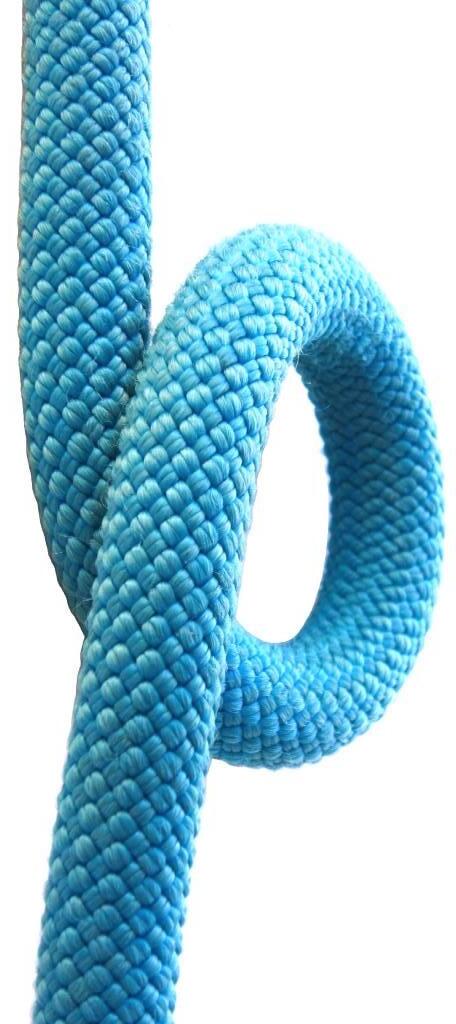
With the virtual explosion of new knots claiming the title of ‘Bowline’ - I (and others) found ourselves in a position of having to more clearly and precisely define what constitutes [a] ‘Bowline’. And this gave rise to the concept of a ‘nipping loop’ (which I conceptualise as a closed helix that is loaded at both ends). And this definition had to be distinguished from an ‘eye’ (which is fixed, and not collapsing like a noose); and so on…
Now, I did say that the term ‘loop knot’ was a throw back to the era of Ashley and ABoK. But, I didn’t say; “ABoK is a throw back to the era of Clifford Ashley” - since that wouldn’t make sense!
What I was referring to is that Ashley’s use of the term ‘loop’ - is what I conceptualise as an ‘eye’ (and yes, by definition, the ‘eye’ is fixed - otherwise it wouldn’t be an eye, it would be a noose).
In reference to your point B:
I did not state that; “Loop knots have the same form as a metal eye bolt”
Respectfully, I am not sure how you derived that understanding? (you will not find those typed words - because I would never make such a remark).
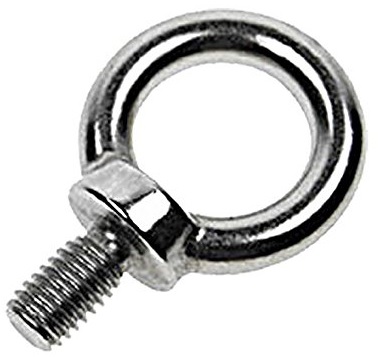
Please understand that my reference to eye bolts (which are distinct from ring bolts), is to provide an analogy.
The idea being that an eye bolt provides a means to connect or attach something.
Its the same with ‘eye knots’ - in that the ‘eye’ permits connections/attachments.
Obviously, a metal eye bolt isn’t a knot. It was simply an analogy.
In terms of terminology, if I walked into a hardware store - I would ask for an ‘eye bolt’. I wouldn’t ask for a ‘loop bolt’ or a ‘bight bolt’. Its ‘eye bolt’.
In the same light, there is ‘eye splice’ - it isn’t ‘loop splice’ or ‘bight splice’.
With reference to your point C:
“The commonplace existence of spliced eyes (with or without thimbles)”
I looked back over my previous posts and could not find any specific argument that I tendered in detail about eye splices.
However, I would again emphasize that an ‘eye splice’ permits connections/attachments to the ‘eye’. It is an analogy.
I would not refer to an ‘eye splice’ as a ‘loop splice’ or a ‘bight splice’.
Derek, with respect - I dont think you have tendered a precise definition of what constitutes a ‘loop’ so as to clearly distinguish it from a ‘bight’ and a ‘nipping loop’ and a ‘turn’.
For example, at what point do you consider a ‘bight’ to make the transition to a ‘loop’? And how do you distinguish between a ‘turn’ and a ‘loop’ (and indeed a ‘hitch’)?
For example, Xarax has advanced that a ‘loop’ takes the form of a closed helix, but does not require a full 360 helical arc to be scribed. He says it can be less than 360 degrees.
Also of interest is distinguishing a ‘bight’ from a ‘loop’ (in precise, measurable language).
(I also feel that you haven’t addressed my distinction of a round sling that is formed by taking 2 ends of a length of cord and then uniting the ends with an ‘end-to-end joining knot’ - which you possibly refer to as a ‘loop’?).
Some random points:
It is implied that the ‘eye’ in an ‘eye knot’ is fixed. It does not act like a noose. I sometimes conceptualise a noose as having a collapsing eye.
I did point out that Ashley made a number of errors in ABoK - but this is understandable. Firstly, he is (was) human -and all humans make mistakes, we are not infallible. Secondly, Ashley didn’t have the power of a computer and the internet like we do today. He did have multiple entries for the same knots, and in my view, he did not have a robust theory of what constitutes [a] ‘Bowline’. I gave examples of 2 entries in ABoK that were erroneously labelled as ‘Bowlines’.
Ashley’s definition of [a] ‘bend’ is problematic. And further, he wasn’t clear on the correspondence between eye knots and bends. In my view, a clearer term is ‘end-to-end joining knot’.
I think you haven’t fully defined what a ‘turn’ is. For instance, does a ‘turn’ form around an object? Example is a ‘round turn and 2 half hitches’. Does a ‘turn’ uniformly encircle a parent object? Is ‘uniform encirclement around an object’ a necessary qualifier? If yes, then how many degrees of arc must be scribed to create a ‘turn’? The encirclement usually takes advantage of the ‘capstan effect’.
Xarax had proposed qualifying terms such as:
‘U turn’ to denote a 180 degree partial encirclement
360 degree uniform encirclement (with each end exiting at opposite sides)
540 degree uniform encirclement (where the tail exits in the same direction and in parallel with its own SPart)…and this would be a ‘round-turn’ in the common vernacular. A capstan effect would play a role.
And the term ‘hitch’ - eg #1763 Prusik hitch.
Does a ‘hitch’ form around a parent object and exert a force upon that object? For example, a ‘Prusik hitch’ exerts a force by crushing the parent object that it is formed around. If you remove the parent object, the hitch ceases to exist. Note that uniform encirclement isn’t a qualifier to be classed as a ‘hitch’ (in my view).
And #1195 ‘Munter hitch’ - is this a subset of hitch termed ‘load control’?
For a Munter hitch to function, it needs to form around a parent object (eg a carabiner). If you remove the carabiner, the Munter hitch ceases to exist. It is possible to control loads using a Munter hitch…and indeed, in my view it works because of a ‘capstan effect’.
With reference to eye bolts:
Link: https://en.wikipedia.org/wiki/Eye_bolt#Ring_bolts
Note the sub reference to ‘ring bolt’.
Ring bolt references:
https://www.bunnings.com.au/zenith-110-x-9-3mm-galvanised-ring-bolt_p3968405
http://wireropeshop.co.uk/wire-store/index.php?main_page=index&cPath=17_87
https://www.sheridanmarine.com/product/ring-bolt
EDIT NOTE:
I have made numerous grammatical corrections and clarifications to make sure that my use of language is as precise as I can achieve (with my non scholarly education level). This is so what I wrote is more difficult to misunderstand.