I discovered by accident that an old t-shirt can provide some basic cordage if you tear strips off it. The back of the t-shirt is the longest (and likely least worn) part, so if you snip through the hem at about 1” (2.5cm) width then tear the full length, the edges will roll in to the centre, and you can further encourage this by slowly pulling it through one hand (light grip) with the other.
Assuming a 100% cotton t-shirt, you’ve got a bio-degradable binding for rubbish or to loosely tie back tender plants. Or where you are anxious to avoid surface damage. Being soft and stretchy, any knots worked tight are likely to be permanent.
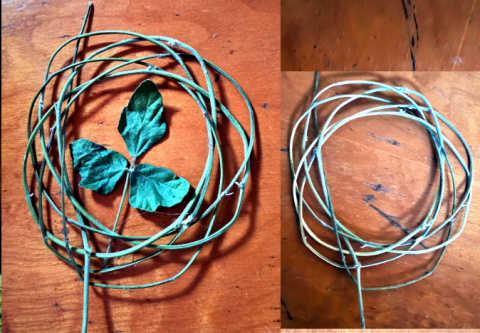
apparently this is a vine pest common to the area,
it’s like a continuous 3mm cord,
needs the leaves taken off it but that’s easy. it’s pretty straight and strong. can’t tie it much past, say, a 2½" diameter.
i think it could do as a Constrictor knot (on a 2½" pipe).
haven’t made anything practical with it but here’s a 5Lx8B ring braid i tied
and how it fared after a few weeks drying out.
[pardon my editing pic; the vine didn’t shrink, i just made the second pic smaller].
it should weave just great
The key is flexibility. Wadab (boiled spruce roots) or withys (twisted shoots from e.g. willow or birch) are eminently knotable, but sometimes fracture when bent too sharply. Still perfect for temporary bindings in the woods, since no synthetic cord will be left be left behind.
Strangest material for me? A partially sun-rotted tarpulin had some substance left in the reinforcing fibers: they made a barely serviceable cord.