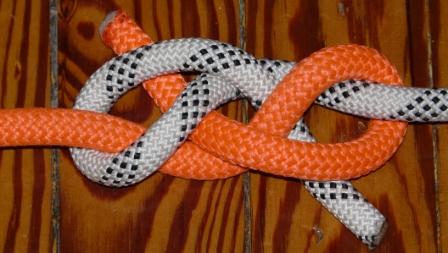
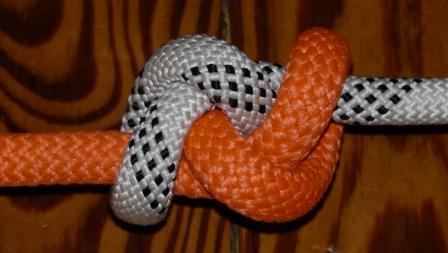
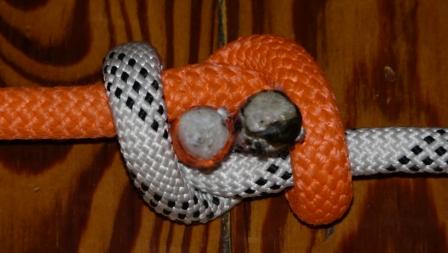
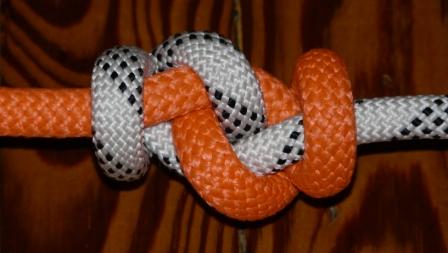
In a second variation of the Double Harness bend with parallel ends, the tails of each rope are tucked differently, so, in the tightened knot, they come closer to their standing ends. This final knot is shorter, and more compact than the “usual” one (1). I do not understand why the second variation is not as well known as the first. Is there any particular reason for that ?
The knots are roughly the same size : there are sort of four diameters
of rope in knot length --viz., the turns of the two S.Parts around each
other, and the two tails pinched within. You might be seeing the
effects of firm rope tied devoid of serious loading, and the tails don’t
want to bend so sharply in the cited (vs. photo’d) “usual” form.
A reason for the other form is the circumstance of tying: one cannot
lay the tails into that nice crossing relation you show if tying first
one and then the other half of the knot --one of the values for this
joint (and the “single” is that by virtue of the 2nd-tied, finishing
half being but a half-hitch, for ease of forming).
This is a knot to consider for rockclimber’s tying tubular webbing
ends together to form slings! (And there, the tails will take a 3rd
orientation.)
The “short” (versus “long”) adjective describes the set and hand-tightened knot, what we have in our hands just after we finish it. Now, as the knot is put under stress, it is deformed, and the difference diminishes. However, on two Double Harness bends with parallel ends, one “short” and one “long”, tied with identical ropes and loaded with identical weights, and put the one besides the other, we will still be able to observe the length difference. That is why I have used those adjectives, in absence of anything better…
In the “short” version of the Double Harness bend, each tail is pushed onto, and squeezed by, the (one) leg of the other rope s collar (the leg of the Standing part of this rope), and not onto the other tail. This might spell a difference in the knot security, but I really can not tell without experiments. To my eyes, the tails are more encircled and better fit into the knot s nub, in the case of the “short” version, but that might well be only a naive impression.
P.S. (2013-11-27)
A similar “Short” and “Long” dressing of the point-symmetric Double Harness bend is shown at the attached pictures. ( One can see that the difference in length is even smaller than in the case of the Double harness bend with parallel ends ). At the “Short” dressing, where the tails of the two links overlap each other, the curvilinear paths followed by the lines are smoother.
This knot is appealing so far based on my preliminary testing. ABOK says it’s hard to untie, but I have not found that to be the case.
This version of the Double Harness Bend is like a compact Carrick Bend. Does anybody have any thoughts of how it compares to the Carrick Bend, or any thoughts in general?
Yes, I concur in this observation --contrary my sizing-by-diameters
belief of equal length, above.
With some minor alterations, one can derive the Reever bend from this
version of the dbl.harness bend --as opposed to the version where
ends exit in opposite directions (and so SParts have Z & S turns).
The untucked “Sidewinder” bend (1)(2), is just the “short” Double Harness bend, discussed in this thread, where the ends, before been tucked, are twisted around their own standing parts - something like what agent smith has done with the Hunter s X bend, in (3). The author of the original “Sidewinder” bend had realized it at (4), and proposed the name “Double-and-a-half Harness bend”, or even “Triple Harness bend”, for the untucked “Sidewinder” bend.
I am not sure that such a twist can offer something new into the parent bend, regarding strength, and the one-diameter twist might even be regarded as detrimental in this, although one might argue that it enhances security, with slippery materials.
(See the attached pictures for an easy comparison between those two bends)