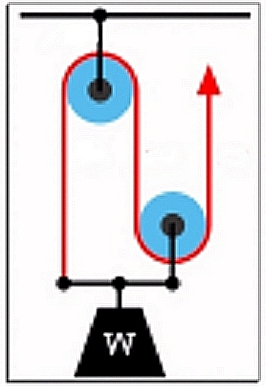
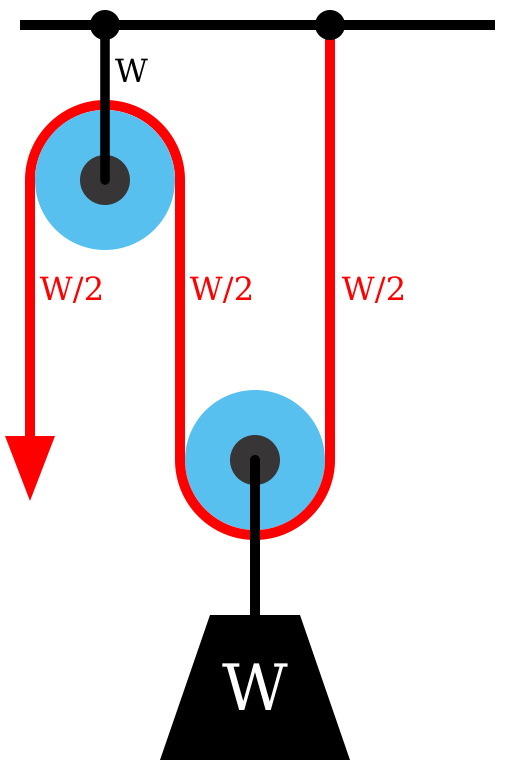
I have a problem with the often-repeated claim that the Trucker’s hitch gives a leverage advantage of THREE-to-one.
I believe this is incorrect, and that the advantage is just a factor of TWO. The loop in this hitch acts identically to the {upper} pulley in the simplest block-and-tackle arrangement. The WEIGHT is being ‘lifted’ by the bight at the bottom, (in most illustrations), and this bight thus carries ALL of the weight, on two ropes! All that the loop, or pulley, really does is to REVERSE the direction of the final pull, so it adds no advantage.
I recall from high-school physics that the rule is: ‘Count the amount of rope-lengths hanging down, then subtract one, to find the advantage.’ This can be checked very simply: pull DOWN on the end rope by a certain distance, say 12 inches. If you are TRULY getting a 3-to-1 advantage, then the loop should rise just FOUR inches.
Yet, it goes up SIX inches, in the Trucker’s hitch, when you pull 12. Thus, your advantage must be 2-to-1. If you test this, under load, you’ll see that I’m right. All the books seem to be giving incorrect information about this hitch, {in my opinion}.
Am I missing something about how this hitch is used? I know that it is NOT used as a pulley for lifting, generally, (though it COULD be used in this way), but more for tying down bulky loads, on top of an open truck, to achieve a tight lashing. Still, I don’t see any way of using it, even for this purpose, that would yield a 3-to-1 advantage.
It’s always bad news when someone believes they’ve tightened something securely, only to have physics prove them wrong.
I’d appreciate any feedback. Are the books wrong, or am I?