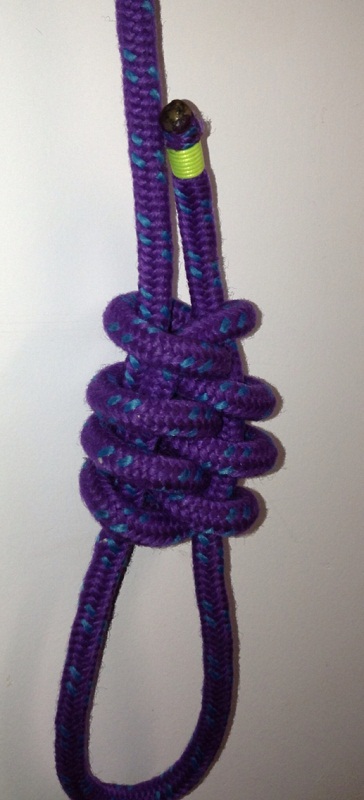
2440, to be precise ! 
The four ( 4 ) pictures shown at Reply # 6, (1), were more than enough, I know… I will be so glad if somebody will manage to say the same things in just a few words ! The interested reader is kindly requested to try his/her hand - and then I will be free to proceed and draw what I am really interested in : a 3D PDF file image of this knot, which one can rotate, translate, zoom and expand to whatever angle, distance, scale and volume he/she wishes…
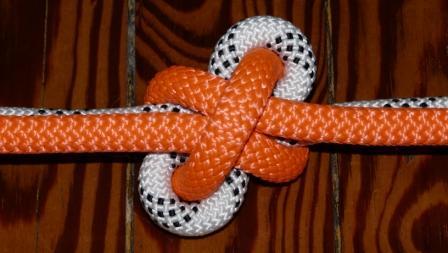
The TweedleDee bend, shown by Roger E. Miles ( and the eye-knot which corresponds to it ) is, in fact, a very simple knot - just two “8” forms, interwoven to each other in the most reasonable, symmetric and simple way. The four bights have to encircle the pairs of the parallel segments of each link.
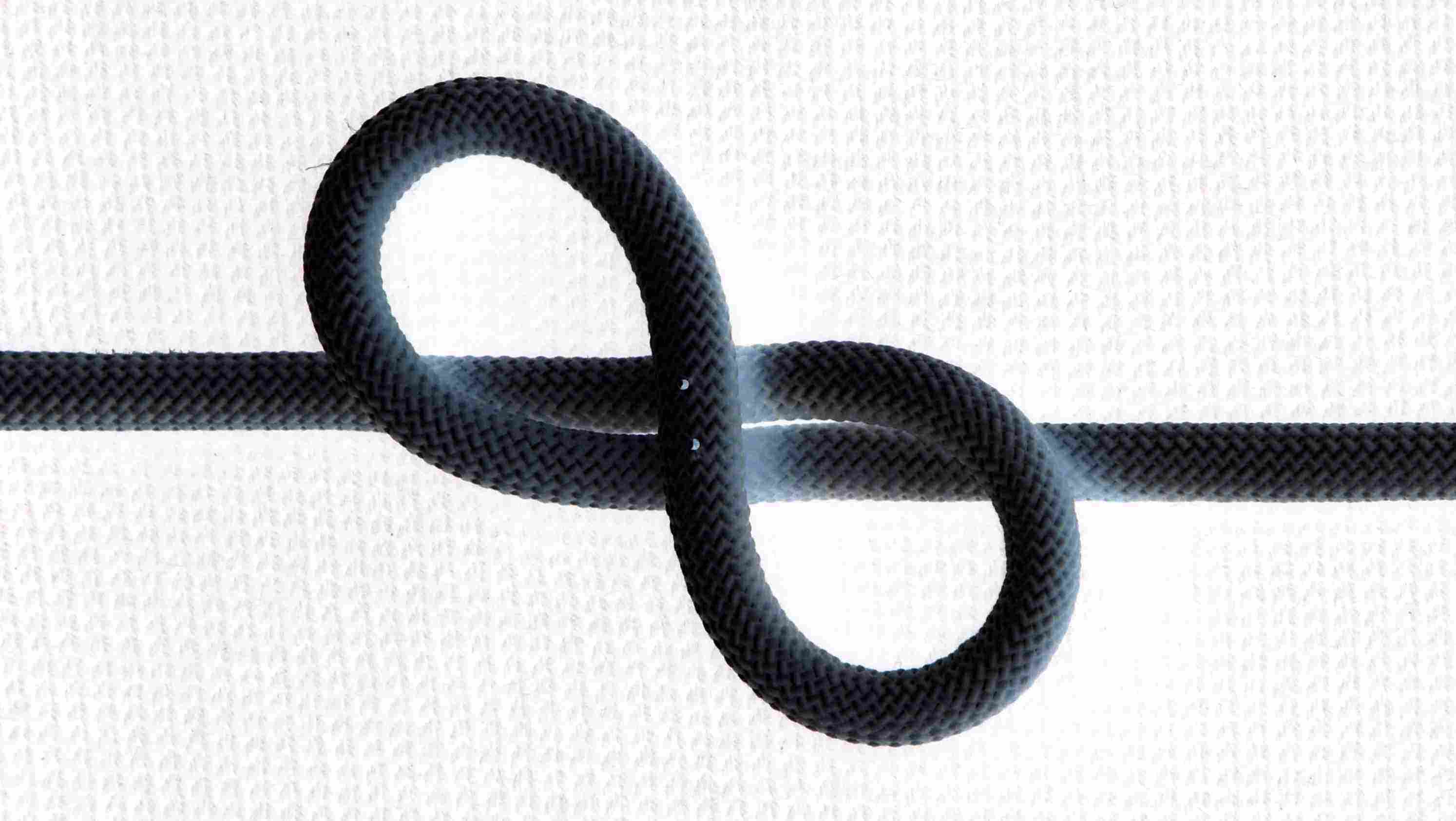
See the attached pictures, for a sequence of moves to tie it. The pictures shown, and the brief verbal instructions below, can be used as a very simple guide :
First picture / stage:
Form an 8-shaped, diagonally opposed double nipping loop on the Standing Part of the eye-knot, where the straight segments of the Standing Part and the working end lay parallel against each other.
The purpose of the whole tying sequence is to weave an identical second 8-shaped double nipping loop, formed on the second line, within and around this first one. It should be of exactly the same shape as the shape of the 8-shaped double nipping loop formed on the Standing Part.
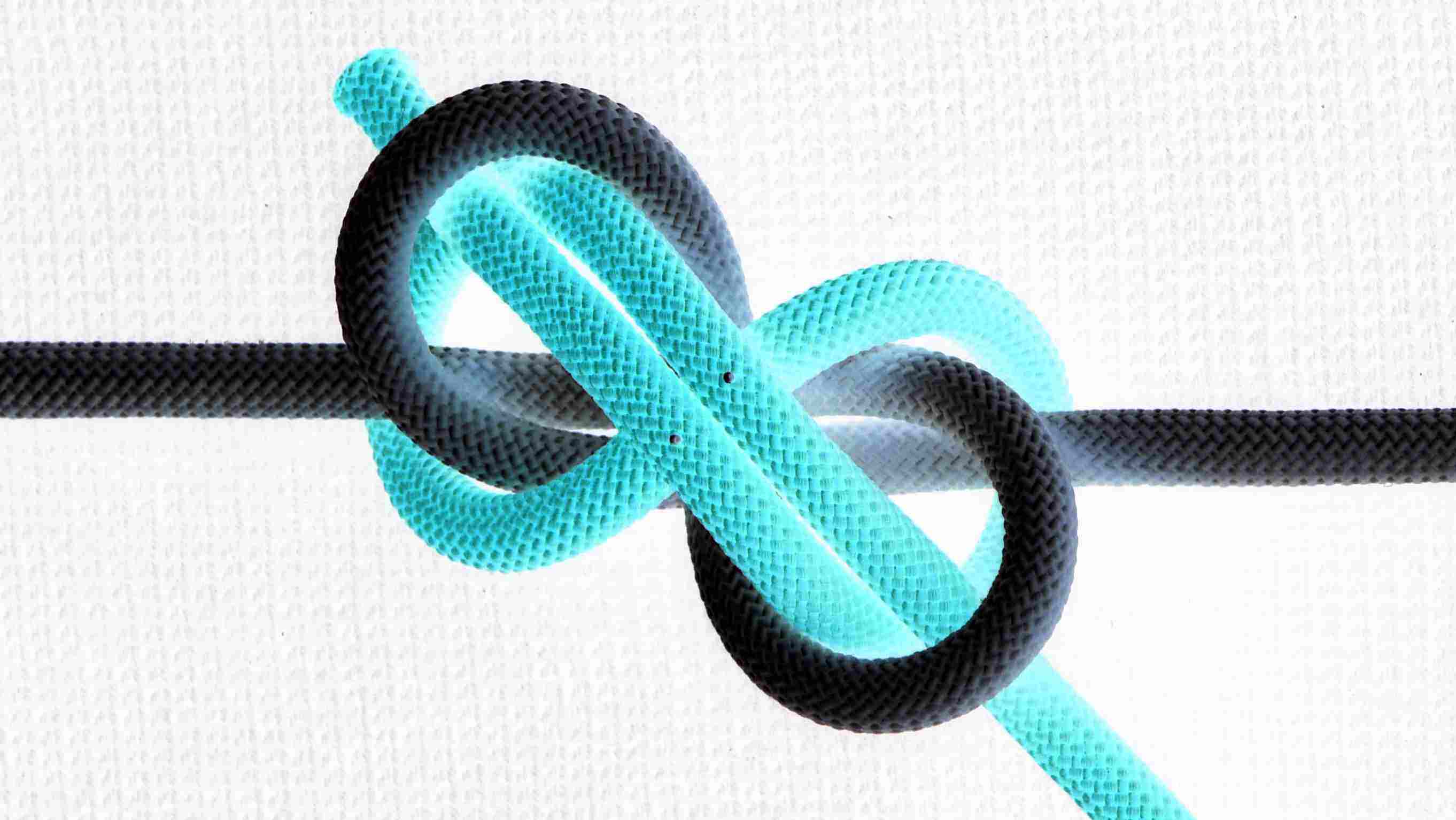
Second picture / stage :
Pass the working end through the “8”, as shown in the first picture.
Third picture / stage :
Crossing under the working part, directly over the parallel segments of the first “8”.
[u][b]Fourth picture / stage :[/b][/u]
At this point, take the working end around the second “8” shape and around the working part, to come through the second nipping loop - running against itself, as it exits through the first nipping loop.
( Notice that, between stage 2 and stage 3, the working end encircles two segments, of the first “8”, while between stage 3 and stage 4 it encircles three segments : two segments of the first “8”, AND the working part of the second “8”. So here, the knot tyer, repeating what he did between stage 2 and stage 3, he may make the mistake to pass the working end around the two segments of the first “8” only, but to forget to also pass it around the working part of the second “8”. )
The Tweedledee is an inside-out transformation of the most beautiful, compact and symmetrical knot, the 2-strand 2-fold Matthew Walker Knot. I stumbled upon the Tweedledee (c.1997-'99) while searching for good alternative harness tie-in knots. I’m not sure if I’d seen it (the Tweedledee) in Roger E. Miles book by then or not.
I too use the tying method you’ve shown. True, I don’t find it difficult to remember, but being somewhat awkward and time consuming to tie I find it lacks good hand and brain ergonomics. Sure, it’s easy to tie while relaxing in your living room, but IMO it won’t so easily pass muster when one may be suffering mental and physical stress, or worse yet shock, and when one’s focus can be distracted by several things simultaneously. These scenarios can and do happen in the natural environment. Harsh criticism? Yes. But the world can be a harsh place with potentially harsh consequences. It’s the nature of the endeavor to put such things under a harsh light before a catastrophic event happens.
The Tweedledee is not TIB and for that reason it’s a bit of a one trick pony at best.
I don’t classify this knot as a Bowline. Is every knot that’s PET knot now a Bowline?
It is amazing how much of this time is reduced after one tie it, say, 100 times. One has only to spend a few hours tying it again and again, and then it comes very easy and fast, indeed. I believe that a few hours of training, even a few days of training, are not such a long time for a serious climber or rescue worker.
All very true. I can not say anything about tying it under such circumstances - on top of raining, snowing, freezing, waves, moving objects, dark, fatigue, danger, people around suffering, you name it…The Fig.8 knot can be tied almost blindly, by a fraction of one s brain cells devoted on this action.
I would love to have a PET + TIB secure eyeknot, with a double nipping turn and a double bight component / collar.
However, I wish a few mooore things : I am convinced that it is better, re. strength, if the nipping turns encircle three rope diameters - and if the eyeknot can remain functional, even in the absence/cut, by accident or by mistake, of one or even two collars.
The Luca s bowline , with a double collar in the shape of a fig.8 knot, is TIB, but its nipping turn encircles two only rope diameters, and its grip on the fig.8 collar is not optimum.
The bowline with the Lehman s lock is TIB, too, but it has only one collar. The pet loop I had presented, and its 3 siblings, seem too fragile to be used as secure bowlines. You can possibly test the double collar TIB bowline based on the Jug sling, or Mike s fancy bend, called "coming and going" bowline, shown at :
http://igkt.net/sm/index.php?topic=4336
http://www.youtube.com/watch?v=Zqh3-uC94aA
To my view, if it is PET [b]AND[/b] it has collar(s), it is a bowline...The Tweedledee eyeknot is PET, [b]AND[/b] it has collars, plenty of them :) - [b]four[/b], [b]two[/b] for each eye leg ! The epitome of a [i]double/double[/i] bowline ! :) However, let us not play this name game too much...
Reading :
I thought that you might have meant the same thing in your comment about the Tweedledee bowline - that it can not be used as a basis for a Double TIB bowline…( Double, here, means : two eyes )
If that is so, I have to say that the “inability” (or “ability”) to do this can not turn such a fine horse into a trick pony… ( a “tricky pony, at best” (sic) ! )
Nor it turns the Tresse bowline frog into a prince !
I am kidding, of course… The Tresse bowline is a fine bowline, very stable and secure - my problem with it was/is the same I have with all double nipping turn but single bight component (collar) bowlines : The one element of those bowlines is sophisticated, while the other remains naive… For a secure bowline, able to withstand the material and psychological conditions you describe, I believe we need a double nipping turn + double bight component bowline - like the one shown at :
http://igkt.net/sm/index.php?topic=4321.msg27020#msg27020
We have dozens of most secure double TIB bowlines…many more than we need ! It is the most easy knot to create - in fact, it seems that every time one sits for some time and try, he can create another one, that probably would be new ! Ashley explicitly says the same thing, and the number of double TIB bowlines he presents in the ABoK chapter on double loops (12) is the largest of all other types of knots, by far ! If you wish to travel to the Double TIB boelinedom, I have to inform you that you are already there ! Myself I will not spend another minute of my remaining life in this type of knots. and I do not care, and I do not even examine if a particular bowline can be turned into a double TIB bowline, or not !
On the other hand, a TIB bowline is a most welcomed thing ! My answer was addressing the question of a TIB bowline, not of a double/twin eyed TIB bowline ! If you find a new TIB bowline, I will be here waiting for you, with open arms !
I think that the first step is known to most knot tyers, because that is the way they tie the Constructor.
To me, the tricky part, where one can make a mistake, is, most probably, the last one : Although it is sooo boring, and it consumes a lot of the bits and bytes of this Forum, perhaps without reason, and is such a wordy mess, I will repeat it :
AND, I will repeat it again ! :
Every knot tyer ties the same knots with a different methods.
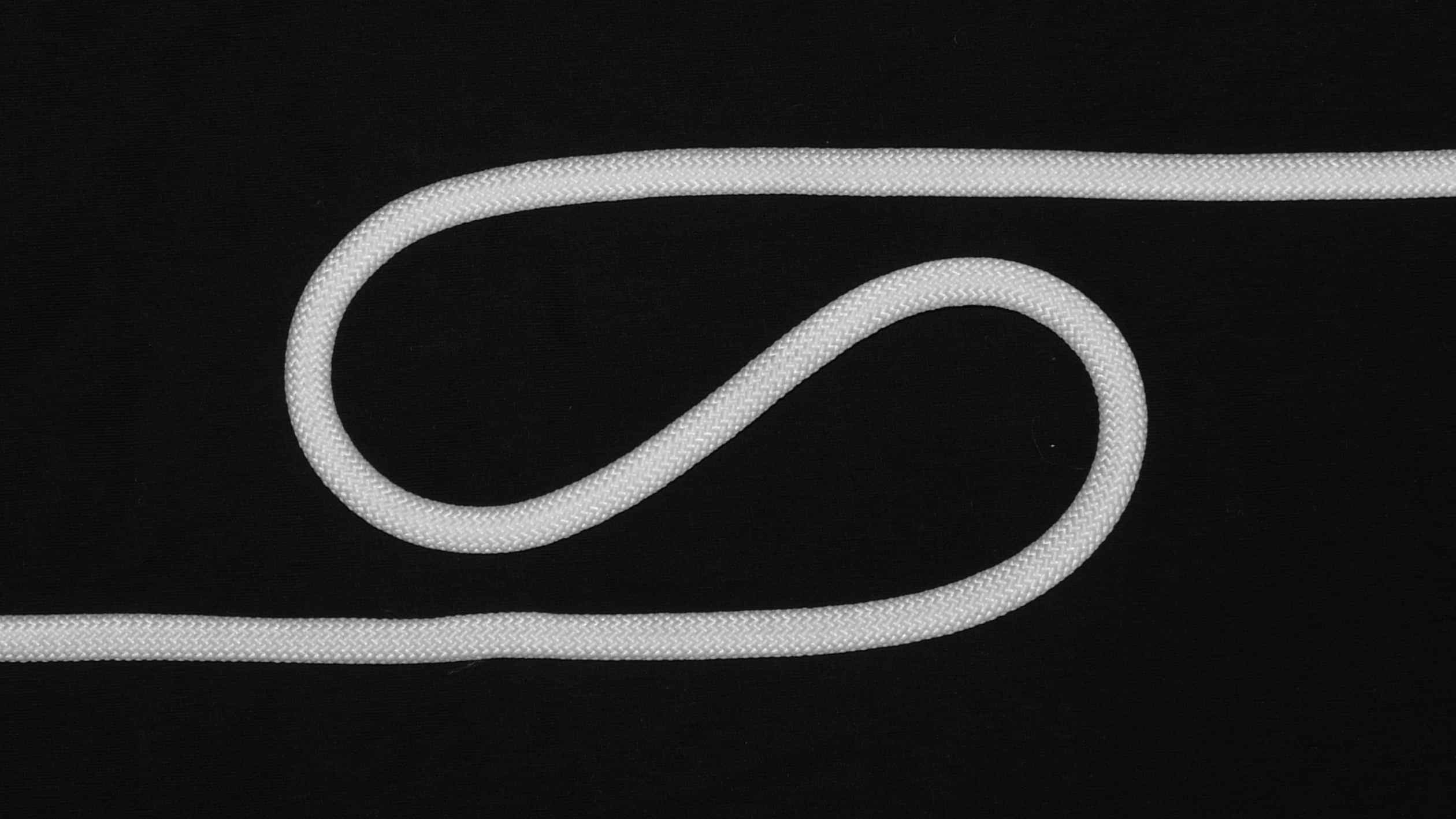
See how I arrive at [b]stage 1[/b] :
A. Form an S.
B. Push the two legs of this S towards each other / towards the centre.
C. Now they are parallel and adjacent to each other. ( In the B&W picture, I leave a little room between them, so one clearly sees them as a pair, and not as one thick rope ! )
4. Flip the whole thing / place it upside down.
Of course, one can do the same thing, pushing the legs “under” the diagonal element, not “over” as shown here, so he will no have to flip the knot at the end. However, personally I prefer the method shown, because it offers me a better control / handling of the whole knot - and, to arrive at the picture shown as stage 1, it starts with a normal S, not with its mirror image !
Piece of cake - but there might well be another, simpler yet method I am not aware of.
When possible, I always prefer to use a tying method where the parts of the knot, as they are formed, are placed in the same - or nearly the same - position inside the knot s nub, in relation to the position they will occupy in the final, dressed and tightened knot.
Believe it or not, I keep the “8” shape of the first link as it is shown in the pictures, and I do not see any problem in weaving the second “8” within and around it - because those two symmetric, “closed”, nice forms, although they have the same colour ! , in my eyes they always remain two completely separated, individual objects. I do not see any mess, because my eyes, helped by the symmetry, are perceiving the ordered “superposition” of those two individual links, and not their tangled sum.
It may seem so, but, conceptually, it is not !
Read my previous reply. The image of the whole thing remains as close to the image of the final dressed and tightened knot as possible
Perhaps you can make a video of your method ? Or show it in a series of MANY pictures, step by step, because I believe you have jumped over some steps in your verbal description.
Good ! Can you show the same sequence of pictures / steps, with ropes, not drawn lines ? If you find it difficult to stabilize the structure, try to use pins, and start from a double loop of a smaller inner diameter, so it remains stable by the stiffness of the material. Beware, because pins are such pointy objects ! Try to take the pictures from the dame angle, perhaps using a tripod for your camera ? A one-colour rope would be better. I like the shadows on the white surface, they give a nice sense of depth.
( They are the same thing topologically, of course, but, geometrically, do they look like the same ? The symmetry of the final knot is lost in your double loop, only to be found much later, at the very end, after the tightening, while on my shape “8” double loop it is retained through out the tying procedure. )
Hi Ruby,
To see this transformation it’s best to use two short (1m) lengths of cordage - giving easy access to all four ends - which is how I’ve conducted my knot explorations since the late '90s. With access to the ends it’s easy to re-route all four ends under the central crossing parts of the Tweedledee to get the MWK. As the eyeknot version will allow you to do this only as a tying procedure I must apologize to you for (unintentionally) misleading.
I found this out working from the MWK. Lamenting the MWK’s unsuitability as a climber’s tie-on - as I love it’s wonderful symmetry - lead me to re-routing the ends and discover the Tweedledee form. I suspect this is how Roger E. Miles originally came upon the knot.
One should now see intermediate and hybrid knot forms between these two extremes.
On the contrary, I am sure he did not come upon this knot that way !
He was just trying to tie all the possible simple symmetric bends there exist - and I know it, because when I re-discovered it, I was trying the same thing, being unaware of his book… and because he has told me so !
I remember very well how I came upon it, 3 1/2 years ago - which was by systematically applying an anything but “random” method, as I was accused too easily by some “founding fathers” here… who were unable to “see” the method under the madness . I simply collected all the symmetric hitching tangles, and tried to connect them one-to-one in every possible way. I started from the shape “8” overhand knot, the fig.8 knot, the Clove hitch, the double overhand knot / Strangle, the Constrictor and the Pretzel ( which is less symmetric than the others) - and I had connected each one of them to each one else, in every symmetric way I was able to figure out. That is, plain dumb, systematic work, that does not need any imagination to be accomplished ! Of course, the most interesting cases were the symmetric ones, where the two links were identical. The particular knot, the Tweedledee ( I had called it the “88” bend at that time, for obvious reasons ), and the somewhat similar topologically but completely different geometrically Oyster bend, were rather easy to tie. I remember that the problem was how to keep each link in one piece, by encircling/connecting the curved segments of the rims of the two bights to the straight segments of the continuations of the standing ends and the tails. It is exactly the same rationale I follow in the tying method I have presented, probably because it has been imprinted in my brain then, right at the start, and old dogs do not learn new tricks !
By a series of unfortunate events where I was as responsible as many other members of this Forum, I had deleted the original posts, so the description of the original ideas was lost. From this time, I keep in my files some relic pictures, remnants of some non-symmetric tangles of hitches, which escaped the incidence… The interested reader can see them in the attached files.
X1,
You seem so willing to misunderstanding. I do not doubt what you say Mr. Miles’ was trying to do and not searching for a climber’s tie-on. I’m only suggesting in his endeavor to find all possible symmetric bends that he came upon the Tweedledee via transformations of the MWK (a well-known symmetric form). Now, enough of this, please.
BTW, did you know that it takes a few words only to state otherwise?
You misunderstand, even if you are not willing to !
I have tried a few words, I have tried many words, but I have not seen much difference ! You still misunderstand…
So, let me try ONE word :
NO
( No, he did NOT come upon the Tweedledee via transformations of the MWK (a well-known symmetric form).)
Now, enough of this, please.
Fine then. I understand.
I am sure you can, but it seems that sometimes you do not.
I have read Miles book as carefully as I could, and I believe I know his method. He DOES NOT start from well known symmetric knots, and proceed by transforming them, as you claim. He starts by the matrices that represent symmetric 2D diagrams of EACH LINK, and then he superimpose those two links, paying attention to the kind of symmetry of the end result. He distinguishes three kinds of symmetry, and the Tweedledee symmetry obeys the higher of them: it is symmetric along two perpendicular to each other axes : he calls the bends which obey that symmetry “triple symmetric”. The 2D diagram of the Tweedledee bend, which I have re-drawn in KnotMaker and posted in this thread, is quite complex, and it can not be used as a basis for an easy to remember tying method ( I have tried it ). Even when Miles describes tying methods, he relates the Tweedledee bend with the Dee bend, which I have also shown in this thread . And the Dee bend itself to the Harness bend… NOWHERE in his line of thought or his sequence of tying methods does he relate the Tweedledee bend with the Matthew Walker bend, for KnotGod s sake ! Read his lips : " To tie [ the Tweedledee bend ] , first tie A10 [ the Dee bend ], then insert free ends symmetrically." Now, read his lips for the Dee bend : " As with A8 [ the Harness bend], a tying method begins with cords aligned in opposite directions, with four crossovers ( over, under, over, under ). Symmetric insertion of the free ends yields the triply symmetric TWEEDLEDEE bend."
ALSO, he examines the Matthew Walker bend in a completely different way, as the first implementation of Ashley s tying method, at ABoK #1426. He calls all the knots in this sequence by Ashley s name, generalized, as N - FOLD OVERHAND BENDS. This method is related to the Oyster bend, NOT to the Tweedledeee bend. ( p. 124, p.125 ). The Oyster bend is topologically different from the Teedledee bend - its “diagonal elements” are on the outer shell, not in the inner core of the knot.
WHERE IS THE TRANSFORMATION OF THE MATTHEW WALKER, THAT SUPPOSEDLY MILES FOLLOWS TO GENERATE THE TWEEDLEDEE BEND ? WHERE IS THE INVERSE TRANSFORMATION ?
You seem too quick to dismiss my willingness and/or ability to understand - you have done it again (1), and you keep doing it now. I have not seen this kind of behaviour by you against any other member of the Forum. Am I sooo mean and dumb, I wonder…
I have been playing with the tweedledee loop/bowline/bend and have settled into a method which seems, to me, quite straightforward and not to fiddly to tie. It is similar to what Ruby has suggested, but begins in a different orientation.
I happen to like X1’s initial naming of the knot the “88” bend, also for obvious reasons. In Mandarin Chinese, the words “eight eight” are homophones with “father/father’s” and the word for “knot” is the same as “day/holiday”. In Taiwan, Father’s Day is celebrated on August 8, and “8 8 knot” and “father’s day” sound exactly the same, hence the name of the video.
https://archive.org/details/FathersDayKnot
– JP
Thank you J.P.
You should had posted this video tomorrow !
The tricky part is at 0.30 , where you pass the working end in between one riding turn and one finger.
I had never tied this knot on such small line ! I use stiff kernmantle lines used for rescue and climbing - where the curves are always smooth and wide. With stiff ropes, the single hairpin, U turns, and the double hairpin, S turns, are easy to follow, so the knot is formed and held in place rather easily.
I know that knot tyers will always tie the same knots in different ways ! I just prefer to tie the knots following a mental image that is related as much as possible to the geometry and the structure of the final, tighten knot. As I tie this knot, the two “8” s are always clearly visible, and they remain symmetric to each other during the whole tying procedure. Perhaps I prefer such slow / dumb methods because the hard disk of my memory is almost full, so there is not enough free space left for new tricks !
well , I think the structure of the final, tighten knot is more like two double loops, not two flat 8. it’s such a round knot.
and see here , I just double double it… 
http://igkt.net/sm/index.php?action=dlattach;topic=3989.0;attach=11852;image
http://igkt.net/sm/index.php?action=dlattach;topic=3989.0;attach=11854;image