Agent Smith, et al,
For me, Hitch/termination of force flow thru rope to another device as a function (not necessarily a knot name) is logical start to ID separate items rope and host as focus, yes. Clean, perfect loaded line, then node swell at termination.
Then expand to Bend/continuation of force (usually thru a jointed node of deformity from pure linear to either side) i see as kinda dual sided Hitch, only each is the other’s host (usually). To this imagery i find we have 2 versions of HH : 1 SPart to end termination and 2 competing (as if ) SParts to shared internal termination/0point between pulls model. But are not each other’s host, but rather each other’s stopping point shared Zer0 point where Termination HH ends too on it’s own.
Knot as a standalone, i see takes it’s own self as host; but once again am trying to stay to loaded rope reference as trace force; so Bowline eye/SPart would be loaded. The 1st 2 youtube vids are definitely part of my self educated background. 2nd 2 less so, ty.
Some ‘electric’ symbols made in the past of imagery of Hitch vs. Bend etc.
https://ropeforcelogic.neocities.org/pics/some-schematic-symbols-ropes.png
.
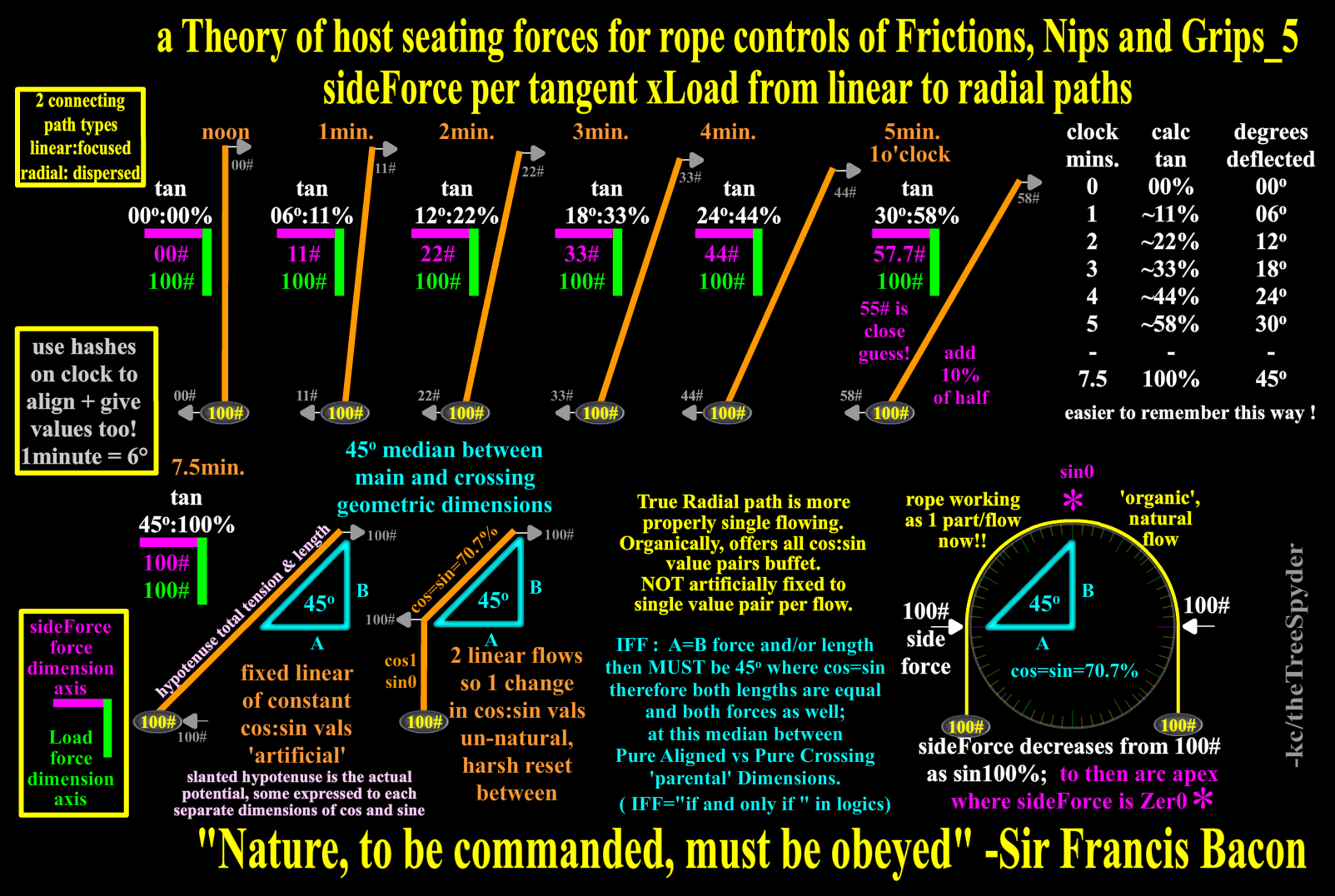
Focused linear/dispersed from center evenly to all axises(only 1) in 1D ( differentiated model) vs.
diffused radial/dispersed from center evenly to all axises(multi ) in 2D (undifferentiated model)
Can make a big difference in all these things.
i find an arc to be an organic continuous flow on radial face on a spar, but a 4x4 host presents segmented flow of non-organic, sudden, harsh reset/not flow of force at corners. The force runs parallel to 4x4 host on the linears, so no host seating pressure pre-exist for nips, frictions and grips until deformity from pure rope line at corners. Drop in cos of pure linear, no inwards to host force direction, to drop in cos>>raise sine to give frictions, nips, grips. Linear rope part is just extension then between the more active machine conversion points of corners here, again. Length of face doesn’t matter force change wise, is just an extender. You can keep the corners and remove faces to same math force wise. To this imagery, radial is more a gradual flow of deformity so gets some host seating forces at all points, but not a reset of the linear force flow thru in big picture.
https://ropeforcelogic.neocities.org/pics/a-theory-of-host-seating-forces-for-rope-controls-of-frictions-nips-and-grips-4-3linear-faces-vs-1-arc-face.png
Previously you had mentioned diameter ratios of rope to host; i hope 4,5 in pic above speak to that some along with the previous post Groundline pic.
i do recognize also aforementioned rope crossings in this model, greater sandwiching lesser to host giving more hitching force against sandwiched layer, lesser over greater giving more firmly pasting the sandwiched layer to host. In all same rope, the lesser is softer than the greater(i call tensioned rigidity); the more rigid greater (tension) does not dent the lesser even if bent around for more force than tension and deforming more rigid greater. The lower tension softer would dent if any. Pinch into ropePart deforms so more positive ‘lock’ than pinch onto more topical rider just trapping/pasting where no to deforming/denting. Kinda a model of can lengthen bolt cutter leverage for more power, but softer jaws to deliver that force are still softer jaws; arc can increase leverage pull beyond tension, but still tension sets the rigidity.
.
All the references to adjsuting nip to top in ABoK, the 3 Half Hitches of different nip at start of tinyurl.com/abok-chap21 and the way the forces change in Sailor Hitch as adjust nip helped me to my radial view of forces maintaining until swap from external linear input to internal radial input(against radial swell already inside controlling arcs/needs no SPart pull in usage).
https://upload.wikimedia.org/wikipedia/commons/f/fc/Sailor-hitch-side-vs-top-crossing-pressure-change-by-position-like-nipping.png
.
Family of Constrictor, Bag, Groundline show no matter what name or position in landscape given, the forces i try to follow define the same, except differently if used as a Hitch as linear external force thru SPart to machine(s) of arc(s) vs used for binding against diffused radial spread as internal force spread to same machine(s) of arc(s). The rope in this imagery thus, is passive material; that force to watch is ported thru is the pivotal game changer quantity. The focused linear input of Hitch usage gives decreasing tension (and thus rigidities) thru the rope, and a focused aspect to where greatest nip is. By contrast, thru same architecture radial bind against swell gives same tension evenly around to nip, and all nip positions thus equal from the evenly diffused radial input to radial arcs. The difference is autonomous and cares not where the coordinate system of rope is for the differences, just the matters of force.
.