Transfigured ABoK#1056, as an end-of-line loop

I had never tied the ABoK#1056 as an end-of-line loop - that is, where both its ends are parallel to each other and to the eyelegs, and it is loaded/hanged by either of them, or by both of them. I had only tied it as shown in ABoK, as an in-line-loop, tied in a straight line, where its ends are pointing to opposite directions. In this form, it can also loaded / hanged by either or by both ends, but it is an altogether different animal of the one described in this thread.
Prompted by Alpineer s opinion, that the Farmer s loop is not meant to be tied/dressed/loaded only as an in-line loop,

I now tied it and tried it, and I see that I have not missed anything worth further examination ! :slight_smile: The ABoK#1056, when it is transfigured this way, it is also badly deformed, and becomes an even worse knot than its amorphous, ugly in-line parent. Moreover, it becomes UNSTABLE : it can easily take many geometrically different, and shaky forms, depending on which end and which eyeleg is loaded more than the other of its pair… In short, a knot we should better not lose our time with.
However, I decided to show some pictures of it, just in case one would imagine that it has ANY relation whatsoever with the neat, stable, and transparent, in the way it “works” as a crossing knot-based loop, Plait loop.
Now, alpineer, although he clarifies that he did nt meant those two knots are the same ( although they are topologically equivalent, but that does not makes ANY sense regarding the “same-ness” of physical knots - it only matters regarding mathematical knots, where there is no friction ), nevertheless he insists that :

Well, I had spent a whole long page blah-blahing - arguing about the opposite, and I can do no more - but I hope that just a quick view of the pictures in this thread will persuade some people, ti tie both knots, compare them, and then laugh… (1)
Attention : the transfigured, but, in fact, badly deformed when it is dressed and loaded that way Farmer s loop, is unstable, and it may degenerate into forms that can not hold even under light loading ! So, it can even become DANGEROUS, if the Standing Part before or after the eye is straightened out. Its pictures in this thread are not meant to show stable knots !

  1. http://igkt.net/sm/index.php?topic=5288.msg35445#msg35445

P.S.
I had tied an in-line loop, which can be transformed to an end-of-line loop, and it is stable in both incarnations of its topological soul :). It is the humble Sheepshank, turned into a single loop, by shrinking the second eye. Is the Farmer s loop anything like this knot ? Absolutely not ! See :
http://igkt.net/sm/index.php?topic=4680
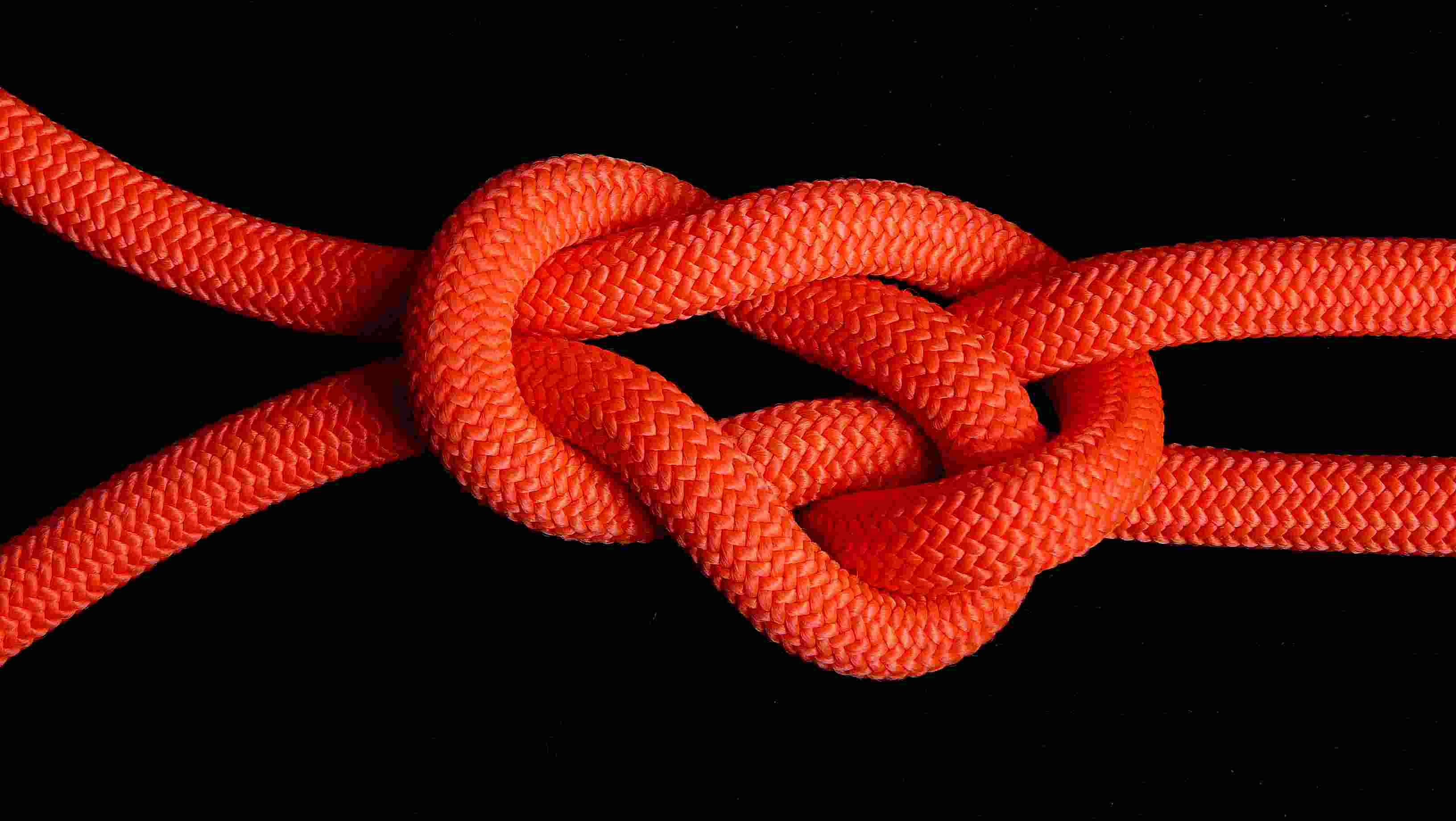
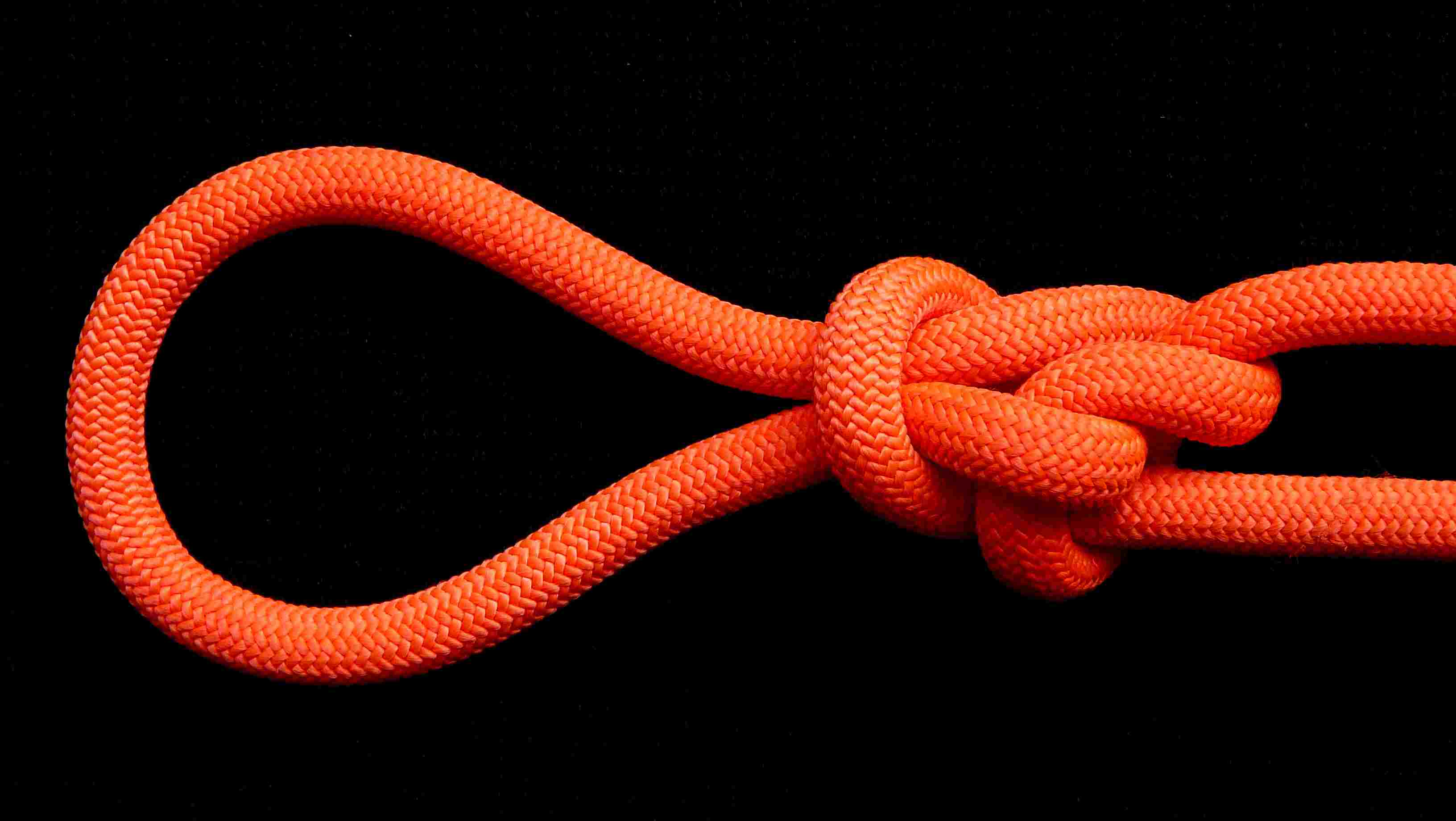
ABoK#1056.jpg

End-of-line ABoK#1056 ( detail ).JPG

Two forms of this knot, which show how unstable it is, and how the one link runs the danger to be straightened out and “open up”, and allow the other to slide along it.


ABoK#1056 end-of-line (1).JPG

Static images prove nothing in this case. Perhaps mobius would be so kind and test on his rig a properly tied and tightened #1056, which is geometrically identical to the #1054 Farmer’s @$$, and compare simultaneously with the Plait loop, as you don’t test knots.

Please find a better term than in-line if you want people to understand what you’re doing because it’s easily confused with mid-line. Although I fail to see much, if anything significant here to merit a special term in the first place. Sorry.

Indeed, but they are indicating something - which, if you pay attention to the knot itself, and to what I had said about it, you will understand it. This knot is unstable - it is neither a bowline-like loop, nor a crossing knot-like loop ( as the Plait loop is ). The one link is more stable than the other - when it is loaded from the one end, it is not so bad, but when it is loaded by the other it is much worse. My effort, with the Plait loop, was to tie an Either End Loadable end-of-line loop, as I had said many times. ( However, when nobody pays attention to what I say, I have to repeat them, with the remote hope they will be heard…and so I write looong posts ! :slight_smile: ) The Plait loop, although it is not symmetric ( there can be no symmetric TIB single loop ), it “works” the same way, as a crossing knot-based loop, when it is loaded by the one or the other end - and it is STABLE in both cases !

I thought that it was a proper, simple term, but I may have been mistaken. Please, propose something less confusing, and we will discuss it. Trying to explain what I understand that this term, which is not mine, means, I had written this, replying to a similar question by Tex :

You do not see that a loop with ends parallel to its eyelegs, has a different geometry and structure, and “works” differently, from a loop with ends perpendicular to its eyelegs ? Even much less differences in the directions of ONE loaded end can deform the nub in a very significant way, and you do nt see how a difference of 90 degrees, in BOTH ends, do not lead to different knots ?
I have to repeat this, for yet another time… Tie the two loops shown at :
http://igkt.net/sm/index.php?topic=4680
and tell me if you think that there is no geometrical / structural difference between those two knots, which difference should be described / labelled by a “special term”.

I do not test knots - but I believe you should had understood, by now, what I mean by “test” ! I mean a repeatable experiment, under laboratory conditions, which produces number of results large enough for statistics. I have not seen many such tests in those 6 years I follow this Forum - except JP s and knot rigger s. Also, the tests should involve ROPES, not small size cords - or fishing lines ! :slight_smile: We just do not know if the results on knots tied on thin lines can be extrapolated for thick lines.

I do not want to discuss this matter here, because it is a subtle, and off-topic issue. The ugly tangly amorphous Farmer s loop, tied with this supposedly “magic”, not-so-clever way, is, as you said, an octopus with many tangled and twisted legs, and the particular form it takes is very sensitive to the particular directions of its four limbs, and to the particular degree they are loaded… That is why I have shown the ABoK#1056, which, when tied in-the-end or in-the-bight as Ashley shows, is almost always self-dressed in the same stable form. A “properly tied” ABoK#1056 is what it is (), but there is no “properly tied” Farmer s loop to compare it to ! :slight_smile: :slight_smile: The tying method of the “professor”, shown in Ashley, is not “proper”, it is !@#$%^&()_+ .

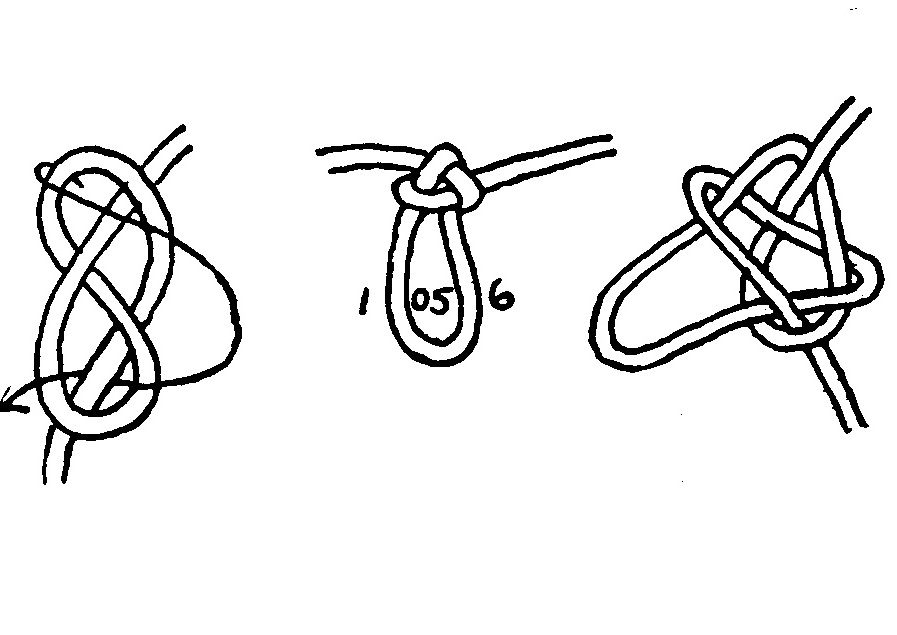
(*) The loop shown in the third picture of the first post, is exactly what one will tie, if he starts from exactly the initial loose form of the knot Ashley shows ( shown in the second picture ), grabs both ends and both eyelegs together, and pulls them toward opposite directions. ( That is why the eye of the shown loop is so big - I had started from the loose knot shown in the second picture, where the relative dimensions of the rope s diameter and the knot s opening are the same with Ashley s sketch )

I can probably find time in the weekend to do so. I have tied the #1054 Farmer’s and Plait Loop several times just to play with, though never trialled them that I remember. I will look at the #1056 version now.

Cheers,

mobius

Thank You mobius.

In the interest of distancing a well known and understood term (mid-line) from the too-similar-to term (in-line) - which you’ve been using to denote what you’re describing - I’ll offer you this… ALP for All Limbs Loaded Parallel. Man, not another acronym!

Now, what I would like from you, xarax, is to show me where ALP has enough value to justify having a term or an acronym associated with it. I’m interested only in practical - not theoretical, or just because it’s there - examples. What practical value has an ALP over non-ALP? What can an ALP do that non-ALP knot can’t? In what practical applications would you require a knot to have all four limbs loaded in parallel? In those cases all you need is an unknotted rope to do the job? I.e. no knot is required. Just run the rope around or through the thing to be attached.

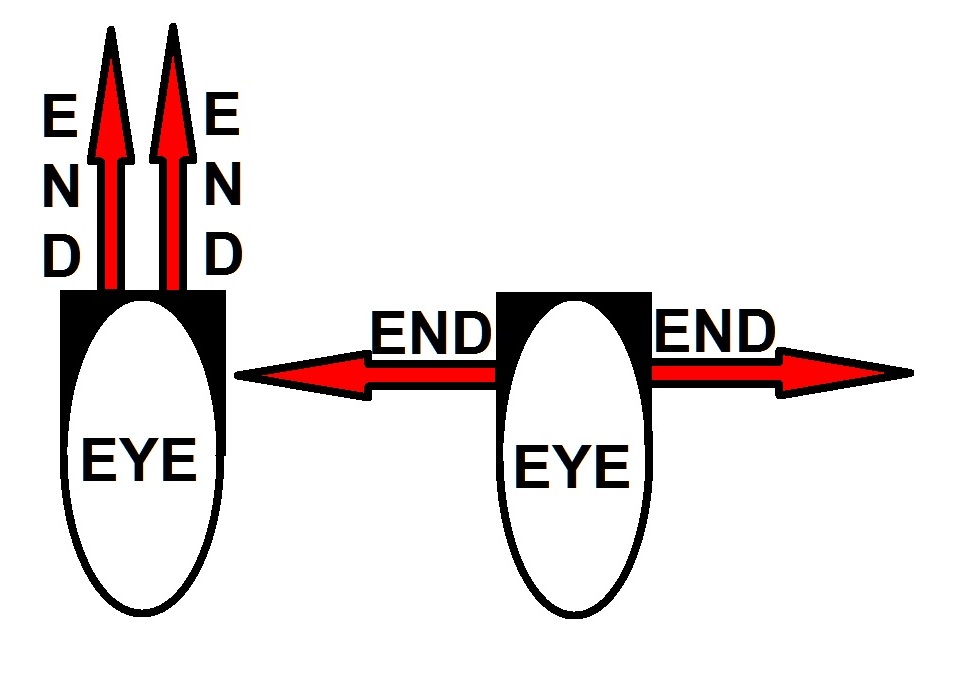
Converging Ends / Diverging Ends ?
( The angle formed by the eyelegs is irrelevant )


Convergent Ends - Divergent Ends.jpg

Meh. Converging denotes lines meeting at a common point, which they do so at any angle at the nub. ELP. Ends Loaded Parallel.

Or, how’s about ends Loaded Same Direction. Ends LSD.

Yes, but I mean the “Ends”, which, at their extreme points, are the ends of the line… I show it with the arrows…
Also, if we also use the antonym “divergent / diverging”, the reader understands that we can not mean the “other” ends, because all “other” ends meet each other at the nub, always !
They do converge at a common point, at infinity ( = parallel ) - or at the anchor.
Ends loaded parallel, can also mean Ends loaded from opposite directions, and so they become parallel to each other, and aligned ! :slight_smile:
LSD, is 60 s ! :slight_smile: :slight_smile: :slight_smile: ( Lysergic acid diethylamide )

I know what you’re saying, but nope.
The dictionary definitions are clear enough.
The problem is how people interpret those terms.

Don’t miss reading my edited post #7.

First, ALP is wrong : a loop may have adjacent and parallel Ends ( which is a description of the geometry of the nub, not its loading !) and yet be loaded / hung by only one of them. As we have said, it is meant to be EEL : Either End loadable, that is, loadable by the one and not the “other” end, or loaded by the “other” end only - or loaded by both ends ( when, indeed, becomes “ALP”).
Such a loop can be loaded by either end, or by both ends, WITHOUT ANY MAJOR CHANGE OF ITS SHAPE / GEOMETRY - for KnotGod s sake ! A loop which is meant to be “in-line”, and have ends pointing to different directions, may be deformed badly, or transfigured totally, when it will be loaded by one or by two ends parallel to its eyelegs - because it is meant to be stable, and retain its shape, mainly/only when its ends are almost perpendicular to its eyelegs.

Loops are not used just to prevent things from falling down ! :slight_smile: The eye of the loop is encircling the object, and does not allow it to move to any direction. It is a RING, attached to one or two lines. Are you telling me that rings are redundant ? :slight_smile:
However, the whole concept of the EEL loops is their versatility - you may not know in advance by which end you are going to hang the object, or you may want to attach it to one anchor point but hang it by both ends, for added strength/security.
I do not understand why you people do not understand this ! Ashley has put his in-line loops the one next to the other, for a purpose - although he had not used a particular name for them. If he had, I guess that anybody would be using it 70 years now, and our discussion would had been meaningless. Have you ever tried to see how all those loops are deformed, when they are NOT loaded as Ashley shows them ? You have seen how the ABoK#1056 is deformed when it is loaded by both ends, pointing to the same direction : It becomes unstable, it may have two, at least, different shapes ( I had shown pictures of them ), and it becomes even uglier than the original loop ! The way it “works”, when it is loaded by the one or by the other end, is NOT the same - in fact, it is very different ! On the contrary, the Plait loop is a crossing knot-based loop, independently by which end it is loaded / hung.

Regarding the “examples”, “practical value”, “practical applications”, etc, :), you should better find a more “practical” knot tyer than me - because, as it is well known 6 years now, I only tie “random” or “decorative” knots. Or, you should only let your imagination free, for a while, and figure out 10 or 100 different specific situations / scenarios, where such a loop can be “used” - even in climbing ! :slight_smile:

How do you call the arm movements in ( Swedish drill ) gymnastics, where the athlete has both his/hers arms spread out horizontally, pointing to opposite directions ( “T motion” ) - or vertically, pointing upwards ( “High Touchdown” ) ? I guess that those terms may offer an image of what we want to describe…

That’s all I need to know. I’m outta here on this one. This concept is of no value to me.

I am afraid that I am not concerned about your needs - and I have to admit that this concept has also no value to egg boiling or coffee making, which are my needs :slight_smile: ! However, it does have value for knot tying, and “knots” - you know, those odd things which are useful to ropes, but have nothing to do with chicken or coffee beans… :slight_smile: :slight_smile:

An interesting and nice midline and TIB bowline, which can be loaded when its ends are either parallel / aligned or perpendicular to its eyeleg without been transfigured, is the Linfit loop, tied by O. Nuttall ( Knotting Matters 17 ) - shown at the attached picture (1).
Notice that the great knot tyer O. Nuttall says : " This knot Wont jam " - and my theory is that this is perhaps due to the fact that it is PET -2 ( the similar Butterfly loop is not, and that is why it may become difficult to untie after heavy and/or unfavourable loading ).

1.http://igkt.net/sm/index.php?topic=5166.msg33873#msg33873

IF this knot really is unstable when loaded with three legs then while it might be a good “in-line” loop, it is a bad midline loop. In the middle of real lines, things can happen. As theoretical “in-line” loops, well I just don’t care. Who wants an inline loop? I want a loop that I can tie midline that can handle the real world. Now if none existed then ok, we’d be stuck talking about inline loops I guess (but we’d still call them mid-line and just wish they were better). But good ones do exist.

I’m with alpineer here. This concept has no practical value, either for practical knots or for practical improvement in communication about impractical knots or knotting concepts where it will cause more confusion than it clears up. It’s only value is as a tool for xarax to refuse to understand a point unless you submit to his personal language.

I have found a picture of the transfigured Farmer s loop, at :
http://en.scoutwiki.org/Farmer’s_loop
It looks like one of the two loops shown at Reply#1 - in fact, like the worse one of them !
http://igkt.net/sm/index.php?topic=5347.msg35556#msg35556
Whoever does not “see” the HUGE difference, in form, structure, and quality, of this unstable loop from the Plait loop, should better consider kniitting rather than knootting ! :slight_smile: :slight_smile: :slight_smile:

Your too much, xarax, offering such weak arguments - showing an unloaded form of the F. Loop - something you can do with any knot. A Farmer’s Loop - dressed and tightened in it’s most commonly accepted shape/ form and subjected to any loading profile - will not distort into any shape/form that would be considered appreciably different from the original. Your beloved plait form cannot, and more specifically, I very much doubt that it will outperform the original Farmer’s Loop under the loading profiles you have intended for it. Such a case would render it as just an inferior form of the proper Farmer’s Loop, IMO. So, once again, probably better used in it’s ABoK #1054 Farmer’s Loop form.