Wait, in what loading were your test results given for?
–through?! I thought it was of both or one of the S.Parts
vs. the eye around a host?!
(The lineman’s loop has been faulted for jamming when
loaded qua EK, the unloaded end’s collar being able to
then collapse and bind it.)
–dl*
From Dan Lehman in relation to load testing of Mobius Butterfly:
Wait, in what loading were your test results given for?
--through?! I thought it was of both or one of the S.Parts
vs. the eye around a host?!
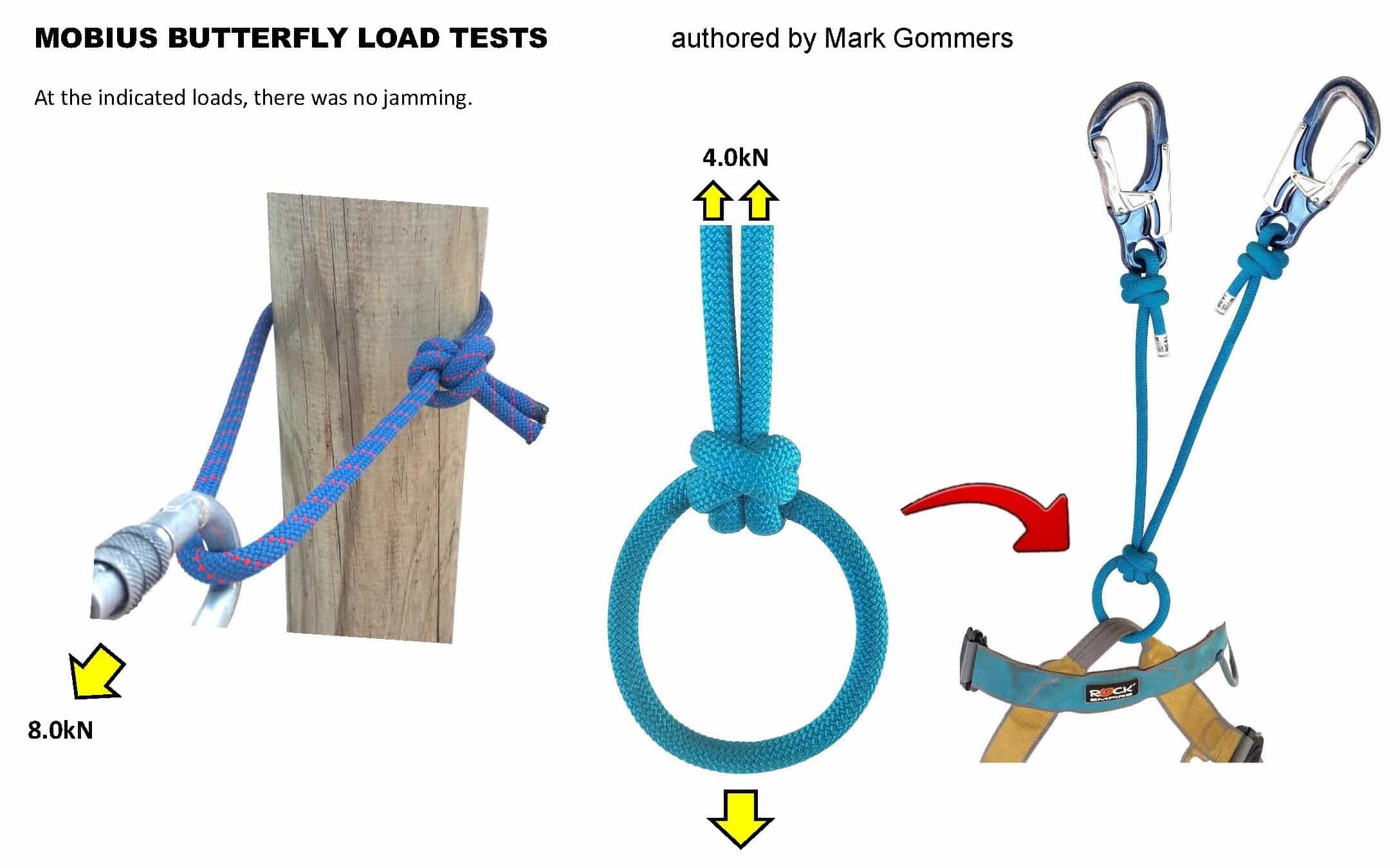
Refer to attached image below.
[ ] Transverse loading up to 8.0kN = No jamming
[ ] Axial loading up to 4.0kN = No jamming
NOTES:
The ‘axial’ loading profile replicates the use of a Mobius Butterfly
being used as a dual leg lanyard.
User groups being rope access workers and recreational climbers.
In this configuration, the Mobius Butterfly will never see loads
beyond 4.0kN.
In transverse loading, this replicates how SAR teams would use the knot.
eg Tied around a sturdy tree.
SAR teams will never reach operational loads beyond 8.0kN.
In fact, typical loads are between 2-4 kN.
8kN would be extremely remote.
(The lineman's loop has been faulted for jamming when
loaded qua EK, the unloaded end's collar being able to
then collapse and bind it.)
Correct, when eye loaded, a regular #1053 Butterfly will jam.
The jamming threshold when [i]eye loaded[/i] is around 3-4kN (EN892 dynamic rope).
Indoor climbing gym operators often use a Butterfly in their
dual clip-in systems - where the Butterfly sustains all of the load.
After a period of sustained use by climbers, staff often have trouble untying
the Butterfly knots to cycle their belay ropes.