TRANSPOSITION (exploring the concept)

NEW TOPIC THREAD TRANSPOSITION

I had introduced the term ‘transposition’ to describe a condition where the S.Part(s) and Tail(s) have changed identities.

In a transposition, the geometry of the core of the knot remains unchanged (ie the geometric configuration of the core remains unchanged - ignoring the effect of load).
Here I use the word ‘core’ (in lieu of nub) to denote the part of a knot that is central or principal to its existence or character.

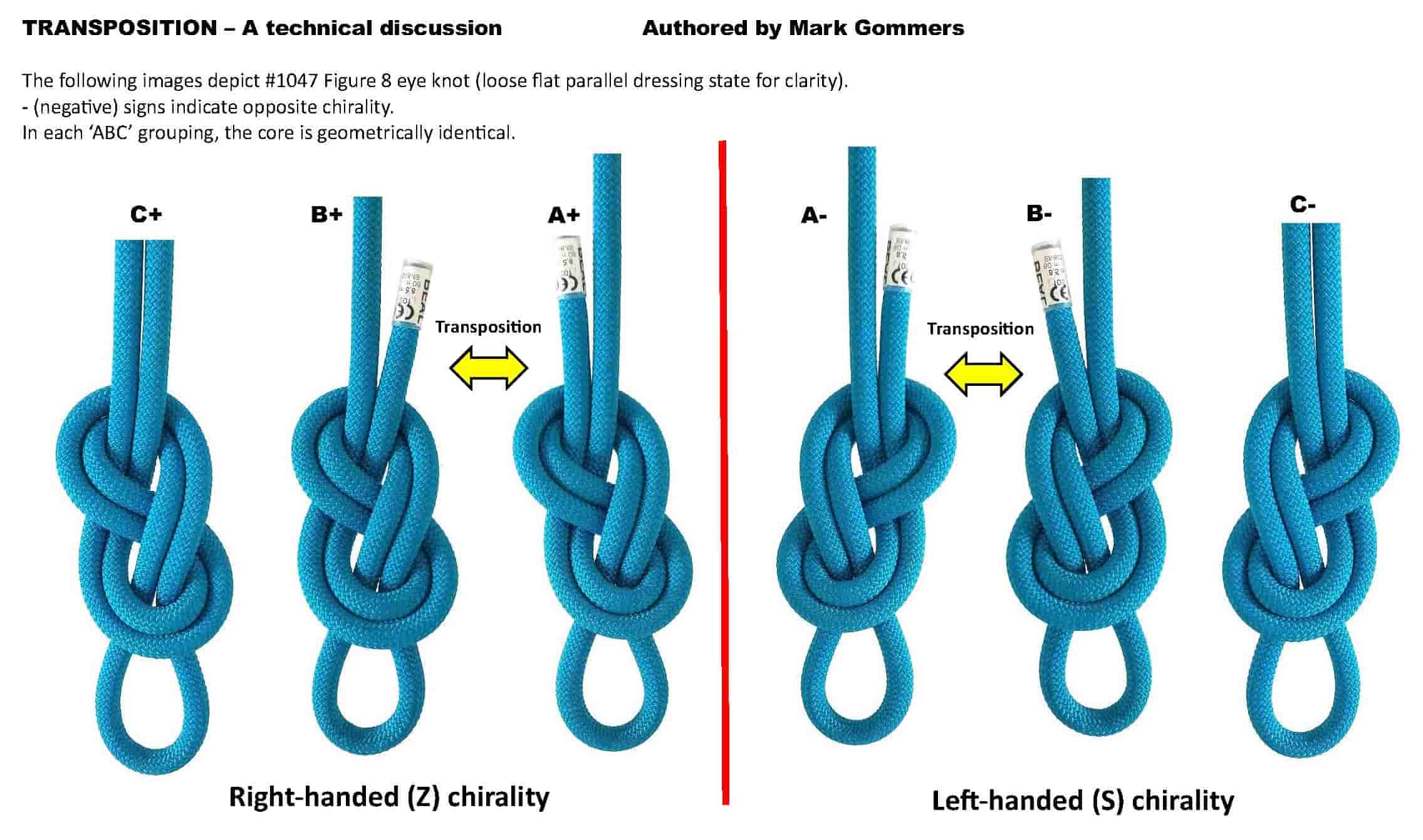
A good example of a transposition is in relation to Ashley #1047 Figure 8 eye knot.
When we speak of a transposition, it can only have meaning if it is relative to something.
With respect to #1047 F8 eye knot, you need 2 F8 eye knots side-by-side, and then you show which segments have been transposed.
It is theorised that in one orientation of a F8, there is better resistance to jamming (I had shown this in another topic thread).

Refer to attached image below for general outline of concepts.

per Dan Lehman:

(Interestingly, the Reverse of the Fig.8 EK changes the Interior/Exterior loading --S.Part & Tail being opposite in this.) For the e2e Joint, "reverse" = "Tail-loaded", but not for Eye Knots.
When you say "reverse of the Fig 8 eye knot" - this has no meaning. Your statement can only have meaning if it is relative to something. You need to show 2 F8 eye knots side-by-side where one version is the transposition of the other. I have already done this in another topic thread.

With regard to your comment:

For the e2e Joint, "reverse" = "Tail-loaded", but not for Eye Knots.
Again, the word 'reverse' implies a transposition (where the geometry of the knot core does not change). And your comment; "but not for Eye Knots" - not sure what you mean? Words have meaning - but there needs to be context/images something that is relative to assist in understanding. In a #1047 F8 eye knot, there are different ways to tie it.

Note: It is possible to tie and use an F8 so that it has 2 S.Parts.
In fact, Ashley at illustration #1047 does not show a tail!
He shows his F8 with 2 S.Parts (dual leg loading).
Obviously, we also know that an F8 eye knot can have single leg loading (climbers do this routinely).

Therefore, in the case of an F8 with dual leg loading (ie 2 S.Parts), a transposition would make no sense!
The transposition can only make sense where an F8 eye knot has one (1) S.Part.

Interesting point:
With respect to #1415 Double Fishermans bend, the transposed version is completely unstable.
Transposing the S.Parts with the tails results in a knot that pulls apart.

EDIT 1 (additional images and text)
I have added some images of #1010 Simple Bowline (with tail tuck).
The great Xarax long ago showed us that most ‘Bowlines’ can be made ‘TWATE’ with
a simple tail tuck through the collar.
TWATE (Tiable Without Access To an End).

EDIT 2
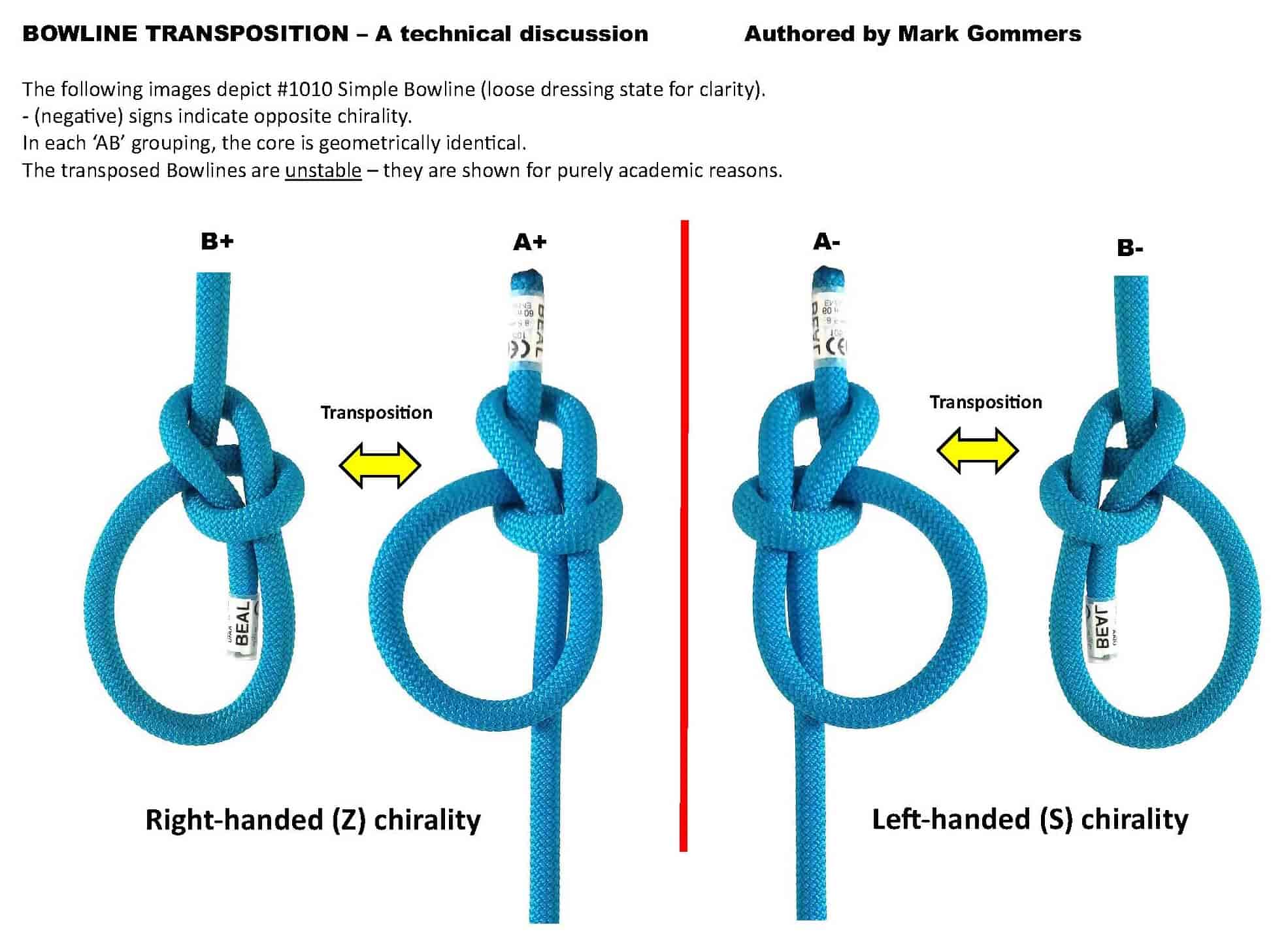
I have added the Simple #1010 Bowline (no tail tuck).
Showing a transposition… although it is completely unstable.
I am showing it for purely academic reasons.
This is an example where a transposition results in something unstable or illogical.
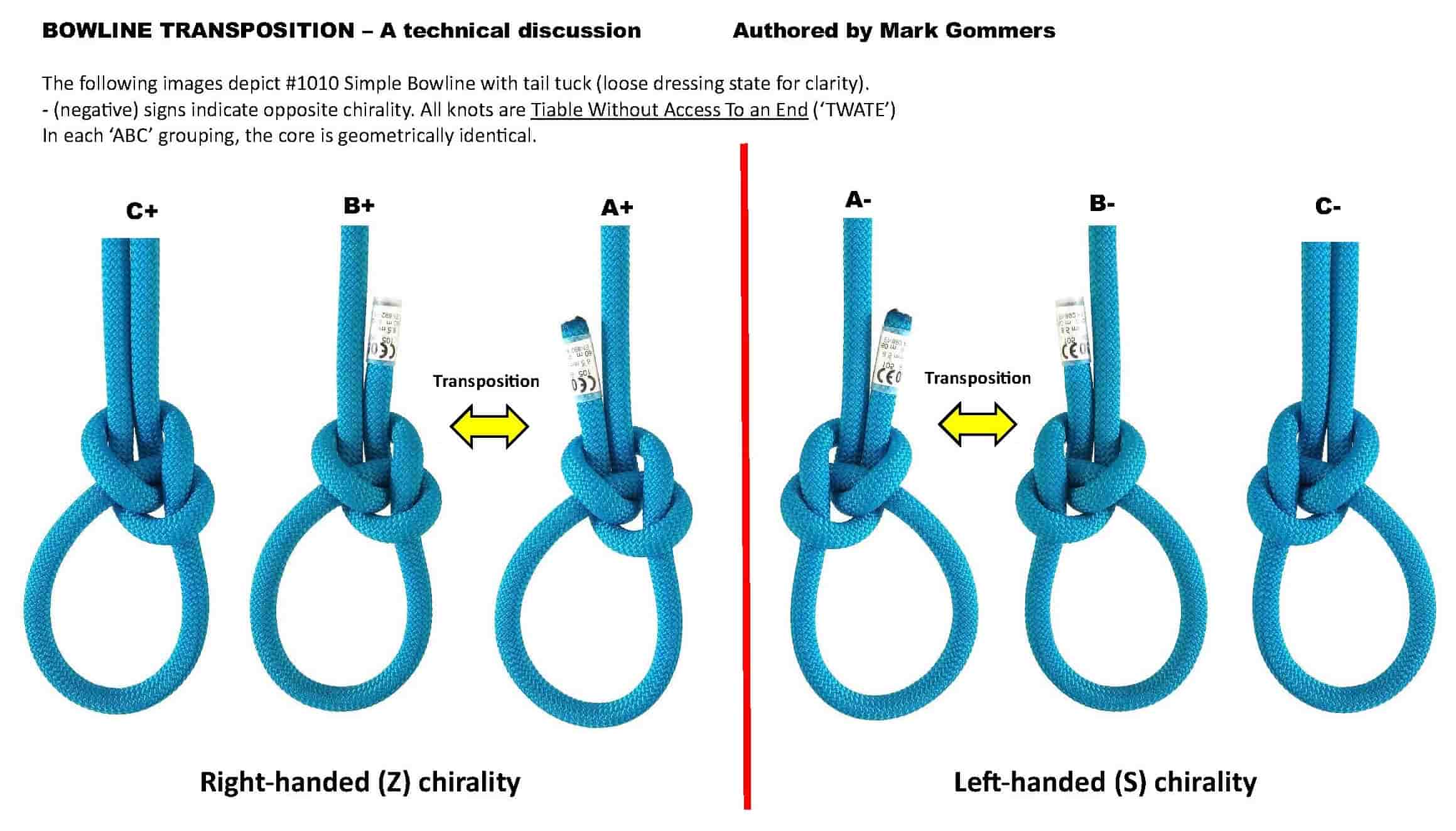
TRANSPOSITION_Bowline_WEB.jpg

TRANSPOSITION_Bowline 1010_WEB.jpg

TRANSPOSITION_F8_WEB.jpg

Why did you omit (reading & comprehending, apparently)
copying my entire statement, which begins exactly with
my definition you so want --to wit :

For an EyeKnot, [b]I define "reverse" to swap the loadings of each of the 2 pieces in the 2-Tangle[/b], after cutting apart the loop (well, my *Tangle* never connected it and joining the old S.Part & Tail), and thus the 1-2 piece will shift from 100%-&-50% to 50%-&-100%, and the A-B piece likewise goes from 50%(RELeg) -&- 0%. (Interestingly, the Reverse of the Fig.8 EK changes the Interior/Exterior loading --S.Part & Tail being opposite in this.) For the e2e Joint, "reverse" = "Tail-loaded", but not for Eye Knots.

–dl*

To Dan:
Take a breath… no conspiracy here.
The last part of your commentary in the previous post appeared
to contradict the first part (" but not for eye knots").

The same can be seen with your apparent irritation with my
use of the phrase “counter claim”.
The word “counter” is not conspiratorial.
It simply means that Alan made an original claim - and then
you also made a claim. This is where the word “counter” means
to rebut or contradict a previous claim.
That is, Alan made a claim of originality.
You then stated that you had discovered the knot prior to Alan.
How are people supposed to interpret this?
(as you point out, there are no awards or ceremonies for knot discoveries!).
I would comment that there are some people in this forum who do
believe in the concept of originality and see no harm in acknowledging
that a particular person claims title to discovery.

Also in this topic thread (which I started) - the theme is transposition.
In my view, the term transposition is more precise and meaningful than “reversal”.

Reversal could be taken to mean a physical exchange of position or some
may interpret it in other ways depending on subject matter.
The word reversal could also be problematic in discussions about chirality.

Transposition - for me - means no alteration of the core geometry.
Key to understanding is the change of identity, without
disturbing the core geometry.

NOTE:
A transposition can occur with End-to-End joining knots (‘bends’),
and it can also occur with Eye knots (ie ‘loop knots’).
A transposition is not limited to End-to-End joining knots alone.

BACK ON TRACK

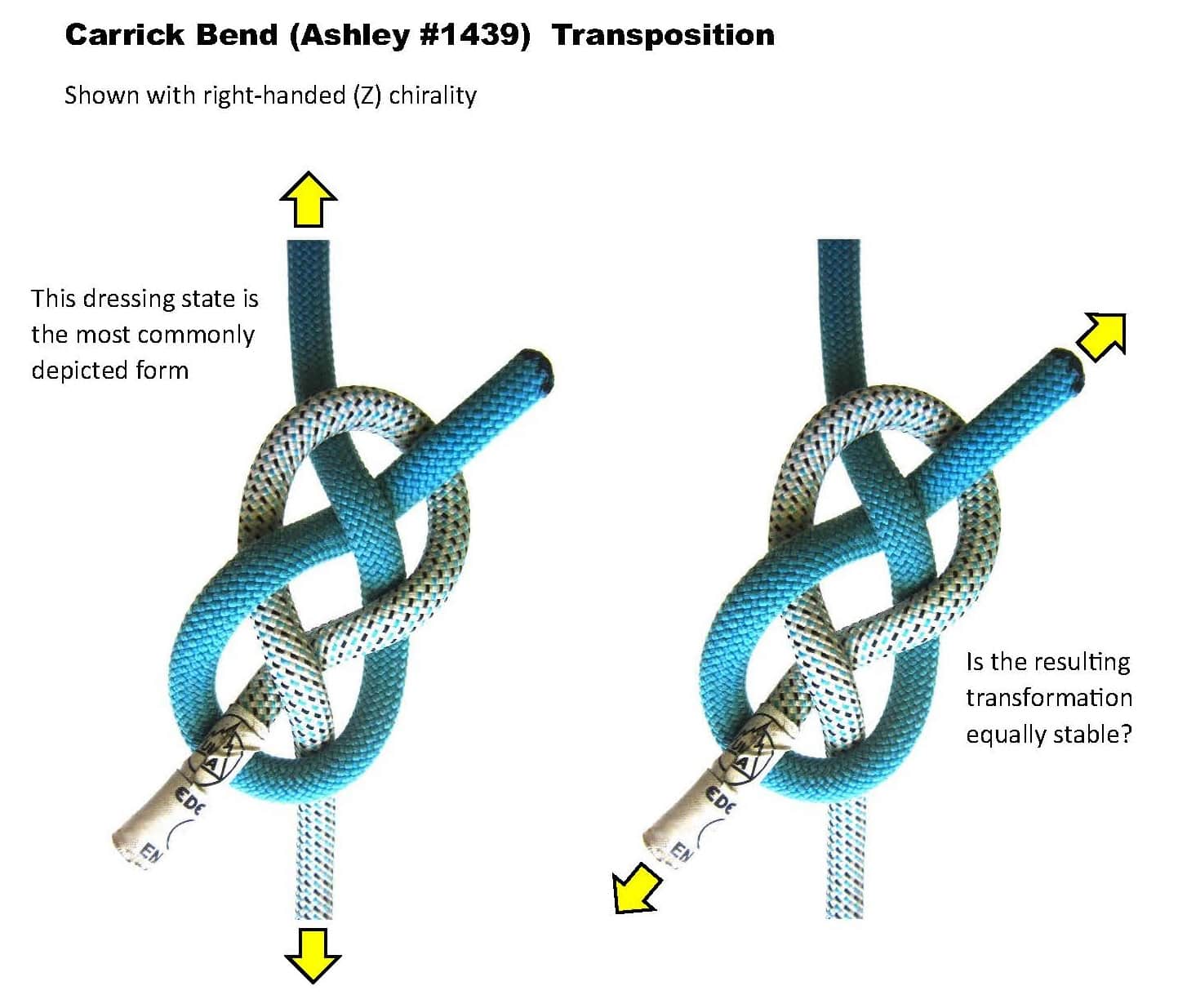
TRANSPOSITION OF CARRICK BEND (Ashley #1439)

What happens in a transposition of the Carrick bend?
Is the resulting transformation equally stable as the original form?
(NOTE: A Carrick bend undergoes transformation when tied in the typically depicted way,
which is a ‘dressing state’ that is unstable).
For example, see this link for a typical tying method: https://www.animatedknots.com/carrick-bend-knot

Of course, we can tie a Carrick bend directly using #206 Crossing hitches.


Carrick Bend transposition_WEB.jpg

But it actually points do a difference between the act
and effect :: that “Reverse (e2e)” gets same result/knot
as “Tail-load (e2e)”, but not so for Eye Knots (where the
Reversal gives 2-v-1+B and Tail-loading gives B-v-2+A
–the Tail “B”, swapped in for former S.Part “1”).

The word "counter" is not conspiratorial. It simply means that Alan made an original claim - and then you also made a claim. This is where the word "counter" means to rebut or contradict a previous claim. That is, Alan made a claim of originality. You then stated that you had discovered the knot prior to Alan. How are people supposed to interpret this?
Yes, but I exactly did neither; rather, YOU have taken these notes of facts as in a contest for prize *FIRST!*, whereas we have merely passed along notes about our travels in the Knot Universe --for which information about our aims & pathways can be of interest.
Also in this topic thread (which I started) - the theme is transposition. In my view, the term transposition is more precise and meaningful than "reversal".
In such technical discussion key terms are defined. ("transposition" has ample generalities too --and esp. re altering physical positioning.)
The word reversal could also be problematic in discussions about chirality.
But those familiar with the concept of chirality would have trouble with your recent images of a BWL tied beside its mirror image with claims of differing chirality when a savvy knot tyer fines one in a line with ends out of play and yet transposes it into the other --which chiral knots can't do!
[u]NOTE:[/u] A transposition can occur with End-to-End joining knots ('bends'), and it can also occur with Eye knots (ie 'loop knots'). A transposition is not limited to End-to-End joining knots alone.
I think this is said re my "but not for Eye Knots"; I hope that that misunderstanding is now erased.

–dl*

Quote from: agent_smith on September 29, 2024, 11:05:44 PM The last part of your commentary in the previous post appeared to contradict the first part (" but not for eye knots").
Quote from Dan Lehman: But it actually points do a difference between the act and effect :: that "Reverse (e2e)" gets same result/knot as "Tail-load (e2e)", but not so for Eye Knots (where the Reversal gives 2-v-1+B and Tail-loading gives B-v-2+A --the Tail "B", swapped in for former S.Part "1").

Word salad :slight_smile:
Cause and effect?
Also, I had previously stated that I prefer to begin with an end-to-end joining knot,
and use that as a base from which to derive the corresponding eye knots.
I find it more logical and intuitive to adopt this approach.

One can of course begin with an eye knot, and then try to derive the
corresponding ‘bends’. However, it is less intuitive and results in more
possible pathway variables.

Note that Double Fishermans bend (Ashley #1415) does not fare so well
in a transposition.

Obviously, I dont like the use of the term “reverse” or “reversal” in lieu of transposition.
I am of the view that ‘reverse’ leaves open too many edge cases and ambiguities.
The term ‘transposition’ locks the concept down nicely for me.

You have made it clear that you don’t believe in prizes, awards, ceremonies,
academy awards, fanfare, or recognition, for making a new knot discovery.
That’s fine.
I am of the view that there are some dedicated knot tyers who do believe in the merits
of awarding recognition of achievement.
Why don’t you make a counter claim against all yChan’s knots?
I reckon he will bark at you faster than you can say “counter claim” :slight_smile:

But those familiar with the concept of chirality would have trouble with your recent images of a BWL tied beside its mirror image with claims of differing chirality when a savvy knot tyer fines one in a line with ends out of play and yet transposes it into the other --which chiral knots can't do!
The great [b]Xarax [/b]reminded me that in all of the technical posts, that I make, I have an audience of one (1)! The word salad that you and I engage in pops up on virtually no one's radar screens. Its just two knot geeks engaging in deep technical dives that interest very few people.

With regard to your comment above:
But those familiar with the concept of chirality would
have trouble with your recent images of a BWL tied
beside its mirror image with claims of differing chirality

I of course disagree.
There was nothing technically wrong with the images of simple Bowlines (#1010)
that I posted previously.
I showed #1010 Simple Bowline in both ‘S’ and ‘Z’ chirality.
I also showed the transposed images.
I drew a red line to clearly separate the differing chiralities.

The key concept is that the core of the knots do not change.
I use the term ‘core’ to denote the part of the knot that is central to its existence or character.
The chiralities shown were correct (one shown as ‘S’ and the other as ‘Z’).

Look - Dan - the fact is that most of this info is rarely (if ever) discussed or published.
With all of my work in relation to chirality, transposition, and correspondence between knots, it is
largely breaking new ground.
Whenever you break new ground, expect teething troubles.
Harry Asher briefly touched on some of these topics - but he never explored it in deep
technical detail. He only ‘dipped his toes into the water’ so to speak…

I think this is said re my "but not for Eye Knots"; I hope that that misunderstanding is now erased.
Well yes and no. Its still a word salad :) What you might have meant is this: [ ] End-to-end joining knots usually tolerate a transposition (loading does not flip the knot - there is no 'eye' to flip) [ ] Eye knots generally don't fare too well in a transposition (the 'eye' will be wrenched and loaded in an opposite direction). This is where the use of the term 'reversal' can be complicated. Although again, the Double Fishermans bend (Ashley #1415) doesn't tolerate a transposition.

To me it has always been as like input/outputs reversed to same sum/or a 1way if not.
i also look at it like a reverse polarity of +/- ;

whereby the input is positive and the terminal as ground negative.
or antennae/force catcher to ground anchor termination type travel.
.
But must be of linear force inputs thru SPart, after witch force typically degrades via friction along travel of input to output.
But NOT of radial force inputs of radial binding, whereby force input is to side of rope and equivalent around
(vs. more typical end input of linear forces for Hitch and Bend then on degrading force travel onto round host).
Radials don’t degrade force as travel around host until crossing nips.
.
Linear vs. Radial input, output, travel always makes big difference.
Linear force is focused to port thru 1 axis.
Radial is NOT focused, but rather radial is evenly dispersed to all axises by extreme contrast.
Thus radial can be folded , funneled , focused to 1 axis as increase
but linear diluted, dispersed from focused to dispersed.
Hand crank winch is radial dispersed focused into linear
lock crank to become single layer rope on drum can be bollard of focused linear input dispersed to radial.

per KC:

i also look at it like a reverse polarity of +/- ;
Yes, I too had originally considered the descriptive term "reverse polarity". But then decided on a singular word: [i]Transposition [/i](one word instead of two words).

Conceptualising as a reversal of polarity might help some in understanding.

Mark,

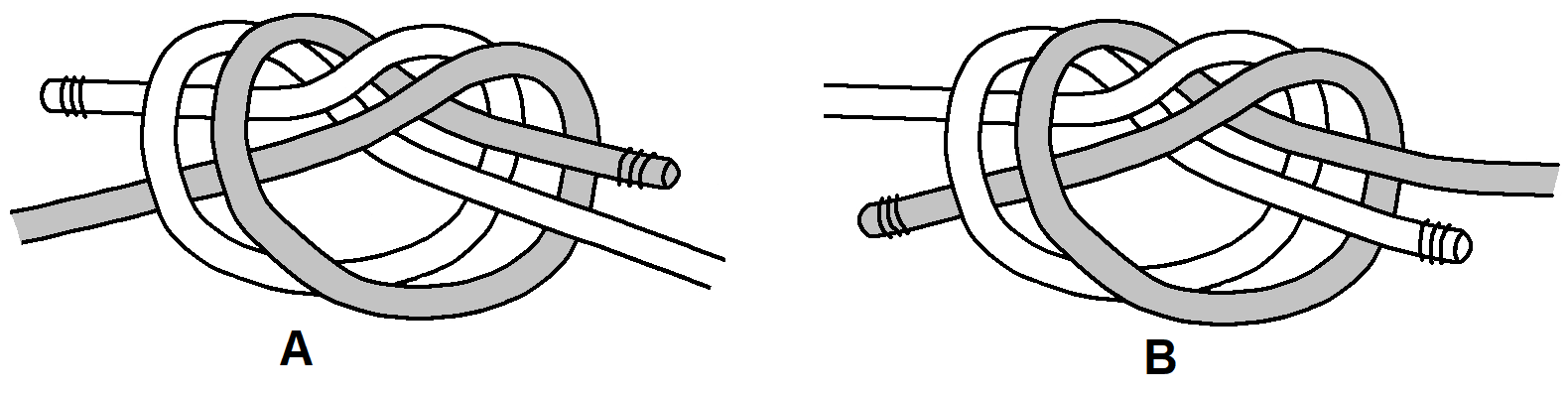
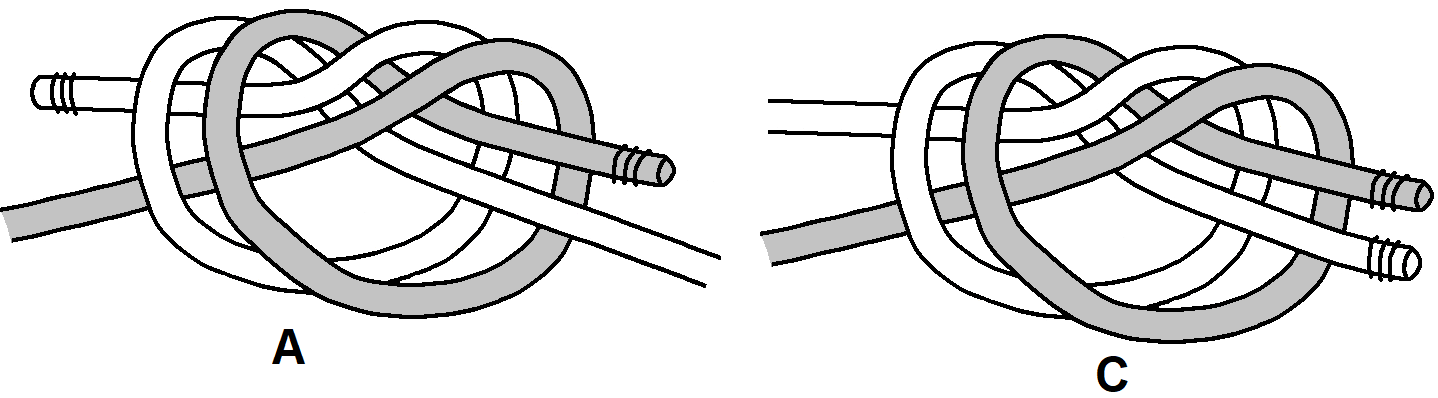
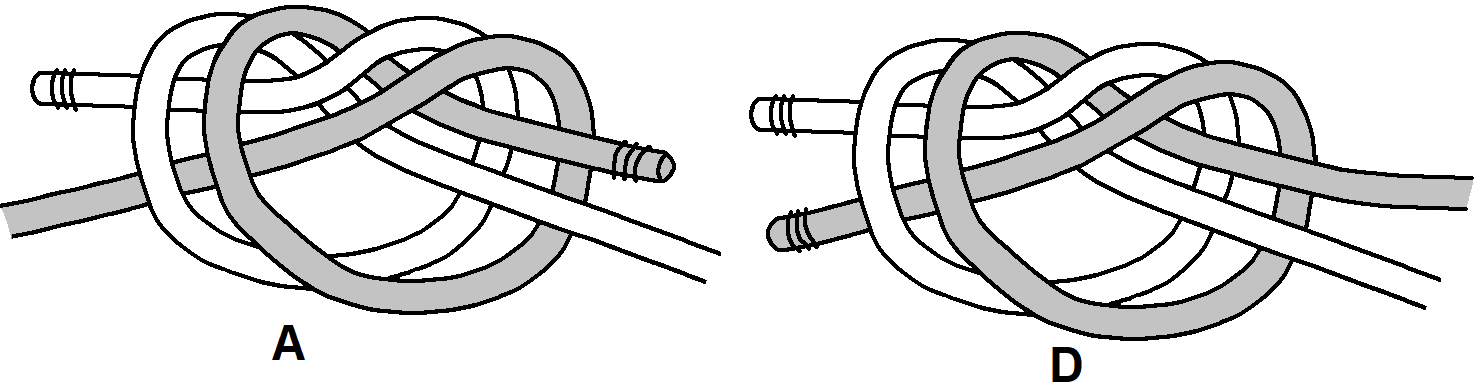
I agree that for a terminal knot or most eye knots, where there is one rope, one standing part, and one free (or working) end, it makes sense to talk about the transposition. But for a bend, there are two ropes, two standing parts, and two free ends. You can transpose one rope but not the other to get what is usually called an offset bend. Then you can transpose the second rope but not the first to get a possibly different offset bend. Or you can transpose both ropes (which is what you seem to be doing). Here is the process for the Water Knot (or Ring Knot) [#296, 1412]. I think Ashley intends the one I have first, but neither of his diagrams makes it very clear. He also has diagrams for the Offset Overhand Bend (which he calls an Overhand Bend) [1410, 1557, 1558]. Here as for the Figure Eight Eye Knot, the two non-offset bends will have different loading properties. I cannot see any real difference between the two offset bends below.


Water Knot, transpositions.png

No, I only pointed to my definition of “reverse” to do
something to an e2e Joint that was same as Tail-loading;
but with an Eye Knot, those, um, acts(?!) give different
results. (each piece in the Joint goes from 100% & 0%
resp. of its ends to then 0% & 100%; in the EK, it’s
100% & 50% ↔ 50% & 100% for S.Part’s piece;
which in Tail-Loading becomes 0% --Tail takes the 100–
& 50% (same outgoing role, coupled w/RELeg).
Tolerance of such changes is a separate matter.

–dl*

Hello Dennis.
Thank you for your reply and interest in tis subject matter.
All of this is largely breaking new ground - there is very little
existing published material about the concept of ‘transposition’
or to put it another way “reversal of polarity” (per KC).

Some replies to your comments as follows:

But for a bend, there are two ropes, two standing parts, and two free ends. You can transpose one rope but not the other to get what is usually called an offset bend.
No - this is not universally true for all 'bends'. The Zeppelin bend and the Riggers bend (Ashley #1425A) do not produce any 'offset' geometries. Although you did say "usually" - I think you are possibly confining your self to one knot form (Ashley #1412 Water knot / Ring bend). I can think of other 'bends' that don't fit the "usually" remark. eg Carrick bend (either in its energy stable dressing state consisting of inter-linked Crossing hitches OR its pre capsized dressing state). Butterfly bend is interesting, there is an offset knot that is produced from a transposition.
Then you can transpose the second rope but not the first to get a possibly different offset bend. Or you can transpose both ropes (which is what you seem to be doing)
I'm not really doing anything per se. I'm simply exploring the concept of transposition. I'm sure that you'll be able to find 'edge cases' to support any claim you wish to make. And thats fine.

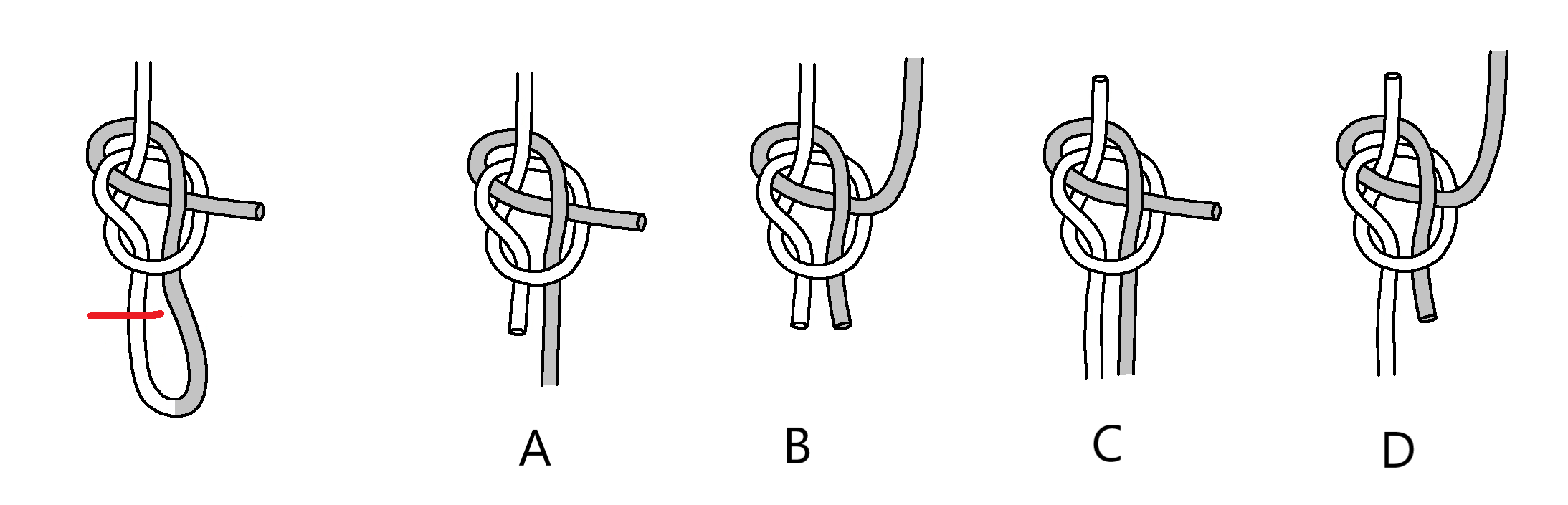
Referring to your original image (see attached) which I’ve borrowed for this post:

  • B is a full/complete transposition of A (and vice versa).

  • C is not a full/complete transposition of A (It is a partial transposition).

  • D is not a full/complete transposition of A (it is a partial transposition).

Important concepts:

  1. A transposition can only have meaning if it is relative to something (a base/parent knot).
  2. It needs to be specified exactly what is being transposed.
  3. ‘Normally’, a transposition will involve the ‘reversal of polarity’ of all protruding rope segments (ie a holistic transposition).
    (here again I’ve borrowed the reversal of polarity concept from KC).
  4. There is no requirement for a transposed knot to become ‘offset’.
  5. The cores of all transposed knots remain identical in geometry to the ‘parent’ structure.

Although again - there is no existing body of peer reviewed work that I can draw from (or source).
Thats because there is no existing body of work that explores the concept of transposition.
There is nothing ‘wrong’ with partial transpositions!
And there is nothing wrong with full (holistic) transpositions either!

I am using the term ‘core’ to denote the part of the knot that is central to its existence or character.


Water knot _transposition_Dennis Pence.png

Water knot _transposition_Dennis Pence_A-B.png

Water knot _transposition_Dennis Pence_A-C.png

Water knot _transposition_Dennis Pence_A-D.png

Mark,

Here is another example of the four different bends that you might get.

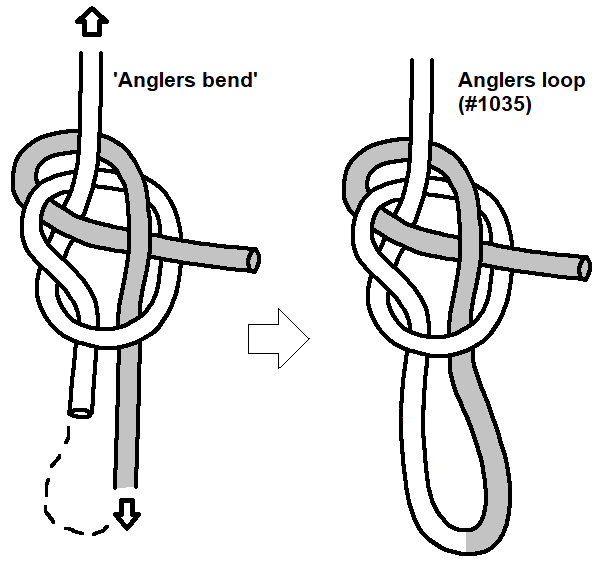
I started with one of the bends A that Asher had suggested could be derived from an Angler’s Loop [#1035]. {I do not understand what he intended to be the second bend in his book, “The Alternative Knot Book,” p. 82.} The first diagram below is the Angler’s Loop, and if you cut it at the red line, you get the bend A. Then if you transpose only the shaded rope, you get a transposition from A-B. If you transpose only the unshaded rope, you get the transposition from A-C. Finally, if you transpose both ropes, you get the transposition from A-D.

The two in the middle (B, C), that I think of as somewhat “offset,” seem to flip some as you try to tighten them, but they still seem to hold. I am not sure how practical any of the four are as a bend.


Angler's Loop (1035) related Bends.png

Thanks Dennis.

EDIT NOTE:
Your post has more to do with the relationship between ‘bends’ and ‘eye knots’ (aka loop knots).
And so might belong in another topic thread.
However, with regard to your attached image in reply #10 above:
‘D’ is a transposition of ‘A’ (and vice versa)
‘B’ is a partial transposition of ‘A’
‘C’ is a partial transposition of ‘A’ (and would be ‘offset’ when loaded)

With regard to your attached image in reply #10 above, you are beginning
from an ‘eye knot’ and then working ‘backwards’ to derive the corresponding ‘bends’.
This is the approach Dan Lehman appears to prefer (I think).

I find this approach to be less intuitive.
Although, its a free world, and we are free to examine the
relationship between ‘bends’ and ‘eye knots’ in any way we choose.

With regard to your attached images of #1035 Anglers loop,
“A” is the parent bend.
When starting from “A”, you can then derive its 4 corresponding eye knots.

There are some possible ‘offset’ ‘bends’ that are derived.
(although again, ‘offset’ is not a required condition for all knots in the universe).

EDIT NOTE:
Again, the Zeppelin bend and Riggers Bend (Ashley #1425A) produce nothing ‘offset’.
Some of the corresponding eye knots are quite good in my opinion.
Although Xarax will likely admonish me for ‘liking’ one of the principal corresponding
eye knots derived from the Zeppelin bend.
Two of the corresponding eye knots derived from the Riggers bend are quite good.

A further note with your approach of beginning with an ‘eye knot’ and deriving its
corresponding ‘bends’ - you can predict when some of the ‘bends’ will be ‘offset’
just by looking at the geometric arrangement of the protruding segments.


Anglers bend_corresponding eye knot_Dennis Pence.png

It is best to see such things both ways, forwards and backwards thru models for most perspective(s).
Also, as checksum; as shows at once, both sides of coin to test in balance against the other.
.
An eye knot comes back to itself as if another rope bending to itself; under the same rules. Not terminating at host but around.
.
i see a lot of rope paths as like electronic schematic symbols, at a force is force depth look.
schematic resistor symbol as rope friction, ground symbol as anchor/rope force termination, transformer for pulley system etc.

https://upload.wikimedia.org/wikipedia/commons/5/57/Electric-scheamtic-symbol-functions-compared-to-rope-functions-of-similar-force-control-needs_.600px.png
(2016)
.

Thank you ‘KC’.
Your graphic images are always high quality (a lot of work goes into it).

With regard to the intent of this topic thread (“Transposition”), I’m
not sure how your electrical diagram directly contributes to, and furthers
the exploration of this subject matter?

Although, I did adopt your idea of “reversal of polarity”.
This is a very good way of explaining what is happening in knots
that have been ‘transposed’. Most people can immediately grasp
the meaning of this concept and apply it to a knot.

I note that your electrical analogy diagram did not include
“reversal of polarity”. If you had such a diagram, it would
be more directly relevant to this topic.

TY Agent Smith, so sorry only meant to show the whole theme of electric wire force and tensioned rope force goes deep. i find many relative points of comparison in a force is force view, wider than this specific reference. A real goldmine sometimes in fact.
.
My constant imagery of a reverse of polarity in a system is to do so physically, like to swap ends of jumper cables to battery.
Does it show the same, less, more or not work at all type observations.
Even though of same family of Crossed Turns : Clove and Constrictor are own equivalents backwards, but not Bag(personal fave a lot of times, especially slipped) nor Groundline. While basic BackHand Turn reverses to accommodate equally to and fro; unless blocked from the flip.

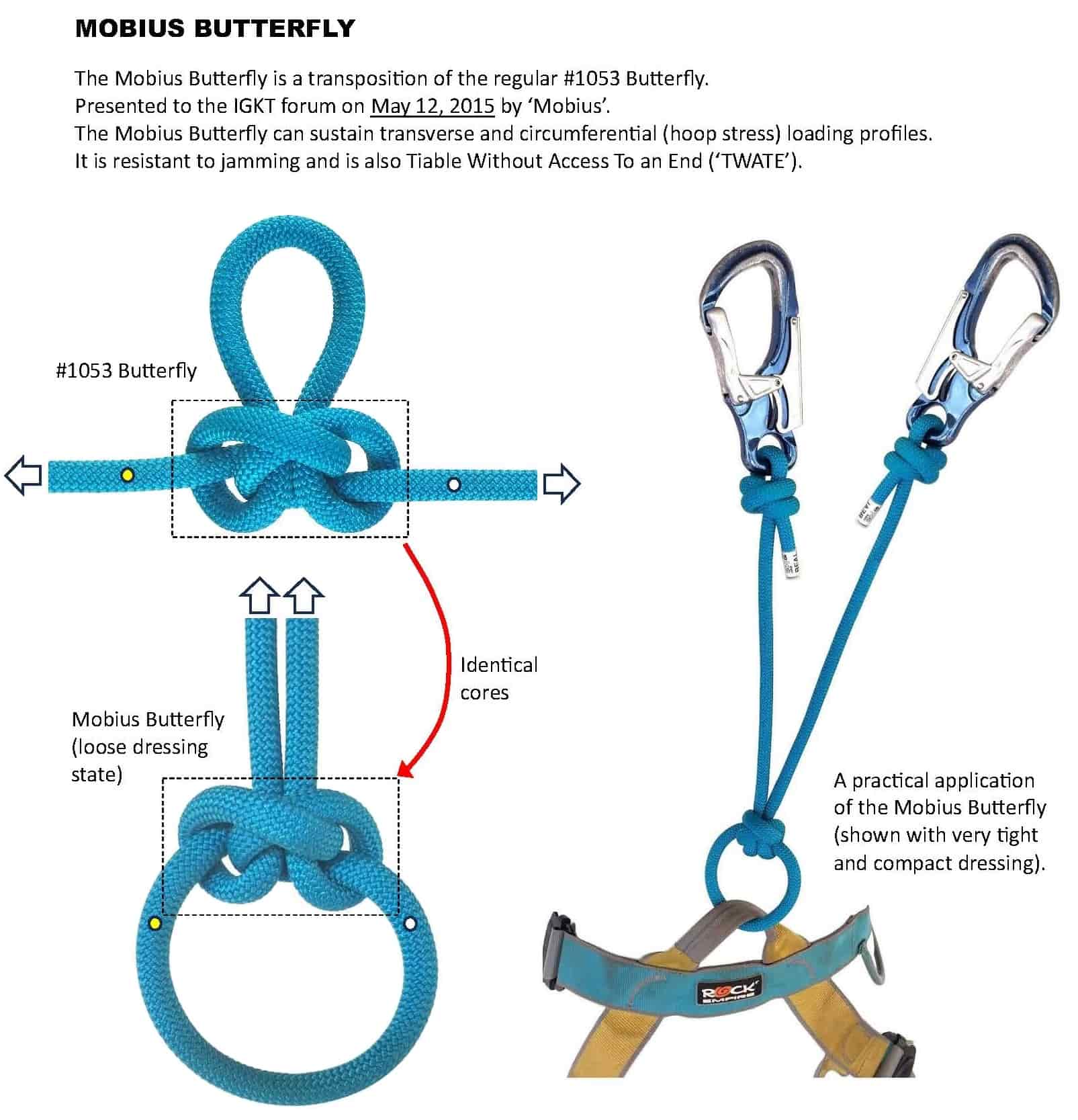
The ‘Mobius Butterfly’ is a wonderful example of the result of
a transposition.

‘Mobius’ presented this structure to the IGKT forum on May 12, 2015.
At that time, the concept of ‘transposition’ was not well understood,
and neither was the ‘correspondence’ between bends and eye knots.
Link: https://forum.igkt.net/index.php?topic=5315.0
Alas, ‘Mobius’ has disappeared from the IGKT forum…

Mobius did not present a parent Butterfly bend and then derive the
corresponding eye knots from the 4 principal linkages.
The ‘Mobius Butterfly’ is one of the 4 principal linkages.
Phil D Smith was possibly the first to publish the ‘Butterfly bend’ in 1953.
This is where I think Harry Asher missed an opportunity to explore and illustrate
the corresponding eye knots derived from a Butterfly bend - had he done so, he
would have discovered the ‘Mobius Butterfly’.

The Mobius Butterfly is remarkable because it can sustain multiple loading
profiles:
transverse loading
circumferential (hoop stress) loading

It is jam resistant.
And, it is Tiable Without Access To an End (‘TWATE’).

Dressing:
In order for Mobius Butterfly to achieve its remarkable capabilities, it
must be carefully set and dressed into a very tight and compact form.
Once this is achieved, it remains stable and secure.

NOTE:
In my opinion, the Mobius Butterfly is a better alternative to
the ‘Wrap 3 - Pull 2’ knot for SAR teams (vertical rescue).
It can be quickly and easily tied around a sturdy tree, using low stretch
(EN1891) rope.
It provides a multi-directional self-aligning anchorage.

EDIT NOTE:
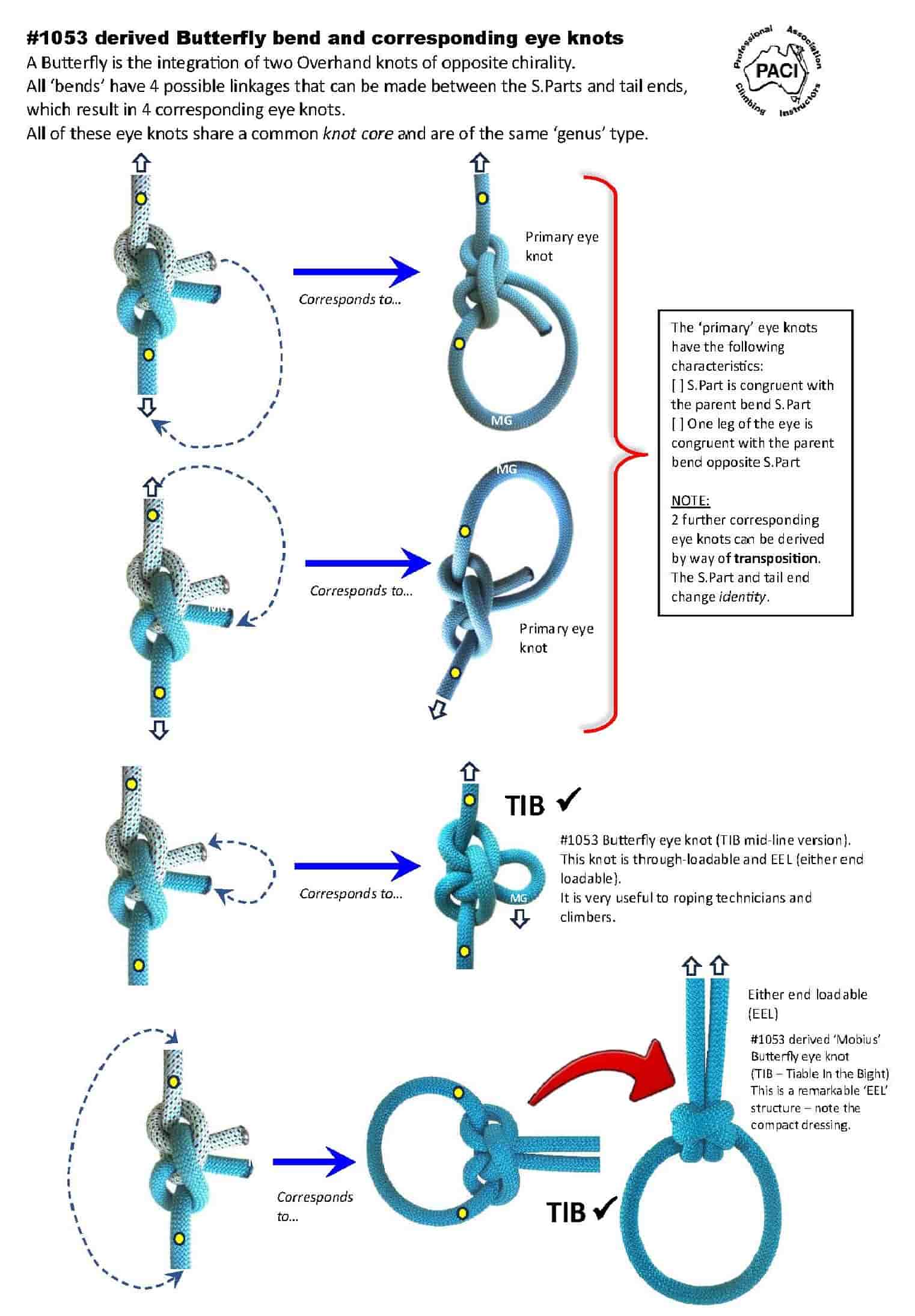
Image added showing corresponding eye knots.
This image is off-topic, but aids in clarity and understanding.


MOBIUS BUTTERFLY_application_WEB.jpg

Butterfly_Corresponding_Eye-knots_WEB.jpg

It is jam resistant. And, it is Tiable Without Access To an End ('TWATE').
Really ?! --it looks to be quite jammable. "TWATE" = "NSE"-> "Noue' Sans Extremites" (I think we can omit the "access to" bit, something that came to rid me of "utilizing", as that allowed in a way a need for "access".)
[u]NOTE:[/u] In my opinion, the Mobius Butterfly is a better alternative to the 'Wrap 3 - Pull 2' knot for SAR teams (vertical rescue). It can be quickly and easily tied around a sturdy tree, using low stretch (EN1891) rope.
But W3P2 is about security-on-the-object --that one unpulled wrap giving the securing binding.
[u]EDIT NOTE:[/u] Image added showing corresponding eye knots. This image is off-topic, but aids in clarity and understanding.
Not so. You have at the top the "same" knot (not quite, given asymmetry of Lineman's Loop), one each for the two S.Parts. Well, you would need that at the bottom for Mobious, no? And then you also have but one of the implied pair for your 3rd case --need the one for the other S.Part to complete this set.

As for you criterion of “same geometry”,
I don’t see that at all for the Mobious :: what are clearly
–and to-untie helpfully-- “proper collars” of the parent
are lost in Mobius --drawn to collapsed snugness.
(Likely --varying per material & load-- in the knots
with one S.Part of parent vs. the united Tails, the
collar around the unloaded parent-S.Part will be
collapsed to the core, also. This is one of the problems
with analyzing/testing mid-line EKs :: establishing what
forces have acted upon them when the loading moves
from one way to another and back … !

–dl*

Quote from agent smith:
It is jam resistant.
And, it is Tiable Without Access To an End (‘TWATE’).

Reply from Dan Lehman:

Really ?! --it looks to be quite jammable.
Curious: Have you actually load tested the Mobius Butterfly? Or are you speculating? Which is it?

Reply from Dan Lehman:

(I think we can omit the "access to" bit, something that came to rid me of "utilizing", as that allowed in a way a need for "access".)
'TWATE' is my invention. I prefer it in lieu of 'TIB'. "Without access" doesn't mean without [i]permission [/i](if that's your supposed interpretation?). [i]Tiable without access to an end[/i] nicely captures the concept. My issue with "tiable in the bight" is that it implies a bight is required or that a bight must first be formed.

With regard to the “Wrap 3-Pull 2” knot used by SAR teams:
Reply from Dan Lehman:

But W3P2 is about security-on-the-object --that one unpulled wrap giving the securing binding.
[u]The wrap 3-pull 2 knot provides 3 key benefits:[/u] 1. Multi-directional anchor; and 2. Resistance to jamming; and 3. Built from lightweight/compact readily available material (ie webbing).

I propose the Mobius Butterfly as a very capable alternative.
And one that is constructed from robust EN1891 low stretch rope.
That is, instead of webbing, a length of 11mm low stretch rope is used.
It can be rapidly deployed and tied around a sturdy tree.
It is easy and quick to tie (and I would argue faster than the wrap 3-pull 2).
The Mobius Butterfly is resistant to jamming (try it yourself).

With regard to adding the second image to aid in clarity and understanding for the casual lay reader:
The second image showed how 4 corresponding eye knots could be derived from a Butterfly bend.
It is providing context.
Reply from Dan Lehman:

Not so. You have at the top the "same" knot (not quite, given asymmetry of Lineman's Loop), one each for the two S.Parts. Well, you would need that at the bottom for Mobious, no? And then you also have but one of the implied pair for your 3rd case --need the one for the other S.Part to complete this set.
You are not making any sense (sorry). The image showing the parent Butterfly bend and its 4 principal linkages is correct. All 'bends' have 4 possible linkages that can be made between the S.Parts and the tail ends. To provide some context, I showed how the Mobius Butterfly can also be derived from the 'Butterfly bend'. In the top (upper) image, I showed a [i]transposition[/i]. That is, it can also be derived by way of a transposition from the regular #1053 Butterfly. The sequence in which I show each of the 4 corresponding eye knots is arbitrary. There is no required sequence/order in which I must show the eye knots. I did not also show the further 4 eye knots that can be derived by way of transposition. The regular #1053 Butterfly is 'EEL' (either end loadable). The Mobius Butterfly is also 'EEL'. And so showing the transposed knots in these cases seems to be redundant.

Quote from Dan Lehman:

As for you criterion of "same geometry", I don't see that at all for the Mobius :: what are clearly --and to-untie helpfully-- "proper collars" of the parent are lost in Mobius --drawn to collapsed snugness.
The collars of a Mobius Butterfly are not 'lost'. They are present - but simply folded inwards. The topology is the same - its simply a compact, and very tight dressing. I would go a little further here... the folding inwards of the 2 collars is a natural tendency - and once achieved, stays that way. It retains its compact dressing as a natural (unforced) state. Of course, in very stiff rope/cordage, it may not perform as well. My experience is that the Mobius Butterfly is effective in more supple, soft/flexible cordage. Some Bluewater low stretch rope has a tendency to stiffen over time. I have some old Bluewater II rope that is virtually like steel wire rope! Tying a Mobius Butterfly in very stiff rope would likely be difficult (I haven't tried).

Further commentary from Dan Lehman:

This is one of the problems with analyzing/testing mid-line EKs :: establishing what forces have acted upon them when the loading moves from one way to another and back ... !
This is an opportunity to declare what your actual in-the-field experience is with using a Mobius Butterfly. Have you actually used and applied it? I have - many times. I think SAR teams will start to adopt it once they learn more about it. It is also quite effective for improvising a dual leg lanyard into a harness. Rope access operators will find it very useful - not only do they have the dual connectors, they also have a secondary 'belay loop'. The 'belay loop' (or eye of the Mobius) - is capable of sustaining transverse and circumferential loading profiles.

EDIT NOTE:
LOAD TEST OF MOBIUS BUTTERFLY

I just tested the Mobius butterfly to 6.0kN force.
TEST 1: EN892 Beal Opera 8.5mm dynamic rope
TEST 2: EN1891 Edelrid 11mm low stretch rope
Result: No jamming - easily untied.
No jamming in either rope.

FURTHER TEST to 8.0kN
TEST 3: EN892 Beal Opera 8.5mm dynamic rope 8.0kN (approx 800kg)
Result: No jamming, super easy to untie.

Commentary:
As a general rule, SAR teams do not reach
a force of 6.0kN (approx 600kg) on their anchors.
Typical loads might be in the range 2-4 kN.

In relation to my third test to 8.0kN - I know for a fact that no SAR team
will ever reach an operational load of 8.0kN.
I am therefore confident to declare that the Mobius Butterfly will
meet and satisfy all SAR needs for multi-directional anchors.

As stated, “it LOOKS…” --clearly that’s sans testing.

Reply from Dan Lehman:
(I think we can [b]omit the "access to"[/b] bit, something that came to rid me of "utilizing", as that allowed in a way a need for "access".)
'TWATE' is my invention. I prefer it in lieu of 'TIB'. "Without access" doesn't mean without [i]permission [/i](if that's your supposed interpretation?).
My point is that the shorter/simpler "without ends" & "sans extremites" get the point, not needing to state "access" (there might be no "ends" !).
The second image showed how 4 corresponding eye knots could be derived from a Butterfly bend. It is providing context. Reply from Dan Lehman:
Not so. You have at the top the "same" knot (not quite, given asymmetry of Lineman's Loop), one each for the two S.Parts. Well, you would need that at the bottom for Mobious, no? And then you also have but one of the implied pair for your 3rd case --need the one for the other S.Part to complete this set.
You are not making any sense (sorry).
Let me work through this better, then (for both of us!).
The image showing the parent Butterfly bend and its [b]4 [i]principal[/i] linkages[/b] is correct. All 'bends' have [b]4 [i]possible [/i]linkages[/b] that can be made between the S.Parts and the tail ends.
Whoa, which is it --"principal" or "possible" : the former implies a subset of the latter. Your 4 images show the 4 possible links : (top=1) white side+ blue bottom; --aka W-Tail +B-S.Part (2nd) white top + blue side; --aka W-S.Part + B-Tail (3rd) white side + blue side; --aka W-Tail + B-Tail (4th) white top + blue bottom; --aka W-S.Part + B-S.Part

Now, if I understand your “principal”,
you want there to be one or the other of the
parent joint’s S.Parts qua S.Part in the EK.
This would then include your top 3 images,
noting that arrowed unlinked ends of top two
are S.Parts, and then that the 3rd image shows
implicitly the other two, per loading either the
white or blue vertical (“top” & “bottom”) ends.

So, Mobious comes as non-principal. It is
what I’d refer to as "fore<=>aft’ing the
Butterfly --cutting original eye to S.Part/Tail
and fusing original S/T into the eye. Which
you see as a “transformation”. One might
also note that the Lineman’s Loop can be
capsized … into itself, Tangle ends swapping
duties/loading!

Now, in my Tangle (“interlacing” is the sense
to be had here, not “confused” or “random”) system,
the images could be defined/labeled as ::

A 2-Tangle of White rope"1-2" with ends “1” & “2”
entangled with Blue rope “A-B” … .

  1. 1 -v- 2+A (a traditional/common EK & joint pairing)
  2. A -v- B+1 ( ditto, but preserving opposite S.Part)
  3. <loading not indicated, but either of
    1 -v- 2+B
    & A -v- B+2.
    And your principals preserve 1 or A source-joint S.Parts.
    The remaining possible EKs left to this Tangle are :
    2 -v- 1+A, …+B and B -v- A+1, …+2
Quote from Dan Lehman:
As for you criterion of "same geometry", I don't see that at all for the Mobius :: what are clearly --and to-untie helpfully-- "proper collars" of the parent are lost in Mobius --drawn to collapsed snugness.
The collars of a Mobius Butterfly are not 'lost'. They are present - but simply folded inwards. --it's simply a compact, and very tight dressing
Yes, very tight; and in my quick check in some small super-flexible/soft cord I see jamming writ large --which, of course, stands in stark contrast to your well-specified check in intended material. But I remain skeptical.

FURTHER TEST to 8.0kN
TEST 3: EN892 Beal Opera 8.5mm dynamic rope 8.0kN (approx 800kg)
Result: No jamming, super easy to untie.

!!

–dl*

To my audience of one (Dan Lehman):
Its getting tedious with copy and paste quotes.

In relation to jam resistance of the Mobius Butterfly:
It is resistant to jamming.
Having reached 8.0kN in a load test with no jamming,
I’m very confident that the Mobius Butterfly will not jam.
However, I have not gone all the way to MBS yield point.
I would point out that SAR teams will never reach operational
loads of 8.0kN.

In relation to my use of the term ‘TWATE’ (Tiable Without Access To an End):
In my view, ‘TWATE’ is accurate and nicely captures the salient features of the tying method.
I dislike your preference for deleting the words “access to”.
‘Access’ is an important concept.
“Without access to” is very specific and self-explanatory.

The rest of your reply has more to do with ‘The relationship between bends and eye knots’.
EDIT NOTE
I have replied in the more appropriate topic thread “Correspondence between bends and eye knots”.

A further remark from Dan Lehman in relation to Mobius Butterfly jamming:

Yes, very tight; and in my quick check in some small super-flexible/soft cord I see jamming writ large --which, of course, stands in stark contrast to your well-specified check in intended material. But I remain skeptical.
Again, I have taken the Mobius Butterfly up to 8.0kN force. Result: No jamming, and super easy to untie. This was with EN892 dynamic rope (Beal Opera 8.5mm). If you think about it, both the Butterfly bend and the regular #1053 Butterfly eye knot are well suited to through loading. In fact, when through-loaded, they are resistant to jamming. I think you already know this! And so, why would the 'Mobius Butterfly' be any different?