I use my feet sometimes too, xarax.  Ropeless Class4/Low5th Class(EU Grade?) scrambling is my favourite kind of climbing, being unencumbered by gear.
I’ll take that as a joke. Let’s return to topic and not ruin the O.P.'s thread.
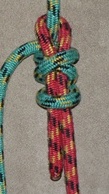
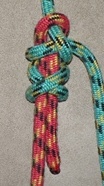
The ONLY advantage the Tresse double or triple nipping turn has, is exactly this “X” point, where the two lower round turns / nipping turns meet each other - BECAUSE one can use it as an anchor point and add the Scott s simple lock around it, through the higher nipping turn and through the collar ( around two rope diameters, so the rope follows a smoother path, as it happens in the modified version / white cow Scott does not prefer, for other reasons ).
The Pretzel ( reversed Girth hitch ) bowline I have been regurgitating for some years now ( just in case one is fed up, and decides to actually tie this, and see what I mean…), utilizes a much simpler but also coherent double nipping structure, that is tied, dressed and inspected much easier, and, on top of all this, it constricts the tail much harder than the Tresse bowline s double/triple nipping turn, by the first curve of its Standing part which conveys the greater amount of the total load. AND it does not suffer from this sharp turn of the eye leg s neck on the nipping turn s shoulders… However, it can not be enhanced by a Scott s simple lock as naturally as the Tresse bowline can, without this sharp U-turn around the rim of the nipping turn of the original Scott s locked bowline ( the black cow, Scott prefers, for other reasons ).
When I first met the Tresse bowline, I dismissed it just because I compared it with the Pretzel bowline. So, I tried to use the multiple X-ed nipping structure as a base for an “Eskimo”-type bowline, which is a more secure form of eye-knot, because it utilizes this L-shaped deflexion of the eye leg of the Tail even before the continuation of this eye leg reaches the collar. It had not crossed my mind that it could be improved so easily, and turned into a serious secure bowline / a possible replacement of the fig.8 eye-knot.
Having said that, I am still interested for the developments of the unlocked Tresse bowline. So, since I saw that JP made a modification that incorporated most of the advantages of the modification I myself had proposed, which, on top of that, turned the knot into a TIB knot, I am very glad, and I am following the thread.
Same stripes, sarcasm from you, xarax.
You’re good at tying knots and taking pictures. Show me your photographic evidence comparing the “modded” Tresse Bowline and Lehman’s Locktight Loop side by side which supports yours and D.L.'s contention that they are different knots. Thank You.
I had shown you your own pictures, which are fine, and show the two X s clearly. I had referred to the rat-tail-stopper thread, where there are plenty of images on this so efficient gripping structure. In fact, the Tresse bowline is but a rat-tail-stopper hitch / nipping structure turned into a bowline. The only difference is that the “Malvolio” crossings go in counter-rotating helices around one rope diameter there, while here they do exactly the same thing, but around two, or three rope diameters ( three, in the case f the “locked” Tresse, via the Scott s simple lock ). I have shown you 4 pictures of the locked Tresse bowline, but you dismissed them as “structures that you have already seen…” - but you never said where you have seen them ! I have referred to the threads in this Forum where Nelson mentions his bowline, and compares it to the “locktight” bowlines. Dan Lehman himself, after he repeated that he already had noticed the difference you and everybody Else had not ( as always…), said the same thing : The dressing is different, the geometry is different, the structure is different, the knot is different !
See the pictures of the dan Lehman clear sketches, and compare them to your clear pictures.
N.B. quote above - 5th one from the left, or 3rd from the right, if you will. It’s not labelled “Locktight” as such, but that they all carry the “core+wrap” locktight theme was my understanding. But that’s beside the point. It’s the 5th one from the left, and that was stated clear enough, and it’s the only one that I’ve ever cited when comparing the Modded Tresse.
Locktight Loops I & II (#6 & #2 in my link above) are, of course, not the same as the M. Tresse.
One might also note that L.L.#5 is the only true bowline of the “Locktight” series of eyeknots. But that’s another debate, is it not?
The “locktight” series is a series of bowlines based on AN ALTOGETHER DIFFERENT CONCEPT FROM THE CROSSED ROUND TURNS / CROSSED NIPPING TURNS concept of the Tresse series ! The “locktight” bowlines, ALL of them, are NOT based on the rat-tail-stopper nipping structure - the Tresse bowlines are ! The Tresse bowlines are different knots than ANY of the “locktight” bowlines, those already published.
The bowline you quoted is EVEN MORE different from the Tresse bowline, than the other one I had shown ! And, of course, no trace of X s whatsoever, no trace of rat-tail-stopper nipping structure.
I stand by my words and leave you with this morsel for your entertainment edification. http://www.youtube.com/watch?v=9wWUc8BZgWE
Balance !
The great Buster Keaton, who busted his chops with the greatest comedic genius of them all, Roscoe Arbuckle, upon whose broad shoulders many comedians have since stood. I’m shedding more tears than Tammy Faye Baker in acknowledgement of their contribution to the art.
http://www.youtube.com/watch?v=wPYlMqpN7fk
Not until Jacques Tati did the complexion of the art change. http://www.youtube.com/watch?v=LE9t98Gox60
http://www.youtube.com/watch?v=3IWqrwC8Ntk
Well, I have one thing in common with Buster, my Canadian heritage.
Perfect balance, I might add, for the situation at hand.
Guys like Keaton ushered in a new era, from which those after can only follow, or they must create their own new era.
JP, I wonder if your TIB method of the locked Tresse bowline and the TIB method of the ( “modified” / second /white ) Scott s locked bowline are somehow related to each other, and both of them to the TIB method of the Lehman s locked bowline. If that is so, perhaps those bowlines are only three members of a broader class of bowlines, which can be locked with a Scott s “simple lock” and turned into TIB knots at the same time. We have only to drive the Tail around the nipping loop, and then, following an anti-parallel direction to the Standing Part, through the collar. Miraculously, in the new locked bowline, the collar can be reeved our of the whole nub, and the knot can become untangled !
Hi xarax,
Although I believe that all the three methods are related, I think that the one for the Tresse and the one for the DLlocked, are more closely related to each other, because they work in exactly the same way:
One have to have a little patience to “decipher” them, but in this post http://igkt.net/sm/index.php?topic=4476.msg29355#msg29355 Dan Lehman provides all the details necessary to make TIB any bowline with a simple/standard collar that may come to mind,just starting from realizing the nipping turn directly as it appears also in the finished knot, as when one makes the corresponding no-TIB version,and also he provides the instructions for making four different versions (righthanded + lefthanded x 2 different retuckings) for each bowline one decides to do with this method"a la Bellringer." Contrary to what I commented on that thread, after having fumbled a bit with this method,I also realized that it is quick and easy also with regard to its practicality.
Now, the method proposed by Dan Lehman and the one proposed by James (I like! ;)) for the DLlocked, they really are not so different:the only major difference is that the first begins directly from the nipping turn and then pass through it the bight or the turn, while in the second occurs Basically that one build the nipping loop around the bight / turn previously built.
So, the second method for the DLlocked corresponds to the option “(c)/(d)” (depends on how it is twisted the bight) of the DL method, while the method for the Tresse corresponds to the option “(a)”, but building initially the tresse nipping structure instead of the standard nipping loop.In the same way, in fact, with the second method, orienting / twisting the bight around which the nipping structure will be built , one can get the same four versions of “handedness” / closure of the bowline.
Bye!
I have not studied all those slightly different methods that much, because I believe that the mnemonic shown at :
http://igkt.net/sm/index.php?topic=4476.msg29203#msg29203
is the shortest and the easiest possible one ! However, it lacks generality, and I do not see how it can be modified without losing its initial simplicity to generate more TIB bowlines…
Whatever method is used for the DLlocked,it seems that one get to a point where has(at least topologically)a simlpe noose in her hands;now: with regard to this type of lock, if you want to get any kind of nipping structure different from the simple nipping loop of the classic bowline, it seems to me that you’re forced to act before it happens: If you start directly from this simple noose, I think at that point the games seem closed with regard to this.
I saw them in my own hands while fiddling with the Tresse.