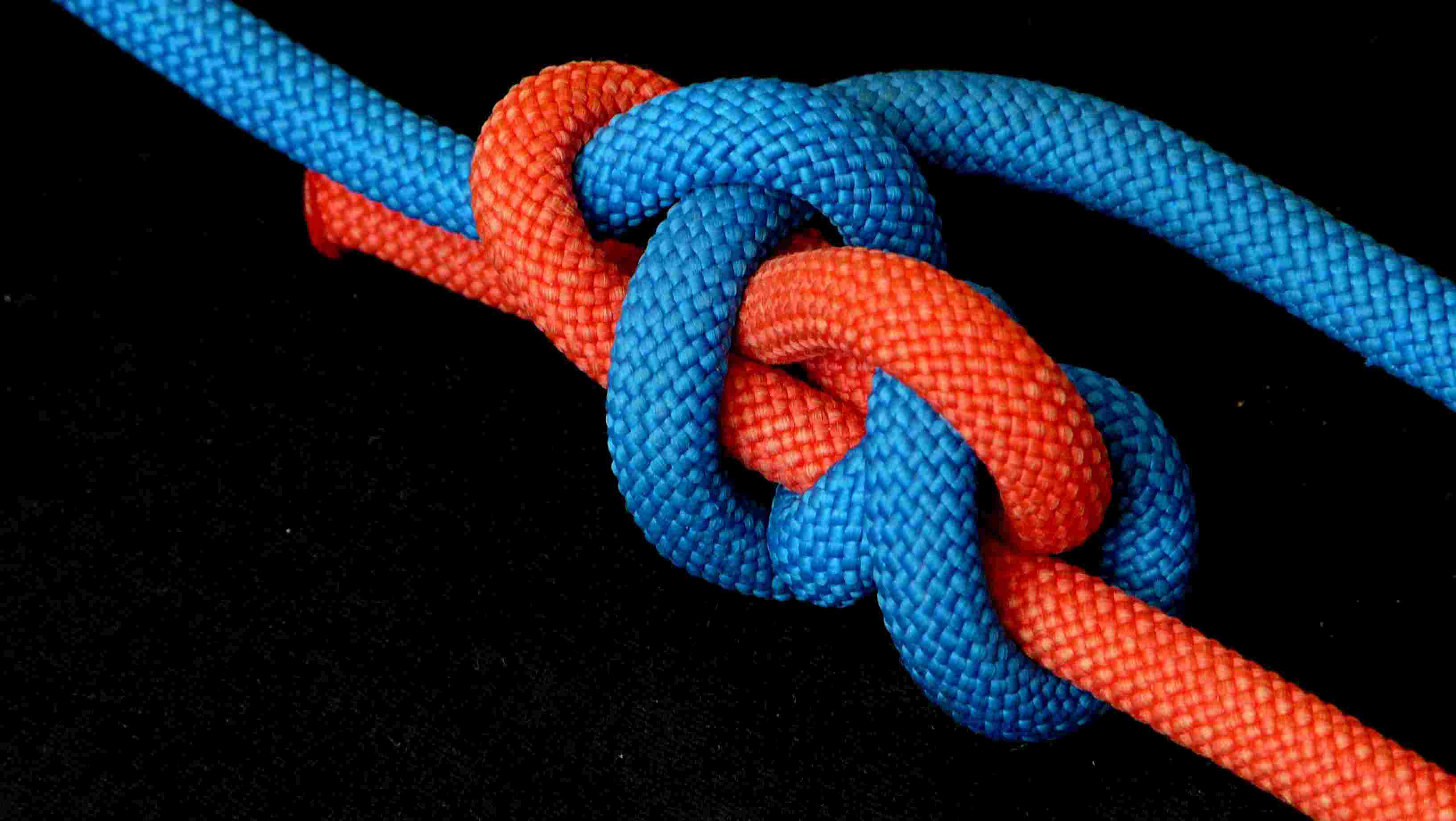
Just reading through some older posts and playing with some of the knots therein and discovered that Alpineer’s Tresse bowline (I hope that is the right name, correct me if I am wrong) can be tied in the bight if the tail is simply passed up through the collar. This may also help with the difficulty in untying the knot that some people noted in the original thread: http://igkt.net/sm/index.php?topic=4321.msg26983#msg26983
Hi J.P.,
Thanks for that point of interest. With access to the end it wouldn’t be my preferred method of tying. I had some trouble following the video. Try slowing your hand movement a bit and this will make your videos easier to decipher.
P.S. James, I forgot to mention that you have the overhand view/underhand view terms reversed. Who taught you to do this? I’ll bet it was that D.L. character!
Seriously though, things get more interesting with the Tresse Bowline because they contain Nipping Loops of both handedness.
Thanks Alpineer. I’ll see if I can’t do it again – a bit slower.
P.S. James, I forgot to mention that you have the overhand view/ underhand view terms reversed. Who taught you to do this? I'll bet it was that D.L. character! :D
Seriously though, things get more interesting with the Tresse Bowline because they contain Nipping Loops of both handedness.
My understanding was that, moving into the nub from the standing end, the if the line crosses over the standing end, we're calling it an overhand view. I now realize the pictures weren't clear. Here is another picture with better shadows. (A "detail," if you will.) ;)
Nice ! I believe that you can present it better by a sequence of carefully taken still pictures.
Any bowline which can also be tied as TIB is an interesting, versatile eye-knot - even if we would seldom tie it this way.
If you run a loop instead of the initial bight,you’ll get the right handed version.
I personally have not persisted with this way of making TIB the Tresse Bowline, because I find that the tail, being in that position, forces the nipping structure to “compact itself”, forcing her to “betray” his original “Tresse-essence.”
The first pictures are clear enough, James. It seems you’re making reference to the Bight Tail component of the knot to define over/underhand. My central point of reference is the Nipping Turn, i.e. a Loop with a specific job application. A Loop can be either over-handed or under-handed. Over/Under handedness is viewer dependent. Left/Right-handedness is something altogether different and is not viewer dependent.
In your clearer photo, see how the “white” line which comes out of the Nipping Turn and into the S.Part Eye Leg crosses under the S.Part. Try pulling the Tail and the Bight right out of the Nipping Turns for easier viewing.
My use was based on the fact that the standing part first crosses over itself when forming the nipping turn (goes into the nipping turn from the SP – 1. in the attached photo), not the line that leaves the nipping turn into the loop, before forming the rest of the knot (2. in the attached photo).
In bowlines with only one, simple nipping turn (around 360 degrees, depending on loading), matters are simpler. In the case of this knot (and other knots where the line travels about 720 degrees or more), things are not so clear. Which crossing should be referred to in the overhand/underhand labeling system? The crossing point created first when tying the pre-eye section of the knot? The crossing point first encountered when moving from the SP toward the tail in a finished knot? The crossing point where the nipping turn moves into a leg of the loop?
I think the crossing in this knot to which you are referring (1. x S.P. in the photo) is the point where the nipping turn(s) likely have the greatest effect, and perhaps we should make reference to the last crossing before the eye, which is the way I am now leaning. But I don’t know if there are other multiple-Turn-Nip knots where this is not true. This is something that will have to be hashed out sooner or later. Thoughts people?
I would n be surprized if this change ( modification, as you like to describe any additional re-tuckings on the same base, starting from the same underlying knot…) would be exactly what was missing from the Ttresse bowline right from the beginning : namely, a more complex bight component structure, in accordance ( “balance”, as I like to describe it ) with the more complex nipping structure. Although you had not made the full operation I had proposed - to make the second U-turn around the rim of the “lower” nipping turn only, and then drive the working end through the “higher” nipping turn, and then through the collar (1) - nevertheless you did enhanced the material and/or psychological security of the structure to a great degree.
You mean, by pushing the one nipping turn on the other, the “X” crossing between them disappears , and the two individual nipping turns look more like the double nipping turn of the double bowline ?
I’ve seen all of these structures before. There’s lots I don’t talk about for various reasons. I want people to discover for themselves what I have by fiddling and make it a community project of sorts. By sharing a basic concept, there’s opportunity for others to discover. There’s lots of Tresse-based structures and many tying methods to be discovered by others. I’m generally interested in the less complex ones.
I wrote about the basic version of the Tresse bowline: the modified version is shown by alpineer also in two other dressings that in fact are more compact, but it is another knot, and also the retucking of the tail that you show is different, it is not of the same type as the one shown by James, and does not make the loop TIB.With regard to the basic version, I believe that the nipping structure has been designed to remain in the position most wide apart as possible, I believe because in this way the “nipping portion of rope” of the tresse structure is more likely to nip around the tail (at least in the right handed version, and then in fact the choice of James to present the TIB left handed version makes sense), instead of wasting more important part of this nip around the portion of rope adjacent to the standing part,as it looks (OK, maybe just a little!) occurring when this structure instead takes a "closed"form.Now, with respect to the type of closure shown by James, one can opt to “shrink” the knot’s nub, as he seems to show, or leave the tail more loose so it does not “close” the Tresse structure: personally, I do not like it very much in either case, but it is only a personal opinion (another impression I have is that when the Tresse structure is “closed” instead of wide open, perhaps is more likely to jam under heavy loading?).A possible conclusion in Yosemite style perhaps better preserves the original Tresse sructure, but I found that it is difficult to realize in the bight and set/tighten.
This “locked” double Tresse utilizes the same Scott s simple lock (0). Moreover, I always search for ways to make the nipping turn to encircle three, at least, rope diameters and become a little rounder and wider, so the first curve of the Standing part becomes a little smoother and wider, too.
Yes, it is not TIB any more - but I was not aware off the JP s TIB modification when I suggested it .
Anyway, I do not believe it is excessively complex at all - in fact, it is the non-locked, the original version that is excessively complex for what it delivers - i.e., a secure bowline with a sophisticated nipping structure but with a naive bight component structure ! If one ties the Tresse bowline, with its complex nipping structure, it would be a pity to not secure it further with this very simple “lock”, that provides it an equivalently bight component structure. It is true that the seek of “balance” between the two basic components of the bowline, the requirement of a double nipping structure PLUS a double bight component is a subtle thing… I believe that the great success of the retraced fig.8 knot as an eye-knot was due to this material and psychological security it offers - by the double nipping turn AND the double bight component - to the rescue worker and the climber, but few people had realized this.
In its “modified” version, where the U-turn around the nipping turn s rim is a turn around two rope diameters, just as here ( see the third and fourth pictures ) - not a turn around one rope diameter as in the original “black” Scott s cow.
James, the magenta portion is part of what I like to call the up-front, built-in security feature of the Tresse Bowline. The cyan portion is part of #1010 Loop which makes up the actual Bowline. Without that upper Loop there is no Bowline. Your images are therefor labelled incorrectly and should be edited to reflect this. It’s best to include the word “edit” in your renamed photos so people will know they’ve been edited and are now correctly identified.
Thanks James.
I consider stuffing the Tail directly through the Collar more a means of managing the Tail than a security feature, which I’ve indicated somewhere should you care to quote. When I do this, I don’t pull the Tail so tight as to “scrunch” up the Nipping Loops, as Luca suggested, if only because it imparts an ugly appearance to the knot. It may not unduly affect the performance of the knot.
xarax(is it still xarax?),
I’ve read it before and I’ve it read now. I understood then and I understand now what you mean by balance. I stand by my quotes.
Rather, I would say it’s you who misunderstands or you would not be regurgitating them. I don’t need, nor want, nor do I require an extra collar. If I decide for whatever reason that more security is needed I will throw in another “up-front” nipping loop. That being said, if someone wants to incorporate tail-related or other security features into the knot, who am I to stop them? That’s their business.
Once again, your language borders on the invective and it’s not necessary in order to get your point across.
P.S. My perception of balance is just different than yours. Mine is climbing oriented. I have many things to consider beyond the security enhancement of a knot which are subtley related to the overall security of the climber. Consider my perspective, that any added security feature also adds unwanted complexity to a structure which is already secure for the task it’s required to perform. Unnecessary security features can negatively effect overall security. The cost of the added security feature is too high. It comes with unwanted baggage, like an offer that’s too good to be true. Surely you can appreciate my point here.
I’ve addressed this issue before. If the knot is dressed correctly there is never any problem untying the knot. The collar should never be snugged right up tight against the nipping turns as this is the key to unlocking the knot. SS369 was the first to report this problem (hence my SuperSnug moniker modification).
I’ve tied the Tresse Bowline in 4mm shock cord and loaded it hard as I can by hand and it always unties easily after making the collar do the Dan Lehman Backflip and pushing the S.Part EyeLeg back through the knot. There’s nothing mysterious or difficult about this.
Generations of rescue workers and climbers use the fig.8 knot just because it has a convoluted double nipping turn and an equally convoluted double collar.
One-upmanship is an easy game for me to play, but not one that I would prefer to play. Rehashing old arguments tells me that you relish that game more than I do. Disengage your self from the proclivity to do so and you will see that I will respond to you with more gentility.