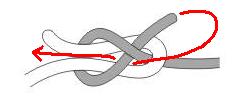
Hmmm, after never paying much attention to this particular bend, I’ve recently started using it when appropriate. I LOVE the way it tucks in and the tag ends lay perfectly parallel with the standing end. I haven’t seen this bend mentioned much in any knotting books, it’s in one of Pawson’s books I own.
I’m assuming it’s stronger than the sheet bend? I’ve noticed I’m starting to use either the Tucked Sheet Bend or Double Sheet Bend for most of my needs. They require very little thinking and are so simple to tie…I go with the Zeppelin Bend in cases where a heavy duty bend is called for.
How do you knot pros feel about the tucked sheet bend?
Can you clarify which knot exactly you refer to? Do you have a picture or diagram?
When I google the tucked sheet bend, I find the fishing knot, which is (slightly) different from the
(one way) back tucked sheet bend I find in Budworth’ complete book of decorative knots, in which the
working end goes around the single standing part (inside the passive loop) and up through the active loop.
I have never actively used either. The sheetbend is a very quick bend and relatively secure. With the extra tuck, it becomes more so.
But on the downside: This extra tuck might make it more difficult to untie. What is your experience with it?
For heavy duty I also go for the zeppelin or the butterfly bend, with the latter the one that can be tied very quickly, which is why
I just can’t make up my mind which one of those is my favorite. I tend to alternate between them and hardly ever
use any other bend.
The Tucked Sheet Bend is in Des Pawson’s Hand Book of Knots, Expanded Edition. First you tie the regular Sheet Bend, but then take the working end and tie a Fig 8. Very simple bend to tie and useful because the working ends lay neatly against the main rope…virtually snagless. I would have to assume it’s much stronger than a regular Sheet Bend because of the Fig 8 you’re tying on top of the loop, you’ve got another friction point.
We are talking about this version then
(see image 1 below)
That is also the one I find in Budworth’s book.
It appears to be (unsurprisingly) stronger then the sheet bend and there are three rope diameter going through the lower loop of the figure 8.
I did some testing in pp (that I use for fancy knotting) and some other synthetic string and it does not seem to jam.
Since the sheet bend and the bowline have the same structure, I wondered what the loop form of this would be and this is what I worked out:
(see image 2 below)
So if that is a safer sheet bend, is the loop form a safer bowline?
Or is it a bowline-figure 8 hybrid?
Is this a “new” knot and what are its properties?
The top picture is correct, I don’t make the movements that the bottom picture shows. I tie it just like the top pic shows and it naturally lets the two working ends lay parallel with the standing part, creating a very neat bend. It’s a snagless bend at this point because you don’t have two working ends coming out perpendicular to the main rope. I wonder how strong it is?
I dragged a bunch of good size tree limbs with my tractor using a rope with this bend and of course the Killick Hitch around the limbs themselves. Worked perfect for me, although the Timber Hitch without the extra half hitch did come undone one time and I lost the load.