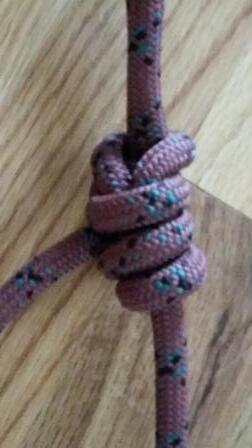
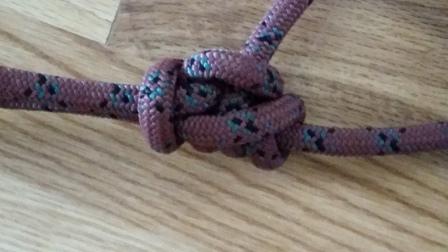
xarax my comment about pinning tails was not specific to that knot, just tidying off 70% of theory needed for an “idealized” understanding simple unlocked hitches while I had the chance. The related point was just that your tail is already nipped and has no more tension be nipped or to nip with.
So in the end you seem to think that a tripple nipped bowline when loaded hard may allow some tension through to the tail and that there is improvement to be made in the nipping power of this knot.
My claim is that in most reasonable rope a tripple nipped bowline will never let any tension through to the tail and so it doesn’t matter what you do with the tail so long as you don’t mess up the bowline with it. Now even if I thought it did something I don’t like the word collar, but being I think it does nothing other than add possibly a small amount of slac security, I especially don’t.
I just tied a tripple-nipped bowline in monofilament. It holds fine. Under what conditions do you think this knot will slip and require extra nipping power from/on the tail?
Furthermore, I think that’s a lousy way to improve nipping. If you really need more nipping power, add a fourth turn to the nip. Ok, but this tuck does exist in reasonable knots because it results from the TIB method and might be liked for slac security, so I don’t need to worry about if it should be there. It just comes back to if it’s ever actually doing anything under load.
Well, ok, so let’s just say in most cases at least this tail is doing nothing. Indeed if the nip does slip then the collar (the real one) does tighten around the tail, though not in a way I love.
I think more turns will help, even if they bunch up.. but as you say, it needs testing, on some very, very slippery, greased rope. First you have a find a situation where a tripple-nipped bowline isn’t good enough. Of course it’s possible. Notice that fishing knots often use many turns, although that’s at least in part for another reason, to increase breaking strength.
It gives me another idea though, not sure if this one has been shown. Retuck the tail back up through the nip and then down into the loop formed under the nip. Dress tightly. I haven’t even tied it though, so just words for now.
The water bowline, aka clove hitch bowline, is good too. I think xarax would say (has said) that less convolution should create tighter nipping, and I’d tend to agree, which is why I don’t use hitches for binding, when round turns will work fine, and more round turns will work even better. Maybe the clove/cow/pretzel bowlines have better slack security though? And again, maybe loaded security is rarely an issue (I did have a sheet bend use recently where it seemed at the time that I needed a double nip to hold under load. I did use a clove hitch maybe because it was easier to hold open while tying – in bowline like fashion --than a double helix, or maybe just because).
I had a question that I’m not sure there is an answer to about tucking the tail of a bowline. Just recently I became familiar with both the water and yosemite bowlines and was wondering if there was a combination of the two (that is a real knot), and if it is worth tying it that way? I just tied one and couldn’t find anything relevant on the internet (not that i looked to hard either), found this site and figured this would be the place to find the answer.
Indeed, often one can take components of various knots
and used them all in one knot (the idea of the “clove hitch b.”
could beget a “rolling hitch b.” which itself could be seen as
a combination of “double” & “water” b. of sorts, and as these
structures are of shaping the S.Part’s structure, there remains
the variety of finishes to incorporate. (I tease Agent_Smith as
wanting to Yosemite everything.)
IMO, the tight turn of the Y.b. is something to make one seek
other securings (and just taking the tail around the opposite
way gets an embedded overhand and a better drawn-up knot?).
I should remark that “The water bowline, aka clove hitch bowline”
might show an accidental/ignorant change of things from origins :
at least, in some older books, the former knot --unknown by the
other name (and perhaps this is why…)-- is shown with the repeated
turNip well spaced from the rest of the knot --i.e., nowhere so close
as to lead one to say/think “clove h.”! And it’s spaced so much that
it’s hard to explain as mere illustrator convenience to clearly show
the knot; there is also no discussion to suggest that a clove hitch
is expected to be the base. So, I think that there might be something
quite distinct in the history, and in the purpose of that knot --vs. the
desire for slack-security in using the clove h. as the base.
(I tease Agent_Smith as
wanting to *Yosemite* everything.)
Luckily I have a thick skin
I am on your side with regard to casual attempts to secure #1010 and #1034 1/2 based Bowlines.
I am not 100% in favour of single nipping loop based Bowlines being ‘secured’ via a ‘Yosemite finish’.
The so-called ‘Yosemite Bowline’ can be inadvertently displaced into an unstable form simply by yanking on the tail before the core structure has been properly set. A novice might not notice the error until too late. However, strong awareness of the risk is a counter-measure against inadvertence.
In recent times, I have been making a strong effort to find practical applications of some ingenious secured Bowlines such as those discovered by Scott and Alan Lee. In fact, I have been using Scott’s locked Bowline regularly and like it for its simplicity.
I also now advocate the use of Alan Lee’s [Lee Zep X Bowline] for integration into a dual clip-in attached for top-rope climbing on artificial surfaces (eg indoor climbing gyms). See attached photo.
I think Alan Lee discovered the ‘Lee Zep X Bowline’ in May 2012… is that correct?
Hi Agent,
I only know in May-2012 I had presented it in here, http://igkt.net/sm/index.php?topic=3908.15
I have no idea anyone have tie it before, so far no body come up and make the claim.
Thanks you .
謝謝 alan lee