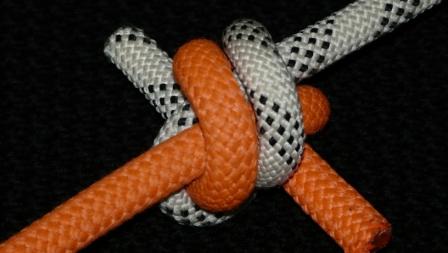
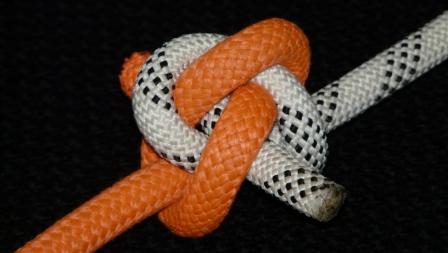
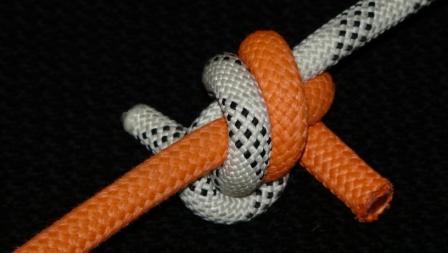
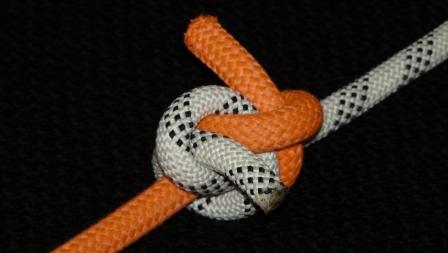
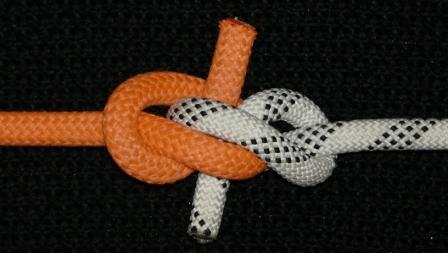
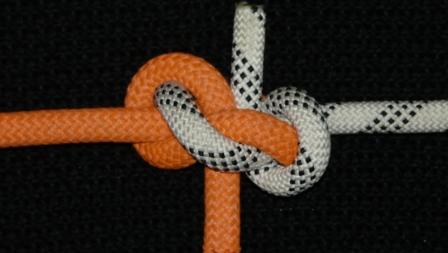
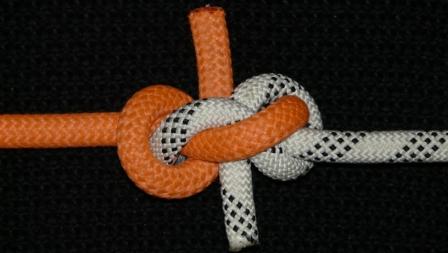
Twisting the standing parts of the falsely tied Hunter s bend

From a exchange of views with DDK about another bend, it became obvious to me that the "twisted falcely tied" Hunter s family of knots was not as extensively documented as it should. So, I felt I had to take my camera, a 600mg Brufen anti-inflammatory pill for the pains of my spinal cord, climb on the peak of a ladder so my camera can focus on the knots on the floor, and start shooting pictures...[b]D[/b] e [b]D[/b] i [b]K[/b] ated to DDK... :)

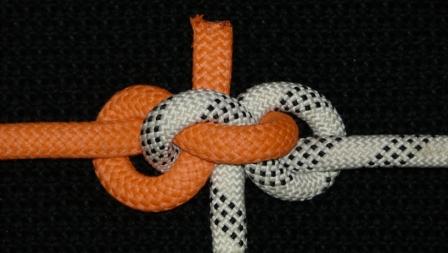
A falsely tied Hunter s bend (1) has one main difference from a properly tied Hnter s bend : Its standing parts are not crossed, twisted around each other, so the whole bend works more like a Zeppelin bend, than a genuine Hunter s bend, i.e. it is a kind of rope made hinge : It is revolving around its tails. Of course, it is a very poor bend, while the Zeppelin bend is superb.
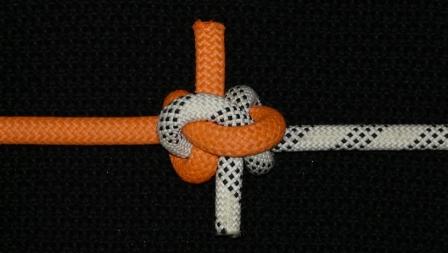
From the moment we make the standing parts of a falsely tied Hunter s bend twist around each other, embrace each other, we turn this bend into a more genuine Hunter s bend, because now the standing parts are crossed. So, a twisted falsely tied Hunter s bend can be considered as a variation of a twisted Hunter s bend as well. With the correct un-tucking and re-tucking, we can transform the twisted falsely tied Hunter s bend into a twisted properly tied Hunter s bend, and finally into a Hunter s bend. In this thread, I follow the direct path, and I examine the bends that are generated by twisting the standing parts of a falsely tied Hunter s bend, and not the opposite path, that of un-tucking and re-tucking a twisted properly tied Hunter s bend and a Hunter s bend, to generate twisted falsely tied Hunter s bends.
As I have said elsewhere, the operation of twisting the standing parts of the falsely tied Hunter s bend, in particular, and of the Hunter s family of bends, in general, has a few twists of its own…Indeed, there are more bends there than some people would have thought, and they come in many variations. The Hunter bend, unlike the Zeppelin bend, has different “top” and bottom" sides, so the twist of the standing parts can be on the one or the other side. ( It can also be at both, but this belngs to another thread). I have specifically examined here the simplest variations, where the tails cross each other before they exit the knot s nub, that I call X variations ( X : crossed tails). These variations come in pairs of different knots, because each tail can pass under, and then over, the other tail before it exits the knot s nub - or the opposite. I call them variations A ( first under, then over) and B (first over, then under), respectably. So, there are two twisted falsely tied Hunter s bends, and two x two twisted falsely tied Hunter s X bend variations, that is, 6 different bends in total.
I start by presenting the twisted variations where the twist is on “top side”, the bottom side staying as it was ( the standing parts remain parallel). Then I will continue with the “bottom side” twisted variations.

  1. http://igkt.net/sm/index.php?PHPSESSID=cccb55c76f162ec461f0ff528d1386a4&topic=1992.msg13968#msg13968
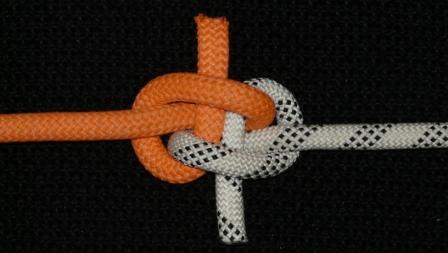
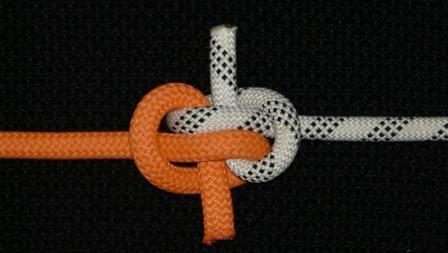
falsely tied Hunter s bend (top view).JPG

falsely tied Hunter s bend (bottom view) .JPG

top side twist (loose knot)(top view).JPG

The compact form of the “top side twist” variation.


top side twist (top view).JPG

top side twist (bottom view).JPG

top side twist (side top view).JPG

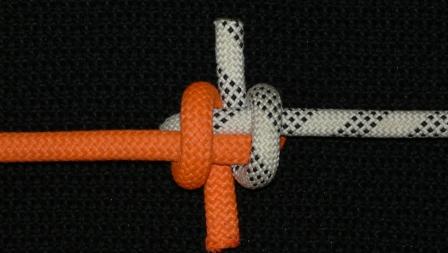
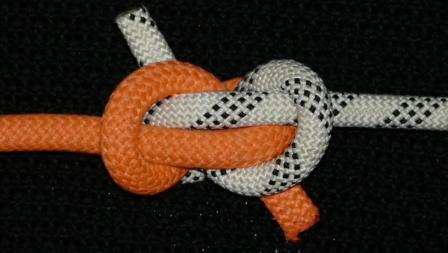
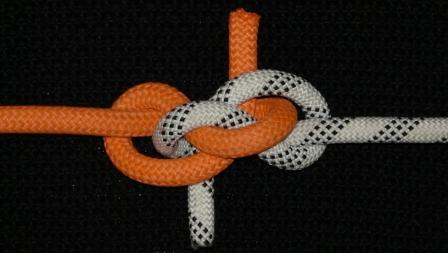
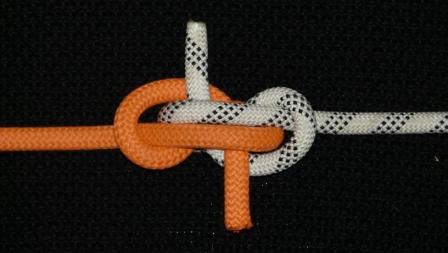
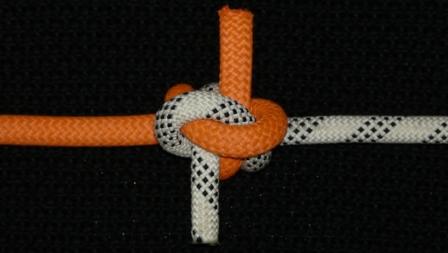
The X ( X ; crossed tails) loose knot form of the two variations of the “top side twist” bend. In the first two pictures, the Vatiation A, where, on the side of the twist, the tails are crossed in the “first under, then over” way before they exit the knot s nub - and in the following two pictures, the Variation B.


top side twist X (loose knot)(bottom view)(variation A).JPG

top side twist X (loose knot)(top view)(variation B).JPG

top side twist X (loose knot)(bottom view)(variation B).JPG

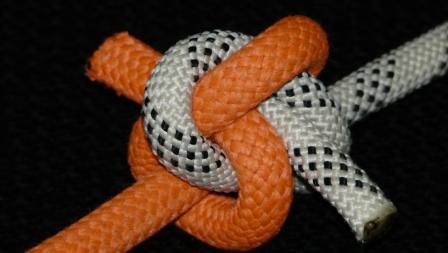
The collapsed, compact form of the “top side twist” X , variation A.

P.S. 2011-10-30 : This bend is identical with the B11 bend, named “SNUG bend”, by Roger E. Miles : Symmetric bends. (How to Join Two Lengths of Cord), 1995.(p. 89, p.110)


top side twist X (top view)(variation A).JPG

top side twist X (side bottom view)(variation A).JPG

The collapsed, compact form of the “top side twist” X , variation B.


top side twist X (side top view)(variation B).JPG

Now, the “bottom side twist” variations.

Two more pictures of “bottom side” twisted standing parts variations.

Thank you very much, I think. :slight_smile:

I would agree that a twisted falsely tied Hunter’s bend could be considered as a variation of a twisted Hunter’s bend only to the extent that a Reef Knot would be considered a variation of a Granny Knot. Because it is indeed the case that the same process of untucking and retucking that would allow one to convert a twisted False Hunter’s Bend into a twisted Hunter’s Bend would also allow one to convert a Reef Knot into a Granny Knot or possibly a Reef Knot into a Grief Knot for that matter (in general, allows one to convert from one single carrick to another). This should be of no surprise as twisted False Hunter’s = tucked Reef Knot and a twisted Hunter’s = tucked Granny Knot.

DDK

Thank you, DDK,

I have followed your reasoning, and generated all those bends from the twisting of parts of a falsely tied Hunter s bend. I can also follow the opposite path, and generate the twisted properly tied Hunter s bend from all those bends ! :slight_smile:
I think I have already proved that there are not only 4 different bends , as you have suggested earlier… ( I will show more twisted bends that belong to the Hunter s family of bends, in a future thread). As I said, the Hunter s family of bends - in which I include the falsely tied Hunter s bend *- has a few twists of its own…You should tie the bends, try all the possible modifications, decide which might be proven to be interesting, possibly practical knots, and then take pictures of them and publish them. How could I make comments about knots that you described verbally in a vague way, but not shown in pictures taken by you ? As you see here, there are no identical pictures, because there are no identical knots. The cases where two different knots have two identical views are very rare, because, with simple knots, the differences in the back side are somehow revealed in the front side as well. When this happens, we just look at the back side view, which must be included in our presentation. I always try to follow this procedure in the pictures of the knot I myself tie and I myself take pictures of.
In the matter of the knot “base” that generates bends, you have not made any progress, I am afraid… :slight_smile: You still start from the very special, restricted cases of the Reef family of knots, when we have almost 768 different knots, that can be generated by various re-tucking of the different knot “bases”, at our disposal ! You need some more time to discover the vast landscape that this general method opens in front of our eyes and fingers, but I am sure you will arrive there, sooner or later. However, that is not the issue of this thread.
There are many ways one can tie one knot, and many more names one can call it…But one knot is one knot, and remains the same knot, however tied or named. I have posted pictures of many interesting simple knots, that you can examine, test, and express your opinion about them. That is my only concern : Know the ropes and the bends ! :slight_smile:

  • in the general division of the similarly-looking, interlocked-overhand-knot bends, into two broad categories, the Zeppelin family of bends, and the Hunter s family of bends. However, the falsely tied Hunter s bend has a deep, functional similarity with the Zeppelin bend, as it is a rope made hinge, just like the Zeppelin bend.

I am afraid you must have misunderstood me if you believe I have suggested that there are only 4 different twisted bends. Possibly my reference to the Reef-Granny-Thief-Grief Knots as 4 bases is to what you are referring. Even these I remember specifically acknowledging as a SUBSET not only of the total bases that one might use but also as a SUBSET of the single carricks which is only one class of knots that might be used as bases. And for the single carricks, surely I have never suggested that tucking the ends through the central opening was the only option given the other six openings which are obviously available.

I have made and continue to make no claims about the diversity of the twisted bends that might exist. My comments have been purely to state that given a specific twisted bend, a unique and specific untwisted bend will be recovered if those twists are completely removed. It has taken considerable time to ascertain that our definitions of “twist” and its “removal” are substantially different.

By a twist, I mean a very specific type of structure as found in the Constrictor Hitch and which differentiates it from the Clove Hitch, eg. a Constrictor is a one twist Clove Hitch. It is the same type of structure found in a Reef Knot which has its ends tucked through its central opening. A twist completely encircles the other rope.

By complete removal of a twist, I mean its removal in a topological/differential geometric sense in which a geometric element is cut producing two cross-sectional areas, parts of the geometric element are repositioned so that they no longer wrap around or encircle a second geometric element and then those cross-sections are rejoined and the original element spliced. Having mentally envisioned the process and resulting structure, its physical undertaking is then very straightforward and unambiguous for every twisted bend.

DDK

Yes, I admitt that I did… :slight_smile:

No, according to my poor nomenclature… :slight_smile: A rope “twist”, is a rope “embrace”, is an “elbow” configuration of two ropes, is ABoK#35. A 180 degrees helicoid rotation around a central axis, is a twist for me. When I see a rope strand, that goes from the “left” side of another rope strand to the “right” side, and the opposite happens to the other rope strand, then I say that those two rope strands are twisted.
.

I see. I have never imagined cutting, and then rejoining, a rope strand ! I un-tuck the rope strand by pulling the free end out of the last hole, then I un-twist it by eliminating the twist/embrace/elbow, and then I re-tuck it, driving the same free end through the same hole, but now in the opposite direction than before.

It has been long my contention that a Square, Granny, Thief, Grief, Whatnot etc. should be shown as a family/class of lacings. Their similarities shown that make them a class, and the slightly different properties that differentiate them from each other, and there by dictate different mechanical commands to the flow of forces in them.

Then show, how altering only 1 side (leave other as bight) of this family, we ‘evolve’ to SheetBend class.

So many lessons, seen at the simplest jointings and what makes them fail in the inferior forms. These lessons are the simplest in rope, and rule all loaded lacings IMLHO. One of which is how squared something has to set to be stable, so i think Square Knot is better than Reef (but Reef historically richer and more colorfull).

i think to be scientific, should show element bases, combinations into ‘molecules’ etc. Compare like things to see what empowers them as a class, find one to hold as base form like control group, remove and add things and doc. the effects to define those altered parts effects etc.

Rope itself would belong to a class/family of support devices that only resists/support on the unique inline axis, and only in the tension direction. Other members of this class are chain, cable, webbing, mono-filament etc.

The "bottom side " X variations (the loose knot forms). The first two pictures are from Variation A, and the last two from Variation B.

The compact forms of “bottom side twist X”, Variation A.

The compact forms of “bottom side twist X”, Variation B.


bottom side twist X (side top view)(variation B).JPG

bottom side twist X (side bottom view)(variation B).JPG

I have re-arranged the 36 pictures of this thread, so the interested reader can follow the presentation of the 6 “twisted” “falsely tied Hunter s bend” variations more easily. The labels of the pictures have also been changed a little, and some new pictures were added.

Part of their relationship is described here http://en.wikipedia.org/wiki/Grief_knot where they use the terms “trans” (opposing side) and “cis” (same side) to label the arrangements of the standing parts and working ends. They use this nomenclature is chemistry as well where they describe the two possible configurations of the aromatic (carbon ring) structures.

DDK

xarax, where does this variation of the Rosendahl fit in?

I tried trawling through all of your photos but my eyes are growing weaker by the minute… in frustration, I took some photos of this bend for you.

Again, you might have already shown this structure but I am just getting lost in the sea of knots…which all appear to be Smithunters variations but couldn’t find Rosendahl variations (but I am not very good at searching through this forum) :slight_smile:

Mark

Edit: This variation can also be tied from #1408 as a starting base - and then untying one side and then re-threading so that the tail goes in the opposite direction to obtain the crucifix / Rosendahl form.
Edit: Forgot to add the other variation when I first tied these bends…new image now added.
I like this bend..its a variation of a Smithunter with a twisted/overlapped core. Seems very secure and stable…might even load test in comparison to ABoK #1415 and perhaps Rosendahl (also to test stability and security under loading).
Edit: The Smithunter variant with twisted/overlapped internal core seems remarkable compared to the original as described by Phil D Smith. The act of twisting/overlapping the tails makes the bend jam resistant.

http://

http://

http://

Hi TreeSpyder, I feel the need to take exception with a couple of things you say in this post.

First up - from a ‘Decoratives’ standpoint, there can be no argument that the ‘Square Knots’ - RGGT/W can be laid out to show a fundamental similarity of structure. However, this is the Practical Knots forum where the primary reference is the use of these structures as ‘Force Machines’, and when force is applied to these structures they fold into totally new ‘load stable’ (we hope) shapes. In doing so, as we have seen with 1406 / 1407 / 1490, they are capable of creating or eliminating key functional knot structures such as the ‘Positive Feedback, Negative Cog’ (PFNC). This function of ‘Load Response’ is a major part of the Practical Knotters game plan.

A grouping of knots that share( under load) the ‘PFNC’ functional structure - now that would be a ‘Practical Knots’ family, but the purely decorative unloaded ‘Square Knots’ is for me a family only in the decoratives weaves/mats sense.

Second, I have learnt a lot from you about knots as force machines, so I am surprised to read your claim that cordage (rope) is “a class of support device that only resists/support on the unique inline axis…” - if this were so, we would have no knots…

Of greatest importance to cord usage and knots is the fact that cordage also ‘resists/supports/transmits’ forces laterally through linear and/or rotational frictional contact, and by lateral compressive forces… Consider round turns around a beam, after only a few turns, all of the linear tension has been shed by lateral frictional contact, or the collar of the bwl where a large part of the tension is transmitted by lateral compression…

Perhaps it is time that Practical Knotters start to formulate ‘Families’ of knots based on functional structures rather than the ‘Pretty’ mats or weaves we make as memory devices to produce our working load bearing knots. The Carrick and the Myrtle are said to be members of the ‘Carrick Family’, yet following each knots structural refolding under load, these two knots bear no resemblance to the pretty mats they hail from and more importantly, they have almost nothing in common as Force Machines.

Derek

Oh, I would love to have been confronted with a question about “How”…" How would this variation fit in ? " Then, I would have had the opportunity to answer by the annoying, megalomaniac : " With great difficulty ! " :slight_smile:
Mark, I have been studying your knot some hours now, and I have gone nowhere ! It looks like a variation of the Zeppelin bend indeed, because of the way the standing parts enter- and the tails exit - the knot s nub. However, it is not a “rope made hinge”, meaning that its function is not depending upon the transverse position of the tails : the two main bights, the two first curves, are themselves crossed with each other, like what is happening in the case of all the other interlocked-overhand-knot bends, except the Zeppelin bend !
Even If this was not enough, we have a variation of one of the most symmetric knots, that destroy this symmetry completely…The aspect of this bend is, to me, awkward, to say the least, in comparison to its, supposedly, parent knot, the Zeppelin bend. It is not the scale of the modification, it is the fact that the changes are disrupting the lines that we are used to follow by our sight of the Zeppelin bend, at exactly the most important areas.
After some thought, I have reached to the conclusion that the obvious name “twisted Zeppelin bend” , would not be a accurately descriptive name for this bend. I might be mistaken in this decision, of course. So, for the time being, I think of this knot as “mark s” bend" :).
I post two pictures of the “twice twisted Zeppelin bend”, to facilitate an easy comparison. To my eyes, the two knots are, and look, very different, but I can not offer any persuasive explanations about this…Your knot is a very strange animal ! It has something of a domesticated pet that is lost in the wild, and turned into a something resembling its rough ancestors…
( I have no doubt the whole or parts of the structure of this simple interlocked-overhand-knots bend would be also present in some knots in the ABoK, but I do not think that this is of any importance.)


mark s bend (bottom view).JPG

twice twisted Zeppilin bend (top view).JPG

twice twisted Zeppelin bend (bottom view).JPG