Variation on the Simple Locked #1410
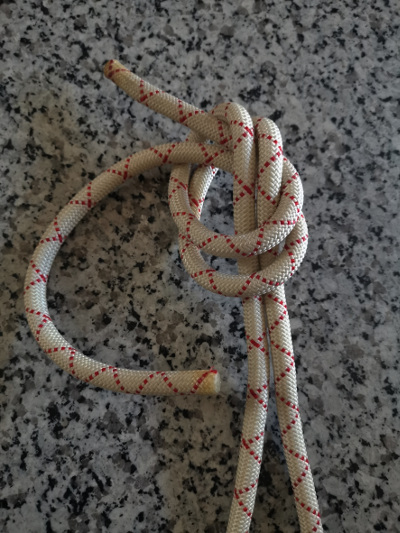
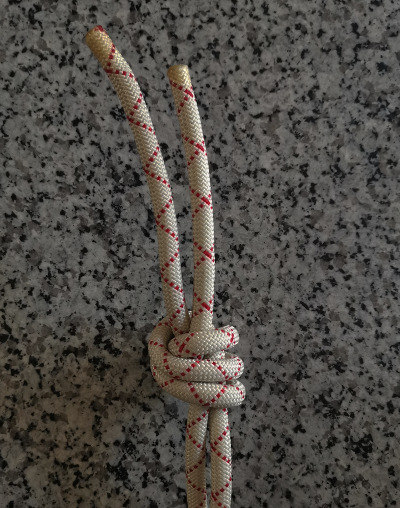
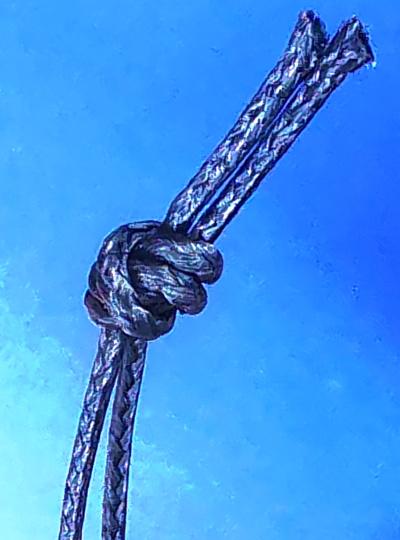
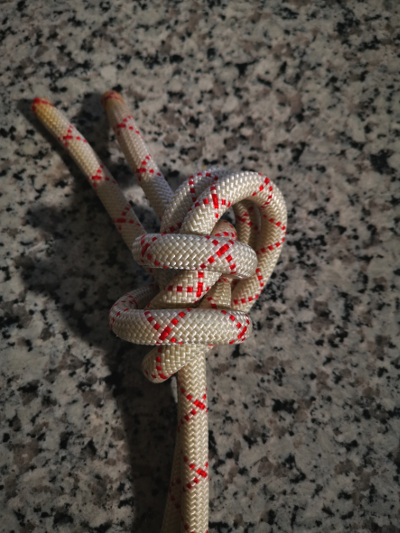
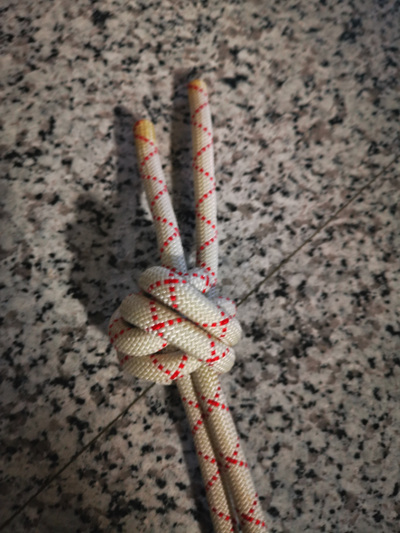
Instead of simply making an additional turn with one working end, parallel and adjacent to the other working end, finishing by passing through the knot a second time, it is possible to pass over both on the outside and come up through the knot, creating an overhand knot encircling the legs coming from the standing end and the other working end.
With this modification, the knot draws up into a form very nearly as compact (at least to my eye) as the Simple Locked version of #1410, and when drawn up looks much like a Matthew Walker knot. The crossing point of this overhand knot is compressed in the center of the knot. I have played with this in 0.75 mm Dyneema fishing line, and have found that it holds drastically better than #1410 and noticeably better than the simple locked version of that knot. The one concern I have is whether it is easily untied after various levels of loading in larger diameter line. And of course, whether this is a solution without a problem.
..
But this puts a 3rd diameter into the choking circle
which is what one wants to keep small/tight.
I have played with this in [b]0.75 mm Dyneema[/b] fishing line,
That is SO not the target market for the offset ends joints! :o
it holds drastically better than #1410 and noticeably better than the simple locked version of that knot.
How does #1410 fail? (In this micro-line, how can one
be sure of what one has tied! ;D )
HMPE is slick but static, and I was thinking that from
the latter its choking part shouldn’t open; but then from
the former, the tails might just get pulled out to loosen … .
When compared to the offset overhand knot it certainly does, but the simple locked version (I am borrowing this name from Mark Grommers, who uses it in his paper " Analysis of offset end-to-end joining knots" – available on www.paci.com.au – p.24 of 33 in the version I have) already has the third diameter present.
That is SO not the target market for the offset ends joints! :o
I certainly concur. And by the same token, teachers of engineering classes in universities who have their students build bridges from popsicle sticks or toothpicks obviously have no intention of promoting various elements of truss bridge design to the companies that produce -- nor the people who normally use -- toothpicks or popsicle sticks. The activity is simply used to teach/reinforce certain general engineering principles that apply to elongated segments of relatively stiff materials which can be combined in various configurations to create structures which span a given gap and bear a load. The same can be said of using polycarbonate models of various items and then using polarized light and photoelasticity to examine internal stresses in the material. The intent is to get an idea of the stresses in items of proportionally similar construction but using different (and presumably more expensive/less readily available/less easily worked with/formed/handled) materials.
How does #1410 fail? (In this micro-line, how can on
be sure of what one has tied! ;D )
Two questions.
Q1: #1410 runs to the end of the line. The "simple locked" #1410 generally runs a bit then jams/holds untli line failure. The version I propose seems to run less before holding until line failure.
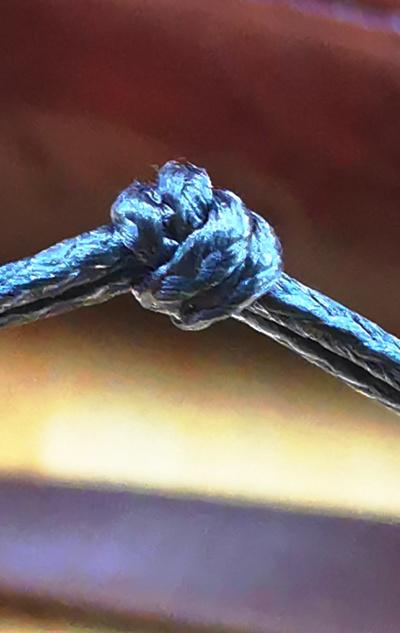
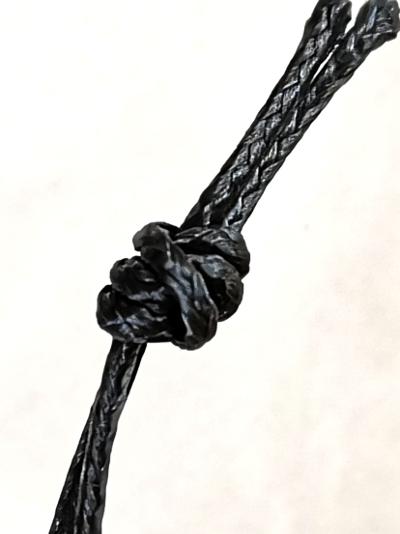
Q2: Actually it is quite easy. There is a new invention called a smart phone, and of late, many of these devices are equipped with quite capable cameras. Further, many of these have as setting called “macro”, or “super macro”, or something along those lines. In photography the term “macro” refers to creating an image on the photographic medium (negative or slide) or sensor that is life size or larger. I doubt that these smartphone cameras are achieving this, but the results are respectable, and can in some instances be stunning. I have included a couple photos taken while tying these knots.
HMPE is slick but static, and I was thinking that from
the latter its choking part shouldn't open; but the from
the former, the tails might just get pulled out to loosen ... .
Which would obviously be easier to determine (though likely exponentially more expensive/time consuming/dangerous) in larger line. But perhaps this knot/variation/device is simply a solution without a problem…
NO, it does not. You’ve mis-tied (misinterpreted) that
knot, which only takes the then interior tail around
a 2nd time and out; but the entry of this knot has only
the two SParts wrapped by the choking strand.
Note where his extra-wrapping, BLUE strand
goes : up to the top/away-from-SParts end.
You, in contrast, bring this extra wrap around over
the spine of the knot and back up-&-out.
(Which might be an easier thing to tie in firm
kernmantle, I’m finding out!
There is a sort of fudge factor : looking at Mark’s
pretty image, one can see nudging the tail back
down against the twin parts wrapping it, and then into the SParts twins at entry --but it’s not there
at the start, as he shows! Look at the entrt point
in his “rear view” and see that the choking strand
need only surround 2 dia., not 3.)
((I’d dismissed the form adopted by Mark as having
less choking wrapping than putting in the extra
wrap AT the entry point; yes, the shown form has
less that, but has a reinforced lock on the choking
strand (just as stoppering it would do), so it’s a
toss-up, both being effective to holding the choke.))