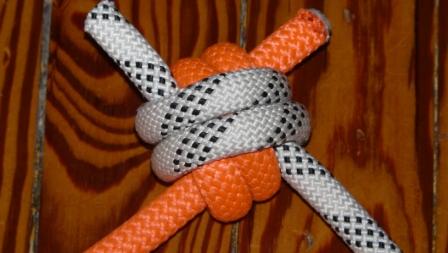
Hello Xarax.
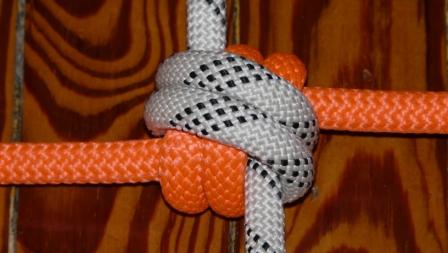
First of all that is a beautiful bend. I like the second picture best of all!
What is the rope you’ve used in your pictures? Is it dynamic climbing rope or static? Diameter?
The reason I ask is that I have a varied supply of rope from the manufacturer BlueWater and the static rope I have will not conform to these curves very well. I am wrestling an anaconda and it just stays loose.
I have to use the softer dynamic rope of the same size to tie it.
I, too, use static ropes, mostly, from 9.5 to 10.5 mm ( the orange/red rope is 11 mm). (Dynamic ropes are more expensive !) I prefer large diameter ropes, because I can set and inspect the knots easily for a correct picture, but I can not load those ropes to their limits… I have a quite large collection of them, as, I have to confess this, I have used all means to persuade the stores to sell short pieces of such ropes to me ! However, I think that those particular ropes I use in my pictures should have been tamed, softened, somehow, from old age and the many knots that I have tied on them…I have some new, springy ropes, too, that should be tightened quite a bid to hold some knots, as the new Rusty s knot in its compact, capsized form, for example! I had not any such problems with “my” knots, or I had, but I have not noticed it !
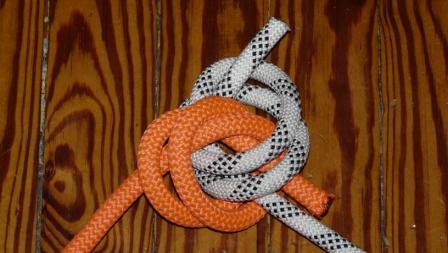
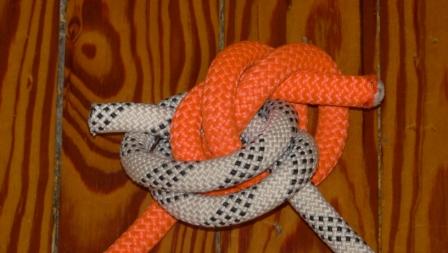
As with the “trefoil bend”, too, we should tie similarly oriented strangle knots, in order to get a properly tied Strangle bend. (See first picture) If we tie the Strangle bend like this, the two links are tightly interlocked, and the two standing ends are more aligned as they exit the knot.
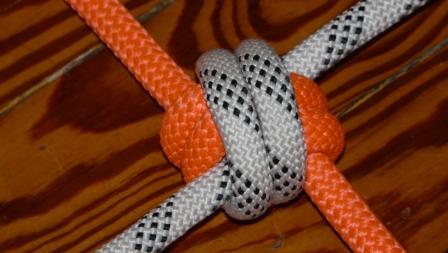
What happens if we do not ? If we interlock one right-handed strangle knot, with one left-handed ? The result is a knot that is, probably, not so well suited for a bend - in this case, the standing ends exit the knot s nub in right angles - but it is a very interesting knot ! And it might be useful, too, as a 4-ends bend : a bend where the ends that are loaded are more than two - they might be three, or even four. Because of this possibility, I call this bend “the Strangle 4-ends bend” (at least for the time being, to distinguish it from the “normal” Strangle bend discussed in the previous posts ). Have a look to this interesting, compact, nice, “ordered rope-tangle”. :)( See attached pictures)
P.S. The 4-ends" Strangle bend was also tied by Max Miller, and presented at Knotting matters 17. I was not aware of this publication when I had written this post.
I’ve tied it, it is clean as a whistle, but I would like to request that you include the rope’s ends in the pictures (always please) to double check the orientations. For me at least.
It may not perform as well with opposite loading. (?)
SS369, I deliberately do not include the rope s ends in my pictures, when ( and only then…) it does not matter. Because of the particular high symmetry of those bends, and the indication the two ropes/links ( with a different colour),
the indication of which end is the standing end and which is the tail offers no new information. On the contrary, it might obscure, the symmetry of the bend!
However…you are right ! Because including the rope s ends, facilitates the reader to check the orientations. So, I will try to follow your advice from now on, even if this spoils the (decorative) balance of the picture of a symmetrical bend, placed in the centre of the frame…