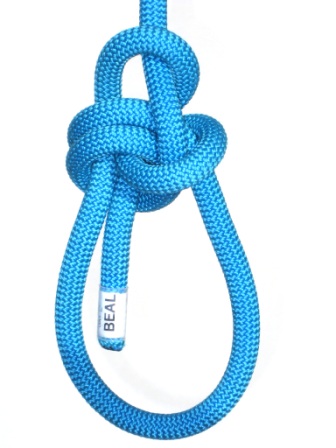
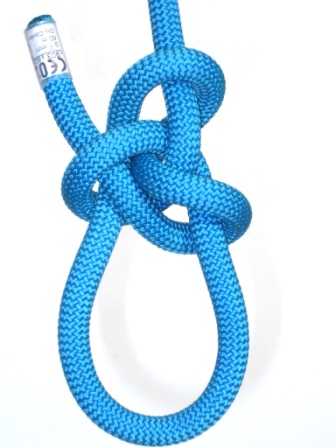
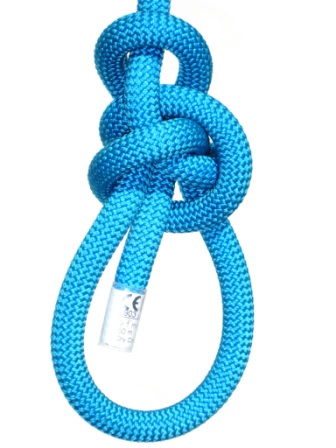
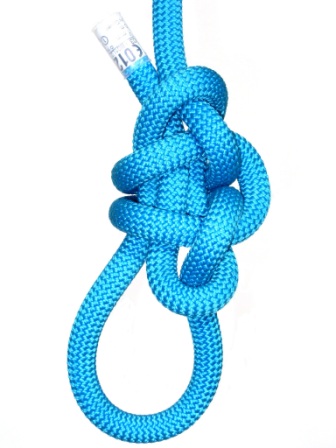
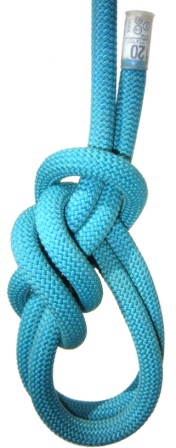
Specifically: An entanglement of rope/cord that possesses form and structure under tension with characteristics that identify it as belonging to a class of knots known as the Bowline.
This thread is not about posting new discoveries - its about the structure of a Bowline.
At present, from what I can fathom, there is information/clues scattered about this forum - but no one coherent body of theory that defines a Bowline. So this is an attempt to bring together our collective knowledge into one place.
Obviously, this could be done for a few other knots as well…
Thus far, I have found the following information:-
The study of how the essential bowline structure can be employed/realized
in knots is helpful in finding "new" knots and understanding old. To my
thinking, the sine qua non / [b]essence of a bowline is the nipping loop[/b];
I don't hold the bight collar to be key, just one way of forming a knot
using that loop. And from a structural assessment, I find the
"double butterfly" (two eyes) to be a bowline variant (indeed, a good
candidate for the moniker "double bowline" !).
.:. An easy-sounding question has more to it than one might suspect.
–dl*
and this (From DL):
Or is there some quintessential aspect of a *[b]bowline[/b]* that qualifies
a knot to be so regarded (named "b." or not --a rose smells as sweet)?
This is a much better criterion, IMO, which will spare the minding of
Irish impostors and much of the nonsense coming from Hensel&Gretel's
make-believe land..... The study of how the name "[b]bowline[/b]" has been employed carries some
merit as a work in knotting history. Unfortunately, it really entails a lot
of NEW work in trying to sort through the extant literature to figure out
which reports have any semblance of truth --a great deal of what's printed
amounts to hearsay from prior printed work.
and this - from xarax:
There are three, and [b]only three elements that characterize a bowline[/b], in relation to any other end of line loop:
1. The knot tied on the [b]standing part s leg, should be a slip knot[/b]. Any sailor will laugh with an end of line loop that is not completely untied like the bowline. Smiley
2. This slip knot should include one, at least, [b]nipping loop[/b], which secures the tail.
3. The [b]tail should form one, at least, collar[/b].
and this (from Derek Smith):
I would argue for the KISS principle where the [b]Bowline is a small number of loop knots based on the SBCore[/b], and that we might consider calling a knot a Bowline variant [b]only if it clearly contains the SBCore[/b] + embellishments.
As for the Janus, it does contain the simple hitch (AKA nipping loop) snugly holding and held by a bight loop, so it can rightly claim to be a Bowline variant, although so far removed from the basic Bowline as for that claim to be almost irrelevant - and what is wrong with simply calling it ‘The Janus Loop’? Containing the SBCore is no great claim to fame or function…
Derek
and this (from TheKnotGuy):
The question still remains, ?How many [b]Bowlines [/b]are there?? Does the structure define the knot? Or do we define the knot because of the nipping loop or the bight collar? Or does a ?true? Bowline need both a nipping loop and the bight collar? Once again, I don?t know, but the question still needs to be asked.
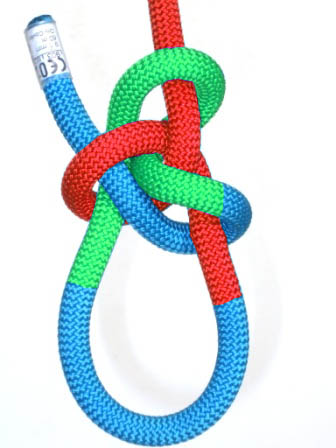
Some images to assist with identifying a Bowlines structure (Note: I am not suggesting that the so-called ‘Janus’ is in fact a Bowline - I am merely posting the image for thoughtful analysis)…
Rather than simply posting a personal declaration of what makes a Bowline, I believe that it is important to include the reasoning that supports that position. To that end, I am reposting the whole of the post I referred to :-
The Sheetbend has two elements, a bight loop and a simple hitch (often called the 'nipping loop').
The Bowline is simply the Sheetbend ‘wired up’ as an end of line loop. It has identical elements to the Sheetbend. It would be inconceivable to describe the Sheetbend as ‘a nipping loop - with or without the bight loop’, and I hold that it is incongruous to describe the Bowline in any way other than we would describe the Sheetbend.
There are four ‘ends’ from the basic Sheetbend core, and these can be ‘wired up’ to form ‘L’ and ‘R’ basic Bowlines and ‘L’ and ‘R’ Eskimo bwls. (the bwls. made by wiring up the SP to either of the bight legs are biased towards spilling and are ignored as practical knots).
Recapping - the ‘Core’ or ‘SBCore’ structure is a bight loop with a simple hitch, which can function as a loop or as a bend.
Beyond this, you are into variations - doubling, TIB with refold security, enhancing the bight, enhancing the hitch and securing the ‘end’… but in all cases, to be a variation it should still contain the two basic components - the co-embracing bight loop and the hitch - the SBCore.
So, for something to be ‘Bowlinesque’, I hold that it must contain the SBCore elements, any embellishment beyond this core and you are into variants which should be described as SBCore(B or E, L or R) + Variation
Give it whatever variations you like and call it whatever crazy name you like - Bobs Bonkers Bowline - the Triple B - but please, only give it the Bowline appellation if it contains the SBCore - the co embracing bight loop and hitch.
This leaves us with just four simple or ‘true’ bowlines and as many variants as you would wish to waste use your life inventing.
snip…
Derek
Applying this to the four knots you posed and we can see they all fit this definition of either Bowline (1010) or Bowline + variations.
Can you apply your magic brush to the Karash double loop to indicate why it is does not meet the topological/structural requirements to be classified as a Bowline?
I’ll also post a photo of ABoK #1080 tomorrow… I particularly want to compare #1080 against the Karash double loop with your colouring scheme.
I can see that in order to make any headway here, I will have to demonstrate to your satisfaction that the basic Bowline has the SBCore-i.e. that it incorporates a simple hitch…
I will start by conceding that under certain loading conditions the element in question is configured as a turned nip - as per the gripping element of the Gleipner, and in the Eskimo bwl the clamping function of the simple hitch is removed by the SP connection to the ‘tail’ of the hitch. Having said that, it is when load is applied to the ‘tail’ of the hitch, that the very worse characteristic of the Bowline shows itself - i.e. loading on this leg of the loop risks an easy transformation from bwl to ‘noose’.
In the spectrum of loadings that a Bowline will meet, the load will vary from 100% on the bight leg, right through to 100% on the ‘hitch tail’.
When the load is full on the bight leg, the knot is working as a pure sheetbend and I hope you can agree, in that loading configuration, it IS a simple hitch. At all other ratios of leg loadings, the hitch is functioning at some fraction as a simple hitch and some fraction as a ‘turn-nip’ - BUT - its function as the ‘turn-nip’ is the configuration we do NOT want to expose the bowline to.
Half convinced?
As for spending my life arguing about this - NO - not interested, but I can spare some time to share perspectives.
The bowline is a loop, where the loading on each of the two legs varies, but, most of the times, very closely around the natural middle value, that is 50% of the total load for each of the two legs. It is THAT loading configuration which will make us decide if the bowline resembles more a Sheet bend, or a Gleipnir ( and/or ABoK#160, ABoK#161).The fact that, at some few and extreme cases, “the knot is working as a pure sheetbend” indeed, does not prove your point. In MORE cases, with MORE realistic loadings, the bowline is working as a Gleipnir with a collar.
In a bowline, none of the two legs of the collar are in a right angle with a segment of the standing part, as it happens with the Sheet bend ! In fact, they are almost parallel with it at the proximity of the nipping loop / the curved-around-360-degrees-segment of the standing end.
To the definition of a Bowline, I’d add the working end (or working bight) first passes through the nipping turn in a way that makes the structure at that point topologically equivalent to an overhand knot. For the case of a Double Bowline, a working bight passes through the nipping turn to form a structure that is topologically equivalent an overhand knot structure.
In contrast, in the Karash Double Loop, there is no overhand knot equivalent at the point where the bight first passes through the nipping turn. Where the bight first passes through the nipping turn, the structure at that point is topologically equivalent to a Figure 8 knot. Thus, the Karash Double Loop is eliminated from the Bowline definition.
Play around around with the structures for awhile. Thank me later.
I have to congratulate you on a skilful piece of educating you have done on me here.
While the Karash does not have a simple hitch and therefore is not a Bowline, it does have the co-engaged bight and hitch. So, by my own definition I must concede that, the Karash IS a Bowline Variant and I withdraw my previous statement.
I believe that it is a self-evident truth, that has no need for any other justification : If part of a knot is a bowlne, the whole knot remains a bowline - albeit a more complex one.
As part of the Karash loop is a bowline indeed, the whole double loop remains a bowline. Completing a knot can not erase a previously tied part of it, so, if a knot was a bowline, at one stage of its tying, it will remain a bowline, even after one adds some new parts on it.
There are two ways one can read this sentence, and both reveal mistakes.
1) There is a structure topologically equivalent to the overhand knot, on the standing part :
Of course not. Any knot that is tied on the standing part, with rope strands of the standing part, ( before the tail passes through it ), must be topologically equivalent to an unknot. ( that is what I mean by saying that it must be a slip knot : If we remove the segment of the line after the eye leg of the bight, the segment of the line before the eye leg of the standing part can, by pulling its two ends, be turned to a straight line, with no knotted structure on it. )
We can speak of a structure topologically equivalent to a one line knot, even if we have twolines. So, even if there is no overhand knot tied on the first line, the standing part line, the local structure at the proximity of the nipping loop is topologically equivalent to the overhand knot, if we also consider the second line that passes through it - the segment of line after the eye leg of the bight.
No. We can not speak of the same or equivalent topology of a one loop knot, and of a two loops link ! We can speak of geometrical identities or similarities. And considering those geometrical qualities and quantities, there is no difference whatsoever at the proximity of the nipping loop, between the simple, common bowline and the Karash double bowline.
You cannot tie a Karash Double Loop if you begin as if you are tying an Overhand knot (on a bight), but you CAN with every Bowline mentioned on this page:
In contrast, you begin the Karash Double Loop with a Figure 8 knot (on a bight). For further explanation, I refer to my previous post. In short, the Karash Double Loop is based on a Figure 8 knot, while the Double Loop Bowline and every other Bowline are based on an Overhand knot. Even the Water Bowline? Yes, even the Water Bowline. If you don’t see the Overhand knot, then keep looking.
As another example, the Double Dragon is also eliminated from the Bowline family because the working end does NOT enter the nipping turn such that the structure is topologically equivalent to an Overhand knot at that point.
Seriously, the term “Bowline” is already watered down enough. Let’s not water down the term even more to include knots that can be mathematically explained away. Xarax, you can kick and scream all you want, but a Figure 8 is not equivalent to an Overhand.
I have read 29 more times your previous post, and I have not understood anything more than the first tme. So, my previous post stands as it is. You could possibly read it 30 times, to check if you could gain anything, but you will live without doing this, of course…
The fact that you try to use the "overhand vs fig.8 " theory of yours to eliminate the Double Dragon (!) from the bowline family, or, fot this loop, any other theory, is an indication that you have not understood very well what a bowline is…Have you ever tied a Double Dragon on a ring, using the one end of the rope, while the other end is pulled by the boat that is pulled by the anchor chain ?
Without completely untying that Overhand Knot on a bight, can you tie a Karash Double Loop on that Overhand? NO.
Task B
Tie an Overhand Knot on a bight.
Without completely untying that Overhand Knot on a bight, can you tie a Double Loop Bowline on that Overhand? YES.
Task C
Tie a Figure 8 Knot on a bight.
Without completely untying that Figure 8 Knot on a bight, can you tie a Karash Double Loop on that Figure 8? YES.
Task D
Tie a Figure 8 Knot on a bight.
Without completely untying that Figure 8 Knot on a bight, can you tie a Double Loop Bowline on that Figure 8? NO.
…I submit the Overhand Knot structure is one defining structure within a Bowline that distinguishes the Bowline from other knots like the Karash Double Loop. Again, the term “Bowline” is already watered down enough. Let’s not water down the term even more to include knots that can be mathematically explained away.
Is THAT the way you tie a bowline ? Well, 99,99 % of the bowlines tied each day are not tied that way…because they are used as end-of-the-line loops that :
1., can be tied by using only one end, and after this end has been driven through a ring, (or around a bollard), and
2., can be untied completely by removing the free end from any knot structure on the eye leg of the standing part,
If we can not do those two things, then, of course, we do not have a bowline. But we can tie the Karash bowline that way, can t we ?
Even the 1/30 th of it, that you manage to read ?
I had never characterized “noise” what another person is trying to tell me.
A friendly advice : Some modesty does no harm to anybody. And some doubt about our beliefs/theories.
As shown in the video, you tie the Karash Double Loop by starting with a loosely tied Figure 8 on a bight.
Now, try this. Instead of starting with a loosely tied Figure 8 on a bight, start with a loosely tied Figure 10 (Stevedore) on a bight. Then, finish the knot as shown in the video. If you are putting a Karash Double Loop in the Bowline family, then you also must put this knot I described in the Bowline Family. If you continue with this same line of thinking (Figure 11, Figure 12, etc.), then the number of knots you must now include in the Bowline family is theoretically infinite.
You cannot tie a Karash Double Loop if you begin as if you are tying an [b]overhand knot[/b] (on a bight), but you CAN with every Bowline mentioned on this page:
and also:
you tie the Karash Double Loop by starting with a loosely tied Figure 8 on a bight.
I wanted to point out you do NOT need to begin from #1047 (figure 8 loop) to tie a Karash.
You can tie the karash by forming an overhand loop (doubled or ‘on-the-bight’) and then following the tying method depicted at #1080 and performing a ‘backflip’ maneuver.
However, after initially forming the overhand loop, you then need to induce an extra twist (or 180 degree U turn) by folding the working end back on top of itself (sort of like a Munter hitch on a double strand). Then you perform the #1080 backflip maneuver.
I think you are referring to #1081 and #1082 - which depict the use of an overhand loop on the bight as a starting point to arrive at a bowline on the bight. Both methods involve a ‘backflip’ maneuver however.
If I am understanding you correctly, your criteria is as follows: All [double] Bowlines can be formed by starting from #1009.
My next step is to see if there is a way of tying the karash double loop from #1009. A theory is a ‘proposed explanation’ (or an “established explanation accounting for known facts or phenomena”)…and all theories must be able to withstand attempts to prove otherwise.
Derek (the dunny man), what rationale are you using as the basis for your proposition that the karash is a Bowline variant? I thought your colored ropes idea had merit…