The forum software can handle this itself. I’ll get started on re-instating those posts.
Thank you. 
The forum software can handle this itself. I’ll get started on re-instating those posts.
Thank you.
If so, what was the meaning or purpose of your reply :
I guess you used the opportumity to teach me a “lesson” about “the good of the community”.
Because I have agreed on this repair already, BEFORE this lesson…(1)
Ok, you wished to show to me some authority…I should not blame you for this, but you should have made it on time !
I agree with all those descriptions and conclusions…
…but not with this silly sentence, of course ! I do not pretend anything ! I see that people have a difficulty accepting the “theoretical” discussions be mixed within the “Applications/uses of Practical Knots”, and I have proposed that a possible solution to this problem is to put labels in front of any thread, indicating the character of the discussion one should expect to find there… OR a split of the “Practical Knots” section into two sub-sections. The one would deal with the applications/uses of practical knots, and the other with the structure/form/funcion/definition of practical knots. The “Knot Theory” joke should have ceased to make us laugh a long time ago !
That would be good, for the conclusion above is
“the development of such under this [viz., knotting theory] forum is a desirable thing”.
THIS forum of knotting theory.
[quote="Dan_Lehman post:198, topic:4096"] It is just silly to pretend that subdividing the Practical forum to do this vice using the extant forum is better ... [/quote] ...but not with this silly sentence, of course ! I do not [i]pretend[/i] anything ! I see that people have a difficulty accepting the "theoretical" discussions be mixed within the "Applications/uses of Practical Knots", and I have proposed that ... OR a split of the "Practical Knots" section into two sub-sections [ : ] The one would deal with the applications/uses of practical knots, and the other with the structure/form/funcion/definition of practical knots.
But this betrays a disregard for discussing knotting theories so labeled,
unless prefixed with “practical” ? There should be no problem with
such discussions as anticipated already; there should be no presumption
that theory has no bearing on knots seen as practical; but the focus
is on non-practical aspects of them (such as nomenclature, such as
classification, such as notions of behavioral mechanics (testable theories,
these).
I do not have an adequate command of the language, but I feel something odd with the term “knotting theory”. Of course, it is not wrong, as the term Knot Theory is ! However, “knotting” is a verb, it describes the action/procedure of making a knot, isnt it that so ? I would prefer a term that refers to the studying, examination of the object of this action/procedure, the knot itself. That is why the term “Theory of Practical knots”, or “Study of structure, form,function,definition of Practical Knots” sounds better to my ears…Of course, if there is such a thing for Decorative Knots, there should be a similar section for them as well.
I understand that the principal division of the entity “knots”, is the division in Practical, Decorative and Mathematical Knots. Then, the priciple division of knots, regarding the kind of our relation to them, is the division in Application/Use, from the one hand, and Study/Theoretical examination (of structure, form, function, definition), from the other.
Now, what is happening here is that some people want to hijack the Practical Knots forum, reduce it to a mere “Application/Use of Practical Knots” forum, ( that is, divide its value in half…), and have all the knots that do not fall in this highjacked by them category, expelled to the other forum…I will not let them do this trick, as long as I stay in this forum, post the knots I tie in this forum, and I am not baned from this forum… I do not buy their hypocritical call for “mis-placed threads”, the “voting” farce, and all this smoke screen of their real intentions…
No. If we should have to do the same for the prefixed as “Decorative” knots, we should have a similar “Study/Theory” section for them, too.
What you label as “practical”, I prefer to label as “having to do with Application/Use”, in contrast to Study/Theory. I keep the term “Practical”, to the distincion Practical-Decorative-Mathematical. So, I translate the sentence above as follows: " the focus is on aspects that do not have to do with applications or uses of them (such as nomenclature, such as classification, such as notions of behavioral mechanics (testable theories, these)"
As a personal opinion on the original topic question I offer that the parts of the most common (or first to be named) bowline knot should define any or all the rest that have “hijacked” the bowline name.
Regardless of the nomenclature used to define each and every part, those have to be there to be a Bowline.
It is a fixed loop.
Do the names of the parts change if and when it capsizes? ???
SS
I do not think that the capsized parts are the same parts any more,so why should they have tha same name ?
I have seen how a double crossed-coils nipping loop capsizes into an “8” shaped one… changing also the path of the tail that goes through it. The two knots do not have any relation any more…If you had not followed closely and very carefully all the steps of the capsize, you would nt be able to figure out if / how the one was transformed into the other ! And the way each of them is nipping the tail that pass through it, is entirely different.So, why should they have the same name ?
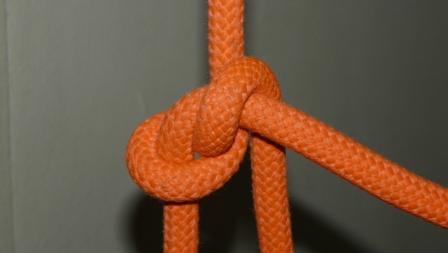
Perhaps we can dispense with “theory” and substitute “philosophy”
or some other term indicating discussions of foundations of things?
–“meta” discussions, might be one way of saying it.
And I don’t think that we need to separate such discussions vis-a-vis
practical/decorative --I don’t see 'a priori that there should be
such a gulf between them when the deliberation is on such first
principles & nomenclature; and even if there are different directions,
ideas from one camp might beneficially influence thinkers of the other.
I understand that the principal division of the entity "knots", is the division in Practical, Decorative, and Mathematical Knots.
So far as one can tell here, no one is concerned with mathematical
knots --though ideas from those studies might be brought to bear
on some conception of others, such as the defined relations.
... and [b]Study/Theoretical examination[/b] (of structure, form, function, definition), from the other. Now, what is happening here is that some people want to hijack the Practical Knots forum, reduce it to a mere "Application/Use of Practical Knots" forum, ( that is, divide its value in half...), and have all the knots that do not fall in this highjacked by them category, expelled to the other forum...
Well, I understand how you might think this, but really
don’t agree with your re-ACTion to it, and don’t think
that you should even so fear & resist it --and if the adjustment
of another forum title can better reflect our hopes for it,
then all the better. And as I said previously, I think
that the vigor you have put into such “non-practical” (to
some) topics will give improved life to another forum,
and all the usual activity in Practical Knots will continue
to sustain it --which is currently the most active forum.
(Often, in Net fora (?), when one forum accrues great
activity, managers seek ways to split it --if helpful-- so
as to make discussions & research (Search or mere paging
through topic listings) more efficient. I recall when there
was the Usenet group “rec.bicycles” (pre-WWW days);
it grew tremendously and got split into seven or so
sub-forums (.marketplace, .tech, .rides, . …).)
And the contentious Move of the long thread should be
seen, without hostility, like planting a mature tree into
a place lacking a forest. --and, no, not so the tree will die
for lack of light; but so that it will help other trees grow.
[quote="Dan_Lehman post:204, topic:4096"] but the focusis on non-*practical* aspects of them (such as nomenclature, such as classification, such as notions of behavioral mechanics (testable theories,these). [/quote] What you label as [i]"practical"[/i], I prefer to label as [i]"having to do with Application/Use"[/i], in contrast to Study/Theory. I keep the term "Practical", to the distincion Practical-Decorative-Mathematical. So, I translate the sentence above as follows: [i]" the focus is on aspects that do not have to do with applications or uses of them (such as nomenclature, such as classification, such as notions of behavioral mechanics (testable theories, these)" [/i]
Fair enough; and that the distinction --however called-- does exist
(i.e., we humans can so conceive such a distinction).
Now, how do YOU define “practical knots” ? --this, you must know,
is an issue with others, with which I have some sympathy, much
ambivalence. For the presentation of a knotted structure simply
AS “practical” with no indication of why/how so except by it being
posted under the forum of that title, is a not very convincing case
for practicality.
I could see such presentations coming --as I earlier said-- in some
(ambitious) exploration (and marking-one’s-exploratory path) of
the vast knotting universe. And, yes, I think it is vast --esp. if such
knots as you have found are included. WHo here has a full grasp
of even Ashley’s set of some few hundred (NOT the oft’-quoted
several thousand!) practical knots? --to which we can easily expand
them from many starting points to a far greater number.
But, back to your conception of “practical knot” : how do you
understand this? --for as you’ve often answered the challenge
by simply waving to the unknown future and claimed that the
knot might be found to be useful! Isn’t it only then, at such
finding (by whomever), that one has the substantiation that the
knot is “practical”? How do we, without that knowledge, make
the prior determination? (And if it’s only by whim or hope, what
knot is not “practical”?) (The black-walled corridor beneath the
art gallery above which has a room with a black canvas with a
frame around it and a title (maybe reading “untitlted”) : and one
is called “art”!?)
You, after all, have counted my “vast” with expressed doubt at
this; that implies you have some sense of limits on what will
be so called; so, what is it that restrains the discovery of knotted
structures so that it is not vast, so that much of what is found
is deemed “not practical” --which your favorite critics might
be surprised to learn you could think! --or which in any case
they have been more ready to award (that judgement) than you.
ps: I am happy that these recent posts have traded substance
and not mere “sound & fury”! And I’ll open a …
 (smiley)
I proposed the “Study of…”, and I had in mind a title like “Study of structure, of form, of function, of definition” .
Practical knots are machines/tools, so they are the subject of scientific/analytical/experimental study. Decorative knots are objects of Art, they are the subject of Aesthetics, they are synthetic, They can NOT be proved or disproved that they are indeed what they claim to be, by a physical experiment
As a person that happened to get involved in both worlds, I know very well the gulf/gap between those “two cultures” C.P Snow was talking about…I am not happy with it, but that is how things are, and WE are not going to change this, I am afraid !
My reaction might well be proved pointless, even mistaken, ( as it was proved to be in the past). But that does not mean I am going to sit speechless and listen to nonsense, that try to propagate dangerous ideas, ideas I know very well that, if implemented, they are going to reduce the Practical Knots forum to half its value ! I have made much effort ( for my age) to enrich this forum as much as my limited knotting knowledge allowed me to do, so I will not sacrifice this,or the interest some other people showed in my efforts, without a re-ACTion !
Exactly ! I proposed to split the present Practical Knots forum to two, where the one subsection will include everything about the Applications and Uses of Practical knots , and one that will include everything about the Study of structure/form/function/definition of Practical knots. Most, if not all, of the content of the misnamed “Knot Theory” forum will go automatically to the second subsection. WHAT ON EARTH IS WONG WITH THIS SIMPLE SOLUTION, I wonder…But perhaps I know…People that fear and hate the proposed second sub-section, are trying to high jack the term “Practical Knots” for themselves, and throw this sub-section as far away from the first one as they can. Well,they have the right to try this if they have such a narrow view about it, but they will succeed in devaluating the Pacica Lnots section only over my dead/baned body !
A nice romantic painting indeed, but you are not as naive to see only this !
The new tree is attempted to be planted UNDER the already grown old tree, so it does not have any chance to grow…And before it will die - as it will, no question about it - it would have destroyed the roots of the old tree as well !
Let the two trees be planted side by side, in the same fertile ground presently covered by the old tree : that is, the fertile ground of Practical Knots forum !
Tell me Dan Lehman, if you post a knot, like the “Violin” bend, a simple bend, should you indicate why/how this bend is a practical knot, or will be proven to be a practical knot in the future, with the materials used in the future ? Do you have to “state an application” for a bend, for KnotGod s shake ?
I have just finished a first reading of ABoK, and I am left with the impression that it is mainly a book about Decorative knots. Not only because of the number of Decorative knots in comparison to the number of Practical knots that is included, but of the relation of the numbers of the knots that could have been included !
I keep the term “vast” for the number of Decorative knots. I can not even imagine a n upper limit of this vast field, in comparison to the field of practical knots. There, with my limited experience, I do see some boundaries, beyond which knots lose their practicality. I am not saying that the number is not big, I only say that, from which I have sensed from my short journeys into KnotLand, the number is only one order of magnitude greater than the presently known…So , if we have a few hundreds knots, the total number of possible practical knots I reckon that should be a few thousands. But that is ot a vast number, in comparison with the few thousands, or even millions, of the Decorative Knots. And as I have said, with the proper computer tools, we could discover all those knots in a few months, even in a few weeks ! Testing those knots - taking into account all the possible materials, loading conditions, environmental aspects, dressings, etc.- THAT is a really vast area we should explore…in the next 10 generations…
My two pence : It has nothing to do with a subjectively chosen quality. It has to do with a quantity, and a quantity only. Unfortunately, this quantity is, at present, very difficult, or even impossible, to measure by using well defined notions and procedure. It is the quantity of simplicity.
Simplicity should be taken into account, and an upper limit of it - that has to do with our brain abilities and the economy of material and time while we tie a practical knot - will automatically pose a limit on the number of possible practical knots.
I had the vague idea to split this measure of simplicity of a knot into two separate domains. First, the simplicity of the “base”, that is, the initial rope configuration -be it still only a mat or an already tied simple knot - we use to weave our working ends around and through it, to tie the final knot. I suppose we should be, eventually, able, to measure the simplicity of this base- somehow, by the number of rope crossings, for example, or the hand moves this “base” requires to be formed, or by measuring whatever other concrete characteristic of it.
Second the simplicity of the next step, the tucking of the working ends through this “base”. I suppose we should be able to measure that simplicity, too - somehow, by the number of tucking, the difficulty of executing the act of a particular tuck, on a particular opening of the “base”, by measuring whatever characteristic of the moves required to dress and finish the knot.
Only a simple enough knot can be a Practical knot. And having an upper limit on the number of measured simplicity of each knot, we have a upper limit on the number of possible knots.
Do not take me wrong here. I am not saying that this is the most important thing when we consider which knot is practical and which not ! I only say that this is the thing that can reduce the number of possible Practical knots, from a vastly big one, to a manageable big one ! All the other considerations, taken together, can not generate such a great reduction from a vastly big number to a big number, as the upper limit of simplicity of a knot can. Some knots present an unacceptable slippage, or an unacceptably tend to jam. Considerations about slippage or jamming of a knot can not offer such a great relief in lowering the number of possible Practical knots, as the upper limit of simplicity can offer. Simplicity turns (vast )infinity into a (big, but finite)number!
Now, a simple enough knot might be proved to be a practical knot, or not. However, I think that all the other characteristics are easier to evaluate - that, of course, does not mean that they could be evaluated in a shorter period of time ! Testing all the possible simple enough knots will probably last for one or century, may be more ! And it will require new automatic machines, to execute those testings in an industrial scale !
I know that all those things might sound as “just thin air talk”, or blah blah to Practical Knot fundamentalists ! ( Some of them will have to use their Google translator, and some help from somebody else that can think, to understand what I am trying to say…) However, I can only say that this is my two pence opinion, earned the hard way, by tying and untying hundreds of knots ! I have presented about half a dozen new knots, that are practical as much as most of the known knots are practical , and I beg anybody that has a different view, to prove that they are not ! I would be glad if my artificial(compute) and/or DNA inherited(brain) memory will be shortened, and cleared to other interesting things of life !
I’ve followed this thread for some time and I think that this quote comes close to what I have been thinking. There is only one bowline (not “a” bowline but “the” bowline) - ABOK #1010 for ease of reference. That said there has built up a bowline family so trying to decide on the characteristics of knots which belong to this family seems to have been the predominant part of this discussion. From that one can look at how far removed from the original any qualified bowline is (by qualified I mean a knot the name of which includes the word bowline or which could include the word bowline if currently it does not or is not named at all). You then have a sort of family tree - to take an example immediately below the bowline are the cowboy bowline, water bowline and the double or round turn bowline. These differ only by one step from the original. Take another step down and you have the end bound double bowline. And so on. Then the eskimo bowline though related fits in another part of the tree perhaps. I hope this concept is clear enough, I am trying to put a visualisation into words. Although a mathematical description of any knot is no doubt possible (and like genetic make up in the plant and animal kingdom can determine perhaps if a knot belongs to a particular family) it needs an above average understanding of the math to follow. Eventually a circle can be drawn around those knots which have sufficient characteristics of the original to be considered related and from that the criteria for inclusion drawn up. Those distant cousins, perhaps recognised as such, are not therefore part of the true family.
If a knot capsizes under extreme conditions into a different knot (as opposed to falling apart) then it should have a different name in my view BUT excluding a formation designed to capsize as in making a carrick bend by reeving the end and then pulling into shape.
Barry
The task of classifying, naming or defining can be a difficult one, but, has been done before and in many areas of interest. I found some interesting comments in the wiki pages on categorization and library classification. http://en.wikipedia.org/wiki/Categorization http://en.wikipedia.org/wiki/Library_classification
For example, an alternative to hierarchal (“tree”) organization termed “faceted classification” allows for multiple classifications of a set depending on one’s focus. http://en.wikipedia.org/wiki/Faceted_classification
On the wiki for categorization was a section labelled “Miscategorisation” which struck a chord with me. “Miscategorization can be a logical fallacy in which diverse and dissimilar objects, concepts, entities, etc. are grouped together based upon illogical common denominators, or common denominators that virtually any concept, object or entity have in common. A common way miscategorization occurs is through an over-categorization of concepts, objects or entities, and then miscategorization based upon over-similar variables that virtually all things have in common.” (see http://en.wikipedia.org/wiki/Categorization, as of August 28, 2011)
DDK
The somewhat naive definition of the bowline, based upon the elements of a simpler or a more complex TIB nipping loop and a “proper” collar, has its problems as well. The first one was pointed out since the very beginning of this thread, and has to do with the “crossing knot”-based loops. We can not exclude those loops from the bowline family, without been forced to do the same to the Eskimo bowline - and I believe that this is a unacceptable high price to pay.
Now, the second, more difficult problem has to do with the shape “8” bowline, also presented previously in this thread, under the telling title “to be or not to be a bowline”.(1) I think that if there might be a plausible argument in favour of Dan Lehman s view of the bowline - that the collar should not be considered as an independent element, but only in relation to its entanglement / stabilizing function with/on the nipping loop - this shaped “8” bowline-like loop is the best I can think of. What can be said about the nipping loop(s) here ? Is there one nipping loop or two ? The second/higher part of it encircles the RIM of the collar, AND the standing end ! What can be said about the collar ? It encircles the standing end, AND the eye leg of the bight ! In short, a complete mess ! Derek, my friend, Ιδού η Ρόδος, ιδού και το πήδημα ( hic Rhodus hic saltus ) !
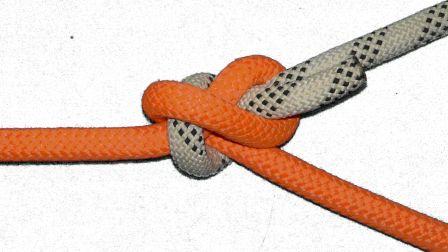
And what of Ashley’s so-called (-disparaged) “left-handed bowline”?
–hardly much of a change from one to the other, here (and there
is the case of the seized (or spliced) tail such that the collar is an eye)!
If a knot capsizes under extreme conditions into a different knot (as opposed to falling apart) then it should have a different name in my view BUT excluding a formation designed to capsize as in making a carrick bend by reeving the end and then pulling into shape.
But note that this capsizing can be a gradual change of geometry
per force, not necessarily the all-or-none sort employed by the
lattice-tying method for the carrick bend --and who should regard
those drastically different structures as the same knot (as we
bump into the undefined “knot” once more)?!
[ 2011-09-21 edit : ‘from on to’ => ‘from one to’]
[Exclude “exclusion” and it reads correctly; or replace “dispense with” with “admit”.]
I say we are bound to face difficulties on account of the
varying geometry of knots per load, per material, per setting;
things are not per-fect! And we face the issue of what to make
of knot --a challenging definition or set of definitions yet to be made.
Now, how should we see the knots presented by photographs here?
We have two stages --set tightly, set loosely & “capsized”, or at
least in a different geometry. (I do not show a regular bowline
here, for surely that is known well enough.)
To those who would insist on seeing both of the eskimo bowlines
as, well, both being A (named) knot,
do you think the same thing in the case of the (capsized) bowline ?
–for it is arguably a similar change to the commonly seen knot
as is the “Ec” version (to the “E” --in my filename) to the eskimo b. .
(I confess to needing to turn this knot around and scrutinize it
in order to identify it --such a hard turn the tail-side eye-leg makes!)
.:. So, I see the eskimo bowline as one, like the also cited carrick loop (#1033),
that straddles the boundary I’d like to keep as a bowline’s essential
quality --a turNip . And, yet, even this structure is problematic, as the
helix (it’s never a perfect circle (well, nearly never : one could do so w/some
loosely-braided cordage by tucking through the lay, I suppose!)) widens
–when must one call “enough!!” That is a per-degree differentiating that
eschews some bright line of demarcation.
Now, the second, more difficult problem has to do with the [i]shape "8" bowline,[/i] also presented previously in this thread, under the telling title [i]"to be or not to be a bowline"[/i]. (1) I think that if there might be a plausible argument in favour of Dan Lehman's view of the [i]bowline[/i] --that the collar should not be considered as an independent element, but only in relation to its entanglement / stabilizing function with/on the nipping loop --this s[i]haped "8" bowline[/i]-like loop is the best I can think of. What can be said about the nipping loop(s) here ? Is there one nipping loop or two ?
How about zero! Again, looking to the turNip as the base, where
the eye delivers force into the loop, one doesn’t have that here,
with the would-be “loop” more a “turn”, not encircling the nipped parts
so much.
Brrr. You do not like making life simpler, do you ? One is trying to learn swimming into his bathtub, and you throw him into the ocean, to get the whole idea…
No, I do not think so. There may be only one (final) stable version of a knot, or more (intermediate) ones, because the geometry seldom varies continuously - but in discrete steps. All those stable versions should be considered as different knots, because the geometry is noticeably different. “Capsizing” may occur due to a lighter or heavier loading, by the tier or the load, it does not matter. The one or more geometrically different stable forms that the knot takes as it is loaded more and more, should be considered as different knots, I believe.
This is a road one can take, it is true, to simplify things : Keep the nipping structure as simple as possible, and allow all other things to be more complex. I tried to walk on a different road, allowing the nipping structure to be as complex as desirable, and keep the collar, its formation, as an individual structure, procedure, separated from the nipping loop conceptually - as well as temporally.
Yes, if you insist in thinking in terms of the simplest possible nipping structure, the “turNip” as you call it, you will probably not be able find any of them here…If you think in terms of complex nipping structures, that can squeeze the working end/tail into their hug from many sides - in the tier s and the load s effort to secure the tail/loop - you would see one twisted - or two consecutive - nipping loop(s), that resembles the shape of an “8”- hence the name given in this contraption.
I do not think that this bowlne-like-or-not fixed end-of-line loop is much related to the Eskimo bowline, although here we have also - a part of - the nipping structure encircling the eye leg of the bight. It was produced by the collapse of the double, crossed coils loop with a Myrtle collar, but, as I have said, that should not be a factor to determine what it is now, in this stable state.
I have not said that “you” would have any problem in defining if this loop is a bowline or not…but “i” do have, and it is a major one…A collar that looks like / is, neither a “proper” collar, or a Myrtle collar, leaves me in a odd in-between no man s land…
An Eskimo crossing-knot based bowline, of course. See the attached pictures. Also see (1)
http://igkt.net/sm/index.php?topic=3467.msg20145#msg20145
(The first picture of reply#216, with the three capsized bowlines, should have been be made by Photoshop, or by some rare favour of the universe that was never ever offered to me ! I have visited hundreds of harbours, looking for something like this, in vein…
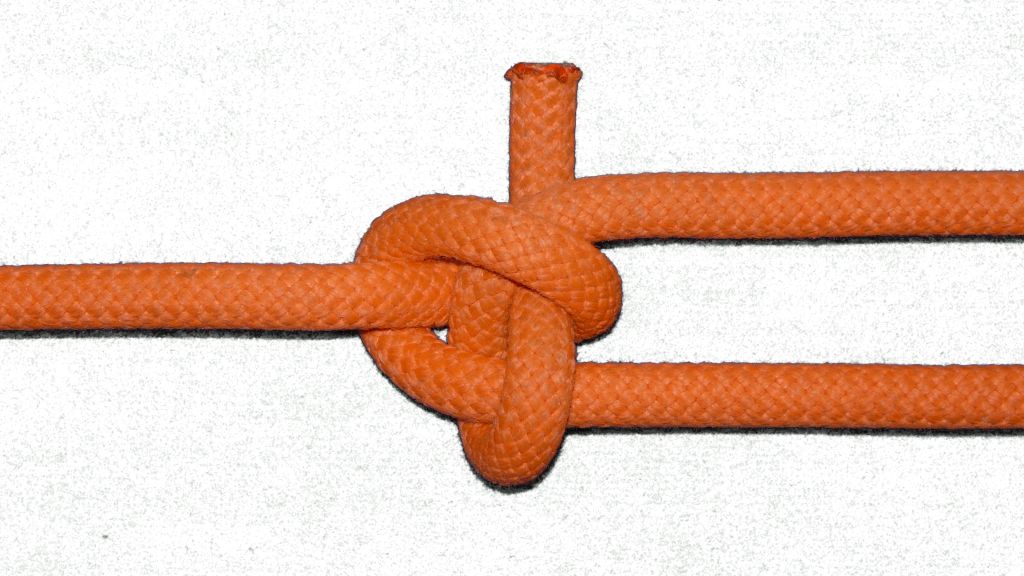
??? It is that, presumably in the tying, for both of what I present,
but the results --my point, for comparison-- differ in regard to what
central knotting the SPart makes : it is the crossing knot only in
the thick rope, and much a turNip in the 3/8" line. For me,
that divides the generally started knot between groupings,
with only the latter regarded as “(anti-)bowline”.
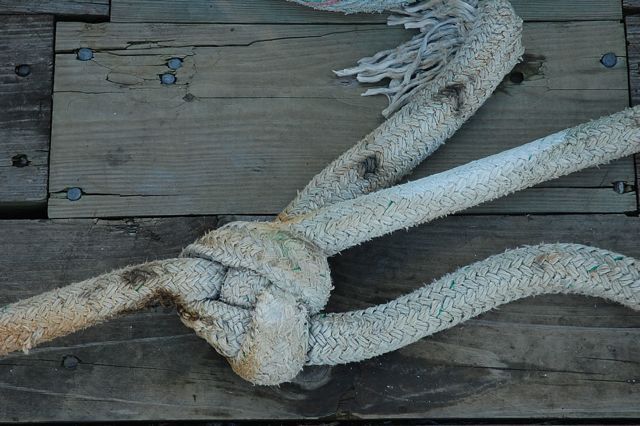
And the capsized bowlineS …
(The first picture of reply#216, with the [u]three[/u] [?!] [i]capsized bowlines,[/i] should have been be made by Photoshop, or by some rare favour of the universe that was never ever offered to me ! I have visited [i]hundreds[/i] of harbours, looking for something like this, in vain...... are put as corresponding different results to that general tying, where one would prefer to put the results into different groups. Btw, I think that there are but TWO capsized [i]bowlines[/i] --not the rightmost one, which has the tail emerging in the wrong orientation to the tail-side eye leg; it might be something got by tying a sort of *granny'd surgeon's bend* and then capsizing that (i.e., tail wraps SPart and then is tucked out through the [i]turNip[/i] in the opposite direction). !?
Have you looked at mooring lines of such size?
I see this (in one locale, mainly) so much that I came
to wonder if it was intended --for how could one do this
to such a degree of frequency, otherwise? But I don’t know … .
(I even salvaged such a knot (like the leftmost orientation)
from the trash, and have it for a souvenir, study item.)
I believe that I also found such a capsized structure in
some thinner line, but for the most part, no; and I have
seen photos of yachting lines under tension with quite
loose collars, uncapsized.
I would be glad if you could elaborate on this a little more. With the help of some “accidentally” taken pictures of knots, in your indoors - or the outdoors - wild, and some plain English I could possibly understand - with the help - or not - of the Google translator. I think that you really believe you have pinpointed some/the(?) crucial difference, but you have not reached a point of understanding that would enable you to express your view with the required clarity and simplicity. It is one thing to “see” something for yourself, and another thing to be able to define something, so other people will potentially be able to see the same thing…
If we could put the results into different groups - knowing exactly what we are doing, and why we are doing this and not something else - then this would be a proof we already have a definition of the differences, would nt it ? Unfortunately, for the moment, I believe/my humble two pence opinion is we/“I” have not.
Not really. The mooring lines that are used for recreational sailing boats (up to 60 ft LOA) are much smaller, and the materials used are, most of the times, lightweight contemporary synthetics. Perhaps this makes them prone rather to slippage than to capsizing - meaning that, under heavy loading, they would probably slip before they would have had the chance to capsize. Also, I happen to live near by a sea that has not strong currents or high tides, that would possibly justify the use of heavier lines. ( However, I had not seen something like this in any of the the many harbours - some of them with commercial fishing boats, too - of Normandy, Oslo, Dublin, or Amsterdam I have recently visited… :). I wonder why I am sooo unlucky…)
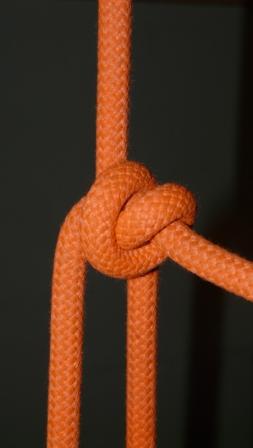
Isn’t it obvious?
In both of my photo’d cases for the “Eskimo Bowline”,
the SPart is collared; but in the one case it is so by its
own continuation (this I call the “crossing knot” structure),
in the other (of which I have two photos, from two sides)
it is by the tail’s wrapping. In the latter case, I see the variously
tight helix as reasonably regarded as a turNip and thereby
qualifying bowline classification; but in the other case,
I regard the base of the knot as a crossing knot and prefer
to let that different structure build its own grouping.
(They both lie in a grouping of “PET” (post-eye [formation] tiable) eyeknots.)
AND a point to note it that these differences can be ameliorated
by degree via setting & loading, just as for eye knot #1033.
I cannot wait for some sharp boundary --that might not exist.
Not to me… Horses for courses. I may be thirsty, I may even be able to smell the water, but I can not see it…
I see the double, crossed-coils nipping loop and the loops based on it. In this structure, we have also one section of the standing part, the second loop, going around another section of the same part, the first loop. Is it a crossing knot structure ? Of course not. However, if this same structure capsizes, it is turned into a more or less typical crossing knot…
Let us imagine a hypothetical structure, where there is a normal, simple nipping loop, with a closed helical form, AND there is a “continuation” of one section of the standing part, that makes a “second” turn around another section of the standing part. Is this one-nipping-loop-after-the-other a crossing knot ? Is the 8 shaped bowline-like loop a crossing-knot-based loop, even if the “first” loop looks more like a tight “turnip” than a lower part of a 8 ?
Please, do not tell this to all those people who already suspect / believe that “theoretical” discussions do not lead to any concrete, practical conclusions !